Shielding a phone, car or room from a jammer comes down to metal, conductive fabric and geometry, not magic. Here is what actually blocks RF, how far jammers reach, and where the legal lines sit.
What Are Signal Jammer Shielding Solutions?
Signal jammer shielding solutions are the physical and electronic countermeasures that keep a jammer's radio energy from reaching your device. Think of a jammer as a denial-of-service attack on the airwaves: it broadcasts on the same frequencies your phone, GPS receiver, or WiFi radio relies on, drowning out the legitimate signal. Shielding fights back in two main ways. Passive shielding relies on metals, meshes, foils, and conductive textiles to reflect, absorb, or scatter incoming RF, and it needs no power source at all. Active shielding and anti-jamming electronics, by contrast, draw on an external power source, directional antennas, or digital filters to cancel the interference or route around it.
This isn't just a hypothetical concern. DHS points out that dense materials like metal or concrete offer the best protection against jammers, and that something as simple as stepping around a corner or behind a vehicle can block or at least weaken a jamming signal. At the same time, jamming interferes with about 25% of commercial and public safety tracking systems in major US and EU markets, costing an estimated $2.5 billion every year, and searches for cheap anti-jammer fixes have spiked roughly 150% since October 2025. Below, we break down the materials that work, the ranges you can realistically expect, and where the law draws the line.
How RF Shielding Blocks Jamming Signals
Shielding basically comes down to three things: reflection, absorption, and scattering. If a surface is conductive, it bounces RF energy right back at whatever sent it. A lossy material soaks that energy up and turns it into heat. And a mesh? It breaks the signal apart and scatters it in every direction. There's another wrinkle, too. Whatever a shield absorbs doesn't just vanish; it can get re-emitted like an antenna, shunted off into a grounded mass, or burned off as heat, and which of those happens depends on the material's resistance and how you've actually installed the thing. That's the whole reason a sheet of foil lying loose acts nothing like an enclosure that's been properly bonded.
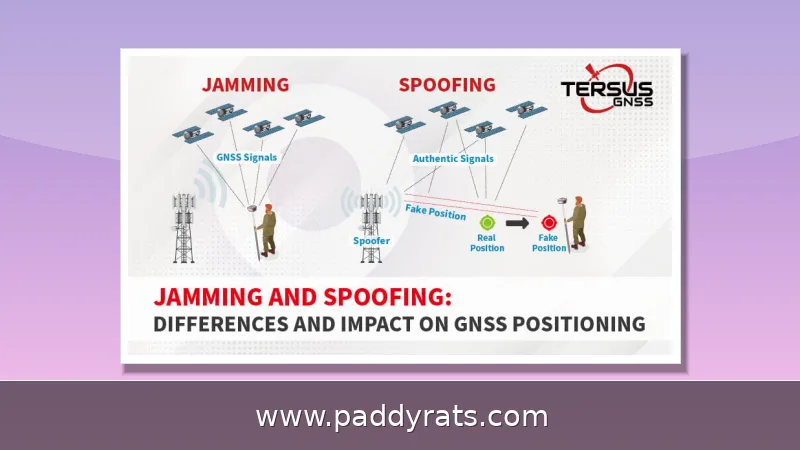
Passive shielding is the simpler approach: it uses copper, aluminum, metal mesh, foil, or conductive fabrics, and it doesn't need any external power to work. Active shielding is different — it draws power from an outside source to generate signals that cancel out the jamming, and it's usually reserved for situations where the stakes are higher, like satellite communications or high-security facilities. Anti-jamming, meanwhile, goes in a completely different direction. Directional antennas and controlled reception pattern antennas (CRPAs) aim nulls at the jamming source, while digital filters, adaptive filtering algorithms, frequency diversity across L1, L2, and L5, and sensor fusion with INS, visual odometry, barometric altimeters, and terrain contour matching all work together to keep a receiver locked on. It's also worth separating two attacks that often get lumped together: jamming blocks a signal outright, whereas spoofing mimics real satellite signals to feed you a false position.
Shielding Materials: Metals, Fabrics and Faraday Enclosures
What you make the shield out of matters more than just about anything else. Heavy metal and concrete give you the strongest attenuation, but good luck carrying that around in your pocket. Conductive textiles land somewhere in the middle: they're flexible, and you can cut, sew, or tape them to fit whatever you need—wrap a device, line a bag, or cover a window. Copper-nickel woven fabric is the go-to example here. It blocks frequencies from the low MHz range all the way up to 40 GHz, manages 65 dB or better attenuation with just a single layer, and holds certifications to MIL-STD-188-125 and IEEE 299-2006.
When it comes to vehicles, Holland Shielding Systems BV, based in Dordrecht, Netherlands, offers car shielding designed around a window mesh that's 64.5% opaque. It attaches with suction cups and is custom made for each car's make and model. If you want to go further, there's a full-compartment option: an internal frame with conductive textile clamped into it, plus transparent mesh over the front window. For rooms and individual devices, the usual move is to wrap your hardware in copper-nickel Faraday fabric or stick it inside a Faraday enclosure. Vacuum metalization is another path worth knowing about. Deep Coat Industries applies coatings ranging from 0.3 to 24 microns using six vacuum chambers—three quad-fire units that can lay down up to four metal layers per cycle, and three dual-fire units that handle up to two layers per cycle. The whole operation is ISO 9001 certified.
| Material | Typical form | Best use | Trade-off |
|---|---|---|---|
| Copper, aluminum | Sheet, foil, mesh | Rooms, enclosures, fixed installs | Heavy, rigid, hard to retrofit |
| Concrete, masonry | Building structure | Whole-building attenuation | Permanent, no portability |
| Copper-nickel Faraday fabric | Woven textile, 65 dB+ single layer | Wrapping devices, bags, windows | Needs full coverage and sealing |
| Transparent conductive mesh | Window film, suction-mounted | Vehicle cabins | Reduced visibility, custom fit |
| Vacuum metalization | 0.3-24 micron coatings | Components, precision parts | Industrial process, not DIY |
The real takeaway here is simple: it doesn't matter how good your shielding material is if you leave gaps. A seam that isn't sealed, a cable pass-through that's left open, a window you forgot to cover — any one of these becomes the easiest path for RF to sneak through. So if you're wrapping a device, take the time to seal every seam and keep the enclosure continuous. And if you're shielding a vehicle, don't forget that the front windshield and any open vent are your weakest points. That's precisely why the compartment approach relies on a clamped frame with transparent mesh instead of just draping fabric over everything — the frame keeps the shield continuous, and the mesh covers the glass without blocking your view.
Shielding Range and Power: From Exam Rooms to Prisons
How far a shield actually gets you has less to do with the shield itself and more to do with how powerful the jammer is and what the local signal environment looks like. High-power jammers — the kind running hundreds of watts or over 1000W, like the ones used in prisons — can have a shielding radius stretching hundreds of meters. Low-power units, usually somewhere between 12W and 20W, are designed for exam rooms and conference rooms and typically cover about 1 to 10 meters. Some vendors advertise 1 to 20 or even 1 to 30 meters, but in real-world conditions that upper figure is pretty tough to hit.
What really determines the shielding range is the local signal strength. If there are base stations on campus and your phone is pulling in -70 dBm or better, a jammer might only cover 2 to 3 meters, since the legitimate signal is strong enough to punch through. But if there's no base station nearby and reception sits at -90 dBm or weaker, you can get 10 meters of coverage. Range also tends to shrink over time. A jammer that once hit a 10-meter radius may only manage 5 meters now, because city base stations keep getting denser and handsets keep getting better at clinging to a weak signal. GPS jammers are a narrower case: they generate an interference signal across a 16-to-33-foot radius to disrupt GPS satellite reception, according to Geotab (July 8, 2025).
| Jammer class | Typical power | Realistic shielding radius | Typical setting |
|---|---|---|---|
| Low-power desktop unit | 12W-20W | 1-10 m (claims of 20-30 m rarely hold) | Exam rooms, conference rooms |
| Strong local signal case | 12W-20W | 2-3 m with reception at -70 dBm | Dense campus or urban site |
| Weak local signal case | 12W-20W | Up to 10 m with reception at -90 dBm | Rural or isolated site |
| GPS jammer | Varies | 16-33 ft interference radius | Vehicle and fleet tracking disruption |
| High-power prison unit | Hundreds of W to 1000W+ | Hundreds of meters | Correctional facilities, open areas |
That table explains why two people can buy the same 15W unit and report completely different results. A jammer does not have a fixed range printed on the box; it has a range that emerges from transmit power, antenna gain, terrain, building materials and how strong the carrier signal already is at that spot. Anyone quoting a single number without the signal environment is guessing.
Vehicle and Satellite Phone Shielding Approaches
Vehicles are the most common shielding project because they are both mobile and exposed. The practical build is a transparent conductive-mesh shield mounted on the windows with suction cups, or an internal frame with conductive textile covering the frame, seats, roof and dashboard. The mesh option is reversible and keeps the car usable; the frame option gives fuller coverage but is more invasive. Either way, the goal is to reduce the RF reaching the cabin, not to create a perfect Faraday cage, since doors, vents and wiring harnesses all leak.
Satellite phones need a different approach because their bands are specific. Common L-band Iridium service runs from 1616 to 1626.5 MHz, and adding a 1.6 GHz module with 2 to 3W transmission power can render Iridium phones unusable within several tens of meters. KA-band, UHF, C-band, X-band and K-band phones require more modules than a single unit can physically hold, which is why vendors such as Jammer Master split the problem. TeXin's shield jammer covers bands including 900M, 1200MA and 2.4G, while Zuden's multi-band jammer ships with a built-in backup battery, a jamming radius of up to 15 to 50 meters, and coverage of 2G, 3G, 4G, 5G, WiFi and GPS. The workable workflow is to identify the exact satellite phone type and frequency band first, then add a matching shielding module or split the system into two units, one for mobile signals and one for satellite frequencies.
Anti-Jamming Devices and Signal Processing
Hardware shielding is only half the answer. On the electronics side, anti-jamming systems use directional antennas or controlled reception pattern antennas that steer nulls toward the jamming source, digital filters, adaptive filtering algorithms, frequency diversity across L1, L2 and L5, and sensor fusion with INS, visual odometry, barometric altimeters and terrain contour matching. Companies active in this space include SBG Systems, Safran Navigation & Timing, Novatel, Resgrid, Post Alarm Systems, Wilson Amplifiers, Verizon Connect and Geotab, whose fleet product detects GPS jamming in the field.
One common misconception is worth killing early: a signal booster cannot defeat a jammer. Boosters amplify an existing signal, so if a jammer blocks that signal there is nothing to amplify. Any signal jammer is also a signal booster jammer, and amplifiers are not an effective defense. Relocating is often the most practical response, because jamming range is usually limited and a few meters of distance or a concrete wall can restore service. Passive shielding is simpler and more common; active shielding is more complex and reserved for satellite communication and high-security areas where the extra cost is justified.
Are Signal Jammers Legal in the US?
No. The FCC prohibits operating, marketing or selling jamming equipment that interferes with authorized radio communications, and there are no exemptions for business, classroom, residence or vehicle use. Unauthorized users may face civil penalties, equipment seizure and criminal sanctions. That legal exposure is rising in practice: since 2021, Customs and Border Protection has seen roughly an 830% increase in signal jammer seizures, a signal that enforcement is tightening rather than loosening.
The market numbers explain the enforcement pressure. Global anti-jamming is valued at USD 5.43 billion in 2025 and projected to reach USD 12.97 billion by 2034, according to Fortune Business Insights. Signal jammer market estimates vary widely by source: USD 1.8 billion in 2026 growing to USD 3.6 billion by 2033; USD 913.05 million in 2025 rising to USD 1209.32 million; USD 2.85 billion in 2025 reaching USD 4.64 billion by 2032 at a 7.2% CAGR; and USD 2.8 billion in 2025 reaching USD 5.6 billion by 2034 at an 8.1% CAGR. Those divergent figures reflect different definitions of what counts as a jammer, but they all point the same direction. If you are considering a shielding project, treat the legality question as step one, not an afterthought.
What Should You Actually Do?
Start by defining the threat. If a device is being jammed, the fastest wins are physical: move it behind a corner, into a metal cabinet or under a vehicle, and test whether service returns. If that works, you have confirmed the problem is RF line-of-sight and you can scale up to fabric or mesh. If it does not, the jammer is likely close and strong, and no consumer shield will fully defeat it.
For a vehicle, mount transparent conductive mesh on the windows with suction cups as a reversible first step, then consider a full internal frame with conductive textile if you need more attenuation. For rooms and devices, wrap hardware in copper-nickel Faraday fabric or place it in a Faraday enclosure, sealing every seam. For satellite phones, identify the exact model and band before buying anything, because a single unit often cannot cover KA-band, UHF, C-band, X-band and K-band together. High-power jammers give strong coverage but affect nearby residents, which is why they are confined to open areas far from housing and to controlled facilities, while low-power units stay in exam and conference rooms. The realistic expectation is attenuation, not immunity. This article is not legal or investment advice.
Frequently Asked Questions
What materials block a signal jammer?
Heavy materials such as metal or concrete work best to shield devices from jammers, according to DHS. Copper, aluminum, conductive fabrics and copper-nickel textiles reflect or absorb RF energy, and certified Faraday fabric can deliver 65 dB or better attenuation in a single layer. Physical barriers such as going around a corner or behind a vehicle also weaken jamming signals.
What is the shielding range of a cell phone signal jammer?
High-power jammers used in prisons have a shielding radius of hundreds of meters, while low-power units for exam and conference rooms generally cover 1 to 10 meters. Actual range depends on nearby base station strength: with reception at -70 dBm it may shrink to 2 to 3 meters, and it can shrink further as networks densify over time.
Can a signal booster stop a signal jammer?
No. Signal boosters amplify an existing signal, so if a jammer blocks that signal the booster has nothing to work with. Any signal jammer is also a signal booster jammer, and amplifiers are not an effective defense against jamming. Moving the device or adding passive shielding is a more realistic response.
Are signal jammers legal in the United States?
No. The FCC prohibits operating, marketing or selling jamming equipment that interferes with authorized radio communications, with no exemptions for business, classroom, residence or vehicle use. Unauthorized users may face civil penalties, equipment seizure and criminal sanctions. Customs and Border Protection seizures of signal jammers have risen roughly 830% since 2021, so enforcement is active.