Signal jammers flood the same radio bands your phone, GPS, or WiFi uses, drowning out legitimate signals with noise. Here is how the interference works, which frequencies get hit, and why operating one is illegal in the US.
What Is a Signal Jammer and What Does It Do?
A signal jammer is a device designed to deliberately break the link between a wireless device and the signal source it relies on. With a cell phone jammer, for example, the connection between the cell tower and your phone gets cut, so calls, texts, and data all stop working. It does this by transmitting on the exact same radio frequencies your phone uses — basically a denial-of-service attack against authorized communications. Any handset within the jammer's range simply stops working, and most users just notice a dropped or missing signal rather than any kind of error message.
At its heart, jamming is a numbers game, and the number that decides everything is the signal-to-noise ratio at the receiver. A jammer pumps so much raw RF energy into a band that the legitimate signal — the faint one coming in from a cell tower or satellite — has no chance of competing. The receiver doesn't decode a call or a GPS fix; it just hears noise. Think of it as a denial-of-service attack delivered over the air. Cheaper units are pretty blunt about it and only block a single frequency, but even that is usually enough to convince a phone that no network exists nearby. And don't count on long range: a low-power consumer jammer covers somewhere around 30 square feet at best, about the size of a small room. The tech didn't start on store shelves, though. It came out of the military and law enforcement world, developed in part to stop cell phone-triggered explosives and to handle hostage situations where one ringing phone could spell disaster.
It also helps to know the vocabulary that shows up in product listings and technical write-ups. You'll run into synonyms like cell jammer, mobile phone jammer, signal blocker, GPS jammer, text stopper, RF jamming, and noise jamming. Then there are the technique names: denial-of-service attack, protocol jamming, spot jamming, barrage jamming, sweep jamming, DRFM jamming, deceptive jammer, reactive jammer, channel-hopping jammer, and proactive jammer. These labels describe how the interfering signal is shaped, not just which band it targets.
How RF Noise Jamming Overpowers a Cell Signal
A signal jammer works by blasting RF noise on the exact same frequencies your phone or other telecom devices rely on. That noise overwhelms the original signals coming from cell towers and satellites, essentially throwing up an invisible wall around whatever area it covers. Most jammers only knock out frequencies within a limited range, but wide-band full spectrum jammers can take down multiple bands at once. The more advanced ones go even further, using protocol jamming to mess with the control channels that manage communication between devices and the network. That approach is a lot more efficient than just dumping raw power across an entire band.
Basically, a cell phone and a tower have to introduce themselves before either one will talk. That back-and-forth — the handshake — is how your phone registers on the network, and it happens in milliseconds on a control channel that your device and the tower both agree on. Flood that channel with RF noise and the introduction never finishes. No handshake means no call, no text, and no data session, even though your phone might still show a few bars or that little "searching" spinner. The kicker here is that jamming is local by nature. Since most jammers only reach about 30 square feet, service usually snaps back the moment you step outside the noise field. Walk a few dozen feet in the right direction and the tower can hear you again. That's exactly why jamming so often feels like a dead zone that comes and goes — one that seems to follow a room, a car, or a single stretch of sidewalk instead of an entire neighborhood.
And no, a signal booster won't rescue you from a jammer. There's a common misconception here: people figure that since a booster can turn a weak signal into something usable, it should also be able to cut through jamming. It can't. A booster can only amplify a signal that already exists — it has no way to manufacture one from nothing. Its entire purpose is to take a faint but readable incoming signal, clean it up, and rebroadcast it at higher power. Jamming turns that logic upside down. Once RF noise has buried the incoming signal, the signal-to-noise ratio falls apart, and the booster has nothing left to work with. Worse, you might actually make the situation worse: a booster will just as happily amplify the jamming noise as it will whatever fragments of a legitimate signal are still hanging around, which can spread the interference to devices that weren't even affected in the first place. Bottom line: signal amplifiers are not a real defense against jammers, and if you buy one hoping to fend off interference, you're probably just wasting your money.
Which Frequencies Do Jammers Target?
What actually goes dark depends on which bands the jammer hits. Cell phone jammers usually transmit noise from 700MHz up to 2100MHz, the same spectrum that 2G, 3G, 4G, and 5G networks rely on, so one unit can take out calls, texts, and mobile data all at once. GPS is a different story. It sits in the 1575MHz band, which explains why your navigation can fail even when your phone still shows a bar or two. WiFi runs on 2.4GHz and 5GHz, well above the cellular range. Since a single jammer can cover several of these bands at the same time, a wide-band unit can silence phones, navigation, and wireless internet together. That overlap is why the frequency range matters just as much as the jammer's power output.
| Targeted Service | Frequency Band |
|---|---|
| Cellular networks (2G, 3G, 4G, 5G) | 700MHz – 2100MHz |
| GPS | 1575MHz |
| WiFi | 2.4GHz and 5GHz |
Here's a quick look at what jammers tend to target and the everyday services that depend on those frequencies.
| Target system | Frequency band | What stops working |
|---|---|---|
| Cellular networks | 700MHz, 800MHz, 900MHz, 1800MHz, 1900MHz, 2100MHz | Calls, texts, mobile data on 2G through 5G |
| GPS | 1575MHz | Navigation, timing, location tracking |
| WiFi | 2.4GHz and 5GHz | Wireless internet, local device links |
| Bluetooth | 2.4GHz | Wireless audio, peripherals, short-range links |
These bands aren't set aside for phones alone, and that overlap is exactly what makes interference a bigger problem than it first seems. The 700MHz to 2100MHz range carrying 2G through 5G traffic sits close to — and sometimes right on top of — frequencies used by GPS at 1575MHz, WiFi at 2.4GHz and 5GHz, and even the radar equipment police depend on. A jammer designed to kill cell service doesn't bother checking labels; it just floods a chunk of the RF spectrum with noise, and anything else running nearby can get drowned out along with it. So it makes sense that regulators don't treat jamming like some petty dispute between neighbors. They treat it as a public safety issue. One device can take out 9-1-1 calls, cut off law enforcement communications, and scramble GPS navigation all at the same time, and that spillover is a big reason the penalties come down so hard.
Types of Jammers: Portable, Drone, WiFi, and Cell Phone
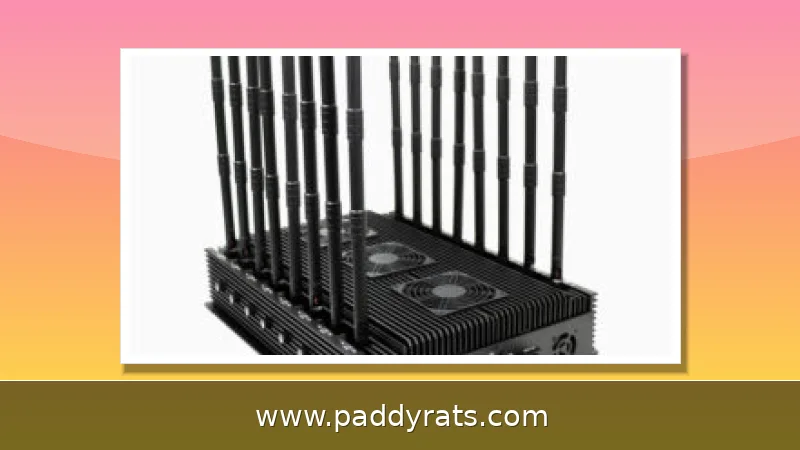
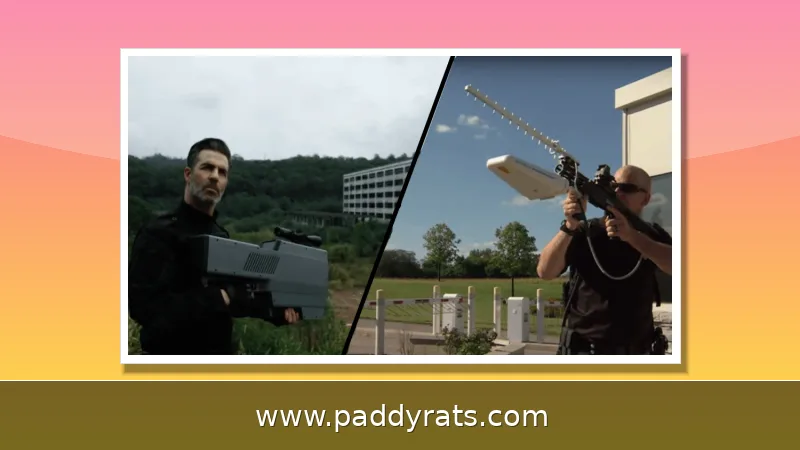
Jammers come in all sorts of shapes, and honestly, the form factor usually tells you what it's meant for. Handheld ones look like walkie-talkies or chunky phones, and they're sold for short-range blocking. If you need more coverage, you go bigger—desktop or vehicle-mounted units with extra antennas and more power. Drone jammers are designed for restricted airspace, and GPS jammers tend to pop up in cases involving vehicle theft or toll evasion. WiFi jammers get pitched as a way to limit internet use during study or work sessions, while Bluetooth jamming shows up at public events where organizers want to cut off short-range links.
Vendors in this space publish price lists that make the market surprisingly easy to read, and those figures are worth a look even though operating any of these devices is illegal in the US. The examples below come from a Jammer Master buying guide, and they show just how wide the price spread runs. On the low end, a 4G Phone Jammer (model JM021), which blocks mobile phone, WiFi, GPS, and LoJack signals, sells for $520.00. A handheld WiFi and Bluetooth jammer covering 2.4, 5.2, and 5.8GHz (JM012) goes for $569.99, while a handheld mobile phone jammer with 16 antennas and a 25-meter range (JM018) is priced at $699.00. The drone-oriented option sits in a different tier entirely: the Built-in Directional Antennas Drone UAV Signal Jammer (JM004) lists at $2,399.99. The gap between a few hundred dollars and well over two thousand reflects antenna count, coverage bands, and range more than any difference in the basic jamming principle.
| Product | Model | Price |
|---|---|---|
| 4G Phone Jammer — Block Mobile Phone/WiFi/GPS/LoJack | JM021 | $520.00 |
| Built-in Directional Antennas Drone UAV Signal Jammer | JM004 | $2,399.99 |
| Handheld WiFi Bluetooth Signal Jammer 2.4/5.2/5.8GHz | JM012 | $569.99 |
| Handheld Mobile Phone Jammer, 16 Antennas, 25 Meters | JM018 | $699.00 |
| Product | Targets | Listed price |
|---|---|---|
| 4G Phone Jammer JM021 | Mobile phone, WiFi, GPS, LoJack | $520.00 |
| Built-in Directional Antennas Drone UAV Signal Jammer JM004 | Drone control and navigation links | $2,399.99 |
| Handheld WiFi Bluetooth Signal Jammer JM012 | 2.4/5.2/5.8GHz | $569.99 |
| Handheld Mobile Phone Jammer JM018 | 16 antennas, listed 25-meter range | $699.00 |
Marketing materials routinely pitch these devices for schools, theaters, vehicles, quiet train cars, and exam halls, along with drone jammers for restricted airspace and WiFi jammers for study or work environments. The pitch sounds practical enough — silence a ringing phone in a lecture hall, shut down a drone near an airport, or cut internet access during a study session. What those same listings almost never mention is the legal reality behind the product. Under the Communications Act of 1934, interfering with authorized radio broadcasts is prohibited, and the FCC bans selling, advertising, distributing, or operating cell signal jammers anywhere in the United States. That prohibition extends to much of the world as well. The agency's concern is not abstract: jamming equipment can block 9-1-1 and other emergency calls, disrupt law enforcement communications, and interfere with GPS, WiFi, and police radar. In other words, the same device marketed for a quiet train ride can put public safety at risk — a trade-off the sales copy tends to leave out.
Jamming Techniques: Spot, Barrage, Sweep, and DRFM
Jamming techniques generally split into two broad families: noise techniques and repeater techniques. The noise family covers spot, barrage, and sweep jamming, and each one makes a different bet about how to spend the jammer's power. Spot jamming puts every available watt on a single frequency, which makes it devastating against one narrow target but useless everywhere else. Barrage jamming spreads that power across several frequencies at once, trading intensity for coverage so it can smother a wider slice of spectrum, though each individual channel takes a weaker hit. Sweep jamming takes a third path, shifting full power from one frequency to another in rapid succession, so it strikes a range of targets in rotation rather than all at once. In practice, the choice comes down to a tradeoff between depth and breadth of interference: how hard you can hit, versus how much ground you can cover.
Repeater techniques rely on capturing and rebroadcasting a signal. DRFM, or digital radio frequency memory, alters or re-transmits radar energy and can create false targets, which is why it appears in military-grade discussions rather than consumer gadgets. The technique is far more sophisticated than simply drowning a band in noise.
Jammer designs are also categorized by behavior. A deceptive jammer transmits continuously instead of random bits. A reactive, or CTS, jammer starts jamming only after it detects an RTS message. A pulse-noised jammer switches channels and jams various bandwidths. A channel-hopping jammer accesses channels by overriding the CSMA algorithm, and a proactive jammer transmits jamming signals regardless of whether data communication is happening. These behaviors determine how efficiently a device uses its power budget.
How a DIY Cell Phone Jammer Circuit Works
A basic cell phone signal jammer circuit needs three subcircuits: an RF amplifier, a voltage controlled oscillator, and a tuning circuit. The RF amplifier, built around transistor Q1 with capacitors C4 and C5 and resistor R1, amplifies the signal coming from the tuned circuit. The amplified signal then travels to the antenna through capacitor C6, which blocks DC current while passing AC. That separation keeps the DC bias from reaching the antenna while letting the radio signal through.
The tuned circuit, formed by capacitor C1 and inductor L1, acts as an oscillator that produces a very high frequency with minimum damping. Tuning that oscillator sets which band the circuit interferes with. According to the Electronics For U project write-up, the design is effective in blocking UMTS, 3G, CDMA, GSM, and PHS networks.
Building or operating such a circuit is not a harmless hobby project in the US. The same technical principles power devices that regulators treat as illegal interference sources, so the circuit is best understood as an educational example of how RF denial-of-service works rather than a build guide.
Why Signal Jammers Are Illegal in the US
It is illegal to sell, advertise, distribute, or operate cell signal jammers in the United States and much of the world. The FCC states that jamming equipment poses serious risks to critical public safety communications, can prevent 9-1-1 and emergency calls, and interferes with law enforcement communications. The Communications Act of 1934 outlaws interference with authorized radio broadcasts, which gives regulators a long-standing legal basis for enforcement.
The risks of jamming attacks extend well beyond a dropped call. They include disruption of communication, impact on emergency services, financial losses, data interception, and threats to public safety. Because jammers also interfere with GPS, WiFi, and police radar, a single device can degrade multiple systems at once. That is why enforcement actions target sellers and advertisers as well as operators.
Spotting jamming in the wild is difficult. The most common indicator is an inability to communicate in areas that normally have good radio or cell coverage. If a location that reliably supports calls suddenly goes dead, and service returns after you move away, interference is a reasonable suspicion. Reports of suspected jamming should go to law enforcement or the FCC rather than being handled informally.
Detection and Countermeasures for Jamming
The most common symptom of jammer interference is dropped service. Apps that claim to detect signal jammers are largely unproven and require a working signal to function, which is exactly what a jammer removes. Without advanced military-level technology, it is virtually impossible for the average consumer to definitively detect a cell phone jammer. That gap between marketing claims and real capability is worth remembering before paying for a detection app.
If you believe a jammer is active, the practical options are limited. You can physically locate and disable the device, which may look like a walkie-talkie, a cell phone, or a wireless router. You can switch the phone's operating frequency, or relocate out of range. You can also report suspected jamming to law enforcement or file a complaint with the FCC.
Protective strategies focus on monitoring rather than blocking. Watching network signals for unusual frequency levels or inconsistent noise ratios can reveal anomalies early. An intrusion detection system (IDS) that monitors network traffic can flag suspicious patterns. Neither approach stops a jammer, but both improve awareness, which matters when the interference threatens emergency communications.
The Bottom Line on Signal Jammers
Signal jammers work by flooding authorized radio bands with noise until receivers cannot separate the legitimate signal from the interference. The physics is straightforward, the targeted bands are well documented, and the techniques range from crude spot jamming to sophisticated DRFM re-transmission. What is not simple is the legal picture: in the US, selling, advertising, distributing, or operating these devices is prohibited, and the FCC ties that ban directly to public safety.
For anyone researching the topic, the useful takeaway is diagnostic rather than operational. Sudden, location-specific loss of service in an area with normally strong coverage is the clearest sign of possible jamming. Detection apps cannot confirm it, boosters cannot fix it, and the proper response is to move, report, and let regulators handle the device.
Frequently Asked Questions
How does a signal jammer actually block a phone?
A jammer transmits radio frequency noise on the same bands a phone uses, such as 700MHz to 2100MHz for cellular service. That noise overpowers the weaker signal arriving from the cell tower, so the phone cannot complete the connection handshake. The effect is a denial-of-service attack on authorized radio communications, and any handset inside range loses service.
Are signal jammers legal in the United States?
No. It is illegal to sell, advertise, distribute, or operate cell signal jammers in the United States and much of the world. The FCC says jamming equipment risks public safety by blocking 9-1-1 calls and law enforcement communications, and the Communications Act of 1934 outlaws interference with authorized radio broadcasts. Enforcement targets sellers and advertisers as well as operators.
Can a signal booster overcome a jammer?
No. A signal jammer also jams a signal booster. Boosters amplify an existing signal, but if that signal is buried under jamming noise, the booster has nothing usable to amplify. Signal amplifiers are not an effective defense against jammers, so buying one to fight interference usually wastes money and does not restore service.
How can you tell if a signal jammer is nearby?
The most common symptom is dropped service in an area that normally has good coverage. Apps claiming to detect jammers are largely unproven and need a working signal to function. Without military-level technology, the average consumer cannot definitively detect a jammer. Report suspected jamming to law enforcement or the FCC instead of relying on an app.