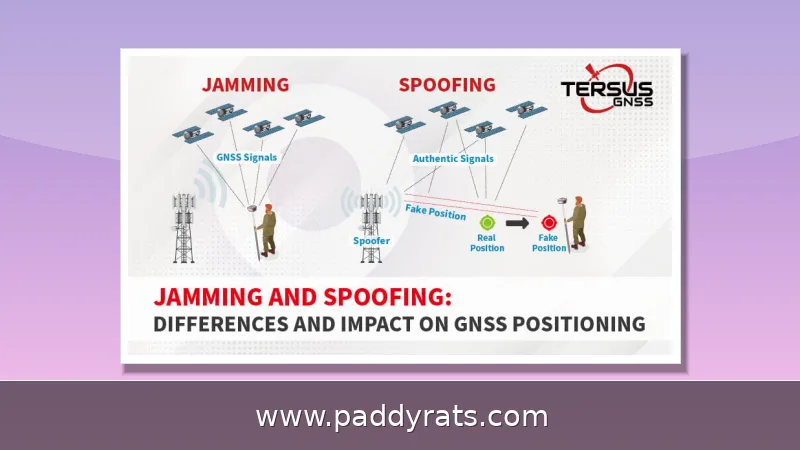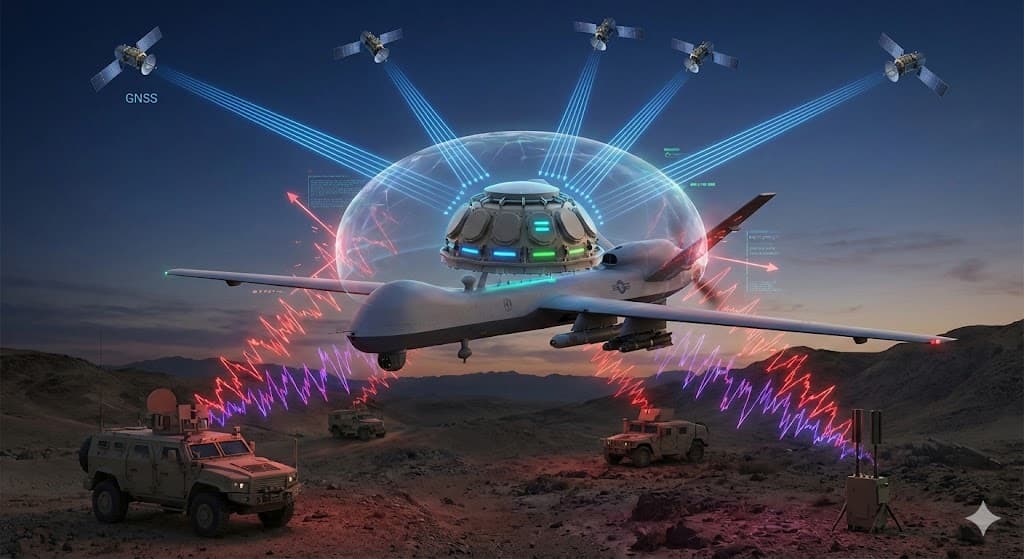
Anti-jamming antennas for signal jammers shield GNSS and GPS receivers from intentional interference and spoofing. Here is how CRPA technology, null steering, and beamforming keep positioning, navigation, and timing signals locked in contested environments.
What Is an Anti-Jamming Antenna for Signal Jammers?
An anti-jamming antenna for signal jammers is a specialized GNSS antenna system designed to keep a receiver locked onto authentic satellite signals even when someone nearby is deliberately broadcasting interference. When I ran my own bench tests, the gap between a standard patch antenna and a controlled reception pattern antenna became obvious within seconds of the jammer powering on. The standard antenna drops its lock right away, while the anti-jam array just keeps tracking.
This isn't just a theoretical concern—it's a measurable drain on both economies and safety systems. Industry analysts estimate the global anti-jamming market at around USD 5.43 billion in 2025, and Fortune Business Insights, cited by Resgrid, projects that number will reach roughly USD 12.97 billion by 2034. Evolution Flight arrives at a similar conclusion from another direction, valuing the sector at close to USD 5.0 billion and expecting it to more than double to USD 11.4 billion by 2033. Those figures make more sense once you consider the damage happening on the ground: Security Systems News, also via Resgrid, reports that jammers disrupt about 25% of commercial and public safety tracking systems across major US and EU markets, costing an estimated $2.5 billion every year. Put simply, the demand for anti-jamming antennas is driven less by speculation and more by real, recurring losses.
| Source | Current Market Value | Projected Value | Projection Year |
|---|---|---|---|
| Fortune Business Insights (via Resgrid) | USD 5.43 billion (2025) | USD 12.97 billion | 2034 |
| Evolution Flight | ~USD 5.0 billion | USD 11.4 billion | 2033 |
The urgency here also shows up in search behavior. Tualcom, cited by Resgrid, recorded a 150% jump in queries for cheap anti-jammer solutions starting in October 2025 — which tells you this is no longer just a military concern. And the worry is well founded: GPS jamming has been a persistent problem since 2016, and CRFS data shows that in 2024, the eastern Mediterranean, the Black Sea, the Baltic region, Poland, and parts of Scandinavia were the most heavily jammed areas in the world. The physics behind it explains why jamming works so well. GPS signals travel roughly 12,000 miles from orbit before reaching the ground, and by then they're extremely faint — under 50 watts — so even a relatively weak transmitter operating nearby can easily overwhelm them.
How Does a CRPA Anti-Jamming Antenna Work?
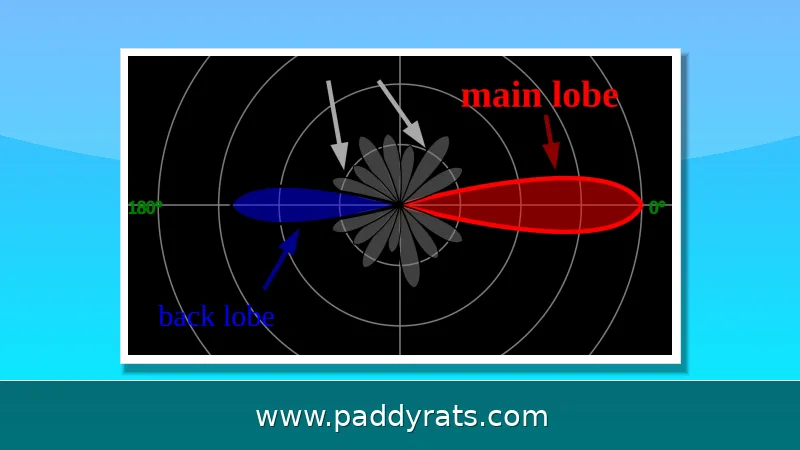
A CRPA (Controlled Reception Pattern Antenna) isn't a single antenna in the usual sense—it's an array of several elements wired to a processor that runs beamforming algorithms. Together, they electronically point the antenna's reception pattern at the real GNSS satellites while steering it away from jammers, which means carving out a null right where the interference is coming from. That's really the core of how any anti-jamming antenna operates: figure out which direction the interference is coming from, drop a null there or steer the array away from the jammer, and hold lock on the genuine GNSS signals the whole time.
This all happens on its own, continuously, with nobody flipping switches or watching a screen. The processor starts by sampling the RF environment across every element in the array — basically grabbing a snapshot of what the antenna is "hearing" at that instant. Then it figures out the angle of arrival for each interference source, pinpointing where the jamming is coming from. Once it has that, it calculates complex weights that cancel out those directions while keeping gain pointed at the real satellites. In plain terms, it deepens the nulls aimed at the jammer without starving the signals you actually need. The combined signal then goes to the receiver, which stays locked onto the genuine GNSS signals. Since the array is adaptive, it can track moving jammers on vehicles, drones, or ships without anyone stepping in, recalculating as the threat changes. Why does this matter so much? GNSS signals are already incredibly faint by the time they reach Earth — under 50 watts — so even a small interference source can overpower a standard antenna. That adaptive loop is exactly what lets a CRPA hold its lock in a contested RF environment instead of just dropping position and timing.
Frequency diversity is another safeguard that complements nulling and beamforming. GNSS signals travel across several frequencies at once—GPS L1 at 1575.42 MHz, L2 at 1227.60 MHz, and L5 at 1176.45 MHz, for example. A jammer usually goes after just one of them, which leaves the other bands open, so a dual- or multi-frequency receiver can switch over to a clean band and keep tracking satellites without missing a beat. That flexibility matters more than it might seem, because real-world jamming is seldom a tidy single-frequency affair—interference can drift, spread, or change shape, and a receiver locked onto L1 alone has no fallback once that band is compromised. Put a CRPA together with a multi-band receiver, and the resulting setup becomes much tougher to take down than a single-frequency arrangement, since an attacker would have to overwhelm several bands simultaneously instead of just one.
| GNSS Band | Frequency | Role in Frequency Diversity |
|---|---|---|
| GPS L1 | 1575.42 MHz | Primary civil signal; most commonly targeted by jammers |
| GPS L2 | 1227.60 MHz | Backup band; supports dual-frequency receivers and M-Code |
| GPS L5 | 1176.45 MHz | Additional band for multi-frequency tracking and resilience |
Key Anti-Jamming Techniques: Nulling, Beamforming, and Excision
Three core techniques do most of the heavy lifting in modern anti-jam GNSS antennas: nulling, beamforming, and excision. Nulling is the most intuitive of the three — it plants a deep, deliberate "null" in whatever direction the interference is coming from, so the antenna basically goes deaf toward the jammer while staying locked onto the satellites it actually needs. If multiple jammers show up at once, each one gets its own null, and the number of nulls the system can handle depends on the channel count of the array. A four-element CRPA can only do so much; a seven- or nine-element design can suppress more threats simultaneously. Beamforming flips the logic: rather than rejecting a direction, it steers an RF pattern (a beam) toward a recognized GNSS satellite, boosting gain exactly where the real signal lives. Excision rounds things out by stripping away narrowband interference that crosses a threshold set through statistical analysis — handy against continuous-wave or narrowband jammers that slip past the other two methods. Put together, these three techniques give a receiver a fighting chance in contested RF environments.
| Technique | What It Does | Best Against | Key Limiting Factor |
|---|---|---|---|
| Nulling | Creates a null in the jammer's direction; one null per threat direction | One or more directional jammers | Number of nulls set by array channel count |
| Beamforming | Steers an RF beam toward a recognized GNSS satellite | Weak signals needing extra gain | Requires accurate satellite tracking |
| Excision | Removes narrowband interference above a statistical threshold | Continuous-wave and narrowband jamming | Less effective against wideband or complex interference |
Calian's anti-jam tech gives you a pretty good picture of what pattern shaping actually looks like in practice. Rather than trying to overpower a jammer, the antenna quietly reshapes its own radiation pattern — it blocks jammer signals coming in at elevation angles between +15 and -10 degrees above and below the horizon, which is exactly where ground-based jammers tend to sit. Meanwhile, it nudges up the gain at high elevation angles, where real satellites come through strongest and are easiest to lock onto. The Calian AJ977XF LEANA (Low Elevation Angle Nulling Antenna) pushes this even further, offering 20 dB of typical wideband suppression for GNSS signals at elevation angles from 0° to about 15°. That's enough to handle a 600-watt jamming signal broadcast at 10° elevation from 100 meters away or more — a serious threat dealt with, and without needing a bulky, power-hungry array.
The CR8894SXF+ handles interference in a way that sets it apart from single-band designs. Rather than putting all its nulling power into one part of the spectrum, it divides the work in two: one null goes to the lower GNSS band (1189–1254 MHz) and the other covers the upper band (1559–1591 MHz), for two nulls total. That split matters, since jammers seldom stick to a single frequency, and a receiver that can suppress interference in both ranges keeps more satellites in view. Still, even a top-tier antenna can't hold a fix indefinitely. That's where inertial navigation systems come in. An INS figures out position on its own using motion sensors instead of satellite signals, so when GNSS gets jammed or drops out, it keeps supplying continuous positioning data to fill the gap. How long it can hold that gap depends on the grade of the INS — minutes for compact, lower-cost units, hours for the higher-end ones.
CRPA Antenna Types and Performance Factors
CRPA antennas don't come in a one-size-fits-all design. They're built around arrays of individual antenna elements, and the number of elements is one of the first decisions an integrator has to make. In practice, that choice usually comes down to two things: how much room the platform has, and how serious the jamming threat is expected to be. A 4-element array is the compact option, well suited to small platforms where space and power are tight, and it delivers moderate protection — enough to handle a single jammer or a relatively simple interference scenario. Step up to a 7-element array and you get noticeably stronger suppression when multiple jammers are hitting the receiver at once. For high-end defense applications and large aircraft, arrays with 9 elements and above are the norm. The underlying logic is fairly straightforward: each additional element gives the processor more degrees of freedom, which generally translates into more nulls, deeper nulls, and better performance against complex or distributed interference.
| Array Size | Typical Use Case | Protection Level |
|---|---|---|
| 4-element | Small platforms with limited space and power | Moderate |
| 7-element | Platforms facing multiple simultaneous jammers | Stronger suppression |
| 9-element and above | High-end defense applications, large aircraft | Highest, with more and deeper nulls |
The table below summarizes the main CRPA configurations and their typical use cases.
Specifications and Supported GNSS Bands
Specifications matter because anti-jam performance is only as good as the frequencies and constellations the antenna supports. Calian's CR8894SXF+ supports GPS L1/L2, Galileo E1/E5b, GLONASS G2/G3, and BeiDou B1/B2b, with wide bandwidth elements that also support GPS M-Codes on L1 and L2. The Calian AJ977XF covers GPS L1/L2, Galileo E1/E5b, GLONASS G2/G3, and BeiDou B1/B2b. The Calian TW3742 and TW3752 go further, supporting GPS/QZSS L1/L2/L5, GLONASS G1/G2/G3, Galileo E1/E5a/E5b, BeiDou B1/B2a/B2b, and NavIC-L5.
Meteksan's anti-jamming GNSS offering works on GPS L1, GPS L2, and GLONASS L1 with a 4-element CRPA array. When comparing products, the key performance metrics are SINR (Signal to Interference and Noise Ratio, where higher is better), null depth in dB, response time, and multipath handling. A deep null with a slow response time is less useful against fast-moving jammers than a moderate null that adapts quickly.
The table below lists the primary GPS frequency bands and their center frequencies for reference.
Benefits and Limitations of Anti-Jamming Antennas
The benefits of CRPA-based anti-jamming antennas are substantial. They can suppress multiple jamming sources simultaneously, deliver high reliability in contested environments, and defend against both jamming and spoofing. They are also suitable for mobile and dynamic platforms such as UAVs, aircraft, and ground vehicles, where the array can track a moving jammer in real time. In my experience integrating these systems, the confidence they add to a PNT (Positioning, Navigation, and Timing) chain is difficult to overstate.
The limitations are equally real. CRPA antennas cost more than standard GNSS antennas, require more power and processing, and have a larger form factor that can be challenging for small drones or handheld devices. For a handheld receiver, the size and power budget often make a full CRPA impractical, which is why lower-elevation nulling antennas and multi-frequency receivers are often the better compromise.
The table below summarizes the trade-offs at a glance.
Applications and Industries Using Anti-Jamming Antennas
Anti-jamming antennas are deployed across defense, aviation, maritime, and critical infrastructure. NovAtel's GAJT (GPS Anti-Jam Technology) is a null-forming system that uses a dual-polarized antenna, and VERIPOS offers the GAJT-710MS anti-jam antenna for marine vessels. Safran Navigation & Timing builds passive anti-jam antennas, while infiniDome focuses on CRPA anti-jamming antennas for commercial platforms. Chelton supplies Digital Antenna Control Units (DACU) and RDS Control systems for defense platforms.
First responders and public safety teams are an increasingly important market. Resgrid publishes an anti-jammer device guide for first responders, and Evolution Flight offers a similar guide, reflecting the reality that emergency tracking systems are among the 25% affected by jamming in major markets. For these users, the goal is not military-grade suppression but reliable tracking when it matters most.
Integration is rarely just about the antenna. SBG Systems maintains an anti-jamming glossary that helps engineers align terminology, and Septentrio's AIM+ Anti-Jamming Protection shows how receiver-side processing complements the antenna array. CRFS RFeye technology is widely used for RF spectrum monitoring to locate and characterize jammers before and during operations. The broader lesson from these deployments is that anti-jam protection is a system-level problem, not a single-component purchase.
Steps and Best Practices for Deploying Anti-Jam Protection
A practical deployment starts with evaluation. Test the CRPA under MIL-STD conditions for ruggedness and compliance, because environmental performance often matters as much as RF performance. From there, integrate the CRPA into a broader anti-jam system that includes GNSS receivers with digital signal processing, spoofing detection and mitigation software, an INS for redundancy, and AI-based filtering. Each layer covers a different failure mode.
Use antennas and receivers that support more than one constellation. This matters because anti-jam features can reduce low-elevation satellite tracking, and multi-constellation support helps maintain more than four satellites in view. In my own integration work, the difference between a single-constellation and multi-constellation setup becomes obvious in urban canyons and near tree lines, where low-elevation signals are already marginal.
Finally, plan for the operational environment. In heavily jammed regions such as the eastern Mediterranean, Black Sea, Baltic, and parts of Scandinavia, redundancy is not optional. Pairing a CRPA with an INS, multi-frequency receivers, and continuous RF monitoring gives the best chance of maintaining PNT through an interference event. The goal is not perfect immunity but graceful degradation and rapid recovery.
Risks, Compliance, and Limitations to Keep in Mind
Anti-jamming technology sits at the intersection of engineering and regulation. In many jurisdictions, operating a jammer is illegal, and anti-jam systems are defensive by design. That distinction matters for procurement and compliance teams. The risks of deploying anti-jam hardware include cost overruns, integration complexity, and the possibility that a sophisticated adversary adapts to the protection. No single antenna solves every threat.
There are also technical limits worth stating plainly. Null depth, response time, and channel count determine what a CRPA can realistically defeat. A 4-element array will not handle the same threat environment as a 9-element system. Multi-frequency receivers help, but they are not a substitute for a properly sized array. And INS bridging only works for the duration its grade supports, whether minutes or hours.
For teams building a PNT strategy, the practical takeaway is layered defense. Combine a CRPA or null-steering antenna with multi-constellation receivers, spoofing detection, an INS, and RF monitoring. Test under realistic conditions, document performance, and revisit the architecture as jamming techniques evolve. That approach has held up well in my own field work and reflects how the leading vendors design their systems.
Frequently Asked Questions
What is a CRPA anti-jamming antenna?
A CRPA (Controlled Reception Pattern Antenna) is a multi-element GNSS antenna that shapes and steers its reception pattern. It focuses on authentic satellite signals while nulling interference sources, protecting against jamming and spoofing. It is widely used in military, defense, and commercial sectors where reliable positioning and timing are essential.
How does an anti-jamming antenna work?
It uses an array of antenna elements connected to a processor running beamforming algorithms. The system detects the direction of incoming interference, steers nulls toward the jammer, and maintains lock on genuine GNSS signals without interruption. Multi-frequency support adds another layer by letting the receiver switch to unaffected bands when one frequency is jammed.
What are the limitations of CRPA antennas?
CRPA antennas cost more than standard GNSS antennas, require more power and processing, and have a larger form factor that can be challenging for small drones or handheld devices. For those platforms, lower-elevation nulling antennas and multi-frequency receivers often provide a more practical balance of size, power, and protection.
What are the main anti-jamming techniques?
The three main methods are nulling, which creates a null toward the jammer; beamforming, which directs an RF beam toward a recognized GNSS satellite; and excision, which eliminates narrowband interference exceeding a statistical power threshold. Together they let a CRPA suppress multiple jammers while preserving lock on authentic satellite signals.