Searching for a legal signal jammer for sale usually leads straight to a hard truth: in the United States, selling, marketing, importing, or operating one is against federal law. Here is what the rules actually say, how jammers work, what devices and prices exist, and where limited legal exceptions apply.
What Is a Signal Jammer and How Does It Work?
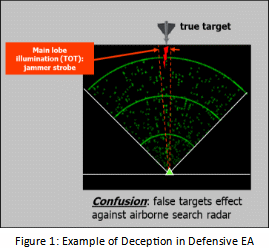
A signal jammer is basically a device that floods the same radio frequencies your phone or other gadget relies on, broadcasting RF noise that drowns out the real signal. Take cell phone jammers: they push out a signal stronger than whatever's coming from the nearest tower. Your phone ends up hearing two signals on the same frequency, can't separate them, so it latches onto the stronger one and the weaker one just gets wiped out. Since the jamming targets the downlink, all you see on your screen is zero bars.
A real signal jammer is not just some box with an on/off switch. It's basically a tiny radio station designed to overpower whatever frequencies you're trying to shut down. Every working unit relies on four core hardware components: an RF generator that creates the interference signal, amplification mechanisms that boost it to a level the target device can't ignore, transmission modules that send it to the right bands, and antennas tuned to match those bands. That hardware list is also why the so-called "jammer apps" you see in app stores are a total dead end. Your iPhone or Android doesn't have an RF generator, an amplifier, or a proper antenna, so there is literally nothing inside the phone that could broadcast interference. Any app that claims to block cellular or WiFi signals is misleading by design. The more sophisticated jammers take a smarter approach than just blasting noise: instead of flooding an entire band, they use protocol jamming to hit control channels directly, cutting off the signaling that devices depend on to stay connected.
Signal jammers don't just broadcast on a single frequency — they flood the specific slices of the radio spectrum that our everyday devices depend on. The usual suspects are the cellular bands at 700MHz, 800MHz, 900MHz, 1800MHz, 1900MHz, and 2100MHz, which together handle everything from 2G up to 5G. Beyond that, GPS signals around 1575MHz and WiFi's 2.4GHz and 5GHz bands are common targets too. A basic single-band jammer might only take out one of these, but wide-band full-spectrum models are designed to block several at once. So in practice, a single device can simultaneously kill voice calls, SMS, mobile data, GPS positioning, and wireless networking — it just comes down to which modules are installed and turned on. Picture a wall of static dropped right over the exact channels your phone, navigation unit, or router is trying to listen on. Anything tuned to those frequencies gets buried, while everything outside them keeps running like nothing happened.
| Target System | Frequency Bands |
|---|---|
| Cellular (2G–5G) | 700MHz, 800MHz, 900MHz, 1800MHz, 1900MHz, 2100MHz |
| GPS | 1575MHz |
| WiFi | 2.4GHz, 5GHz |
Why Is Selling or Using a Signal Jammer Illegal in the US?
The FCC doesn't really do gray areas when it comes to jammers. Federal law flat-out bans operating, marketing, or selling any kind of jamming equipment — and that includes devices that mess with authorized communications. The same goes for advertising, distributing, importing, or otherwise getting RF jamming devices onto the market for non-federal entities in the US. That last part is worth paying attention to: the agency has made it clear this applies to online storefronts too, not just physical retail, so a website listing jammers for sale gets the same scrutiny as a shelf in a store. As for consequences, the FCC points to fines of up to $11,000, seizure of the illegal equipment, and criminal penalties that can include prison time.
Enforcement isn't just a formality, either. Back on June 19, 2014, the FCC hit online retailer CTS Technology with the biggest fine in its history — a whopping $34.9 million — making it clear that jammer sales are not some gray-market side hustle you can just brush off. But that warning didn't exactly scare everyone straight. NBC News later looked into retailers that were still selling RF jammers, even though these devices are illegal to sell and operate, and Amazon and other retailers were reportedly under investigation at the time. There's also an important distinction people tend to overlook: jamming speed enforcement radar is illegal under US federal law (47 U.S.C. 302a(b)), while laser jamming isn't subject to federal restrictions. Plenty of drivers assume both are treated the same way, but they're not.
States are getting involved too, and they're all moving in the same direction. California's SB 701, introduced on October 7, 2025, would criminalize manufacturing, importing, marketing, purchasing, selling, or operating a signal jammer unless you're authorized to do it — with fines of up to $1,000. Indiana got there even sooner, passing a law on August 11, 2025, that makes both using and possessing a jamming device a crime. So you've got two states taking two different tacks: California goes after the entire supply chain, from the factory floor to the end buyer, while Indiana aims squarely at users and owners. Different strategies, same destination. If you're someone who's been thinking about grabbing a jammer just for personal use, the signal from state legislatures couldn't be clearer — this isn't a gray area in most of the country anymore, and the days of treating it like one are numbered.
Which Frequencies and Device Types Are Available?
Jammers usually get sorted by what they block and how they're built. Portable jammers are the most basic type: small, handheld, battery-powered, cordless, with built-in antennas, meant for a single room, a car, or some localized outdoor spot. Drone jammers target the ISM bands and navigation signals that UAVs depend on, severing the command link so the drone either hovers in place or flies back to where it launched. Depending on the model, that range can stretch from a few hundred meters up to roughly 1 km. WiFi jammers operate on the 2.4GHz and 5GHz bands, stopping devices from finding or connecting to a wireless network. Cell phone jammers cover the 700MHz to 2100MHz bands used by 2G, 3G, 4G, and 5G, cutting off voice calls, SMS, and mobile data within their jamming radius. Prison jammers are a heavier, outdoor-rated category designed to run 24/7, with weather-resistant housings, side air intakes, rainproof structures, bottom exhaust vents and connectors, aluminum heat sinks, and fans on both the top and bottom. Each RF module has its own switched-mode power supply (SMPS) that converts AC 210V–240V to DC 28V, and the units can be controlled over IoT through RJ45 Ethernet or 433MHz magnetic antennas.
| Jammer Type | Targets | Typical Use Case |
|---|---|---|
| Portable | Varies by model; small, battery-powered, built-in antennas | Small rooms, vehicles, localized outdoor use |
| Drone | ISM bands and UAV navigation signals | Breaks command links; drone hovers or returns to launch (several hundred meters to 1 km) |
| WiFi | 2.4GHz and 5GHz bands | Prevents devices from finding or connecting to wireless networks |
| Cell phone | 700MHz–2100MHz (2G, 3G, 4G, 5G) | Blocks voice calls, SMS, and mobile internet within the jamming radius |
| Prison | Outdoor-rated, 24/7 design; per-module SMPS (AC 210V–240V to DC 28V) | Correctional facilities; IoT control via RJ45 Ethernet or 433MHz magnetic antennas |
Prison jammers are really their own category, and they look and work nothing like the little handheld units people buy for casual use. These things are built to sit outside in a correctional yard and run 24/7, so the housing is designed for weather resistance, with side air intake vents, rainproof structures, bottom exhaust vents, and protected connectors. Keeping a unit alive around the clock also means dealing with a lot of heat, which is why you'll find aluminum heat sinks plus top and bottom fans constantly pulling heat away from the electronics. For power, each RF module gets its own independent Switched-Mode Power Supply (SMPS), converting AC 210V–240V down to DC 28V, so if one module fails it doesn't drag the whole system down with it. And for control, the unit can be managed remotely through either RJ45 Ethernet or 433MHz magnetic antennas.
Here's a quick rundown of the main device families and what each one is designed to interfere with.
What Do Signal Jammers Cost and What Range Do They Cover?
Pricing varies widely by band count and power, and that spread shows up clearly across the Jammer Master catalog. A basic 4G Phone Jammer JM021 starts at $520.00, while a Portable JM008 runs $659.99 and a Portable JM009 sits at $739.99. Handheld models like the JM016 at $899.00 and the WiFi/Bluetooth JM012 at $569.99 sit in the middle of the range, and the 16-antenna JM018 at $699.00 and JM002 at $1,088.99 show how quickly antenna count pushes the price up. For 5G coverage, the Portable JM010 costs $856.99 and the Desktop JM006 jumps to $1,839.99, while the Handheld Signal Blocker JM024, which covers 5G cellular, UAV, and GPS, is listed at $825.00. The Drone UAV JM004 tops the list at $2,399.99. Range depends on the model, typically somewhere between 10 and 80 meters, and the store throws in a 5% off code (BLOCKER), free worldwide shipping, and a 1-year warranty.
| Model | Type / Coverage | Price |
|---|---|---|
| JM021 | 4G Phone Jammer | $520.00 |
| JM012 | Handheld WiFi/Bluetooth | $569.99 |
| JM008 | Portable | $659.99 |
| JM018 | Handheld, 16 antennas | $699.00 |
| JM009 | Portable | $739.99 |
| JM024 | Handheld Signal Blocker, 5G cellular/UAV/GPS | $825.00 |
| JM010 | Portable 5G | $856.99 |
| JM016 | Handheld | $899.00 |
| JM014 | Desktop | $899.00 |
| JM002 | 16 antennas | $1,088.99 |
| JM006 | Desktop 5G | $1,839.99 |
| JM004 | Drone UAV | $2,399.99 |
Telejammer pricing runs lower on some units: a Full Band Drone Detector 700-6300MHz with 800-1000m range at $650.00 (from $900); an EMP jammer marketed for fishing games and slot machines at $135.00 (from $180); a G9 PRO USB Car GPS Jammer covering L1 L2 L3 L4 at $36.00 (from $72); a W9 WiFi 2.4G/5.2G/5.8G Blocker at $65.00 (from $120); a P6S USB OBD Anti Car GPS Jammer at $40.00 (from $80); an M6S Car GPS Jammer at $40.00 (from $80); a Hidden 4-Antenna GPS Jammer SN4-G at $45.00 (from $80); a USB WiFi Blocker at $33.00 (from $69); a Handheld 32-Band Cell Phone Signal Jammer at $800.00 (from $1,500); and a Handheld Drone FPV Detector 100MHz-8GHz at $1,200.00 (from $2,000). The catalog also lists 12-band 44W and Portable Briefcase 158W 18-antenna models, with free shipping over $200.
Real-world range is far less impressive than marketing suggests. In dense urban areas, a 50W jammer covers only around 50 meters, because base station signals are strong and buildings attenuate RF. Drone jamming reaches several hundred meters to 1 km precisely because drone control signals are lower power than cell towers. Amazon also sells passive accessories such as a Fireproof Waterproof Signal Blocking Pouch at $88.99 with a 5% off coupon, which shields a device rather than transmitting anything.
Where Are Jammers Used Legally Around the World?
Federal law enforcement agencies in the US may use jammers only in limited exceptions, and cell phone signal detectors in correctional facilities are legal and common. State lawmakers have called to legalize jamming technology in correctional facilities because of contraband cell phones, which are used to run criminal operations from inside prisons. Brazil, New Zealand, and Sweden have considered similar exceptions for jamming in correctional facilities. In the United Kingdom, law enforcement, intelligence agencies, and jails have used signal jammers since 2012 under strict regulation.
The pattern is consistent: legal use is narrow, institutional, and heavily authorized. A private individual buying a jammer for an office, classroom, vehicle, or home is not operating inside any of these exceptions. Even where a country permits jamming in a specific setting, the authorization typically sits with a government agency, not with a consumer.
For anyone weighing a purchase, the practical takeaway is that the legal question comes before the technical one. A device that works exactly as advertised is still unlawful to operate in the US, and the FCC treats advertising, sale, distribution, and import as violations in their own right.
How Can You Detect a Jammer and What Should You Do?
Signs of jamming are usually simple: dropped signal and no visible signal bars on a device that was working moments earlier. Other causes can look identical, including faulty equipment, physical obstructions, and lawful devices transmitting on the same frequencies. That overlap is why diagnosis requires more than a guess.
Detection is best done with a spectrum analyzer, which can analyze frequencies and reveal interference patterns. These instruments are not commonly available and require specialized knowledge to interpret. Jammer-detection apps are largely unproven and should not be relied on for anything important.
If you suspect jamming, the responsible steps are to document when and where the outage occurs, move to a different location to see whether service returns, and report persistent interference to the FCC or local law enforcement rather than attempting to counter-jam. Counter-jamming is itself illegal and can interfere with public safety communications.
What Are the Risks of Using a Signal Jammer?
The biggest risk is not technical failure but legal exposure. Jammers can block emergency 911 calls and interfere with public safety communications, which is why the FCC treats them as a public safety issue rather than a consumer electronics nuisance. Fines can reach $11,000 per violation, equipment can be seized, and criminal sanctions including imprisonment are on the table.
There is also a market dimension worth understanding. Signal Jammer Market data from market.us values the category at USD 4.04 billion in 2025, projected to reach USD 8.70 billion by 2035 at an 8.70% CAGR. Alternative figures put it at USD 2.85 billion in 2025 rising to USD 4.64 billion by 2032 at a 7.2% CAGR (Strategic Market Research), or USD 2.8 billion in 2025 to USD 5.6 billion by 2034 at an 8.1% CAGR (Dataintelo).
That growth is driven largely by institutional and overseas demand, not by US consumers, because the US market for civilian jammers is closed by law. If you are researching a legal signal jammer for sale, the honest answer is that a compliant consumer product of this kind does not exist in the United States.
Should You Buy a Signal Jammer at All?
For most US buyers, the answer is no. The device is illegal to operate, illegal to market, and illegal to import, and the FCC has pursued retailers with eight-figure fines. The prices listed by overseas sellers, from $33 USB WiFi blockers to $2,399.99 drone jammers, do not include the cost of a fine, seized equipment, or a criminal record.
If your goal is privacy or signal control in a specific space, lawful alternatives exist. A signal-blocking pouch or faraday bag shields one device without transmitting anything, and it is sold openly on Amazon for under $100. For facilities with a genuine security need, the path runs through authorized government channels, not a retail checkout page.
This article is for informational purposes only and does not constitute legal advice. Anyone considering jamming technology should consult a qualified attorney and check current FCC guidance before spending money.
Frequently Asked Questions
Is it legal to buy a signal jammer in the United States?
No. Federal law prohibits the operation, marketing, and sale of jamming equipment, and it is unlawful to advertise, sell, distribute, import, or otherwise market RF jamming devices to non-federal entities. Penalties can include fines up to $11,000, seizure of the equipment, and imprisonment.
How do cell phone signal jammers actually work?
Jammers emit a radiofrequency signal stronger than the nearest cell tower signal on a similar frequency. The phone receives two signals at once, cannot distinguish them, and locks onto the stronger one, so the weaker signal cancels out and the device loses reception, showing no signal bars.
Which frequency bands do signal jammers block?
Common targets include cellular bands at 700MHz, 800MHz, 900MHz, 1800MHz, 1900MHz, and 2100MHz, GPS at 1575MHz, and WiFi at 2.4GHz and 5GHz. Wide-band full-spectrum models block multiple bands at once, and advanced units use protocol jamming to disrupt control channels.
Do signal jammer apps on a phone really work?
No. Dedicated jammers rely on an RF generator, signal amplification, transmission modules, and antennas. Smartphone apps, whether iOS or Android, lack these physical components, so their blocking claims are misleading and should not be trusted for privacy or security.