A signal blocker floods the radio bands your phone, Wi-Fi or GPS depends on, turning a small area into a dead zone for wireless traffic. Here is how the hardware works, what it can silence, and where the law draws the line.
What Is a Signal Blocker and What Does It Do?
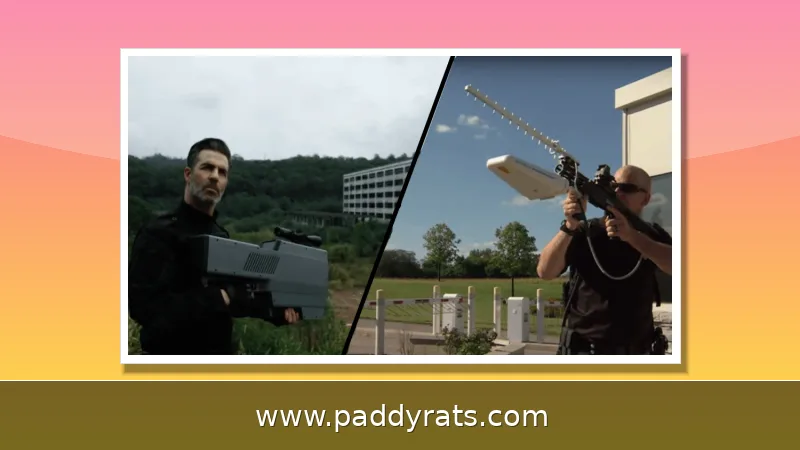
A signal blocker — most people just call it a jammer — is a device that disrupts the reception of communication signals like Wi-Fi, GPS, Bluetooth, and cell traffic. It's not hacking into your phone or reading your data. What it actually does is transmit radio waves on the same frequency the target device uses, flooding that band so nearby receivers can't pick out normal transmissions. The result? A phone sitting inside the coverage area just goes unreachable, and calls, texts, or data sessions fail with no warning at all.
People searching for these devices usually fall into one of three camps. Some want to grasp the physics behind how a jammer actually works, others are shopping around and comparing models and specs, and a third group just wants to know if owning or using one is legal where they live. You'll find listings for these products on sites like Mercado Livre, Shopee, Amazon and AliExpress, mixed in with technical articles and videos that break down the basic principles.
It's easy to get confused here, since the terminology shifts a lot from one region to another. Depending on where you're reading, you'll run into bloqueador de sinal, bloqueador de sinais, bloqueador de sinal de celular, bloqueador de señal celular, signal jammer, signal blocker, WiFi jammer, GPS jammer, Bluetooth jammer, inhibidor de frecuencias, inhibidores tácticos, bloqueador de transmisores, anti-drone jammer, convoy blocker, or mochila blocker — and they all refer, more or less, to the same category of hardware. The label changes, but the underlying mechanism doesn't: the device pushes out enough energy on a given band to drown out the legitimate signal.
How Signal Jammers Work: Congesting the Radio Spectrum
The basic idea here is pretty blunt: it just drowns everything out. A blocker fires off a very strong frequency signal on the same spectrum mobile networks rely on, so once you're inside its coverage area, phones simply stop working. As Canaltech put it back in April 2023, the effect isn't really like cutting a wire — it's more like a traffic jam. The channel is still there, but nothing can get through it cleanly. Inside that range, the device shuts down all communication, essentially creating a little bubble of radio silence where calls and texts can't go out or come in.
Think of it like a targeted anti-drone weapon. Both work by saturating a narrow slice of the spectrum instead of physically damaging anything, which explains why a device usually bounces back the moment it leaves the jammed area. The blocker doesn't need to know what the phone is actually saying, only which frequencies it's using. That's exactly why modern units sweep across several bands at once, so they can catch whichever channel a handset tries to fall back on.
Ham radio write-ups have been covering the guts of this stuff for decades. Take Newton C. Braga, who published under the name TEL204 — he describes a transmitter blocker as basically an interference generator that spreads across a wide frequency range and messes with any receiver close enough to pick it up. In his circuit, a strong FM transmitter gets overmodulated so it sweeps across a broad band. The overmodulation comes from a low-frequency audio generator built around a unijunction transistor, with its frequency determined by R9 and C1. From there, that sawtooth signal feeds a high-frequency oscillator, and its frequency is set by C3, D1 and L1.
The real trick here is the varicap diode. D1 is a varicap, meaning its capacitance changes with the voltage applied to it, so the overmodulation voltage keeps shifting the oscillator's frequency. With the values given, the sweep usually lands somewhere between 50 and 200 MHz, and throwing two varicap diodes in parallel can stretch that range even wider. From there, a BD135 power amplifier boosts the signal, which gets you roughly 500 meters of range with a one-meter telescopic antenna — all running on 12 V at a minimum of 500 mA.
Some of the more advanced designs are smarter about where they actually put that energy. Take the distributed digital signal blocker BSR600EX: it automatically tracks the cell signal in the environment and emits the blocking signal only on the corresponding frequency, which cuts down on useless transmission power and wasted heat. Tactical inhibitors work in a similar way, transmitting a signal that occupies the same frequency as the cell phone and producing what the industry calls a denial attack.
Which Frequencies and Devices Can Be Blocked?
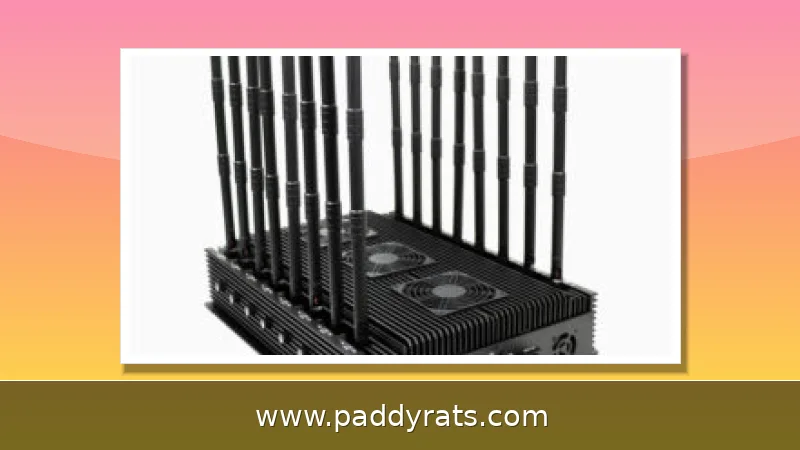
A signal blocker goes after the specific bands its target devices rely on. In practice, that usually means the cellular bands for 2G, 3G, 4G LTE, and 5G, along with Wi-Fi at 2.4 GHz and 5 GHz, Bluetooth, GPS, and UHF or VHF radios. If you look at commercial listings, you'll see ranges like 20–6000 MHz with customizable bands — which explains why a single unit can often be set up at the factory to match whatever combination of networks a buyer happens to need.
Wi-Fi jamming is worth mentioning on its own. Back in July 2025, LB-LINK explained that a Wi-Fi jammer blocks wireless networks by blasting strong signals across the Wi-Fi bands, which disrupts connections without actually damaging any devices — and it goes specifically after 2.4 GHz and 5 GHz. Since most consumer routers and laptops bounce between those two bands, a jammer that covers both can essentially wipe out local wireless networking within its range, all while leaving the hardware itself totally fine.
GPS is a different story, though, because the signal coming down from satellites is incredibly weak by the time it actually reaches the ground. Geotab pointed this out back in December 2024, describing a GPS blocker as a kind of digital smoke screen — it blocks the signals and makes fleet monitoring a real headache. For logistics operators, insurers, or really anyone who depends on location telemetry, that's a big deal. A truck that suddenly vanishes from the map isn't necessarily broken; it might just be shielded.
The table below breaks down the main frequency bands and shows what usually happens once each one gets flooded.
| Target band | Typical devices affected | Practical effect |
|---|---|---|
| 2G / 3G / 4G LTE | Cell phones, modems | Calls, SMS and mobile data fail |
| 5G | Phones, fixed wireless | High-band connections drop |
| 2.4 GHz Wi-Fi | Routers, laptops, IoT | Local network traffic stalls |
| 5 GHz Wi-Fi | Routers, laptops | Faster links become unusable |
| Bluetooth | Earbuds, trackers, peripherals | Pairing and streaming break |
| GPS / GNSS | Navigation, fleet trackers | Position fixes lost or wrong |
| UHF / VHF | Two-way radios | Voice radio goes silent |
One practical takeaway from that table is that no single jammer covers everything well. Wider coverage usually means more bands, more amplifiers and more heat, which is exactly why the specification sheets that matter most are the ones listing band count and total output power rather than the marketing name on the box.
Choosing a Jammer: Power, Range, Cooling and Power Supply
Once you move past the theory, the buying decision comes down to numbers. A listing on Made-in-China dated March 2026 describes a Portable Mobile Phone Jammer marketed as a bloqueador de sinal and Bluetooth blocker backpack jammer, with a frequency range of 20-6000 MHz, customizable bands covering 2G, 3G, 4G, 5G, WiFi, UHF and VHF, and a choice of omni antenna or handheld directional antenna. Those four parameters, range, bands, antenna type and power, define what the unit can actually do.
Power ratings in the tactical segment span a wide spread. Tactical Security sells tactical frequency inhibitors with models ranging from 12 Watt to 270 Watt, with band counts from 8 to 21 bands and coverage of 2G-5G and WiFi. Higher wattage generally translates into more coverage area, but it also means more heat, larger batteries and heavier enclosures, which is why briefcase and backpack formats dominate the high-power end of the catalog.
The table below shows a representative slice of that lineup so the trade-offs are easier to see.
| Model | Output | Bands / focus | Format |
|---|---|---|---|
| TS4112 | 12 W | Tactical cell | Compact |
| TS9351 | 16 W | Portfolio jammer | Briefcase |
| TS9266 | 20 W | VHF-UHF | Portable |
| TS9621 | 45 W | WiFi, Bluetooth, cell | Portable |
| TS9721 | Total coverage | Multi-band | Briefcase |
| TS9958 | High power | Convoy bomb blocker | Vehicle |
| TS9995 | 270 W | 12-band 2G-5G WiFi | High power |
Cooling and power supply are the two specifications buyers most often overlook. A 270 Watt unit generates serious heat and needs active cooling to avoid derating or shutdown, while a 12 Watt handheld can run on a modest battery pack. The older TEL204 reference design, by contrast, needs 12 V at 500 mA, which shows how far the low end of the market sits from the tactical hardware sold today.
Antenna choice matters just as much as wattage. An omni antenna spreads interference in every direction and suits area denial, while a handheld directional antenna concentrates energy toward a specific target. That distinction shapes both the effective range and how much stray interference leaks into neighboring spectrum, which is one reason regulators treat higher-power units with more suspicion than low-power consumer gadgets.
Legal Restrictions and Anatel Rules in Brazil
In Brazil, blockers cannot be used by individuals or companies. Use without Anatel authorization is classified as clandestine telecommunications activity, with penalties ranging from two to four years in prison. Anatel, the Agência Nacional de Telecomunicações, regulates and enforces jammer use nationwide, and determinations approved in early 2023 allow blockers to also operate in ports and airports, public security areas and other designated environments under official control.
That framework keeps lawful jamming in the hands of prisons, public security and national defense bodies, and government tactical operations, all coordinated by Anatel. For everyone else, the answer to whether signal blockers are legal is a straightforward no. This is not a gray area of consumer electronics regulation; it is treated as interference with telecommunications infrastructure, which is why enforcement targets sellers as well as operators.
France offers a useful contrast. Legislation there is less strict, and blockers may be used in cinemas, concert halls and other performance venues, where silencing phones during a show is treated as a legitimate cultural practice rather than a criminal act. The same device that is contraband in one country can be a permitted tool in another, which is why jurisdiction matters more than the hardware itself.
The United States takes a hard line as well. The FCC prohibits using, selling or importing jammers, so a unit that is legal to advertise in one market cannot lawfully be shipped into the U.S. as a consumer product. Tactical Security states plainly that its frequency inhibitors are not available for sale in Spain, Mexico, Argentina, Brazil and the U.S. except under express request by letterhead and sealed by a government entity as end user, with each unit including personalized training by an engineer and color manuals in Spanish.
Real-World Uses: Prisons, Exams, Government and Public Spaces
The legitimate use cases cluster around controlled environments. Prisons use jamming to stop contraband phones from coordinating activity inside and outside the walls, and public security agencies deploy blockers during operations where radio silence is an advantage. Government facilities and defense installations use them to protect sensitive areas, and airports and ports fall under the expanded Anatel authorizations approved in early 2023, covering logistics and border environments where unauthorized transmissions pose a security risk.
Exam halls and performance venues are the other common setting. France permits blockers in cinemas and concert halls, and the same logic, preventing phones from disrupting a shared experience or leaking exam content, drives interest in schools and testing centers elsewhere. In each case the justification is a bounded space and a temporary need, not blanket coverage of a neighborhood or city.
The market, however, does not respect those boundaries. TecMundo and Estadão reported back in January 2016 that even though illegal, cell phone signal blockers are sold online, and several jammer models were found being commercialized openly. A widely viewed video from around the same period, with roughly 4.6K likes and 249K views, made the same point: blockers are illegal yet sold online. A decade later, the gap between the rulebook and the marketplace has not closed.
For buyers, that gap is the real risk. A device advertised as a privacy tool can carry criminal exposure in Brazil and the U.S., and even in permissive jurisdictions its operation can interfere with emergency calls, aviation systems and public safety radio. Mercado Espião publishes a technical guide on choosing a cell phone signal jammer along with legal guidance on acquisition, and that pairing of technical and legal advice is the responsible way to approach the category.
Can You Block a Signal Jammer?
Jammers affect receivers, so blocking the interference means reducing its effect at the receiver rather than at the source. Even if you counter the jammer, that does not give you the frequency on which you are being jammed to transmit your own conversations, as discussed in amateur radio communities. The jammed band is occupied by interference, and simply overpowering it in one direction does not create a clean channel for two-way traffic.
In practice, defenses fall into a few buckets. Directional antennas and shielded enclosures can reduce how much interference reaches a sensitive receiver, and frequency hopping or spread-spectrum systems can make a narrowband jammer less effective by moving the signal faster than the jammer can follow. None of these approaches restores the original link, because the underlying band is still congested.
For most people, the realistic answer is not technical but procedural: move out of the coverage area, switch to a wired connection, or use a band the jammer is not targeting. That is why fleet operators treat GPS loss as a signal to investigate rather than a problem to solve remotely, and why venues that jam phones rely on the physical boundary of the room to define where the effect starts and stops.
How does a signal blocker work?
A blocker transmits a strong radio signal on the same frequencies used by phones, Wi-Fi or GPS. This floods or congests the spectrum, so nearby receivers cannot pick up normal transmissions. Devices are not damaged; they simply lose the ability to send or receive data within the blocker's range, and service usually returns once the device leaves the affected area.
Are signal blockers legal?
In Brazil, jammers are restricted to prisons, public security and national defense bodies, and government tactical operations, coordinated by Anatel. Unauthorized use can be treated as clandestine telecommunications activity with penalties of two to four years in prison. In the U.S., the FCC prohibits using, selling or importing them, while France allows them in cinemas and performance venues.
What frequencies do signal jammers block?
Jammers target the bands used by the devices they aim to silence. Common targets include 2G, 3G, 4G LTE and 5G cellular bands, Wi-Fi at 2.4 GHz and 5 GHz, Bluetooth, GPS and UHF/VHF. Commercial listings describe frequency ranges such as 20-6000 MHz with customizable bands, and tactical models span 8 to 21 bands with output from 12 Watt to 270 Watt.
Can you block a signal jammer?
Jammers affect receivers, so blocking the interference means reducing its effect at the receiver. Even if you counter the jammer, that does not give you the frequency on which you are being jammed to transmit your own conversations, as discussed in amateur radio communities. Directional antennas, shielding and frequency hopping can help, but the congested band remains unusable.
Frequently Asked Questions
How does a signal blocker work?
A blocker transmits a strong radio signal on the same frequencies used by phones, Wi-Fi or GPS. This floods or congests the spectrum, so nearby receivers cannot pick up normal transmissions. Devices are not damaged; they simply lose the ability to send or receive data within the blocker's range, and service usually returns once the device leaves the affected area.
Are signal blockers legal?
In Brazil, jammers are restricted to prisons, public security and national defense bodies, and government tactical operations, coordinated by Anatel. Unauthorized use can be treated as clandestine telecommunications activity with penalties of two to four years in prison. In the U.S., the FCC prohibits using, selling or importing them, while France allows them in cinemas and performance venues.
What frequencies do signal jammers block?
Jammers target the bands used by the devices they aim to silence. Common targets include 2G, 3G, 4G LTE and 5G cellular bands, Wi-Fi at 2.4 GHz and 5 GHz, Bluetooth, GPS and UHF/VHF. Commercial listings describe frequency ranges such as 20-6000 MHz with customizable bands, and tactical models span 8 to 21 bands with output from 12 Watt to 270 Watt.
Can you block a signal jammer?
Jammers affect receivers, so blocking the interference means reducing its effect at the receiver. Even if you counter the jammer, that does not give you the frequency on which you are being jammed to transmit your own conversations, as discussed in amateur radio communities. Directional antennas, shielding and frequency hopping can help, but the congested band remains unusable.
What is a signal blocker and how does it work?
A signal blocker, also called a jammer, is a device that transmits radio waves on the same frequency a target device uses, such as Wi-Fi, GPS, Bluetooth or cellular bands. Instead of hacking the phone, it floods the band with strong energy so nearby receivers cannot pick out normal transmissions, making calls, texts and data sessions fail inside the coverage area.
Which frequencies and devices can a jammer block?
Common targets include 2G, 3G, 4G LTE and 5G cellular bands, Wi-Fi at 2.4 GHz and 5 GHz, Bluetooth, GPS and UHF or VHF radios. Commercial units often cover ranges like 20-6000 MHz with customizable bands. No single jammer covers everything well, since wider coverage usually means more bands, more amplifiers and more heat.