Signal jammer coverage area depends far more on local signal strength, antenna height, and placement than on the wattage printed on the box. Here is how range really works, from 12W portables to prison-grade high-power units.
What Determines a Signal Jammer's Coverage Area?
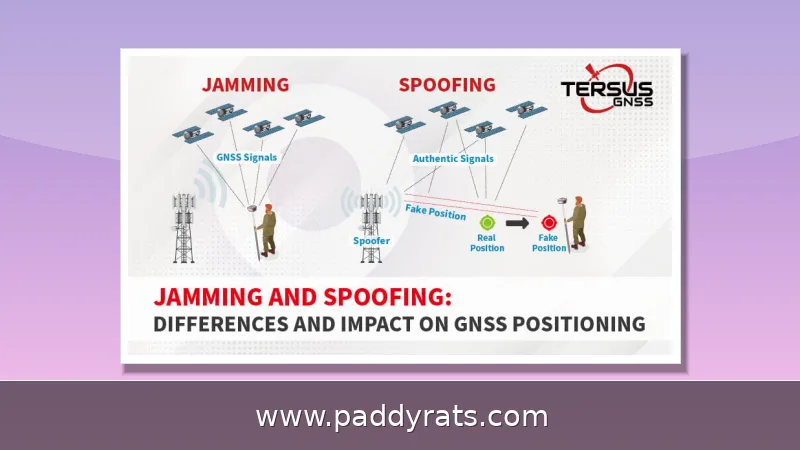
I've tested portable jammers in apartments, conference rooms, and open parking lots. The same unit that killed every bar of signal indoors did almost nothing on a rooftop 200 feet from a cell tower. That gap says everything about coverage area: a jammer doesn't create some fixed bubble of dead air. It wins or loses a power struggle against every base station and satellite your target device can hear. Jammers transmit RF noise on the same frequencies phones, WiFi gear, and GPS receivers use, overpowering the legitimate signal so devices can't send or receive.
The frequency bands that jammers target are pretty well established. Cell networks operate on 700MHz, 800MHz, 900MHz, 1800MHz, 1900MHz, and 2100MHz, which covers everything from 2G up through 5G. GPS sits at 1575MHz, and WiFi runs on 2.4GHz and 5GHz. A wide-band, full-spectrum jammer can hit several of these bands at once, which sounds great until you consider what you're sacrificing. Some advanced models go even further with protocol jamming, going after control channels directly rather than just flooding the air with noise. But here's the catch: the more bands you add, the more you're spreading the same amplifier power across the spectrum. That's why a five-band unit rarely reaches as far as a single-band device with the same wattage—the total power gets divided among more frequencies, leaving each band with less energy to overpower incoming signals.
Typical Range by Power Class: Low-Power vs High-Power Jammers
Power class basically sets the ceiling for what you can realistically get, but the specs on product pages are almost always more generous than reality. If you're looking at a low-power jammer in the 12W to 20W range, expect a shielding radius somewhere around 1 to 10 meters. You'll definitely come across listings that promise 1 to 20 or even 1 to 30 meters, but that upper end is only achievable out in the middle of nowhere with no cell tower anywhere nearby. Then there are the high-power units—the ones drawing hundreds of watts or over 1000W—which is what prisons actually use, and for those, a shielding radius of hundreds of meters is a pretty reasonable estimate.
One figure that gets passed around a lot—and that you should honestly treat with some skepticism—is the claim that jamming range is "no more than 30 square feet." For starters, that confuses area with distance; square feet measure coverage, not how far a signal actually travels. Beyond that, it simply doesn't line up with what people observe in practice. A much more dependable benchmark comes from portable 3G, GSM, and CDMA jammers, which are capable of blocking all cell phone frequencies within a radius of up to 30 meters when conditions cooperate. At the other end of the spectrum, low-power units that reach roughly 30 feet (about 9 meters) are best suited to small rooms and personal spaces, where a modest bubble of silence is all you're after. The table below lays out what to expect by class.
| Jammer Class | Typical Shielding Radius | Best-Fit Use Case |
|---|---|---|
| Low-power (12W–20W) | 1–10 meters (about 30 feet / 9 meters in favorable setups) | Small rooms, personal spaces, vehicles |
| Portable 3G/GSM/CDMA | Up to 30 meters under favorable conditions | Localized, temporary jamming outdoors or in open areas |
| High-power (hundreds of W or 1000W+) | Hundreds of meters | Large facilities such as prisons |
| Power class | Typical shielding radius | Realistic use case |
|---|---|---|
| Low-power (12W–20W) | 1–10 m | Small rooms, personal space, vehicles |
| Vendor claims for low-power | 1–20 m or 1–30 m | Rarely achieved outside weak-signal areas |
| Portable multi-band (3G/GSM/CDMA) | Up to 30 m | Localized outdoor jamming |
| High-power (hundreds of W to 1000W+) | Hundreds of m | Prisons and institutional facilities |
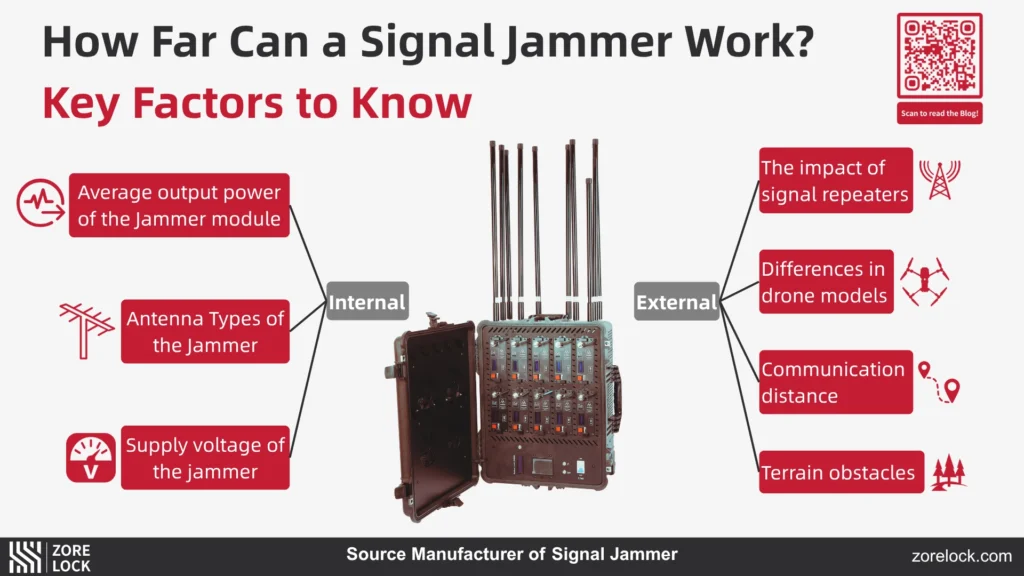
You'll see this pattern across basically every power class, too. Double the wattage and the range doesn't double with it. RF energy spreads out as it travels and fades fast, and whatever sits in its path—walls, buildings, trees, even heavy base station coverage—soaks up a good chunk of what's left. That's why a 20W unit won't necessarily reach twice as far as a 10W one, and why a jammer rated for 10 meters might only manage 5 in a dense urban area. So when a spec sheet throws out a single range number, take it as the best case under ideal conditions, not a hard guarantee you can count on in the real world.
How Placement and Antenna Height Increase Jamming Distance
The cheapest way to extend coverage usually isn't a bigger amplifier — it's a taller antenna. A portable signal jammer's main unit is only about 70cm tall with the antenna screwed on directly, so if you just set it on the floor, the antenna barely clears one meter. Lift that antenna off the ground, though, and the effective jamming distance increases noticeably. The reason is simple: the RF noise no longer has to punch through all the ground-level clutter — furniture, cars, walls — that soaks up and scatters the signal. Height matters for a jammer the same way it matters for any radio transmitter. A few extra feet of elevation can stretch the usable radius further than a modest bump in wattage would. Some companies sell antenna mounts that connect the antenna to the main unit with a 3-meter cable, raising it to about 3 meters off the ground. That's a cheap, easy fix for squeezing more coverage out of a small room, an office, or an outdoor space.
| Setup | Approximate antenna height | Effect on coverage |
|---|---|---|
| Main unit on the ground | Under 1 meter | Baseline; signal is blocked and scattered by nearby objects |
| Unit raised on a table or step | 1–2 meters | Noticeably longer effective jamming distance |
| Unit with a 3-meter antenna cable and mount | About 3 meters | Best practical gain for a portable setup |
When you're actually setting one up, the goal is to find the highest practical spot in the room. A table, a stair landing, a shelf, or even an upper floor will do. Some manufacturers sell antenna mounts that let you connect the antenna to the main unit with a 3-meter cable, which means you can keep the electronics on the floor while raising the radiating element to around 3 meters. Try to keep the jammer near the center of the area you want to cover, away from anything that might block it. An open, elevated, central position lets the signal spread out in every direction instead of getting cut off on one side.
Frequency Bands and Their Impact on Effective Coverage
Bandwidth is the quiet range killer that almost nobody bothers to check on a spec sheet. Two modules can both claim 100W of total output and still perform nothing alike in the real world, because what actually reaches a phone or a WiFi radio is average power per MHz — not the big wattage number printed on the box. Take Jammer A: it covers 2400–2500MHz with 100W total, so that 100MHz slice gets roughly 1W per MHz. Now look at Jammer B: it spans 2000–2700MHz with the same 100W, spreading that power across 700MHz and leaving only about 0.14W per MHz. Same number on the label, but roughly seven times less punch in any single channel. That's exactly why Jammer A is the smarter pick for hitting the 2.4GHz band, and why it reaches farther — its energy stays concentrated where your target devices actually operate, instead of getting watered down across bands you may not even care about.
| Jammer | Frequency Coverage | Total Power | Average Power per MHz | Best Use |
|---|---|---|---|---|
| Jammer A | 2400–2500MHz (100MHz) | 100W | ~1W/MHz | Targeted 2.4GHz jamming, longer range |
| Jammer B | 2000–2700MHz (700MHz) | 100W | ~0.14W/MHz | Wide-band coverage, shorter effective range |
Power ratings on spec sheets can be misleading, because the same 50W (47dBm) or 100W (50dBm) total is spread across the whole frequency band a module covers — not concentrated on the channel your phone is actually using. Think of it like a fixed budget: the wider the band, the thinner that budget gets stretched, and the less energy lands on any single frequency. That is why the type of jamming signal and its modulation strategy matter just as much as raw wattage. A device that focuses its energy on the exact channel a phone is using will outperform a broadband noise emitter of equal power, sometimes by a wide margin. A quick comparison makes this concrete: Jammer A covers 2400–2500MHz with 100W total, which works out to a full 1W per MHz, while Jammer B spreads the same 100W across 2000–2700MHz and gets only 0.14W per MHz. Same power label, very different real-world reach — Jammer A is the better tool for the 2.4GHz band. So before you believe any range claim, divide total power by bandwidth, and ask which bands the unit actually covers.
Real-World Limits: Base Station Density and Environmental Factors
Base station density is the factor buyers underestimate most. A jammer that once achieved a 10-meter radius may now only reach 5 meters, because carriers keep adding towers and raising overall signal strength. The reception level on the target phone is the best predictor of results. If reception is at or above -70dBm, meaning multiple base stations are nearby, actual shielding may only cover 2 to 3 meters. If reception is at or above -90dBm, with no base station on campus, shielding can reach 10 meters with the same hardware.
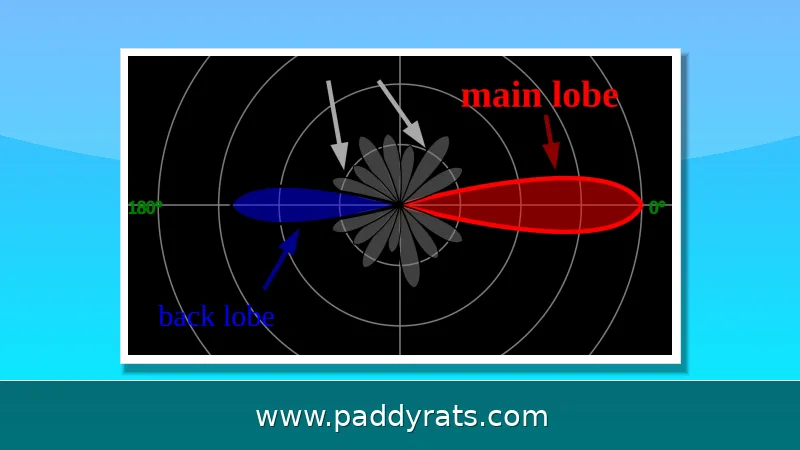
External conditions don't just tweak coverage—they can rewrite the whole equation. Buildings and walls absorb or scatter RF energy, the surrounding environment adds its own clutter and competing signals, and installation conditions determine how cleanly the jammer's output actually radiates. Then there's antenna gain and the strength of the target signal itself, both of which can quietly push or pull the effective radius by several meters. Antenna type matters too. An omnidirectional antenna spreads energy across 360 degrees horizontally, which is handy when you want broad coverage in every direction. A directional antenna does the opposite: it concentrates energy into a single beam, much like a flashlight, so the jamming reaches farther along one path instead of fading evenly all around. That distinction often decides whether a job succeeds. If your goal is to cover a long corridor or seal off a doorway rather than fill an entire room, a directional antenna will usually outperform a higher-powered omnidirectional setup—because raw power spread in all directions is simply wasted where you don't need it.
Which Jammer Type Fits Which Coverage Need?
Coverage goals really do vary by device category, and matching the right tool to the job is where you save money. Take portable signal jammers: they're small, handheld, battery-powered, cordless, and rely on built-in antennas. That combination makes them a temporary personal zone rather than a blanket solution — think a single small room, a vehicle cabin, or a localized outdoor work area where you only need a short window of quiet. Cell phone jammers work differently in terms of what they target. They go after the bands phones actually use, from 700MHz up to 2100MHz, covering 2G, 3G, 4G, and even 5G networks. Within their radius, that means voice calls, SMS, and mobile internet all get blocked. So if your coverage need is a person-sized pocket of silence, a portable unit fits; if it's blocking phone traffic specifically, a cell phone jammer is the category to look at.
| Jammer Type | Form Factor | Target Frequencies | Typical Use Case |
|---|---|---|---|
| Portable signal jammer | Small, handheld, battery-powered, cordless, built-in antenna | Varies by model (cellular, WiFi, GPS, etc.) | Temporary personal zone; small rooms, vehicles, localized outdoor work |
| Cell phone jammer | Varies (portable to high-power installations) | 700MHz–2100MHz (2G, 3G, 4G, 5G) | Blocking voice calls, SMS, and mobile internet within its radius |
Specialty units cover narrower missions. WiFi jammers transmit interference on 2.4GHz and 5GHz to stop devices from finding and connecting to nearby wireless networks. Drone signal jammers interfere with the communication frequencies used by drones and UAVs, transmitting on ISM bands and navigation signals to break command connections so a drone hovers or returns to its launch site. Wide-band full-spectrum models combine several of these bands in one enclosure, which is convenient but splits power across more spectrum.
| Jammer type | Bands targeted | Coverage character |
|---|---|---|
| Portable signal jammer | Multiple cellular bands | Small personal zone, battery powered |
| Cell phone jammer | 700MHz–2100MHz | Voice, SMS, mobile data within radius |
| WiFi jammer | 2.4GHz and 5GHz | Blocks wireless LAN connectivity |
| Drone signal jammer | ISM bands and navigation signals | Breaks command link, triggers hover or return |
Legal Status and Enforcement of Signal Jammers
In the United States it is illegal to sell, advertise, distribute, or operate cell signal jammers. Federal law prohibits operation, marketing, or sale of any jamming equipment that interferes with authorized radio communications, including cellular and PCS, police radar, and GPS. The Communications Act of 1934 outlaws interference with authorized radio broadcasts, and there are no exemptions for use within a business, classroom, residence, or vehicle. Even local law enforcement agencies do not have independent authority to use jamming equipment, though federal agencies may be authorized in some instances.
Enforcement is not theoretical. Since 2021, Customs and Border Protection has reported roughly an 830% increase in signal jammer seizures, a signal that imported devices are being stopped at the border. In the USA, over 30,000 portable RF signal jammer units are procured annually across federal and state agencies, so the legal market exists but is tightly controlled. In many jurisdictions, unauthorized use of equipment designed to jam radio communications is strictly illegal and can lead to severe legal penalties.
Market projections vary widely depending on the analyst, which tells you how unsettled this category is. Published estimates include $4.98 billion in 2026 growing to $9.27 billion by 2034 at 8.1% CAGR; $2.8 billion in 2025 to $5.6 billion by 2034 at 8.1% CAGR; $1.8 billion in 2026 to $3.6 billion by 2033; $2.35 billion in 2026 to $3.64 billion by 2030 at 11.5% CAGR; and $2.85 billion in 2025 to $4.64 billion by 2032 at 7.2% CAGR. Treat any single figure as one analyst's model rather than a settled fact.
How Do You Improve Coverage Without Breaking the Law?
If you are evaluating jamming for a lawful application such as a controlled test environment or a government-authorized deployment, the practical levers are placement, antenna height, and band discipline. Start by measuring the ambient signal level where you intend to operate; a reading at or above -70dBm tells you to expect only a few meters of effective shielding, while -90dBm or weaker opens the door to 10 meters or more. Then raise the antenna as high as the installation allows.
Next, narrow your target. Choose a jammer whose power is concentrated on the bands you actually need instead of a full-spectrum unit that spreads watts thin. Use a directional antenna when the coverage area is a corridor, entryway, or perimeter rather than a room. Finally, verify the legal status of the specific application before purchasing anything, because the equipment itself is restricted in the United States regardless of how carefully it is placed. This article is not legal advice, and nothing here should be read as encouraging unlawful operation.
Frequently Asked Questions
How far can a signal jammer reach?
Range varies widely by power and environment. Low-power jammers from 12W to 20W typically cover 1 to 10 meters, and vendor claims of 1 to 20 or 1 to 30 meters are hard to achieve in practice. High-power units drawing hundreds of watts or more than 1000W, such as those used in prisons, can reach a radius of hundreds of meters.
What factors affect a signal jammer's coverage area?
Key factors include output power, operating frequency, antenna gain, target signal strength, surrounding obstacles, and installation conditions. Base station proximity matters a great deal: a strong local signal at or above -70dBm can shrink effective shielding to 2 or 3 meters, while a weak signal at or above -90dBm allows up to 10 meters from the same device.
Does a signal jammer block WiFi and GPS too?
Many jammers block multiple bands. Cell phone jammers transmit on cellular frequencies from 700MHz to 2100MHz but can also interfere with GPS at 1575MHz, WiFi at 2.4GHz and 5GHz, and even police radar. Wide-band full-spectrum jammers block several frequency bands simultaneously, though spreading power across more bands reduces the reach on each one.
How can I increase a portable signal jammer's coverage range?
Optimize placement by putting the jammer at the highest available point and away from obstructions. Raising antenna height above ground significantly increases effective jamming distance, since a unit sitting on the floor rarely clears one meter. Antenna mounts with a 3-meter cable can elevate the antenna to about 3 meters for larger coverage.