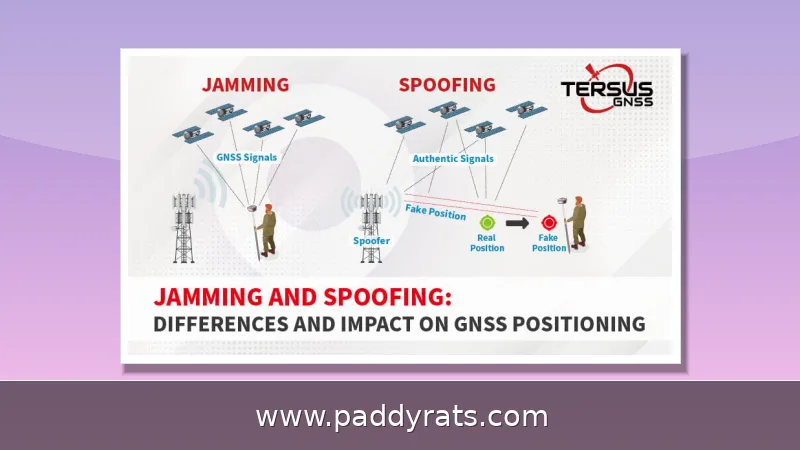
RF jamming drowns GNSS signals in noise so a drone loses its fix, while GNSS spoofing feeds counterfeit satellite signals that make a receiver trust a false position or time. One attack disrupts, the other deceives, and the defenses for each are very different.
What Is RF Drone Jamming and How Does It Work?
Radio frequency (RF) drone jamming is the deliberate transmission of high-power noise or competing signals on the same frequencies a GNSS receiver depends on, so the receiver can no longer acquire or track satellite signals. The goal is denial, not deception: the operator wants the drone, vehicle, or timing system to lose its position fix entirely. Because GNSS signals arrive from satellites more than 20,000 kilometers away, they reach the ground extremely weak, which is exactly why a low-cost, low-power jammer can overwhelm them.
In practice, jamming energy is aimed at the bands where GNSS lives, notably the 1.2 GHz and 1.5 GHz regions that carry L1, L2, and L5 signals. A sweep jammer moves its carrier frequency over time, while a single-frequency jammer stays fixed on one spot. A sufficiently strong jammer can also block other radio communications on any device operating within its range, which is why drone operators often see both a lost GPS fix and a degraded control or telemetry link at the same time.
The signature of jamming is a sudden drop in carrier-to-noise ratio, a rising noise floor, and a receiver that simply fails to compute a position. That failure is loud and obvious, and it is usually the first clue that something is wrong. From a security standpoint, jamming is crude but effective: it does not need to imitate anything, only to be stronger than the satellite signal at the antenna.
What Is GNSS Spoofing and Why Is It Different?
GNSS spoofing is the broadcast of counterfeit satellite signals designed to be believed. Instead of drowning out the real constellation, a spoofer faithfully recreates signals from multiple satellites, with manipulated timing and navigation data, and transmits them at a power level that captures the local receiver. The objective is to make the target compute a wrong position or time while believing everything is normal. Where jamming is disruption, spoofing is deceit.
The technical bar for spoofing is higher than for jamming. A credible spoofer has to reproduce the structure, timing, and Doppler characteristics of several satellites at once, then gently pull the receiver away from the genuine solution. Done well, the receiver never reports an error, which is precisely what makes spoofing so dangerous for drones, autonomous vehicles, financial timestamping, and telecom synchronization that depends on GNSS-based timing.
The practical contrast is simple to remember. Jamming causes signal loss; spoofing causes false trust. A jammed drone knows it has no fix. A spoofed drone confidently flies to the wrong coordinates, and without advanced anti-spoofing techniques such as signal authentication and consistency checks, the operator may have no idea an attack is underway.
Jamming vs Spoofing: Objectives, Methods, and Impact Compared
The two attacks differ in intent, technique, and the kind of damage they cause, which is why mitigation strategies are not interchangeable. The table below summarizes the core differences across objective, method, impact, and detection difficulty.
| Attribute | RF Jamming | GNSS Spoofing |
|---|---|---|
| Objective | Deny GNSS service | Deceive the receiver with false data |
| Method | High-power noise or swept tones on GNSS bands | Counterfeit satellite signals with manipulated timing and navigation data |
| Typical impact | Total loss of positioning or degraded accuracy | Wrong position or time that the system trusts |
| Detection | Sudden signal loss, higher noise floor, no fix | Hard without authentication and consistency checks |
| Nature of attack | Disruption | Deceit |
Read the table as a decision aid rather than a scorecard. Jamming shows up as an outage, so basic monitoring often catches it. Spoofing shows up as a plausible but wrong answer, so catching it requires cross-checking multiple frequencies, constellations, and independent sensors. That asymmetry explains why anti-jamming focuses on filtering and antenna design, while anti-spoofing focuses on authentication and validation of the data itself.
Real-World GNSS Interference Incidents and Their Consequences
GNSS interference is not theoretical. In 2017, more than 20 vessels reported GPS spoofing incidents near Russia's Novorossiysk port in the Black Sea; ships that were stationary in real life appeared displaced by hundreds of kilometers on digital maps. The event became a landmark case because it showed that a receiver can be moved on paper without any hardware failure or obvious alarm.
In 2022, a GNSS interference event near Dallas-Fort Worth Airport disrupted aircraft navigation systems across a wide area, underlining how exposed critical infrastructure is, including telecom networks that rely on GNSS-derived timing. Multiple airports, especially in conflict zones and border regions, report frequent GPS jamming affecting aircraft navigation during takeoff and landing, and IATA has called for urgent action on GNSS interference.
The downstream effects reach beyond aviation. GNSS interference has been used to prevent drone flights at heavily attended events such as Euro 2024 and the Olympics, and militaries have employed it near borders. Criminals have used jammers to disable tracking on high-value shipments for cargo theft and vehicle hijacking. ADS-B, which relies on GNSS for position data, can be silenced by jamming or falsified by spoofing, which means air traffic surveillance inherits the same weaknesses as the receivers feeding it.
Are Jamming and Spoofing Devices Easy to Obtain?
Availability is part of the threat model. Commercial jammers marketed as privacy tools can be bought online for as little as $20, sometimes disguised as USB sticks or car chargers, even though they are illegal in most countries. Spoofers can be assembled from open-source software or low-cost components, and software-defined radios (SDRs) have made both classes of attack far more widespread and easier to iterate on.
Capability also keeps improving at the low end. Some jammers offer multi-frequency operation, targeting several GNSS signals simultaneously, which makes simple single-band filtering less effective. On the spoofing side, the barrier is knowledge and timing discipline more than hardware cost. For defenders, the practical takeaway is that the threat is cheap, accessible, and improving, so resilience has to be designed into receivers and platforms rather than assumed.
Anti-Jamming and Anti-Spoofing Mitigation Techniques
Anti-jamming defense starts at the antenna and the front end. Adaptive filtering with notch filters suppresses known jamming frequencies, while beamforming antennas such as Controlled Reception Pattern Antennas (CRPAs) steer nulls toward the jammer and gain toward the satellites. Integration with Inertial Navigation Systems (INS) provides backup positioning during GNSS outages, so a platform can coast through interference instead of losing navigation entirely.
Anti-spoofing defense focuses on proving that the signal is genuine. Signal authentication such as Galileo's Open Service Navigation Message Authentication (OSNMA) adds verifiable data to the navigation message, and future protocols like GPS Chimera add digital signatures or cryptographic elements. Using multiple frequencies and constellations, such as L1 and L5 with GPS plus Galileo, makes spoofing much harder because a spoofer must fake every band consistently. Receiver-level detection monitors signal strength, Doppler shifts, and cross-checks for inconsistencies that betray a counterfeit.
Multi-constellation, multi-frequency receivers that track GPS, Galileo, GLONASS, and BeiDou across L1, L2, and L5 can detect discrepancies, resist narrowband jamming, and flag anomalies such as unusually strong signals. Trimble Maxwell technology, for example, includes signal processing techniques that monitor, analyze, and remove unwanted interference. Other vendors take similar approaches, and the common thread is continuous validation rather than blind trust in a single frequency.
Detection Methods and GNSS Resilience Best Practices
Proactive detection turns GNSS from a black box into a monitored sensor. Spectrum monitoring watches for anomalies in GNSS bands, Received Signal Strength Indications (RSSI) flag unusually high power levels that suggest a nearby transmitter, and time-difference or angle-of-arrival techniques can pinpoint the direction of an interference source. Geofencing adds a behavioral layer: if a reported location jumps outside a known operating area, the system can raise an alert instead of acting on the false fix.
Sensor fusion and alternative PNT sources provide the second opinion. Combining GNSS with INS, using accelerometers and gyroscopes to track motion without external signals, lets a platform compare dead-reckoned movement against the satellite solution and catch a spoofed jump. Timing systems can be cross-checked against independent clocks. The goal is not to eliminate GNSS but to make any single point of failure non-fatal.
Testing closes the loop. Safran Federal Systems' BroadSim can generate jamming and spoofing GNSS signals simultaneously in a single system, with interference types including Carrier Wave, Additive White Gaussian Noise (AWGN), and IQ File Playback. It features Skydel software control and four RF outputs, supports multiple simultaneous constellations, and can produce hundreds of interference signals from one RF output, each with different power levels, modulations, and locations. Jamming can be switched on and off through the Skydel GUI and API during runtime, which lets teams rehearse detection and mitigation under realistic, repeatable conditions.
What Do These Differences Mean for Drone Operators?
For anyone flying or protecting drones, the operational lesson is that jamming and spoofing demand different playbooks. A jammed drone typically loses its fix and may switch to attitude or visual modes, so the failure is visible and recoverable. A spoofed drone keeps reporting a healthy position while drifting off course, so recovery depends on detection that happens before the flight path is committed.
That is why a layered architecture matters: authenticated signals where available, multi-frequency and multi-constellation reception, inertial backup, spectrum awareness, and geofence-based sanity checks. None of these is sufficient alone, but together they turn a silent, believable lie into a detectable anomaly. As jammers and spoofers get cheaper, the receivers that validate rather than assume will be the ones that keep flying.
Frequently Asked Questions
What is the main difference between RF jamming and GNSS spoofing?
RF jamming overwhelms GNSS signals with high-power noise so a receiver loses its position fix entirely, while GNSS spoofing broadcasts counterfeit satellite signals that make a receiver trust a false position or time. Jamming is disruption and is usually obvious; spoofing is deception and can go undetected without authentication and consistency checks.
Why is GNSS spoofing considered more dangerous than jamming?
Spoofing is more dangerous because the receiver reports a healthy but wrong solution, so operators may act on false coordinates or timing without any alarm. Jamming causes a visible loss of fix that triggers fallback modes, whereas spoofing can silently mislead drones, vehicles, and timing-dependent infrastructure until the damage is already done.
How can drone operators detect and defend against GNSS jamming and spoofing?
Defense combines authenticated signals like Galileo OSNMA, multi-frequency and multi-constellation reception, inertial navigation backup, spectrum monitoring, and geofence-based sanity checks. Jamming is caught through signal loss and a rising noise floor, while spoofing requires cross-checking multiple bands and independent sensors to expose inconsistent or implausible position and timing data.
Are jamming and spoofing devices easy to obtain?
Yes. Commercial jammers sell online for as little as $20, sometimes disguised as USB sticks or car chargers, though they are illegal in most countries. Spoofers can be built from open-source software and low-cost components, and software-defined radios have made both attack types cheaper, more widespread, and easier to iterate on.