A signal jammer floods the same radio frequencies a phone, GPS receiver or WiFi device relies on, dropping the signal-to-noise ratio until the receiver can no longer decode legitimate traffic. Here is how the hardware works, which jamming techniques exist, what the devices cost, and why the FCC treats them as illegal in the US.
What Is a Signal Jammer and What Does It Target?
A signal jammer is a device built to deliberately cut the link between a wireless device and whatever signal source it's trying to reach. The classic case is a cell phone jammer that severs the connection between a handset and a nearby cell tower, which means calls, texts and mobile data just stop working. In networking terms, that's a denial-of-service attack delivered over the air instead of through a cable. And jamming didn't start out as a consumer gadget — it came out of military and law enforcement work, including operations against cell phone-triggered explosives and hostage situations where blocking outside contact is the whole point.
Basically, anything that relies on RF reception can be a target. That covers 2G, 3G, 4G, and 5G cellular connections, GPS receivers, WiFi routers, Bluetooth devices, and the control or navigation signals drones depend on. Here's the thing, though: a jammer doesn't need to decode what's being transmitted. It just has to make the receiver incapable of telling the legitimate signal apart from the interference. That's exactly why one basic design can be aimed at a phone, a GPS unit, or a drone, with the frequency band and antenna being the only real changes.
How Does a Signal Jammer Work at the Frequency Level?
Every jammer runs on the same three-stage signal chain. First, an RF signal generator produces the jamming waveform. Then a power amplifier brings that waveform up to a usable output level. Finally, one or more antennas broadcast it across the target frequencies. What happens next comes down to raw power: the jamming signal reaches the victim receiver at a stronger level than the legitimate transmission, and that crushes the signal-to-noise ratio. Once noise takes over, the receiver has no way to tell valid data apart from interference, so the link simply falls apart.
There's no single blocking radius that applies across the board. A handheld unit might only reach a few meters, while a high-power system can cover several kilometers. What you actually get depends on a mix of factors: output power, antenna gain, terrain, building materials, and how far the target device is from its own tower or access point. Even a wall, a hill, or a metal structure can cut the effective range way down. That's why real-world performance often looks nothing like the numbers printed on a product page.
Radio jamming, in its simplest definition, means deliberately blocking or interfering with wireless communications. Since this kind of attack goes after the physical layer instead of a password or encryption key, a device can be silenced even if it's otherwise well secured—no hacking required. That's basically why regulators treat jamming hardware so differently from ordinary network gear.
Noise, Spot, Barrage, Sweep and Deceptive Jamming Techniques
The main thing that separates one RF jamming technique from another is how it spends its power budget. Noise jamming just blasts continuous noise on the target frequency—simple, effective, but pretty easy to spot. Spot jamming takes the opposite approach: it dumps every last bit of power onto a single frequency. That makes it brutal against a fixed-frequency target, yet basically worthless against frequency-agile radar, since the radar just hops to another channel and leaves the jammer behind. Barrage jamming sits somewhere in the middle, spreading its power across several frequencies at once. You cover more ground that way, but the trade-off is that you're weaker at any one point.
Sweep jamming works differently. Instead of parking its power on one frequency, it hops from one to the next in rapid succession, sweeping across a whole band so the receiver never really gets a clean window to lock onto. Deceptive jamming is a sneakier play — it sends out misleading signals built to look like the real thing, so the target treats them as legitimate. Then there's the repeater approach, and DRFM (digital radio frequency memory) is the classic example: it grabs radar energy, tweaks it, and sends it back out. Do that right and you can paint false targets all over an enemy's display.
The table below breaks down how each of these techniques actually behaves in practice.
Types of Jammers: Portable, Cell Phone, WiFi and Drone
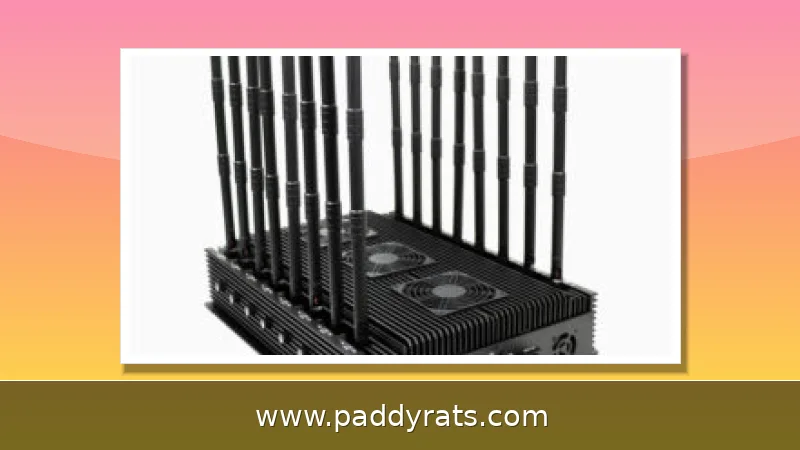
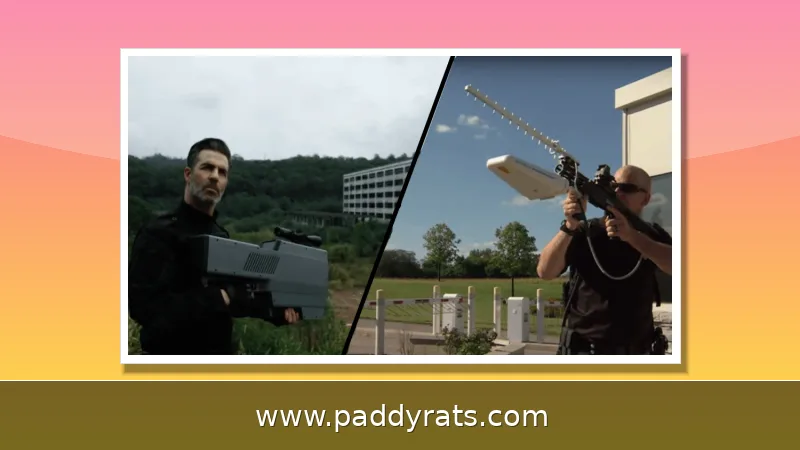
If you've ever shopped around for one, you know jammers come in a few fairly distinct shapes. Portable signal jammers are the handheld kind — battery-powered, cordless, easy to toss in a bag, though that convenience comes at a cost: limited output power and short runtime. Cell phone jammers go after voice calls, texts and mobile data by hitting the bands that 2G through 5G networks rely on. WiFi jammers zero in on 2.4GHz and 5GHz, which is enough to knock laptops, cameras and smart-home gear offline. And drone signal jammers are a different beast altogether — they use directional antennas aimed at ISM bands and navigation signals, which can leave a drone stuck hovering in place or send it retreating back to where it launched.
Pricing varies widely by power, band coverage and antenna count. The examples below come from published vendor listings and are shown for context, not as a recommendation.
Jamming Frequencies and Bands: Cellular, GPS and WiFi
Frequency choice determines what a jammer can and cannot touch. Cellular networks operate across 700MHz, 800MHz, 900MHz, 1800MHz, 1900MHz and 2100MHz bands, and cell phone jammers typically sweep from 700MHz up to 2100MHz to cover 2G, 3G, 4G and 5G traffic. GPS sits near 1575MHz, which is why GPS jammers are a distinct product category. WiFi uses 2.4GHz and 5GHz, so a WiFi jammer needs hardware tuned to those specific slices of spectrum.
Because these bands sit close together in some devices, a jammer aimed at one service can cause unintended interference with another. That spillover is one of the reasons regulators treat jamming as a public-safety issue rather than a private property dispute. It also explains why a device advertised as a single-band blocker may affect nearby equipment in ways the buyer never intended.
In my experience reviewing RF hardware, the practical takeaway is that band coverage, not raw wattage, decides whether a jammer actually works against a given target. A 10-watt unit on the wrong frequency does nothing; a lower-power unit on the exact band can be far more disruptive.
Does a Jammer Block Signal Boosters and Amplifiers?
Yes, and this surprises people who buy a booster expecting it to fight back. A signal booster works by amplifying an existing signal it receives from a tower or access point. If a jammer is flooding that same frequency with noise, the booster has nothing clean to amplify; it will happily amplify the interference instead. Any signal jammer is effectively also a signal booster jammer.
That is why amplifiers are not an effective defense against jamming. The booster sits downstream of the problem, and once the signal-to-noise ratio at the antenna collapses, no amount of gain restores the original transmission. The only practical fixes are removing the interference source, changing frequency, or physically relocating away from the jammed area.
Where Jammers Are Used: Military, Security, Airports and Schools
Military and defense users jam enemy communications, GPS, radar and drone links to degrade command and control. Law enforcement and security teams use jammers to prevent unauthorized drone flights over airports, prisons and government buildings, and to stop inmate phone use inside correctional facilities. Airports have historically deployed them to block signals from remote-controlled explosive devices, and cybersecurity teams use jamming to protect government buildings, military installations and data centers from eavesdropping.
Schools and theaters use jammers to create quiet environments, and some venues rely on them to keep performances or exams free from phone interruptions. Each of these use cases carries a tradeoff, because the same RF energy that silences a nuisance device can also silence a legitimate one nearby.
The risks are not theoretical. Jamming can prevent 911 calls and emergency alerts, interfere with law enforcement communications, disrupt payment processing and cause direct financial losses, and in some configurations enable data interception. Overuse can also cause unintended interference well beyond the intended target, which is exactly the scenario regulators cite when explaining why the technology is restricted.
Are Signal Jammers Legal? The FCC and Communications Act
In the United States it is illegal to sell, advertise, distribute or operate cell signal jammers. The FCC states that jamming equipment poses serious risks to critical public safety communications and can block 9-1-1 and emergency calls. Radio frequencies are legally protected by the Communications Act of 1934, which outlaws interference with authorized radio broadcasts. Violations can result in heavy fines and imprisonment, and the EU and other developed regions have similar restrictions.
The enforcement logic is straightforward: spectrum is a shared public resource, and a device that transmits on licensed frequencies without authorization can degrade services that millions of people depend on. That is why the ban covers marketing and distribution, not just operation. Selling a jammer, or even advertising one, can trigger penalties independent of whether the device is ever switched on.
If you suspect illegal jamming in your area, report it to law enforcement or the FCC rather than trying to locate and disable the device yourself. The FCC maintains a dedicated jammer enforcement channel for exactly these complaints.
Detection and Defense: What Actually Works?
The most common symptom of jamming is dropped service: calls fail, data stalls or GPS position freezes, often in a specific spot rather than everywhere. Consumer detection apps are largely unproven and usually need a working signal to function, which is a problem when the signal is the thing being blocked. More reliable defenses include monitoring network signals for unusual frequency levels or noise ratios, deploying an intrusion detection system, switching the phone's operating frequency, physically locating and disabling the jammer, or simply relocating, since jamming range is often no more than about 30 square feet in practice.
For businesses, the practical playbook is to log the anomaly, compare it against known outages, and escalate to the carrier or regulator if a pattern emerges. Documenting time, location and affected services makes a complaint far more actionable. Term-wise, you will see the same hardware described as cell jammers, mobile phone jammers, signal blockers, GPS jammers or text stoppers, alongside technical labels like RF jamming, radio jamming, noise jamming, spot jamming, barrage jamming, sweep jamming and DRFM jamming.
One final note for anyone shopping for this hardware: the legal exposure follows the device, not the intent. A jammer bought for a quiet office or a security test is still an illegal transmitter in the US, and the fines are structured to reflect that. If the goal is reliable coverage rather than disruption, a licensed signal booster installed within carrier rules is the compliant path.
How does a signal jammer work?
A jammer transmits radio frequency noise on the same frequencies a target device uses, such as cellular, GPS or WiFi bands. This noise overpowers the legitimate signal and lowers the signal-to-noise ratio until the receiver can no longer decode the original transmission. The device itself needs three parts: an RF signal generator, a power amplifier and an antenna tuned to the target band.
What are the main RF jamming techniques?
Common techniques include noise jamming, spot jamming on one frequency, barrage jamming across many frequencies, sweep jamming that shifts power between frequencies, and deceptive or repeater jamming such as DRFM that mimics and retransmits radar energy to create false targets. Each method trades coverage and power efficiency against how easily it can be detected or countered.
Are signal jammers legal?
In the United States it is illegal to sell, advertise, distribute or operate cell signal jammers. The FCC says jamming equipment interferes with authorized radio communications and can block 9-1-1 and emergency calls. Similar restrictions exist across much of the world, and the Communications Act of 1934 provides the legal basis for penalties including heavy fines and imprisonment.
Does a signal jammer block a cell phone signal booster?
Yes. A signal booster amplifies an existing signal, but if a jammer blocks that signal the booster has nothing to amplify and may simply amplify the noise. Any signal jammer is effectively also a signal booster jammer, so amplifiers are not an effective defense. Removing the interference source or relocating is the practical fix.
Frequently Asked Questions
How does a signal jammer work?
A jammer transmits radio frequency noise on the same frequencies a target device uses, such as cellular, GPS or WiFi bands. This noise overpowers the legitimate signal and lowers the signal-to-noise ratio until the receiver can no longer decode the original transmission. The device itself needs three parts: an RF signal generator, a power amplifier and an antenna tuned to the target band.
What are the main RF jamming techniques?
Common techniques include noise jamming, spot jamming on one frequency, barrage jamming across many frequencies, sweep jamming that shifts power between frequencies, and deceptive or repeater jamming such as DRFM that mimics and retransmits radar energy to create false targets. Each method trades coverage and power efficiency against how easily it can be detected or countered.
Are signal jammers legal?
In the United States it is illegal to sell, advertise, distribute or operate cell signal jammers. The FCC says jamming equipment interferes with authorized radio communications and can block 9-1-1 and emergency calls. Similar restrictions exist across much of the world, and the Communications Act of 1934 provides the legal basis for penalties including heavy fines and imprisonment.
Does a signal jammer block a cell phone signal booster?
Yes. A signal booster amplifies an existing signal, but if a jammer blocks that signal the booster has nothing to amplify and may simply amplify the noise. Any signal jammer is effectively also a signal booster jammer, so amplifiers are not an effective defense. Removing the interference source or relocating is the practical fix.