A cell phone jammer floods the same radio frequencies your phone uses, drowning out the tower's signal so calls, texts, and data simply stop. Here is how RF jamming works, what it blocks, and why it is illegal in the US.
What Is a Cell Phone Jammer?
A cell phone jammer is a device that deliberately breaks the wireless link between your phone and whatever it's trying to talk to — a cell tower, a WiFi router, or a GPS satellite. It doesn't physically block the device; instead, it goes after the air interface itself, blasting out radio frequency energy that competes with the real signal. Your phone still turns on, the screen still lights up, but the connection carrying voice, texts, and mobile data just falls apart. And since jammers transmit on the same licensed frequencies the carriers use, regulators treat this as a denial-of-service attack, not just harmless interference.
You can usually tell right away when a jammer is nearby: the phone just shows zero bars. That happens because the jamming targets the downlink — the tower-to-phone direction the handset relies on to figure out whether it has service in the first place. Some of the older, simpler jammers only knock out a single frequency, which can fool a phone into thinking there's no network within range at all, sending it into an endless search loop. Newer wide-band models, on the other hand, sweep across several bands at once, so the handset has nothing left to fall back on.
These aren't some exotic piece of lab equipment you'd only see in a research facility. US Customs and Border Protection (CBP) has reported roughly an 830% jump in signal jammer seizures since 2021, and that number says a lot about how cheap handheld units have become online. The FCC even keeps a dedicated jammer enforcement page, and it treats sales, advertising, distribution, and operation as separate violations. Penalties can run up to $11,000 per violation, plus seizure of the equipment and possible imprisonment. That's a big reason why the legitimate buyers in the US tend to be government agencies or licensed testing labs, not your average consumer.
How Does a Cell Phone Jammer Work?
At its core, jamming comes down to a simple contest of signal strength. A jammer puts out an RF signal that, at the phone's antenna, is stronger than whatever is arriving from the nearest cell tower. Now, when a handset picks up two transmissions on the same frequency at the same time, it has no way of knowing which one is actually carrying the network's data. So the receiver just latches onto the stronger carrier, and the weaker one gets wiped out. Engineers call this capture. What you end up with isn't exactly a blocked call — it's more like a channel that's there but completely unusable.
This is why jamming is often referred to as noise jamming: the device floods the channel with meaningless RF energy, so the real frame structure never gets decoded. More sophisticated models take things a step further with protocol jamming, which targets the control channels that phones rely on to register with the network, negotiate handoffs, and receive paging messages. Once a control channel is knocked out, the handset can't even start the process of placing a call, so it acts as if it's far outside of coverage.
The hardware it takes to pull this off is honestly pretty minimal. A typical jammer circuit breaks down into three subcircuits: an RF amplifier, a voltage-controlled oscillator, and a tuning circuit. In the reference design that gets passed around everywhere, the RF amplifier relies on transistor Q1 along with capacitors C4 and C5 and resistor R1, while the tuned circuit uses capacitor C1 and inductor L1 to lock in the operating frequency. According to the documentation, that circuit blocks UMTS, 3G, CDMA, GSM, and PHS networks — a good reminder that this whole approach was around long before LTE and 5G radios showed up.
Range is the biggest catch. Most jammers you can buy as a regular person only reach about 30 square feet, so a phone just one room over might still have a usable connection. That tiny radius is also why jamming can be easy to miss in a big building—the dead zone follows the device around instead of blanketing the entire place.
What Frequencies Do Cell Phone Jammers Block?
A jammer has to match the frequencies of whatever it's trying to knock out, which is why the band list basically doubles as a map of modern wireless communication. Here in the US, and in plenty of other markets too, cellular networks run across the 700MHz, 800MHz, 900MHz, 1800MHz, 1900MHz, and 2100MHz allocations, covering everything from 2G all the way up to 5G. Tune a jammer to those bands and you can cut off voice calls, SMS, and mobile internet all at once—since all three travel over the same licensed spectrum.
This same idea isn't limited to phones, either. GPS receivers rely on the 1575MHz band, WiFi runs on 2.4GHz and 5GHz, and drone control links sit on their own slices of spectrum. A wide-band, full-spectrum jammer can flood several of these bands at once, while a narrower unit is built to take out just one service. The table below breaks down the usual targets and what goes dead once each band gets buried in RF noise.
What Are the Main Types of Signal Jammers?
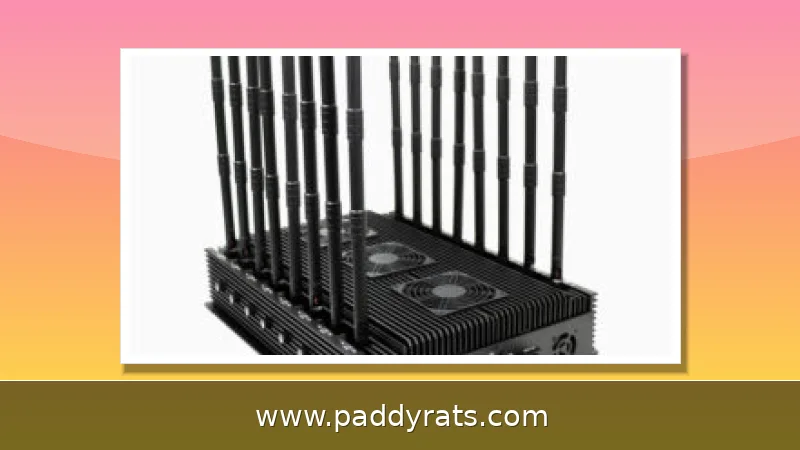
Jammers generally get grouped by what they're designed to silence, and those distinctions actually matter if you're trying to figure out why your signal dropped. Portable signal jammers are the small, battery-powered, cordless ones with limited range—the type you could slip into a pocket or toss in a bag. Drone signal jammers go after the control and GPS frequencies a UAV depends on, which forces the aircraft into a failsafe hover or sends it back home automatically. WiFi jammers flood the 2.4GHz and 5GHz bands so devices can't connect to a router at all. And cell phone jammers zero in on the 700MHz to 2100MHz cellular bands, cutting off calls, SMS, and mobile data.
There's also a whole commercial market selling this equipment, and vendors usually sort it by capability and price. That spread actually tells you something useful: how much power you're getting and how many bands the thing can block. The table below shows some representative examples pulled from vendor catalogs, with the prices exactly as the sellers list them.
One practical takeaway from this list is that jamming is not a single capability. A $520 4G phone jammer and a $2,399.99 drone jammer are solving different problems, and neither one is a general-purpose switch that turns off all wireless communication in an area. Buyers who assume otherwise tend to be disappointed by the actual coverage.
Are Cell Phone Jammers Legal?
No, not in the United States. Federal law prohibits selling, advertising, distributing, or operating cell phone jammers, and the FCC cites risks to public safety and emergency 911 calls as the central justification. Radio frequencies are protected under The Communications Act of 1934, and there are no exemptions for business, classroom, residence, or vehicle use. Penalties may include fines up to $11,000, seizure of the equipment, and imprisonment, and the agency maintains a public enforcement page documenting actions against vendors and operators.
Enforcement authority is narrower than many people assume. Local law enforcement lacks independent authority to use jamming equipment, while federal agencies may be authorized in limited cases. Even there, the bar is high because a jammer cannot distinguish between a criminal's phone and a bystander calling 911. Some countries, including Brazil, New Zealand, and Sweden, have considered or adopted narrow exceptions for correctional facilities, where blocking contraband phones is weighed against the same safety concerns.
The United Kingdom offers a useful comparison. Law enforcement, intelligence agencies, and prisons there have employed signal jammers since 2012 under strict regulation, which shows that legal operation is possible when a government controls both the equipment and the geography. For private individuals and businesses in the US, the answer remains a flat no, regardless of how annoying the nearby phone use may be.
How Can You Detect a Cell Phone Jammer?
Detection starts with symptoms rather than gadgets. The most common sign is dropped service on multiple devices in an area that normally has good reception, especially when the outage appears suddenly and affects different carriers at once. Other indicators include signal fluctuations, unusually high latency, packet loss, and reduced bandwidth on a connection that was previously stable. If a phone shows no bars while a laptop on wired Ethernet keeps working normally, that pattern points toward wireless interference rather than a network outage.
Consumer apps that claim to detect jammers are largely unproven, and I would not rely on one to make a decision about safety or security. A spectrum analyzer can identify interference and even show its signature, but interpreting the display requires specialized knowledge and calibrated equipment. For most people, the practical path is to document the pattern, note the time and location, and hand that record to someone with the tools to investigate.
Responding is a matter of escalation. Contact your wireless network provider first, since carriers monitor their own spectrum and can confirm whether a cell site is degraded. If the interference appears deliberate and persistent, report it to law enforcement or file a complaint with the FCC. For protection, remember that jammers only affect wireless devices, so a wired Ethernet connection continues to work when WiFi is jammed, and relocating may restore reception because the effective range is so short. Signal boosters amplify an existing signal but cannot overcome a jammer that is drowning it out.
Risks, Compliance, and Limitations
The most serious risk is the one regulators keep repeating: a jammer cannot tell who is calling. By silencing a band, it can prevent 911 calls and emergency alerts, delaying critical response for exactly the people who need it most. It also interferes with law enforcement communications, which is why agencies treat deliberate jamming as a public safety threat rather than a nuisance. That reasoning is the foundation of the US prohibition and of similar rules in much of the world.
Compliance is not optional and does not depend on intent. The Communications Act of 1934 protects the radio spectrum, and the FCC has not carved out exceptions for businesses, classrooms, residences, or vehicles. Anyone importing, marketing, or using these devices in the US is exposed to fines, equipment seizure, and criminal penalties. The roughly 830% rise in CBP seizures since 2021 shows that enforcement is active at the border as well as in the market.
The limitations are technical as well as legal. Jamming range is typically no more than about 30 square feet, so results vary wildly with distance, walls, and building materials. Jammers block voice, text, data, GPS, WiFi, and police radar, but they do not touch wired connections. Anyone evaluating this technology should treat it as a short-range, indiscriminate tool with serious legal exposure, not as a targeted solution to a specific problem.
The Bottom Line on RF Jamming
A cell phone jammer works by transmitting RF noise on the same frequencies a phone uses, overpowering the tower's downlink signal so the handset cannot decode it. The technique is simple in principle, cheap to build, and short in range, which is why it shows up in small rooms rather than across whole neighborhoods. Wide-band models extend the trick to GPS at 1575MHz and WiFi at 2.4GHz and 5GHz, and protocol jamming can take out the control channels that phones need just to register on a network.
None of that changes the legal picture. In the US, selling, advertising, distributing, or operating a jammer is illegal, with fines up to $11,000, equipment seizure, and imprisonment on the table, and there are no business, classroom, or residential exemptions. The United Kingdom allows tightly controlled use by law enforcement, intelligence agencies, and prisons, and a few countries have debated narrow exceptions for correctional facilities. For everyone else, the practical answer is detection and escalation: document the outage, call your carrier, and let the FCC handle the rest.
How to Recognize and Respond to Jamming
If you suspect jamming, work through the symptoms in order before assuming the worst. Start with a second device on a different carrier, then check whether wired Ethernet still works, and finally note the time, location, and duration. A pattern that repeats in the same spot at the same hours is far more telling than a single dropped call.
Once you have a record, escalate rather than improvise. Your carrier can check whether a cell site is degraded, law enforcement can investigate deliberate interference, and the FCC accepts complaints about jamming. Because effective range is so short, simply moving a short distance often restores service, and a wired connection sidesteps the problem entirely. Signal boosters help with weak coverage but cannot beat an active jammer.
Sources and Further Reading
The technical and legal details in this article draw on publicly available documentation from regulators, vendors, and reference publications, including the FCC's jammer enforcement page, Wikipedia's overview of mobile phone jammers, HowStuffWorks, Wilson Amplifiers, Cellbusters, Post Alarm Systems, Jammer Master, Electronics For U, and a Hindustan University PDF on signal jammers. Vendor pricing reflects published catalog listings at the time of writing.
Readers who want to go deeper can review the FCC enforcement materials for the legal framework, the reference circuit designs for the electronics, and vendor documentation for current band coverage and pricing. Because regulations and product lineups change, verify the current rules in your jurisdiction before drawing conclusions about what is permitted where you live.
Key Facts at a Glance
The table below condenses the most important numbers and rules covered above into a single reference. Use it as a quick check when you need the headline fact rather than the full explanation.
Frequently Asked Questions
How does a cell phone jammer work?
A cell phone jammer transmits radio frequency noise on the same frequencies used by mobile phones. This stronger signal collides with the tower's signal, so the phone cannot distinguish between them and locks onto the jammer instead, losing service. Jamming happens on the downlink, which is why the handset typically shows no signal bars.
What frequencies do cell phone jammers block?
Cell phone jammers target bands from 700MHz up to 2100MHz used by 2G, 3G, 4G, and 5G networks. Some also block GPS at 1575MHz and WiFi at the 2.4GHz and 5GHz bands. Wide-band full-spectrum models block several of these bands at once, while simpler units target only one frequency.
Are cell phone jammers legal?
No. In the United States and much of the world, it is illegal to sell, advertise, distribute, or operate cell phone jammers. The FCC cites risks to public safety and emergency 911 calls, and penalties can include fines up to $11,000, seizure of equipment, and imprisonment. There are no business, classroom, or residential exemptions.
How can I detect a cell phone jammer?
The most common sign is dropped service on multiple devices in an area with normally good reception, along with signal fluctuations, high latency, and packet loss. Apps claiming to detect jammers are largely unproven. Spectrum analyzers can detect interference but require specialized knowledge, so report persistent cases to your carrier or the FCC.