A signal jammer floods the same radio frequencies your phone, GPS, or WiFi uses with noise, drowning out legitimate signals. Here is how the hardware works, what bands it hits, and why selling or operating one is illegal in the US.
What Is a Signal Jammer and What Does It Do?
A signal jammer is a device designed to cut the connection between a receiver and whatever's sending it a signal — a cell phone linking up with a tower, a GPS unit pulling data from satellites, or a laptop hooked onto WiFi. It pulls this off by blasting radio frequency noise on the same frequencies the target device relies on, drowning out the legitimate signal on purpose. Engineers call the outcome a denial-of-service attack on the airwaves, since the point isn't to decode anything — it's just to make communication impossible.
The first thing most people notice is the practical fallout: the signal bars disappear, calls won't go through, texts stack up in the outbox, and mobile data slows to a crawl. What makes it so confusing is that your phone gives you no hint about what's really going on. Since jamming goes after the downlink—the tower-to-phone path—the handset has no way of knowing it's being targeted. From the phone's point of view, it has just lost coverage, so it does what it always does in a dead zone: hunts for a tower, pushes its transmit power higher, and keeps trying. I've seen this happen in testing environments, and the tell is how suddenly and evenly every device in a room drops at the exact same moment. In a real dead zone, phones fade out one at a time as people move around and signal strength shifts. Under a jammer, they all go quiet together—and they stay that way until the device is turned off or you step out of range.
It's worth separating a jammer from the devices it often gets mixed up with. A signal booster grabs an existing cell signal, amplifies it, and rebroadcasts it to fill in a dead zone. A repeater is similar — it catches a signal and passes it along so it can travel farther. A jammer does the exact opposite: rather than strengthening or relaying a signal, it floods the airwaves with RF noise until the original signal is drowned out and useless. That distinction isn't just technical trivia, either — it matters legally, since boosters are allowed in the US under certain FCC rules while jammers are banned outright. It also explains a quirk I'll get into later: a jammer can wipe out a booster's hard work, because no amount of amplification can save a signal that's being actively overpowered.
How Does a Signal Jammer Work Technically?
Fundamentally, jamming comes down to a signal-to-noise ratio problem. The jammer puts out an RF signal that's stronger than whatever is coming in from the nearest cell tower or base station. Once a phone picks up two signals on the same frequency, it has no way of knowing which one actually carries valid data — so it grabs the stronger one, and the weaker signal gets canceled out. The legitimate transmission is still physically floating around in the air, but the receiver can't separate it from the noise anymore. That's why people often call jamming a denial-of-service attack: nothing gets destroyed, yet the connection becomes completely useless. And since the interference targets the downlink signal — the tower-to-phone path — your phone just shows zero bars, even though the network itself is still running perfectly fine.
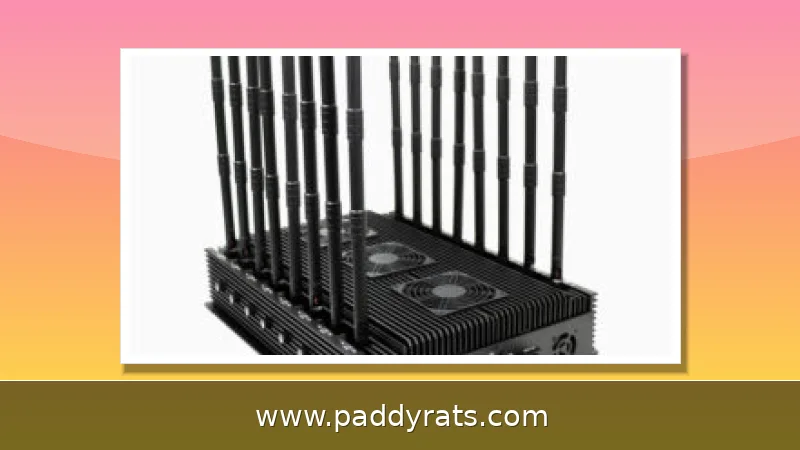
Any jammer that actually works needs three functional pieces. First, an RF signal generator creates the interfering waveform. Then a power amplifier pushes that signal up to a level that's strong enough to matter. Finally, antennas radiate it toward whatever you're trying to disrupt. On the circuit side, a basic cell phone jammer usually breaks down into three subcircuits: an RF amplifier, a voltage controlled oscillator that determines the interfering frequency, and a tuning circuit that adjusts where the noise actually lands. The oscillator is really the key part here, since it's what allows one device to sweep across an entire band instead of being stuck on a single frequency.
Most people are surprised by how power and frequency interact. Picture the RF output as a fixed budget: the wider the frequency range you're trying to cover, the more thinly that power gets spread across it. That's why a cheap handheld unit can't possibly blanket every cellular band at once. The 700MHz-to-2100MHz spread is just too broad for a pocket-sized device to flood with meaningful noise, so most low-cost jammers zero in on one or two bands and leave the rest alone. Range is just as unpredictable, and it has less to do with the spec sheet than with what's standing between the jammer and its target. Walls, hills, and dense materials like concrete and brick soak up RF energy before it ever reaches a phone, so the same device that quiets a room can barely make it across a parking lot. Open outdoor spaces let signals travel farther, while a basement or a steel-framed building can shrink coverage to a fraction of that. Even antenna orientation and the height of the unit matter more than most buyers expect.
What Frequency Bands Do Jammers Target?
Cell phone jammers aren't just generic noisemakers—they're tuned to the exact slices of spectrum that phones depend on. In practice, consumer models target the bands that carry 2G, 3G, 4G, and 5G traffic, a range that starts around 700MHz and stretches up to roughly 2100MHz, with 800MHz, 900MHz, 1800MHz, and 1900MHz filling in the space between. That spread is a big deal, because carriers rely on different bands depending on where you are: one network might run voice and data over 1900MHz in a city, while another leans on 800MHz to cover wide rural areas. And it doesn't stop at cellular traffic—jammers can also be aimed at GPS around 1575MHz, plus WiFi's 2.4GHz and 5GHz channels, which comes in handy if the goal is to kill location tracking or wireless internet along with calls. A wide-band, or full-spectrum, jammer takes things a step further by hitting several of these bands at once instead of locking onto a single frequency, which makes it much harder for a targeted device to just hop over to a cleaner channel.
The table below breaks down the most common targets and what each one tends to disrupt.
| Target service | Typical frequency | What gets blocked |
|---|---|---|
| Cellular low band | 700MHz, 800MHz, 900MHz | Voice, SMS, rural and long-range coverage |
| Cellular mid band | 1800MHz, 1900MHz, 2100MHz | 4G and 5G data, urban capacity |
| GPS | 1575MHz | Positioning, navigation, timing |
| WiFi | 2.4GHz and 5GHz | Local wireless networks and devices |
Each of these bands does a different job, so what actually breaks depends on which one the jammer goes after. Take out the low end — roughly 700MHz to 900MHz — and you kill wide-area coverage, the stuff that reaches suburban streets, rural highways, and the inside of buildings. Move the attack higher, into the 1800MHz to 2100MHz range, and the damage looks different: those bands carry the high-capacity data layers that urban users depend on all day, so calls might still go through while streaming, maps, and uploads grind to a halt. GPS is its own separate case at 1575MHz, and jamming it comes with a whole different set of risks. That timing signal quietly feeds everything from navigation apps to the time stamps on financial transactions, so losing it can cause problems that go well beyond a wrong turn.
| Target Band | Typical Use | What Jamming Disrupts |
|---|---|---|
| 700MHz–900MHz | Wide-area cellular coverage (2G/3G/4G/5G) | Broad coverage, including suburban, rural, and indoor service |
| 1800MHz–2100MHz | High-capacity data layers (2G/3G/4G/5G) | Urban data performance: streaming, maps, uploads |
| 1575MHz | GPS | Navigation and timing signals used by apps and financial transaction stamps |
What Are the Main Types of Signal Jammers?
Portable jammers are the pocket-sized option: they run on batteries, put out low power, and in open conditions without walls or other barriers, they can block data delivery out to roughly 15 meters. That short reach is a trade-off for their size and portability, since a battery can only push so much RF energy. Stationary jammers sit at the other end of the spectrum. They are larger, draw more power, and cover more ground, which is why they turn up in fixed installations, such as a building or a vehicle, rather than in someone's pocket. Drone jammers are a more specialized category. Instead of blanketing every band, they target the control and GPS bands a drone relies on, which forces the aircraft into a failsafe hover or an automatic return-to-home.
WiFi jammers zero in on the 2.4GHz and 5GHz bands that most home and office routers rely on, which is enough to knock a local network offline and take every connected device down with it. Cell phone jammers cast a wider net, cutting voice calls, SMS, and mobile internet all at once rather than picking off a single service. Range is the question people ask about most, and the honest answer is less impressive than the marketing suggests: consumer-grade devices typically cover no more than about 30 square feet, roughly the size of a small room. That figure is not fixed, though. It shifts with power output, the frequency range being targeted, and the physical environment—walls, furniture, and other obstacles all eat into the effective radius. There is also a trade-off baked into the design: the wider the frequency range a jammer tries to cover, the more power it needs to achieve the same reach, which is why compact, battery-operated units tend to be limited in both coverage and staying power.
In practice, the device you notice is rarely labeled. Jammers commonly look like a walkie-talkie, a cell phone, or a wireless router, which is exactly why casual observation is a poor detection method and why spectrum analysis is the reliable route.
What Jamming Techniques Are Used?
Jamming techniques fall into two broad families: noise techniques and repeater techniques. Noise jamming simply floods the spectrum, and it splits into three recognizable patterns. Spot jamming focuses all power on a single frequency, which is devastating against a fixed target but ineffective against frequency-agile radar that hops around. Barrage jamming spreads power across several frequencies at once, covering more ground but hitting any single frequency with less force. Sweep jamming shifts full power from one frequency to another in rapid succession, trying to catch a moving target.
Repeater jamming takes a smarter approach. Digital Radio Frequency Memory, or DRFM, captures incoming radar energy, alters it, and re-transmits it, which can create false targets and confuse the receiving system rather than simply drowning it. Other variants include deceptive jamming, which sends continuous false signals, reactive jamming, which stays silent until it detects a legitimate transmission and then fires, constant jamming, and protocol jamming, which goes after control channels instead of raw spectrum.
The choice of technique is really a trade-off between coverage, power efficiency, and how sophisticated the target is. A prison blocking contraband phones and a military unit spoofing radar are solving different problems with the same underlying physics.
Are Signal Jammers Legal and What Are the Penalties?
In the United States, it is illegal to sell, advertise, distribute, or operate cell signal jammers, and much of the world follows a similar stance. The FCC states plainly that jamming equipment poses serious risks to critical public safety communications, can prevent 911 and emergency calls, and interferes with law enforcement communications. The Communications Act of 1934 outlaws interference with authorized radio broadcasts, and that statute is the backbone of enforcement today.
Penalties are not symbolic. They include fines up to $11,000, seizure of the equipment, and criminal sanctions that can include imprisonment. Federal law enforcement use is authorized only under limited exceptions, and even then it is tightly controlled. The UK has employed signal jammers in law enforcement, intelligence work, and prisons since 2012 under strict regulation, while Brazil, New Zealand, and Sweden have considered narrow exceptions for correctional facilities.
One important nuance: cell phone detectors, which sense the presence of a handset rather than block it, are legal in the US. That distinction between detecting and jamming is where a lot of confusion starts. Anyone weighing a purchase should treat the legal question as settled rather than gray, because the enforcement record is real and the fines are not theoretical.
How Can You Detect a Signal Jammer and Respond?
The most common symptom is dropped service, especially when several devices lose coverage at the same moment in the same place. Apps that claim to detect jammers are largely unproven and, critically, they need a working signal to function, which is exactly what a jammer removes. Spectrum analyzers can detect interference properly, but they are not commonly available and require specialized knowledge to interpret.
If you suspect illegal jamming, the practical countermeasures are limited. You can relocate away from the source, switch frequency if your equipment allows it, or physically locate and disable the device. Contacting law enforcement or filing an FCC complaint is the correct escalation path. Signal amplifiers are not an effective defense, since a booster cannot amplify a signal that has already been drowned out.
The broader risks are worth naming: disruption of communication, impact on emergency services, financial losses from blocked transactions, potential data interception, and direct threats to public safety. Jamming can affect GPS, WiFi, and police radar at the same time, which is why regulators treat it as a public safety issue rather than a consumer convenience.
Where Are Signal Jammers Actually Used?
Military and law enforcement agencies use jammers to disrupt enemy communications and to prevent the remote detonation of improvised explosive devices, a use case where blocking a signal saves lives. Prisons and government offices deploy them to stop unauthorized communications inside controlled facilities, which is the context behind the correctional exceptions debated in several countries.
Schools and theaters occasionally use jammers to create quiet environments, though that practice sits uneasily against the emergency-call problem regulators keep raising. The common thread across all of these applications is that the operator accepts responsibility for the communications they are cutting off, including the ones that might be urgent. For everyone else, the technology is best understood as a regulated tool with real consequences, not a gadget to experiment with at home.
Do Signal Jammers Block Boosters and Other Gear?
Yes, and this surprises people who assume two pieces of RF hardware might cancel each other out. A signal booster works by amplifying an existing signal, but if a jammer has already buried that signal in noise, the booster has nothing clean to amplify. Any signal jammer is effectively also a signal booster jammer, because both depend on the same underlying signal being usable.
That is why buying a booster as a defense against jamming does not work. The booster sits downstream of the problem. The same logic applies to GPS and WiFi gear: if the incoming signal is overwhelmed at the antenna, no amount of downstream gain recovers it. The only reliable fixes remain distance, frequency change, or removing the interfering device through the proper legal channels.
What Should You Take Away From All This?
A signal jammer works by transmitting RF noise on the same frequencies a target device uses, lowering the signal-to-noise ratio until the receiver cannot separate valid data from interference. It hits the downlink, so the phone shows no bars rather than an error, and it can target cellular bands from 700MHz to 2100MHz, GPS at 1575MHz, and WiFi at 2.4GHz and 5GHz. The hardware itself is simple: a generator, an amplifier, and antennas.
The legal picture is the part that matters most for anyone reading this out of curiosity. Selling, advertising, distributing, or operating a cell signal jammer is illegal in the US and much of the world, with fines up to $11,000, equipment seizure, and possible imprisonment. If you run into suspected jamming, document what you observe, move away from the source, and route the report to law enforcement or the FCC rather than trying to counter it yourself.
How does a signal jammer work?
A signal jammer transmits radio frequency noise on the same frequencies used by target devices such as cell phones, GPS receivers, or WiFi gear. That noise overpowers the legitimate signal from towers or satellites and lowers the signal-to-noise ratio, so the receiver cannot distinguish valid data and communication is blocked.
Are signal jammers legal in the United States?
No. It is illegal to sell, advertise, distribute, or operate cell signal jammers in the United States and much of the world. The FCC cites risks to public safety communications and 911 calls, and the Communications Act of 1934 outlaws interference with authorized radio broadcasts. Penalties include fines up to $11,000 and possible imprisonment.
Does a signal jammer block a cell phone signal booster?
Yes. A signal jammer interferes with cell phone signal boosters. Boosters work by amplifying an existing signal, but if that signal is blocked by a jammer, the booster cannot function. Any signal jammer is effectively also a signal booster jammer, so a booster is not a viable defense.
How can I detect a signal jammer?
The most common symptom is dropped service across multiple devices at once. Apps claiming to detect jammers are largely unproven and need a working signal to run. Spectrum analyzers can detect interference but are not commonly available and require specialized knowledge. If you suspect illegal jamming, contact law enforcement or file an FCC complaint.
Frequently Asked Questions
How does a signal jammer work?
A signal jammer transmits radio frequency noise on the same frequencies used by target devices such as cell phones, GPS receivers, or WiFi gear. That noise overpowers the legitimate signal from towers or satellites and lowers the signal-to-noise ratio, so the receiver cannot distinguish valid data and communication is blocked.
Are signal jammers legal in the United States?
No. It is illegal to sell, advertise, distribute, or operate cell signal jammers in the United States and much of the world. The FCC cites risks to public safety communications and 911 calls, and the Communications Act of 1934 outlaws interference with authorized radio broadcasts. Penalties include fines up to $11,000 and possible imprisonment.
Does a signal jammer block a cell phone signal booster?
Yes. A signal jammer interferes with cell phone signal boosters. Boosters work by amplifying an existing signal, but if that signal is blocked by a jammer, the booster cannot function. Any signal jammer is effectively also a signal booster jammer, so a booster is not a viable defense.
How can I detect a signal jammer?
The most common symptom is dropped service across multiple devices at once. Apps claiming to detect jammers are largely unproven and need a working signal to run. Spectrum analyzers can detect interference but are not commonly available and require specialized knowledge. If you suspect illegal jamming, contact law enforcement or file an FCC complaint.