Real-world RF jamming cases show how a single jammer can spill across borders, degrade cellular and GPS performance, and threaten public safety. This case study walks through how jamming works, what the data shows, and how detection and mitigation actually perform.
What Is Signal Jammer Interference?
Signal jammer interference is what happens when a device puts out enough RF energy to drown out the legitimate signals a receiver is trying to pick up. There's no need to crack encryption or fake a network—the jammer just raises the noise floor on the same frequency until the weaker signal from a cell tower, satellite, or radio system can't be read anymore. Pretty much any wireless link is fair game here: cellular, GPS/GNSS, land mobile radio, Wi-Fi. A low-powered jammer might only cause some voice fading, dropped packets, or failed connection attempts, but crank up the power and you can wipe out coverage across a whole neighborhood.
The vocabulary here is wider than it first seems, and it's worth having it down before you sit with an incident report in front of you. Analysts draw a line between RF jamming and radio frequency jamming—that's the act itself—and jamming attacks, which are deliberate, and anti-jamming defenses, the countermeasures. Then there are the technique labels: noise jamming, deceptive jamming, barrage jamming, spot jamming, reactive jamming, and proactive jamming. Each one describes a different way of denying or corrupting a signal. Here's the part people tend to miss: even when the jamming is intentional, its side effects usually aren't. A device aimed at one target doesn't politely stop at the property line—it can drag down dozens of surrounding networks at once. That spillover is the central lesson of the prison case below, and it's why regulators treat jamming as a public safety matter rather than a private spat between neighbors.
How Does RF Jamming Work?
At its most basic level, a jammer is nothing more than a radio transmitter with one job: blasting a high-powered RF signal on the exact same frequency that the target communication is using. The result is that the legitimate signal from a cell tower or satellite gets buried, or "drowned out," by the interference. Picture trying to have a conversation while someone runs a leaf blower right next to you—your voice is still there, but whoever's listening can't pick it out from the noise. That's basically what happens to phones, GPS units, and Wi-Fi devices under jamming. They lose the ability to decode the weaker legitimate transmission, so calls drop, data stalls, GPS positioning fails, and Wi-Fi connections fall apart. Under the hood, it all comes down to the signal-to-noise ratio. Once the interfering energy hitting the receiver outweighs the wanted signal by a wide enough margin, demodulation just breaks down—and it doesn't matter how strong the source signal is at the tower or satellite end. That's why even a fairly modest jammer can knock out coverage across a wide area, and why no wireless network—cellular, GPS/GNSS, LMR, or Wi-Fi—is really safe from this kind of attack.
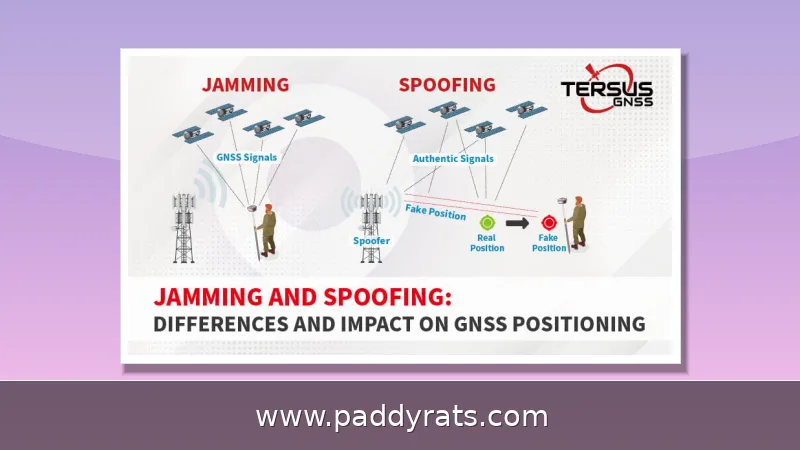
Different techniques trade coverage for precision, and that trade-off determines both how much damage a jammer does and how difficult it is to track down. Noise jamming is the bluntest tool in the box: it floods the target frequency with continuous noise, raising the noise floor until the receiver simply can't pick out the legitimate signal anymore. Deceptive jamming is sneakier—instead of drowning the signal, it sends misleading signals that trick a device into trusting false information. Barrage jamming spreads noise across a wide frequency range to disrupt several channels at once, while spot jamming pours all its energy into one specific frequency for a deeper, more focused hit. Reactive jamming works differently altogether. It senses active transmissions and only emits interfering signals when traffic actually shows up. That on-demand behavior disrupts packet delivery while keeping the jammer's own transmission time to a minimum, which makes it far harder to locate than a jammer that just broadcasts nonstop.
| Technique | How it works | Typical effect |
|---|---|---|
| Noise jamming | Continuous noise on the target frequency | Raises noise floor, blocks decoding |
| Deceptive jamming | Misleading signals that confuse the device | False data, positioning errors |
| Barrage jamming | Noise across a broad frequency range | Multiple channels disrupted at once |
| Spot jamming | Targets one specific frequency | Narrow but complete channel loss |
| Reactive jamming | Senses active transmissions, then interferes | Packet delivery disrupted, low transmit time |
Frequency hopping and spread spectrum aren't just buzzwords in jammer design—they show up in the circuits and software of the jammers themselves, and they're also the foundation for a lot of the defenses against them. The basic idea is simple: if a legitimate system hops between frequencies faster than a jammer can track it, or spreads its energy across a wide band, the jammer suddenly has to cover way more spectrum to keep up. That's a tall order, and it's exactly why modern anti-jamming efforts have shifted away from trying to shield one single channel. Instead, the focus is on making the whole link resilient across many channels at once, so that even if a jammer manages to disrupt part of the signal, the communication keeps flowing.
Case Study: Mexican Prison Jammer Affecting US Mobile Networks
Mexican prison officials used a jammer to block inmates from using cell phones — a purpose that's actually legal in many places. The problem was the prison's location: it sat close to the US border, and the jamming signal didn't stay inside the walls. It leaked across the line and seriously degraded US mobile network operators on the American side. That's the spillover problem in a nutshell. A containment tool pointed inward turned into an external source of interference for commercial networks serving an entirely different country.
Even after national regulatory bodies got involved and the jammer's transmit power was turned down, US mobile network operators were still reporting degraded performance at a lot of cell sites. That caught people off guard, since the assumption was that a weaker signal would just fade out at the border. But in reality, simply lowering the power didn't fix anything, because what really determined which receivers got hit wasn't raw wattage—it was the interference geometry: where the tower sits, where the prison transmitter sits, and how the two line up across the border. ISCO's solution was brought in at that point, and performance metrics like the number of connected users, downlink speed, and throughput went up by more than 100%. What that tells us is that mitigation can bring service back even when the source of the interference is still sitting right there.
| Stage | Action taken | Reported result |
|---|---|---|
| Initial deployment | Prison jammer blocks inmate cell phones | Signal escapes border, US MNOs degraded |
| Regulatory response | Transmit power reduced with national regulators | Degradation persisted at many cell sites |
| Mitigation | ISCO anti-jamming solution deployed | Connected users, downlink speed, throughput up over 100% |
The order in which you tackle this problem really matters, and anyone planning a similar deployment should pay attention. Simply turning down the jammer's transmit power is a blunt fix: it can weaken the intended effect inside the prison while still leaving cross-border damage on the table, since even a reduced signal can degrade cell sites on the US side. Network-side mitigation works on a different principle. Rather than going after the source, it targets the interference at the receiver, which means it can be tuned and refined without undermining the facility's own goal of blocking contraband phones. That difference is exactly why prison jamming occupies such an odd legal space. It's still one of the few lawful uses of jammers, yet it demands coordination with regulators and mobile operators across the border, because RF signals don't stop at a fence line.
GPS Jamming Efficacy: Ground-to-Ground Interference Findings
A January 2026 study — *An Empirical Analysis of GPS Jamming Efficacy: A Case Study on Ground-to-Ground Interference and Receiver Response* — tested a portable jammer in a controlled ground-to-ground setup to see how GPS reception really holds up under attack. The pattern was hard to miss: the closer a receiver got to the jammer, the higher the RF noise floor climbed, and the worse the receiver performed. That correlation is a big deal, because it recasts GPS disruption as a question of degree rather than a simple on-or-off failure. Distance from the source and local RF conditions both shape what happens, which explains a familiar real-world puzzle: two people standing just a block apart during the same jamming event can come away with totally different stories — one loses their position fix altogether, while the other hardly notices anything.
| Variable | Observed Effect |
|---|---|
| Proximity to jammer | Closer distance correlates with greater performance degradation |
| RF noise floor | Increases as the receiver approaches the jammer |
| Receiver performance | Degrades in correlation with proximity and rising noise floor |
Related research has widened the picture considerably, spanning different wireless technologies and new ways of spotting interference. One line of work looked at an intelligent jammer aimed at LTE mobile networks, testing downlink-band jamming against factors like mobile phone sensitivity, signal noise, and signal level strength — a reminder that how badly a device suffers depends as much on the receiver as on the jammer. A 2026 study on real-world jammer and spoofer localization using a low-cost receiver pushed things closer to field conditions, running simple scenarios with a displaced jammer alongside car-based jamming and spoofing across different receiver setups. And research on the practical realization of reactive jamming attacks on Long Range showed how attackers can identify active transmissions and emit interfering signals at just the right moment to disrupt packet delivery, rather than jamming blindly.
| Study focus | Setting | Key finding |
|---|---|---|
| GPS jamming efficacy | Controlled ground-to-ground, portable jammer | Proximity correlates with higher noise floor and receiver degradation |
| LTE downlink jamming | Mobile network experiments | Sensitivity, noise, and signal strength drive impact |
| Jammer and spoofer localization | Low-cost receiver, car-based tests | Displaced and mobile sources can be located in varied setups |
| Reactive jamming on Long Range | Packet delivery attacks | Interference triggered only on active transmissions |
Detection research has been shifting toward real-time methods, and two recent efforts show how far that work has come. A 2025 study applied windowing alongside hybrid deep learning and machine learning models to catch deception and suppression jamming in Ublox-M8T receivers, essentially teaching the receiver to flag interference as it happens rather than after the fact. A separate 2026 network-based GNSS jamming prediction effort took a wider view, processing data from networks of hundreds of receivers over several months. That long look revealed jamming patterns consistent with interference from road users, appearing on daily or other cycles rather than as a constant, targeted assault. Those cyclic patterns matter a great deal in practice. When interference repeats on a predictable schedule, operators can treat it as recurring local noise and avoid overreacting. When it does not follow any cycle, that is a strong hint of a deliberate, persistent attack worth escalating.
Jamming Techniques and Interference Analysis in the Field
Field measurements repeatedly show that the interference range of a jammer depends heavily on the receiver architecture, not just the jammer's rated power. A transportation-focused interference analysis from October 2011 concluded exactly that, and the finding still holds for modern receivers with better filtering and different antenna designs. A separate demonstration placed a 10W jammer in a city center and documented its impact on a local cell, a scenario that mirrors how a modest, commercially available device can degrade service for many users at once.
Contraband devices inside facilities create their own measurement challenges. An NTIA technical report, Emission Measurements of a Contraband Wireless Device, analyzed a jammer's potential for harmful interference to licensed radio services outside the targeted prison cell. That framing is important: the question is not whether the jammer works inside its intended boundary, but how much energy leaks into licensed spectrum used by neighbors, emergency services, and commercial operators.
Detection and mitigation tools increasingly rely on the RF signature of the interfering signal. ISCO offers real-time anti-jamming and interference mitigation for cellular networks, with algorithms that automatically detect, log, and cancel jamming signals based on their RF signature. Anti-jamming also protects satellite signals for reliable navigation and communication, where even brief disruption can corrupt timing and positioning downstream. Signal Jammer Market Analysis, Size, and Forecast 2024 noted that frequency hopping and spread spectrum techniques are employed in jammer circuits and software, which means defenders must plan for interference that adapts rather than sits on one frequency.
Real-World Jamming Incidents and Statistics
Enforcement data paints a picture of rapid growth in jamming activity. Seizures of jamming equipment jumped nine-fold between 2021 and 2025, and Homeland Security reported an 830% spike in jammers seized by Customs and Border Protection since 2021. In October 2024, the FBI charged ten individuals in connection with a $2.5 million crime spree in California that involved more than a dozen bank heists tied to a criminal gang. Those numbers reframe jamming from a technical curiosity into an operational tool for organized crime.
Consumer access is part of the problem. In March 2024, the FCC investigated jammers sold online, and an NBC News report found jammers for sale on vendor websites and marketplaces, with Amazon among the retailers under investigation. Regulatory pressure has not eliminated availability, and the FCC continues to enforce jammer rules because interference from RF jammers can prevent people from making 911 calls or receiving emergency alerts.
| Indicator | Reported figure | Time frame |
|---|---|---|
| Jamming equipment seizures | Nine-fold increase | 2021 to 2025 |
| Customs and Border Protection seizures | 830% spike | Since 2021 |
| California crime spree | $2.5 million, ten charged | October 2024 |
| First responders affected | 31% report interference | SAFECOM survey, July 2024 |
Public safety communications are directly in the blast radius. Thirty-one percent of first responders reported being affected by interference, and in the SAFECOM Nationwide Survey, frequency interference ranked third among factors affecting first responder communications in July 2024. A DHS survey of 4,933 first responders found 9% report frequency interference affects communication to a great extent, while 22% say it affects communication to some extent. Jammers may interfere with public safety communications, leaving responders without vital communications and situational awareness during the incidents when they are needed most.
Legal, Regulatory, and Policy Dimensions
Jamming is illegal and often malicious, used by bad actors with criminal intent rather than by legitimate operators. The FCC enforces jammer rules, and its enforcement actions target both sellers and users. One of the few legal uses of jammers is in prisons, where blocking contraband cell phones serves a clear institutional purpose. Even that exception comes with obligations, as the Mexican border case demonstrated, because escaped energy can harm licensed services in another country.
Policy experimentation is expanding. Canada allowed a pilot project to deploy and evaluate jamming technology in federal prisons in March 2025, signaling that governments are willing to test controlled deployments while regulators watch the spillover effects. The tension is structural: the same physics that makes jamming effective inside a facility makes it dangerous outside one, and no amount of paperwork changes the propagation of RF energy.
For network operators, the practical takeaway is that legal and technical defenses must advance together. Detection systems that log jamming signatures create the evidence regulators need, while mitigation systems keep service running during an event. Operators who wait for a regulatory resolution before investing in detection will spend that time explaining outages to customers and public safety agencies alike.
Jamming Detection, Mitigation, and Defenses
Defense starts with recognition. Jamming indicators include the inability to communicate in areas where there is typically good radio or cell coverage, and the inability to communicate in areas where communication is normally reliable. When those symptoms appear across multiple users and devices at the same time, the cause is more likely external interference than a handset fault. Documenting the time, location, and affected services turns a vague complaint into actionable data for an operator or regulator.
Technical mitigation combines network-side and device-side approaches. ISCO's real-time anti-jamming and interference mitigation for cellular networks automatically detects, logs, and cancels jamming signals based on their RF signature, which restores performance without requiring the jammer to be shut down first. Anti-jamming protects satellite signals for reliable navigation and communication, and frequency hopping plus spread spectrum techniques are used in jammer circuit and software design, so defenders must assume an adaptive adversary. Detection research using windowing and hybrid models, along with network-based GNSS jamming prediction, points toward earlier warning and faster isolation of affected receivers.
| Defense layer | Approach | What it protects |
|---|---|---|
| Detection | RF signature monitoring, windowing and hybrid models | Early warning, forensic logging |
| Network mitigation | Automatic detect, log, and cancel algorithms | Cellular connected users, speed, throughput |
| Signal resilience | Frequency hopping and spread spectrum | Satellite navigation and communication links |
| Policy | FCC enforcement, prison pilot programs | Public safety spectrum, legal boundaries |
The most durable defenses treat jamming as a spectrum-management problem rather than a single-device problem. That means monitoring continuously, correlating anomalies across many receivers, and maintaining mitigation capacity that can be activated within minutes. The Mexican prison case showed that mitigation can more than double key performance metrics even when the interfering transmitter stays on the air, which is the realistic scenario most operators will face.
Frequently Asked Questions
How does a signal jammer cause interference?
A jammer transmits a high-powered RF signal on the same frequency as the target communication, drowning out the legitimate signal from cell towers or satellites. Receivers can no longer decode the weaker legitimate transmission, so calls, data, GPS, and Wi-Fi fail. The effect is driven by signal-to-noise ratio, not by breaking encryption.
What happened in the Mexican prison jamming case study?
Mexican prison authorities used a jammer to block inmate cell phone use. The prison sat near the US border, and the jamming signal escaped, degrading US mobile network operators' performance. Reducing transmit power did not fix it; ISCO's anti-jamming solution improved connected users, downlink speed, and throughput by over 100%.
Is jamming illegal?
Yes. Jamming is illegal and often malicious, used by bad actors with criminal intent. The FCC periodically cracks down on jammer sales, and seizures of jamming equipment jumped nine-fold between 2021 and 2025. One of the few legal uses is in prisons, where blocking contraband phones serves a clear institutional purpose.
What are the main RF jamming techniques?
Common techniques include noise jamming, which floods the target frequency with continuous noise; deceptive jamming, which sends misleading signals that confuse the device; barrage jamming, which spreads noise across a broad frequency range to disrupt several channels; and spot jamming, which targets one specific frequency. Reactive jamming interferes only when it senses active transmissions.