Federal law bans operating, selling, or marketing signal jammers in the US, and the FCC says there is no consumer exception for homes, cars, classrooms, or businesses. Here is how jammers work, what penalties look like, and how to report one.
What Are the FCC Rules on Signal Jammers?
The FCC doesn't really do subtle on this one. Its stance on jammers is about as blunt as a federal agency gets: there's no legal path for consumers, period. Under Section 302(b) of the Communications Act and Section 2.803 of the Commission's rules, you can't manufacture, import, sell, offer for sale, or ship devices that don't comply with FCC rules. And since a jammer's whole purpose is to interfere with authorized radio communications, it can never get an equipment authorization to begin with. That's the logic running through every FCC jammer enforcement action I've looked at: the problem isn't just how the device gets used, it's that the device can't be approved by design.
The FCC's latest public warning is blunt: there are no exceptions for using a jammer in a business, a classroom, a home, or a car. That warning is worth repeating, because plenty of people still believe that owning the property means you own the airwaves above it. You don't. Radio frequencies belong to the public, and the FCC controls them no matter whose building the transmitter happens to be sitting in. As for vendors who sell jammers to US customers and then slap on a disclaimer telling buyers to "check local law"—that trick doesn't get them off the hook either, at least not the way the Commission reads its own rules.
Which Laws Make Jammers Illegal in the US?
Jamming is illegal under several overlapping statutes and rule sections, not just one. Section 333 of the Communications Act bans willful or malicious interference with the radio communications of any station licensed or authorized under the Act. Section 301 says you need a valid FCC authorization or license to operate radio transmitting equipment. And Section 302(b), along with Section 2.803 of the Commission's rules, prohibits manufacturing, importing, selling, offering for sale, or shipping devices that don't comply with FCC rules.
Taken together, these provisions cover the entire chain: the person operating the jammer, the seller, the importer, and the manufacturer. Under federal law, it's illegal to operate, market, or sell any kind of jamming equipment—whether it blocks cellular and PCS services, police radar, GPS, or Wi-Fi. The table below breaks down each provision and what it actually prohibits, drawing on the FCC's own enforcement guidance.
| Legal Provision | What It Prohibits | Who It Reaches |
|---|---|---|
| Section 333, Communications Act | Willful or malicious interference with authorized radio communications | Operators of jamming devices |
| Section 301, Communications Act | Operating radio transmitting equipment without FCC authorization or license | Operators |
| Section 302(b) and Rule 2.803 | Manufacture, import, sale, offer for sale, or shipment of non-compliant devices | Manufacturers, importers, retailers |
| FCC Enforcement Advisory 2011-03 (DA 11-249) | Marketing and sale of jammers to US buyers | Online retailers and distributors |
The Communications Act of 1934 is where all of this traces back to, and it's worth pausing on just how old that framework really is. The FCC's broad ban on signal jamming was written over 50 years ago — well before anyone had a smartphone in their pocket. In a paper published on October 31, 2022, Data Catalyst made the case that Congress and the FCC should take another look at those rules and carve out a limited right to block mobile signals in certain private spaces at certain times. So far, though, that argument hasn't gotten much traction with the Commission, which still treats the prohibition as absolute for anyone who isn't a federal user.
How Do Cell Phone Jammers Work?
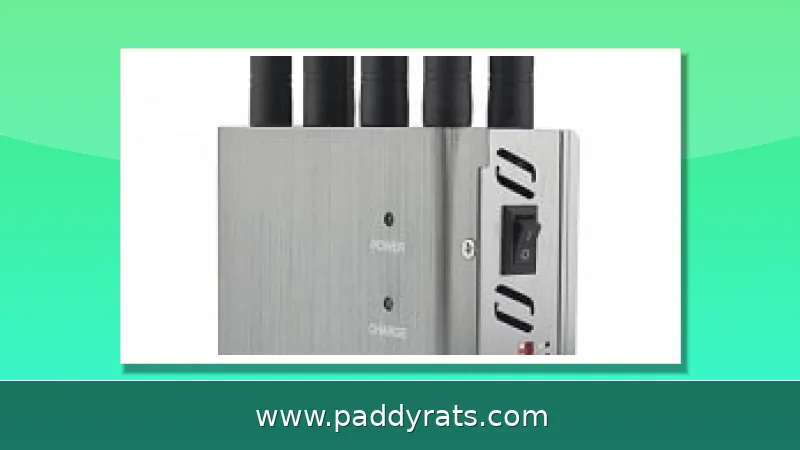
Here's how a jammer actually pulls it off: it blasts an RF signal on roughly the same frequency as the nearest cell tower, but stronger. Your phone ends up hearing two signals on that frequency at once, and it has no way to tell them apart, so it latches onto the stronger one while the weaker one gets wiped out. The key detail is that this happens on the downlink signal, which means your phone can't receive anything from the tower at all and ends up showing zero bars. That's exactly why a jammed phone looks just like a phone sitting in a dead zone, and why most people have no idea they're being jammed while it's happening.
Simpler jammers only take out a single frequency, which is enough to trick a phone into thinking there's no service at all. Others are built to sweep across multiple bands, so they can knock out several carriers simultaneously. Either way, what you end up with is basically a localized denial-of-service attack on radio communications — and that's exactly how the FCC sees it. The range tends to be pretty small, usually no more than about 30 square feet for low-power consumer models, so sometimes just moving a few feet is enough to get your signal back. Boosters won't save you here. A jammer will interfere with a cell phone signal booster, since a booster can only amplify a signal that already exists — and if that signal is being blocked, there's nothing for it to work with.
Why Are Jammers Illegal in the US?
Jammers don't just block one phone — they overpower the cellular signal on that frequency altogether. That means a single device can knock out 911 calls, get in the way of everyday communication and public safety messages, and even disrupt law enforcement communications. This public safety angle is really the core of why the law treats them so harshly. A jammer isn't polite enough to stop at your property line, either. RF energy spreads, so a device powerful enough to kill reception in one room can easily degrade a neighbor's call — or interfere with an emergency response happening nearby.
The Communications Act of 1934 gives legal protection to radio frequencies, and the FCC has never shown any interest in making exceptions for ordinary consumers. Its enforcement advisory is about as clear as it gets: jammers can never be authorized because they are designed to interfere with authorized radio communications. I've seen vendors try to argue that their device is "passive" or that it only blocks incoming signals, but the downlink mechanism I just described is precisely the kind of interference the statute is aimed at. No technical gimmick gets a jammer around that.
What Penalties Apply for Using or Selling a Jammer?
Violations are punishable by fines of up to $112,500 per violation, according to the FCC. Penalties may also include seizure of the unlawful equipment and criminal sanctions including imprisonment. Retailers and manufacturers must immediately stop marketing jammers in the US, decline to sell or ship jamming devices to US addresses except for permitted US government sales, and ensure that US-manufactured jammers are for export only. Disclaimers that place sole responsibility on buyers do not absolve manufacturers or retailers of liability.
Enforcement history shows the Commission is willing to act against sellers, not just users. In Enforcement Advisory No. 2011-03, dated February 9, 2011 (DA 11-249), the FCC Enforcement Bureau issued seven citations to online retailers, launched a proceeding to revoke the equipment authorization for a text stopper, and initiated a $25,000 forfeiture proceeding against Phonejammer.com. The Bureau has also issued a $22,000 forfeiture that included a $10,000 fine for operation without authorization and a $7,000 fine, among other amounts. Third-party sources such as Cellbusters cite fines of up to $11,000 in some cases, which is a useful reminder that figures vary by action and source. The table below summarizes the penalty landscape.
| Penalty Type | Detail |
|---|---|
| Monetary fines | Up to $112,500 per violation under FCC guidance |
| Equipment seizure | Unlawful jamming devices can be seized |
| Criminal sanctions | May include imprisonment |
| Retailer obligations | Stop marketing, selling, or shipping jammers to US addresses except permitted government sales |
| Enforcement examples | Seven citations, a revocation proceeding, and a $25,000 forfeiture action (DA 11-249, 2011); a $22,000 forfeiture including a $10,000 and a $7,000 fine |
Are There Any Legal Exceptions for Jammers?
The federal government's own spectrum use is not regulated by the FCC, so jammer prohibitions do not apply to federal agency use. Federal law enforcement use of cell phone jammers is authorized only in limited exceptions. That carve-out is narrow and does not extend to state, local, or private parties. The FCC has issued a specific warning that jammer use by public and local law enforcement is illegal, which should settle the question for anyone assuming a badge creates an exemption.
Outside the US, the picture is more varied, and I mention it only to show that these rules are policy choices rather than physical constants. The UK has employed signal jammers since 2012 by law enforcement, intelligence agencies, and jails under strict regulation. Brazil, New Zealand, and Sweden have considered exceptions for correctional facilities. Meanwhile, cell phone signal detectors in correctional facilities are legal and common in the US, because detecting interference is not the same as causing it. Indiana has moved in the opposite direction from any liberalization, criminalizing unauthorized jamming devices under Indiana Code 35-45-2-6 as of 2025. The 2025 Indiana General Assembly passed Senate Bill 26. Use of a signal jamming device is a Level 6 felony, elevated to a Level 5 felony if used to disrupt critical infrastructure or public safety agency communications, and possession with intent to use is a Class A criminal misdemeanor. Exceptions apply to law enforcement officers, correctional authorities, and governmental entities acting within scope.
How Do You Detect and Report a Jammer?
A dropped signal is the first sign of jamming, but bad connections can also come from faulty equipment, physical obstructions, or lawful devices on the same frequencies. Apps claiming to detect jammers are largely unproven, and I would not rely on one to make a legal accusation. Spectrum analyzers can detect jammers by analyzing frequencies, but they are not commonly available and require specialized knowledge to interpret. In most cases, the first practical step is to contact your wireless network provider, which can check for outages or interference reports in your area.
If you suspect authorized communications are being jammed, report it to law enforcement or file a complaint with the FCC at www.fcc.gov/complaints. The FCC Enforcement Bureau handles jammer-related complaints through that online form. Because jamming can block 911 calls, treat any suspected device as a safety issue rather than a nuisance, and avoid confronting the operator yourself. Document what you observed, when reception failed, and where you were standing, since that detail helps investigators determine whether a device is actually present.
Can a Signal Booster Fix Jamming?
No. A signal jammer will interfere with a cell phone signal booster, and cell signal amplifiers are not an effective defense against jammers. Any signal jammer is also a signal booster jammer, because both depend on the same downlink signal path. If the signal is blocked, the booster has nothing to amplify. This trips up a lot of people who buy a booster expecting it to punch through interference; the booster can only strengthen a signal that already exists.
The practical workaround is distance, not hardware. Since jamming range is usually no more than about 30 square feet for typical low-power devices, relocating within a building may restore reception. If reception returns sharply when you move a short distance and fails again when you return, that pattern is consistent with a localized jammer rather than a network problem. Report the pattern to your carrier and to the FCC rather than trying to counter-jam, which would create a second violation.
Frequently Asked Questions
Are cell phone jammers legal in the United States?
No. Federal law prohibits operating, marketing, or selling any jamming equipment that interferes with authorized radio communications. Jammers can never receive FCC authorization because they are designed to interfere, so they cannot be marketed in the US except for limited authorized US government use.
What penalties can you face for using or selling a jammer?
Violations are punishable by fines of up to $112,500 per violation, seizure of the unlawful equipment, and criminal sanctions including imprisonment. The FCC Enforcement Bureau has issued citations, revocation proceedings, and forfeiture actions against jammer retailers.
How do I report a cell phone jammer to the FCC?
File a jammer-related complaint with the FCC Enforcement Bureau using the FCC's online complaint form at www.fcc.gov/complaints. You can also contact your wireless network provider and law enforcement if you suspect authorized communications are being jammed.
How does a cell phone jammer actually work?
A jammer emits a radiofrequency signal stronger than the nearest cell tower's signal but on a similar frequency. The phone cannot distinguish the two signals, picks the stronger one, and the weaker cancels out, disrupting the downlink so no signal bars appear.