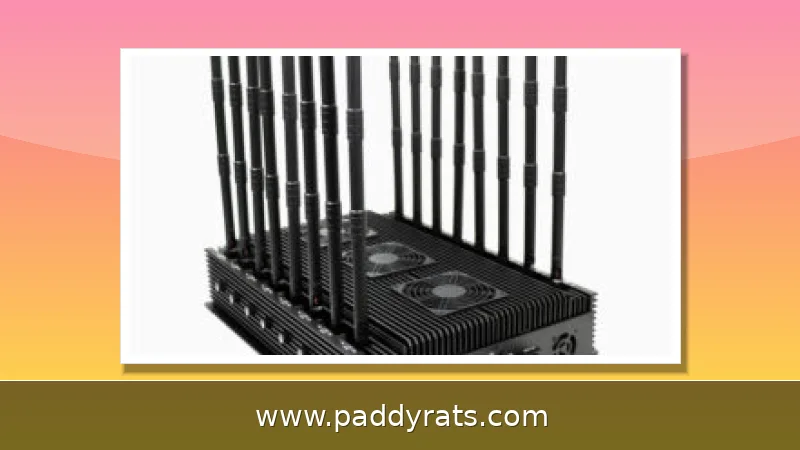
A network jammer is a device that deliberately floods radio frequencies with noise to cut off wireless communication. Here is what jammers block, how they work, and why they are illegal in the US and Canada.
What Is a Network Jammer?
A network jammer — sometimes called a signal jammer — is a device that intentionally sends out radio signals to mess with communication systems, cutting off the transmission or reception of data. Simply put, it severs the connection between a device and whatever signal source it relies on. Take a cell phone jammer: it blocks the link between a cell tower and a mobile phone, which is why the handset ends up showing no bars and can't make or receive calls.
Regulators, though, use a much broader definition. Under that view, a radiocommunication jammer is any device—or combination of devices—that transmits, emits, or radiates electromagnetic energy and is capable of interfering with, disrupting, or blocking radiocommunication signals and services. That wording is deliberate, since it doesn't just cover a handheld box with antennas. It also takes in equipment that sends spoofed signals to a drone or its controller.
There's a surprisingly long list of terms for these devices, and marketers tend to pick the gentler-sounding ones. You'll run into cell jammer, mobile phone jammer, signal blocker, signal silencer, GPS jammer, text stopper, radio jammer, and WiFi jammer, just to name a few. They're often pitched as privacy protection tools, drone deterrents, or anti-surveillance gear, which makes them come across as pretty harmless. In reality, though, it's all the same technology underneath.
How Do Signal Jammers Work?
Jammers work by transmitting on the exact same radio frequencies that the devices they're targeting use. A cell phone jammer, for example, puts out a radiofrequency (RF) signal that's stronger than whatever's coming from the nearest cell tower, and it does this on frequencies close to the ones cellular carriers rely on. When a phone picks up two signals on the same frequency, it has no way to tell them apart. So it grabs the stronger one, and the weaker signal basically gets wiped out.
Cell phone jamming typically goes after the downlink signal — that's the path from the tower to your handset. Once the phone can't pick up what the tower is sending, you'll see zero signal bars and you won't be able to connect at all. Security researchers put this in the denial-of-service category, the same bucket as network floods and other attacks that go after a system's availability rather than its data.
The complexity really varies from one device to the next. A basic jammer might only block a single frequency, but that alone is often enough to convince a phone that there's no service at all. More advanced models sweep across multiple bands instead. At its core, jamming is just the release of noise on the same frequency, and the wider the range you're trying to cover, the more power the jammer needs to keep working effectively.
Smart active jamming works differently. Rather than flooding the entire spectrum with noise, it focuses its energy only on the specific frequency ranges where it picks up a signal. That approach makes the jammer more efficient and much harder to spot, which is part of why detecting one in real-world conditions can be so tricky.
What Devices and Signals Can Jammers Affect?
A mobile signal jammer doesn't just take out voice calls and texts. Depending on which bands it covers, it can also mess with GPS, WiFi, and even police radar. WiFi jammers, for example, push out strong RF signals on the same bands your local network uses—think 2.4 GHz and 5 GHz—flooding the air with digital noise that keeps wireless devices from communicating with a router or internet access point.
One big limitation is that jammers only mess with wireless connections. If a computer or smart device is plugged straight into the router with an Ethernet cable, it keeps working like nothing happened, since that traffic never goes through the air. That one detail explains why you might see someone in a jammed area still browsing the internet while everyone else on WiFi is completely offline.
Signal boosters won't solve the problem either. A jammer will also mess with cell phone signal boosters, since a booster can only amplify a signal that's already there — and once that signal gets blocked, there's nothing left to amplify. In other words, amplifiers aren't a reliable defense against jammers.
The table below breaks down the signals jammers typically go after and what you'd actually notice if each one got hit.
What Was the Original Purpose of Jammers?
Jammers were developed for military and law enforcement use, originally to counter threats such as cell phone-triggered explosives and hostage situations where an outside call could endanger people. In those settings, cutting off wireless communication is a tactical tool rather than a consumer convenience, and it is deployed under strict operational control.
Proponents of wider use argue jammers are needed in places where people struggle to follow cell phone etiquette, such as schools, theaters, vehicles, or quiet train cars. The argument is that a localized block restores quiet and attention. Critics counter that the same technology disables emergency calls and can be abused far more easily than it can be controlled.
Illicit uses are well documented. Jammers have been used to force silence, to keep drones away from property, and to block access to emergency responders. Burglars use cell and WiFi jammers to disable security systems by blocking alarm signals and preventing outside communications, which is one reason insurers and alarm companies treat unexplained signal loss as a red flag.
In short, the technology is neutral in design but not in effect. The same device that protects a convoy can silence a 9-1-1 call, which is exactly why regulators treat it as a controlled item rather than an ordinary consumer gadget.
Are Network Jammers Legal?
In the United States it is illegal to sell, advertise, distribute, or operate cell signal jammers, and similar prohibitions apply in much of the world. The FCC states that jamming equipment interferes with authorized radio communications, including cellular and Personal Communication Services (PCS), police radar, and Global Positioning Systems (GPS), and poses serious risks to critical public safety communications.
Those risks are concrete. Jamming can prevent 9-1-1 and other emergency calls and interfere with law enforcement communications. Radio frequencies are legally protected by The Communications Act of 1934, which outlaws interference with authorized radio broadcasts. There are no exemptions for use within a business, classroom, residence, or vehicle.
Even local law enforcement agencies do not have independent authority to use jamming equipment, though federal law enforcement agencies may be authorized in some instances. Penalties in the US may include fines of up to $11,000, seizure of unlawful equipment, and criminal sanctions including imprisonment. Cell phone detectors, by contrast, are legal in the United States even though jamming is prohibited.
Canada takes a similarly strict line. Jammers are prohibited and subject to offences and penalties under sections 4, 9, 10, and 15.1 of the Radiocommunication Act. Subsection 4(4) prohibits installation, use, possession, manufacture, importation, distribution, lease, offer for sale, or sale of jammers, while subsection 9(1)(b) prohibits interference with or obstruction of radiocommunication without a Ministerial Exemption.
Exemptions exist but are narrow. The Minister may grant them under subsection 14(1) via Ministerial Order, reviewed case by case and limited to specific purposes such as national security and public safety. Suppliers working under contract with an exempted entity may also be exempt in relation to those contractual obligations, with supervision requirements attached.
Enforcement carries real money. ISED can impose administrative monetary penalties of up to $25,000 for a first violation by an individual and $50,000 for subsequent violations. For businesses and other entities, the figures rise to up to $10 million for a first violation and $15 million for subsequent violations. Consequences can also include seizure of unlawful devices and other enforcement measures.
Counter-drone systems sit inside the same rules. Counter Uncrewed Aerial Systems (CUAS) that emit electromagnetic energy and can interfere with radiocommunications are considered jammers, and devices that send spoofing signals to a drone or its controller are also jammers under this framework.
How Can You Detect a Jammer?
Detection starts with patterns rather than a single symptom. Common signs include dropped service or loss of signal on multiple devices in an area with normally good coverage, erratic signal fluctuations, and WiFi disconnections paired with high latency, packet loss, and reduced bandwidth. If several unrelated phones fail at once, a jammer becomes a plausible explanation.
The wired-versus-wireless test is the most useful diagnostic. Because jammers only affect wireless devices, a laptop on an Ethernet cable will keep working while phones and WiFi clients nearby go dark. That split between wired and wireless behavior in the same room is a strong hint that RF interference, not a carrier outage, is the cause.
Timing and location also help. Jamming is usually localized, so moving a short distance may restore service, and the outage may follow a schedule, such as during specific events or hours. Before assuming a jammer, rule out simpler causes like a carrier outage, a failed router, or a dead battery in a signal booster.
What Should You Do If Your Signal Is Being Jammed?
If you suspect jamming, move away from the affected area first and try to place an emergency call from a location with normal coverage. Document what you observe, including the time, the devices affected, and whether wired connections still work, because that record is useful to carriers, building managers, and regulators.
Report suspected jamming to your carrier and, in the United States, to the FCC, which handles complaints about illegal jamming equipment. In Canada, the relevant authority is ISED. Do not buy or install a jammer to fight back, since possession and operation are themselves violations in both countries.
For businesses, the practical defense is redundancy rather than counter-jamming. Wired backbones, monitored alarm panels with cellular backup, and staff training on recognizing signal loss reduce exposure without breaking the law. The table below outlines a quick response checklist by situation.
Quick Reference: Signals Jammers Target and What Users Notice
| Target | Typical Band | What Users Notice |
|---|---|---|
| Cellular voice and text | Cellular carrier bands | No signal bars, dropped calls, failed texts |
| GPS | L1 and related GPS bands | Navigation apps lose position or drift |
| WiFi | 2.4 GHz and 5 GHz | Disconnects, high latency, packet loss |
| Police radar | Radar bands | Enforcement equipment reads no target |
| Signal boosters | Same as boosted carrier band | Booster has nothing to amplify and fails |
| Wired Ethernet devices | Not affected | Connection keeps working normally |
The pattern in the table explains why jamming is so disruptive: it targets the wireless link itself rather than any single app or service. A phone that cannot hear its tower cannot call 9-1-1, and a WiFi client that cannot hear its router cannot reach the internet, no matter how healthy the rest of the network is.
Frequently Asked Questions
What is a network jammer in simple terms?
A network jammer, also called a signal jammer, is a device that deliberately floods radio frequencies with noise to break the link between a wireless device and its signal source. A cell phone jammer, for example, blocks communication between a tower and a handset, so the phone shows no bars and cannot place or receive calls.
How do signal jammers actually block communication?
Jammers transmit on the same radio frequencies as the devices they target, using a signal stronger than the one coming from the nearest tower or router. A receiver seeing two signals on the same frequency locks onto the stronger one, so the weaker legitimate signal is effectively canceled out. This is classified as a denial-of-service attack.
Are network jammers legal in the US and Canada?
No. In the United States it is illegal to sell, advertise, distribute, or operate cell signal jammers, with penalties including fines up to $11,000 and imprisonment. Canada similarly prohibits jammers under the Radiocommunication Act, with administrative monetary penalties reaching $25,000 for a first individual violation and up to $10 million for a first business violation.
How can you tell if a jammer is causing your signal loss?
Look for patterns rather than one symptom: multiple unrelated devices losing service at once, erratic signal fluctuations, and WiFi disconnects with high latency and packet loss. The strongest test is wired versus wireless, because a laptop on an Ethernet cable keeps working while nearby phones and WiFi clients go dark.