RF jamming drowns out the radio link between a drone and its pilot, while spoofing feeds the drone a counterfeit signal it trusts. Here is how both work, what frequencies they hit, and who may legally use them in the US.
What Is Drone Jamming and How Does It Differ From Spoofing?
Drone jamming is the deliberate transmission of a blocking signal that cuts off the communications link between a drone and whoever is flying it, as Dedrone explained in a January 7, 2023 breakdown of the technique. The jammer basically floods the same radio frequencies the drone relies on with electromagnetic noise, drowning out the back-and-forth between aircraft and operator until the command, control, video and telemetry channels all go dead. Spoofing works differently. Rather than silencing the link, it sends out a fake signal that the drone accepts as legitimate — first with a slight delay, then with a stronger false signal — which allows the spoofer to seize control, steer the flight path, and tap into data or the camera feed.
If you're in the market for counter-drone equipment, this distinction should be your first priority. Jamming pushes the drone into a fail-safe response; spoofing, on the other hand, tries to take it over outright. GPS spoofing is particularly nasty to defend against, since satellite GPS signals can't carry standard encryption or certificates — a receiver has no cryptographic way to tell a genuine satellite from a fake one. Both fall under the umbrella of non-kinetic soft-kill electronic warfare, and for private operators in most countries, both exist in a legal gray zone.
How RF Jammers Break the Drone-to-Pilot Link
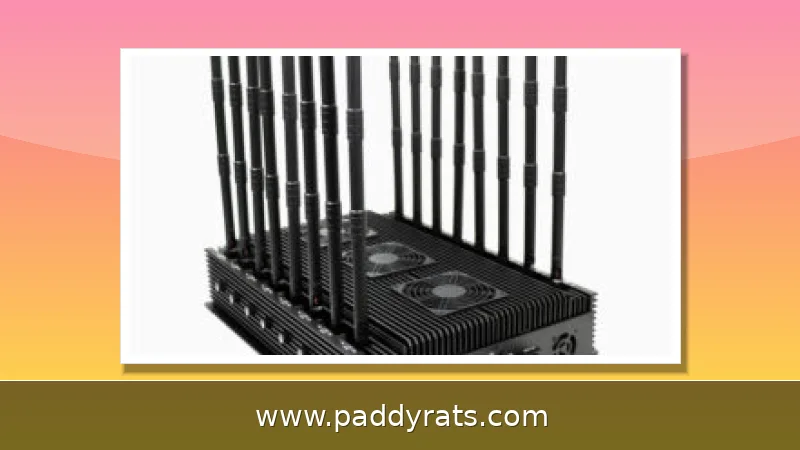
RF jamming systems for drones work by drowning out the weak radio signals a drone depends on. The drone's receiver gets hit with a wall of noise on its control channel, and at that point it can't tell the pilot's commands apart from the interference. The bands hit most often are 2.4 GHz and 5.8 GHz — unassigned public frequencies that nearly every consumer and commercial drone uses for primary command-and-control. Beyond those, jammers commonly go after 433 MHz and 900 MHz for control links, 1.2 GHz and 1.5 GHz for video and telemetry, plus the GNSS bands that GPS, GLONASS, Galileo, and BeiDou rely on for navigation.
Once the link drops, what the drone does next comes down to how it was programmed. After jamming, it will usually land on the spot, return to its home location, hover until the battery dies, fall out of the sky, or veer off in some random direction. That unpredictability is a core operational problem: the operator has no say in which outcome occurs, and a drone that flies home can still complete part of its mission. Jamming is also an incomplete countermeasure, since it doesn't locate the pilot or reveal the flightpath, and the drone's intended path or payload stays unknown.
Jamming Techniques: Broadband, Spot, Barrage and Protocol-Aware
Jammers don't all function the same way. Broadband jamming throws high-power noise across a wide frequency range. It's a simple approach and tough for a drone to escape, but it burns through energy fast and can mess with other devices in the area that have nothing to do with the drone. Spot jamming, by contrast, zeroes in on one specific band. That makes it more precise and more efficient. Barrage jamming takes both approaches and combines them, hitting multiple frequencies at the same time. Then there's protocol-aware jamming, which is a different beast altogether: it mimics and overlays the original signal, as Zidane et al. (2024) describe in MDPI Drones. Because the interference looks like a legitimate signal rather than random noise, the drone has a much harder time flagging it as an attack.
The table below breaks down how these techniques stack up against each other in terms of targeting, complexity, and collateral risk, drawing on both the technical literature and vendor documentation.
| Technique | How it works | Targeting | Collateral risk |
|---|---|---|---|
| Broadband | High-power noise across a wide frequency range | Low | High |
| Spot | Noise focused on one specific band | High | Medium |
| Barrage | Broadband plus spot, multiple frequencies at once | Medium | High |
| Protocol-aware | Imitates and superimposes the original signal | Very high | Low |
According to Septentrio, a chirp jammer putting out only about 10 mW can wipe out GNSS signals across a radius of several hundred meters — a good illustration of just how little power it takes to break satellite navigation. But that efficiency is a double-edged sword. The same low-cost, low-power hardware that makes real disruption possible also makes it nearly impossible to keep the effects confined to a single target.
What Hardware Exists and How Do the Specs Compare?
Counter-drone vendors love publishing spec sheets, and honestly, those numbers are a good way to see just how big the gap is between something a person can carry and something bolted to a fixed site. Take ElevonX's Skyner line — it's a handy reference because the company actually breaks out detection, positioning, and jamming ranges instead of lumping them together. The Skyner Raptor SJ works by locally overpowering GPS satellite signals, blending narrow-band low-power precision with wide-band high-power jamming. Out of the box, it covers 900 MHz, 1.5 GHz, 2.4 GHz, 5.2 GHz, and 5.8 GHz.
| Device | Key specs |
|---|---|
| ElevonX Skyner Raptor SJ | Detection up to 3 km, positioning up to 3 km, jamming up to 2 km; <=5.5 kg with battery, <=4 kg without |
| ElevonX Skyner Base SDJ | Jamming up to 4 km; detection height 0-1200 m; 360 degrees horizontal, -90 to +90 degrees pitch; detects 25 MHz-6000 MHz; <=31.5 kg without antenna |
| ElevonX Skyner Base J | Covers 95% of drone communication and navigation signals; jams up to 30 drones at once; IP66; -40C to +55C; 7 jamming antennas plus 1 GPS antenna; first channel 2400-2500 MHz at 50 dBm |
| Airsight Smart and Autonomous Jammer | 360-degree coverage out to 1.9 miles; manual and automatic activation; fixed, tripod or vehicle mount; integrates with AirGuard detection |
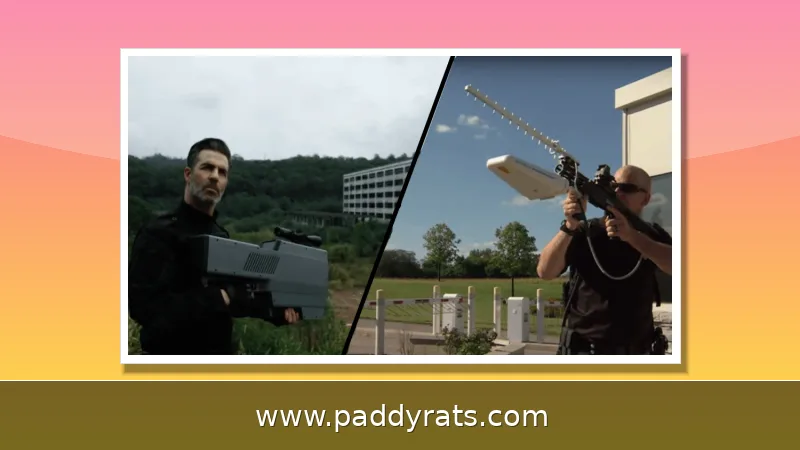
According to UAV Coach, heavy-duty jammers can reach targets from nearly a mile out, and jammer guns throw a cone of about 15 to 30 degrees—so where you aim and where you stand can matter just as much as how much power you're pushing. A few jamming devices have actually shown up by name in press coverage, including the Argus-5000, the SkyHunter-4M/P, Volnorez and the RP-377. Beyond those, there's a whole roster of companies working this space: Doodle Labs with its Sense and Mesh Rider Radios, infiniDome with GPSdome and GPSdome2, Robin Radar, Rohde & Schwarz with R&S ARDRONIS and GUARDION, Septentrio, and Bavovna.AI.
Who Can Legally Operate a Drone Jammer in the US?
Are drone jammers legal in the US? For private citizens, the answer is no. The Communications Act of 1934, Section 301 (47 U.S.C. 301), requires licensed or authorized operation of radio transmitters, and Section 333 (47 U.S.C. 333) prohibits willful or malicious interference with authorized radio communications. The FCC prohibits the operation, marketing and sale of jammers, and violations carry fines up to $112,500 per incident plus criminal sanctions including imprisonment, according to Airsight's legal guide. That penalty applies per incident, not per device.
Federal agencies operate under a different framework. Authorized under existing federal law are the Department of Defense and military installations (Title 10, expanded by JIATF-401 guidance in January 2026), DHS including CBP and the Secret Service, DOJ including the FBI, the Department of Energy for nuclear facility protection, and the Coast Guard for maritime security. The FEMA C-UAS Grant Program prohibits purchasing weapons with grant funds, and mitigation equipment is only available to certified law enforcement personnel.
Newly authorized under the SAFER SKIES Act, part of the FY2026 NDAA, are state and local law enforcement after training at the FBI's National Counter-UAS Training Center in Huntsville, Alabama; correctional facility security agencies meeting federal certification requirements; and agencies protecting National Special Security Events and SEAR-rated events such as the FIFA World Cup 2026. The practical takeaway for businesses and homeowners is that buying a jammer for private use remains illegal, no matter how compelling the security rationale sounds.
Pros, Cons and Limits of Jamming as a Counter-Drone Measure
The case for jamming rests on speed and reversibility. It is non-kinetic, meaning nothing explodes and the drone is usually disabled rather than destroyed, which preserves it as evidence. Cost is moderate compared with kinetic interceptors, the hardware comes in many sizes from handheld guns to fixed masts, and it can neutralize a threat within seconds. For sites that need an immediate response to an intruding drone, that combination is attractive.
The drawbacks are equally concrete. Range is limited, effects are imprecise and unpredictable, and the technique is illegal in most countries including the United States. Jamming is ineffective against pre-programmed drones flying without GPS, gives no positive control over the target and no pilot location, and can disrupt nearby communications including 9-1-1 calls. That last point is why regulators treat jammers as a public safety hazard rather than a simple security tool, and why detection-first systems are usually the recommended starting point.
How Drones Defend Against Jamming: Anti-Jam and Resilient Datalinks
Drone makers have responded with anti-jam technology, and the cat-and-mouse dynamic shapes what buyers should expect. Resilient datalinks use frequency hopping, spread spectrum and directional antennas to make the control signal harder to find and overwhelm. LPI/LPD datalinks, short for low probability of intercept and low probability of detection, aim to keep the transmission quiet enough that a jammer never locates it in the first place. Inertial navigation and visual odometry let a drone keep flying when GNSS is lost, which directly counters the chirp-jammer threat.
The scale of the problem is visible in Ukraine. RUSI estimated in May 2023 that Ukrainian forces were losing as many as 10,000 drones per month, mainly due to Russian jamming, along a frontline roughly 1,000 km (620 miles) long, according to Doodle Labs. That figure explains why military buyers now prioritize jam-resistant links over raw range, and why the counter-drone market keeps splitting into detection, mitigation and resilience layers rather than a single product category.
Frequently Asked Questions
How does jamming a drone actually work?
A jammer transmits electromagnetic noise on the same radio frequencies the drone uses for command, control, video and navigation, drowning out the link to its operator. The drone then typically returns to its home point, lands, hovers, or falls uncontrolled, depending on how its firmware is programmed.
Are drone jammers legal in the United States?
No. Under the Communications Act of 1934 (47 U.S.C. 301, 302a, 333), the FCC prohibits operating, marketing or selling devices that block authorized radio communications. Violations carry fines up to $112,500 per incident plus potential criminal prosecution. Only authorized government entities may legally operate them.
What is the difference between jamming and spoofing a drone?
Jamming blocks or overwhelms the radio link between drone and pilot, forcing a fail-safe response such as landing or returning home. Spoofing instead emits a counterfeit signal that mimics the real one, letting a third party take over the drone, direct its flight, and access data or the camera feed.
Which frequencies are targeted when jamming a drone?
Common targets are 433 MHz and 900 MHz for control, 1.2 GHz and 1.5 GHz for video and telemetry, 2.4 GHz and 5.8 GHz for primary command-and-control, plus GNSS bands (GPS, GLONASS, Galileo, BeiDou) to disrupt satellite navigation and timing.