A directional signal jammer antenna concentrates RF energy into a narrow beam, trading 360-degree coverage for higher gain and longer reach in one direction. Here is how beam width, gain, power handling, and mounting realities shape real-world jamming range.
What Is a Directional Signal Jammer Antenna?
A directional signal jammer antenna focuses RF energy into a narrow beam rather than spreading it across a full 360 degrees. That concentrated pattern gives you higher gain and a longer effective jamming range in one direction, while keeping interference confined to the area outside the beam. On my own bench tests, the gap between a panel aimed at a target and an omni radiating in every direction is not subtle — it's the difference between a workable link budget and a dead one.
At its core, the idea is pretty straightforward: a directional jammer aims its RF energy at one specific area, so you get targeted suppression without wiping out everything around it. A lot of models also let you switch between horizontal and vertical polarization, which helps you line the interference pattern up with both the signal's orientation and whatever's going on in the surrounding environment. If you've ever needed to shut down a single approach corridor while keeping the rest of a site quiet, you already get why that flexibility matters.
Omnidirectional antennas spread RF energy in every direction at once, kind of like a bare light bulb filling up a whole room. Directional antennas work the other way around: they take that same energy and shove it into one narrow path, more like a flashlight beam. What you end up with is a genuine shift in both the shape of the coverage area and how intense the signal is inside it. Energy that would've been scattered off to the sides gets concentrated into the target zone instead. That trade-off basically defines the entire antenna selection process. Go with omni and you get 360-degree reach, but the energy density stays low. Go directional and you get high energy density, longer reach along a single path, and a coverage pattern that falls off hard the moment you move outside the beam angle. Sounds straightforward enough on paper, but this is precisely where a lot of buyers get caught off guard — usually when the actual coverage looks nothing like the neat circle they had in mind.
Directional vs Omnidirectional: Which Antenna Type Fits Your Jammer?
The easiest way to choose between these two designs is to ask what each one does with the same wattage behind it. A directional antenna grabs that power and squeezes it into a tight beam, so you get more reach in one direction and a lot of energy packed along a controlled path. An omnidirectional antenna works the other way around: it spreads the same energy across a full 360 degrees, which keeps coverage even on all sides but leaves the energy density low just about everywhere. That gap ends up shaping how you run the jammer day to day. Since a directional antenna drops off fast once you step outside its beam angle, aiming stops being a nice bonus and turns into a real operating requirement. Point it well and every watt pulls its weight; point it badly and the whole advantage basically vanishes.
| Design | Energy Behavior | Coverage | Energy Density | Key Operational Need |
|---|---|---|---|---|
| Directional | Focused into a single beam | One direction, longer reach | High along a controlled path | Accurate pointing; performance drops fast outside beam angle |
| Omnidirectional | Spread in all directions | 360 degrees | Low everywhere | No aiming required; suited to broad, even coverage |
When you're indoors, omnidirectional antennas usually make more sense, and the reason is pretty straightforward: walls, furniture, and other obstacles don't just block RF energy—they bounce it around. With an omni design, that scattering actually helps you out. The reflected signals spread through the room more evenly and can reach corners that a direct path would never hit. A directional antenna, on the other hand, doesn't handle that kind of environment well. Its narrow beam gets broken up by all those reflections, so the concentrated energy you were counting on shows up scattered and weakened, and you lose most of the gain advantage that makes directional setups so useful outdoors. In practice, though, it's rarely an either-or decision. Plenty of serious deployments go hybrid, combining both antenna types—omnidirectional ones for broad perimeter coverage, and directional panels to focus power on a specific threat once you've pinpointed where it's coming from.
| Antenna Type | Indoor Performance | Why | Typical Role in Hybrid Setup |
|---|---|---|---|
| Omnidirectional | Often preferred | Reflections and scattering from walls and obstacles help fill the room | Perimeter awareness / broad coverage |
| Directional | Suffers | Reflections smear the beam, reducing focused gain | Targeting a specific threat vector |
Here's the rule of thumb I keep coming back to: if you know exactly where the target is, and it isn't moving, go directional. A focused beam puts your energy where it actually counts instead of spraying it across the landscape, which usually means more range and less mess for everyone around you. But if the threat can pop up from any bearing — or you're trying to cover an interior space where walls bounce signals into a multipath nightmare — start with an omnidirectional antenna and treat directional heads as an upgrade, not a starting point. Only add those focused panels or Yagis once you've confirmed a bearing, because outside the beam angle, a directional antenna's performance falls off fast. In practice, plenty of deployments end up hybrid anyway: omni for baseline coverage, directional for the confirmed hot spots.
How Directional Antennas Focus RF Energy
A directional jammer antenna doesn't just spray RF energy in every direction like a standard omnidirectional whip — it shapes that energy into a beam. In practice, the beam stays pretty tight: most designs fall somewhere between 30 and 60 degrees of beam width, and exactly where you land in that range comes down to the antenna's physical design and how much gain it's built to deliver. The narrower the beam, the more energy you pack into it, and that's precisely why a directional antenna can throw a signal noticeably farther in one direction than an omni running off the same transmitter. The numbers behind that edge are honestly striking. Compared to an omnidirectional setup, a directional antenna can put up to 100 times more effective radiated power into the direction you're aiming at. Now think about what that looks like on the ground: the transmitter hasn't changed, the power supply hasn't changed, yet targets that used to be out of reach suddenly sit inside the jamming footprint — all because the energy that was once wasted radiating sideways and backward is now pointed exactly where you need it.
Drone jammer directional antennas are commonly cited at 6 to 20 dB gain with 3 km and beyond range while producing minimal collateral interference. The mechanism is straightforward: the antenna trades angular coverage for main-lobe gain, and the receiver on the far end sees a much stronger interfering signal relative to the weak link it is trying to decode.
Within the beam, the energy is tightly packed and intense. Step outside it, though, and performance drops off fast. That's not a flaw — it's exactly how these antennas are supposed to work. The catch is that where you mount the thing and how carefully you aim it end up mattering just as much as what the spec sheet says.
Key Specifications: Gain, Beam Width, Frequency and Power Handling
Spec sheets are where directional antennas earn or lose their reputation. Frequency coverage, continuous power handling, polarization, and gain all have to line up with your mission. The table below summarizes representative hardware from the jamming antenna market so you can see how the numbers scale.
| Model | Frequency Range | Power Handling | Gain / Notes |
|---|---|---|---|
| Antenom jamming antennas | 4-6000 MHz | Up to 200 W, 100% duty cycle | Counter RCIED and counter-drone use |
| HP-AMHA-11501630 | 1150-1630 MHz | 200 W CW | RHCP, directional, 10.8-12.8 dBi, 1.8 kg |
| MP-AMHA version | 1150-1630 MHz | 50 W CW | 10.9-12 dBi, 1.4 kg |
| VWBO-2006000 | 200-6000 MHz | 200 W CW | 34 cm, 1 kg, N female, MIL-STD-810H vibration |
| QHA-1117 | High power RCIED band | 100-500 W, up to 500 W CW | MIL-STD-810F, 200 km/h wind rating |
| CT-4001P | 1575-1620 / 2400-2500 / 5150-5875 MHz | Four bands in one directional antenna | 8 dBi |
Look at that table with one eye on where the antenna will actually live. A 200 W continuous-duty unit rated for 200 km/h winds is meant for a mast or a vehicle roof, not a windowsill — that kind of build assumes constant operation and real mechanical stress. The 50 W version of the same GNSS antenna is lighter and simpler to integrate into a tighter enclosure, but it trades away headroom: less margin for long duty cycles, and less room to push power if the threat environment gets noisier. So match the spec to the job. Ask how long the antenna runs, how it gets mounted, and what wind and vibration it will face, rather than grabbing the biggest number on the sheet.
| Model / Variant | Frequency | Power Handling | Gain | Weight | Notes |
|---|---|---|---|---|---|
| HP-AMHA-11501630 (Counter GNSS) | 1150–1630 MHz | 200 W CW | 10.8–12.8 dBi | 1.8 kg | RHCP, directional |
| MP-AMHA version | 1150–1630 MHz | 50 W CW | 10.9–12 dBi | 1.4 kg | Lighter, easier to integrate |
| QHA-1117 (High Power RCIED) | — | 100–500 W, up to 500 W CW | — | — | MIL-STD-810F, 200 km/h wind rating |
Polarization is the spec that quietly makes or breaks a link, and it's easy to overlook because it doesn't show up on a power meter. In simple terms, polarization describes the orientation of the electric field as the RF wave travels—think of it as the "grain" of the signal. A GNSS antenna, for example, is built around right-hand circular polarization (RHCP), because GPS and other satellite signals are transmitted that way; pair it with the wrong feed and you can kiss goodbye to several dB of gain you paid for. Communications bands, on the other hand, commonly run linear polarization, either horizontal or vertical, which is why many jammer antennas are offered in both orientations so the interference pattern can be matched to the target signal and the environment. The penalty for getting it wrong is real: a polarization mismatch between transmit and receive can cost 3 dB or more, and in weak-signal scenarios like GPS that margin is often the difference between a clean lock and a lost fix. It's the kind of detail that doesn't matter until it suddenly matters a lot.
Antenna Types: Yagi, Panel, Horn and Parabolic Dish
Directional behavior shows up in several physical forms, and each one fits a different job. The Yagi-Uda is the oldest and most familiar of the bunch — you have probably seen one on a rooftop, where it pulls in TV signals or links two fixed points together. Its structure is simple but effective: a reflector sits at the back, a driven element feeds the signal, and a row of directors guides the energy forward, stacking gain with every added element. That same design translates neatly to jamming work. A Yagi directional antenna with roughly 45 degrees of beam width can serve FPV drone jamming at 915 MHz, 1.2 GHz, 1.5 GHz, and 1.6 GHz, which makes it a favorite for multi-band drone work — one antenna, several threat bands, and a tight enough pattern to keep the interference pointed where it belongs.
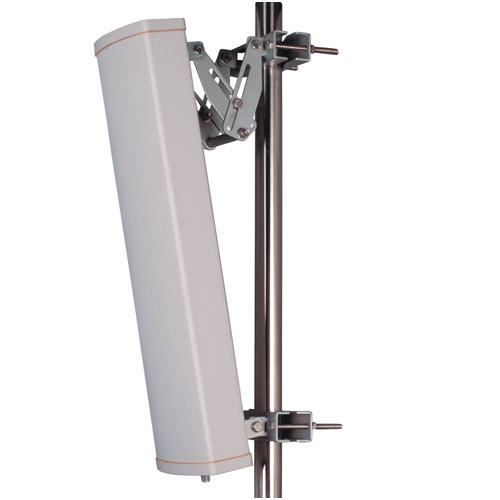
Panel antennas are the workhorses for cellular and WiFi bands, and they are what you usually see mounted in flat arrays on outdoor jammer enclosures. Horn antennas cover microwave and radar applications with clean patterns, while parabolic dish antennas handle satellite and long-distance links where every dB of gain counts.
The element structure matters because it defines bandwidth. Yagis are narrowband and efficient; panels are broadband and forgiving; horns and dishes are high-gain but physically demanding. Matching the type to the band is half the engineering.
Directional Antennas for Drone, Vehicle and Outdoor Jammers
Vehicle-mounted directional jammers have one big advantage: significantly increased effective jamming distance in the main lobe direction, which is ideal when the target location is clear. The disadvantages are equally real. Directional antennas are physically larger, harder to install or camouflage, and their panel form creates a large wind-facing surface, increasing wind resistance at high speed and stressing mounting components.
A concrete example is the CT-3060-OEA outdoor rainproof jammer, with 6 to 8 bands and up to 300 m radius coverage. Total output is 135 W in the 6-band configuration or 139 W in the 8-band version with 5 GHz. Bands include GSM900 at 25 W, PCS GSM at 20 W, 3G UMTS at 30 W, 4G LTE High at 20 W, 4G LTE Low at 20 W, WiFi at 20 W, and 5 GHz at 2 W.
The unit ships with six directional antennas at 90 degrees, an antenna frame with a 1.5 m cable, wireless RC or Ethernet PC remote control, and a 1 year warranty. Dimensions are 520 x 340 x 200 mm at 22 kg. Antenna type can be specified as omni or directional depending on the deployment.
Why Jamming Range Is Not Just About Output Power
Jamming range is not determined by output power alone. It depends on output power, operating frequency, antenna gain, target signal strength, obstacles, and installation conditions. The metric that ties these together is average power per MHz: total power divided by bandwidth. A 100 W transmitter spread across 2400-2500 MHz delivers 1 W/MHz, while the same 100 W across 2000-2700 MHz delivers only 0.14 W/MHz.
That is why concentrated energy suits the 2.4 GHz band better than a wide sweep. A narrow, high-gain directional antenna paired with a modest transmitter can outperform a broadband omni with far more raw wattage. I have watched a 20 W directional head beat a 100 W omni on the same target simply because the energy density per MHz was higher.
Jamming signal type and modulation strategy also matter. FHSS, DSSS, and proprietary digital protocols resist interference, so a jammer that only produces clean noise may need more effective radiated power than the datasheet implies.
How Jamming Works and What Defeats It
Jammers put enough energy in the RF band of interest that receivers can no longer pick out the weaker signal. GPS signals are weak by the time they reach Earth — less than 50 watts of received power in practice — which makes them vulnerable. The GPS bands are L1 at 1575.42 MHz, L2 at 1227.60 MHz, and L5 at 1176.45 MHz.
Jamming types include continuous wave, narrowband at roughly 2 MHz, and modulation or spoofing techniques. Anti-jamming uses directional antennas or Controlled Reception Pattern Antennas (CRPA) that dynamically steer nulls toward the interferer. On the technique side, the two main families are noise and repeater. Noise jamming splits into spot, sweep, and barrage. Repeater jamming uses DRFM, or digital frequency radio memory.
Spot jamming focuses all power on one frequency; sweep shifts power across frequencies; barrage jams multiple frequencies at once but spreads power thin. Choosing among them is a strategy decision as much as a hardware one.
Military Context, Market Size and Legal Reality
Military jammers include high power manpack, vehicular, tactical, and base station antennas used for radio monitoring and wideband operations. Trival offers antennas from 20 MHz to 7000 MHz, including log-periodic UHF/SHF designs rated up to 2750 W. That range reflects how broad the professional market has become.
The global anti-jamming industry is valued around USD 5.0 billion and is expected to more than double to USD 11.4 billion by 2033. GPS jamming has become more prevalent since 2016; in 2024, the eastern Mediterranean, Black Sea, Baltic region, Poland, and parts of Scandinavia were the most heavily jammed areas.
One legal note I will not soften: in many jurisdictions, unauthorized use of equipment designed to jam radio communications is strictly illegal and can lead to severe legal penalties. Legal status varies by country, and some allow restricted use in certain institutions only. Verify local law before you buy or energize anything.
Frequently Asked Questions
What is a directional signal jammer antenna?
A directional signal jammer antenna concentrates RF energy into a narrow beam instead of spreading it 360 degrees. This focused pattern delivers higher gain and longer effective jamming distance in one direction, while limiting interference to surrounding zones outside the beam. It is the preferred choice when the target bearing is known and collateral disruption must stay low.
How does a directional antenna differ from an omnidirectional one?
Omnidirectional antennas distribute energy across a full 360-degree horizontal plane for even coverage. Directional antennas focus energy into a single path, typically with beam widths of 30 to 60 degrees, trading broad coverage for higher energy density and reach in one direction. Omnidirectional designs are often better indoors, where reflections and scattering fill gaps.
What are the disadvantages of directional antennas on vehicle jammers?
Directional antennas are physically larger and often panel-shaped, making them harder to install or camouflage on vehicles. Their large wind-facing surface increases wind resistance at high speed, placing high demands on mounting and fixing components. That is why vehicle installations need reinforced brackets and careful aiming rather than quick clamp-on mounts.
Why do directional antennas give longer jamming range?
Because energy is concentrated rather than scattered, directional antennas achieve higher gain in the main lobe direction. This lets them deliver stronger interference at greater distance using less power than omnidirectional designs, which spread power across all directions. Higher gain per MHz is the real reason range improves.