Jammers rely on two antenna families—omnidirectional and directional—and the choice between them, plus internal versus external designs, decides how far and how selectively a jammer can work. Here is how antenna type, length, gain, and frequency band shape real-world jamming range.
What Are the Main Signal Jammer Antenna Types?
If you've ever cracked open a jammer casing, you've probably had the same reaction I did: the antennas give away almost everything about what the thing can actually do. From my time testing and reviewing RF hardware, jammers generally fall into two antenna camps—omnidirectional, which spreads a signal across 360 degrees horizontally to cover a wide area, and directional, which focuses that energy toward one bearing to reach farther, though you give up coverage everywhere else. There's a second split that matters just as much in practice: internal versus external antenna designs. That one choice shapes the unit's size, how discreet it looks, and how many frequency channels it can handle at once.
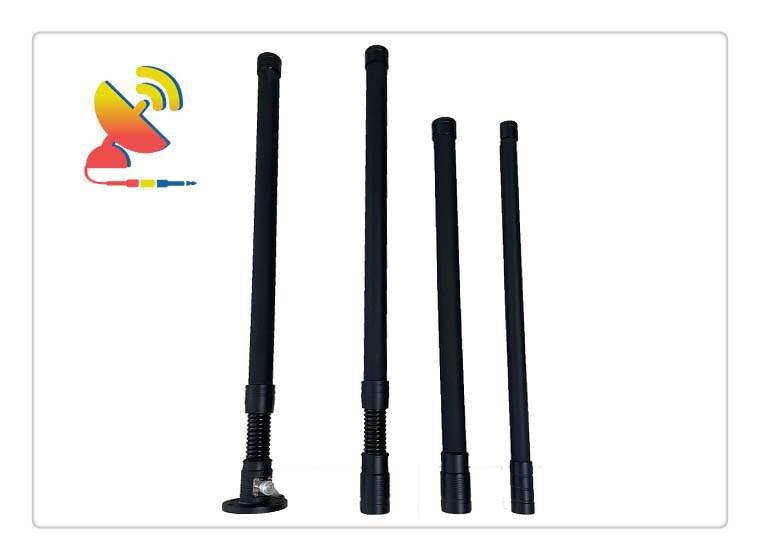
If you take apart most consumer and commercial jammers, the antenna you'll keep running into is the cylindrical omnidirectional whip. There's a good reason it's everywhere: it's cheap to manufacture, it doesn't need careful aiming during installation, and it radiates a full 360 degrees horizontally, so one stick can cover a room, a vehicle, or an open yard without anyone worrying about which way it's pointed. That forgiving, wide-arc behavior is exactly why multi-band units rely on it—stack a few whips for a few frequency ranges and you get broad coverage with almost no setup hassle. Directional types work differently. Yagi, log-periodic, and panel antennas focus the signal in one direction, trading that easy 360-degree reach for a narrower corridor of interference. You go for them when the job is specific: blocking a single approach route, shielding one doorway, or pushing energy toward a target far away, where a whip's spread-out power would just thin out before it got there. Military and high-power systems usually hedge by mixing both. Omnidirectional elements handle area denial—keeping an entire perimeter noisy—while directional elements take on selective, long-range work, concentrating power where it actually counts.
Omnidirectional vs Directional Jammer Antennas: How Do They Differ?
The trade-off basically comes down to coverage versus reach, and you'll see it reflected in pretty much every spec sheet. An omnidirectional antenna radiates its power across the horizon, which means the effective range in any single direction is shorter—but you never have to aim it. A directional antenna takes that same transmit power and concentrates it into a narrower beam, boosting the effective radiated power toward the target and stretching the range out. The catch? You get a blind spot behind and to the sides of it.
In real-world use, picking between an omnidirectional and a directional antenna is mostly a question of what you're trying to cover. If the setup is fixed—guarding a perimeter fence, for example, or locking down a single room—omnidirectional is usually the way to go, because 360° horizontal coverage leaves no gap where a signal can sneak through. Mobile situations flip that logic. Manpack rigs, vehicle-mounted units, or really anything where you know which direction the target is coming from tend to work better with directional antennas, since the operator can point the beam that way and squeeze more distance out of the same amplifier. That said, a lot of actual deployments don't choose one over the other—they run both at once, using omnidirectional elements for wideband coverage alongside directional elements on the bands where range matters most. It's a trade-off that makes sense in practice: broad coverage where you need it, extra reach where you can't afford to lose it.
Internal vs External Antenna Jammers: Which Design Fits Your Needs?
Internal antenna jammers flip that approach on its head. Rather than leaving connectors exposed for each frequency band, they pack the antenna, power supply, and heat dissipation into one compact housing. The result is a clean, self-contained unit that honestly looks more like some generic gadget than a piece of jamming gear. That's a big deal for portable and covert use, where the device has to sit on a desk, ride along in a car, or move with a person without turning heads. The catch is flexibility. Once the antenna is sealed inside, you can't swap it, angle it toward a specific target, or upgrade it down the road. You're stuck with whatever coverage the factory built in. Need to block another band? Now you're cramming extra hardware into a case that's already tight on space, which typically means more heat, more power draw, and a bulkier footprint. So internal antenna jammers win on convenience and concealment, but you're locked into a fixed coverage profile from day one.
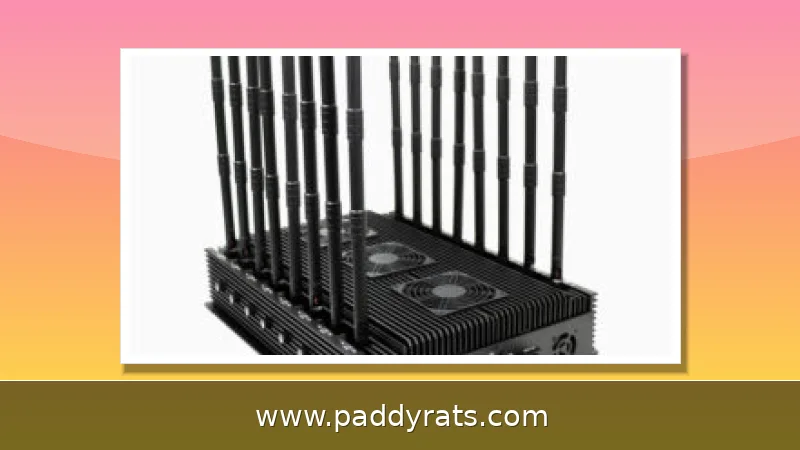
External antenna jammers put multiple connectors right on the housing, and each antenna you attach represents its own signal channel. That design choice matters more than it might sound at first: add more antennas, and you generally widen the range of signals you can block, since every channel can be tuned to a different band. Because the antennas sit outside the box, you can also aim them, upgrade them, or swap them out as the bands you care about change, which is a real advantage when you're dealing with everything from Wi-Fi to GPS to cellular frequencies. In my own comparisons, external designs consistently win on flexibility and multi-band coverage, while internal designs win on discretion and simplicity — there's nothing sticking out, nothing to connect, and nothing to misconfigure. That trade-off is exactly why buyers should match the choice to the mission rather than to the spec sheet. A fixed installation with known targets can often get by with a compact internal unit, but if you need to adapt, expand, or fine-tune coverage over time, the external route usually pays off.
| Design | Antenna Setup | Main Advantage | Best Fit |
|---|---|---|---|
| Internal antenna jammer | Antenna, power supply, and heat dissipation integrated into a compact casing | Discretion and simplicity | Fixed, low-profile use with known targets |
| External antenna jammer | Multiple connectors, each antenna representing a separate signal channel | Flexibility and multi-band coverage | Adaptable setups where bands may change or expand |
How Antenna Length and Resonant Frequency Affect Jamming
An antenna's core length isn't something a manufacturer just picks at random—it comes down to resonance. An antenna radiates most efficiently when its core matches the wavelength of the signal it's designed to handle. The logic is simple: higher frequency means shorter wavelength, which means a shorter core. That's why a 5.8 GHz element looks tiny next to a 100 MHz whip—the 100 MHz signal has a much longer wavelength, so its antenna has to be physically longer to resonate with it. Some manufacturers do take a cosmetic shortcut, though. They slap uniform-length outer shells on their jammers so everything looks neat and consistent, but that's just the housing. Underneath, each antenna is still tuned to a specific frequency range, so two whips that look identical on the outside might actually be handling completely different bands. Bottom line: if you're swapping antennas or troubleshooting a channel, don't judge by appearance. The label, not the shell, tells you what the antenna is really built for.
| Frequency | Wavelength | Core Length |
|---|---|---|
| 100 MHz | Longer | Longer |
| 5.8 GHz | Shorter | Shorter |
Power handling is another factor that shapes antenna design. High-power jammers tend to use antennas with varying lengths and diameters, and that's not just a cosmetic choice—it comes down to meeting power-handling and standing wave ratio (VSWR) requirements. The underlying reason is pretty straightforward RF behavior: when an antenna isn't properly matched to its feed line and amplifier, some of the energy bounces back toward the source instead of radiating out into the air. That reflected power is wasted, and even worse, it turns into heat that can stress or outright damage the amplifier stage. A well-matched antenna keeps VSWR low, which means more of the generated power actually leaves the system as usable jamming signal. This is why you'll sometimes notice a high-power unit sporting visibly thicker or longer antennas on certain bands while lower-power bands get slimmer ones. Whenever I look at a multi-band jammer, I don't just take the labels on the case at face value. I check whether each antenna is actually tuned to the band it claims to cover, because a mismatched or mislabeled antenna can quietly shrink your effective range and wear down the hardware over time.
Military Manpack Jammer Antennas: Frequency Bands and Gain Specs
Military manpack jammer antennas cover roughly 20 MHz to 6000 MHz, a stretch that carries them from VHF through UHF and up into SHF. That range isn't arbitrary. It reflects the reality that manpack systems have to take on everything from low-band tactical radios to GPS, cellular, and drone control links, often with the same kit in the same mission. In practice, these antennas are vertically polarized and radiate in an omnidirectional pattern, so the operator doesn't have to aim the pack at a target — coverage spreads out around them. They're also rated for operating temperatures from -55°C to 80°C, which tells you something about where they're expected to serve: deserts, mountains, arctic posts, and everything in between. Gain is where the models really diverge. Low-band elements can sit down around -15 dBi, while higher-band designs climb to 9 dBi, trading broad, forgiving coverage on the low end for more concentrated reach as the frequency rises.
| Frequency Band | Approximate Range | Typical Gain |
|---|---|---|
| VHF | 20 MHz – 300 MHz | -15 dBi to 2.5 dBi |
| UHF | 300 MHz – 1000 MHz | 2.5 dBi to 7 dBi |
| SHF | 1000 MHz – 6000 MHz | 5 dBi to 9 dBi |
The table below pulls together representative manpack jammer antenna models along with the band and gain figures their manufacturers publish. Think of these numbers as catalog specs, not measured field results — real-world performance will shift once you factor in terrain, cabling loss, and whatever signal you're actually trying to overpower. Even so, the list is useful because it shows a pattern: a typical manpack kit doesn't rely on one do-everything antenna. Instead, it splits the spectrum across several antennas, each tuned to its own slice. You'll see low-band VHF models covering tens of megahertz, mid-band units around 380–960 MHz, and higher-gain antennas stepping up through the 1.2 GHz, 1.5 GHz, 1.8–2.5 GHz, and 5.8 GHz ranges, with gain rising as the frequency climbs. The takeaway is simple: when you review a manpack antenna lineup, compare band coverage and gain side by side rather than assuming any single model covers the whole range.
| Model | Frequency Band | Gain |
|---|---|---|
| JCM-20-100 | 20–100 MHz | -15 dBi |
| JCM-150 | 100–200 MHz | -3 dBi |
| JCM-415 | 380–450 MHz | 2.5 dBi |
| JCM-485 | 450–520 MHz | 2.5 dBi |
| JCM5-800 | 758–894 MHz | 5 dBi |
| JCM5-810 | 800–1000 MHz | 5 dBi |
| JCM5-850 | 850–894 MHz | 5 dBi |
| JCM7-850 | 850–894 MHz | 7 dBi |
| JCM5-950 | 925–960 MHz | 5 dBi |
| JCM7-950 | 925–960 MHz | 7 dBi |
| JCM6-1216 | 1200–1600 MHz | 6 dBi |
| JCM7-1227 | 1210–1240 MHz | 7 dBi |
| JCM7-1575 | 1550–1590 MHz | 7 dBi |
| JCM6-1820 | 1800–2000 MHz | 6 dBi |
| JCM6-1850 | 1800–1870 MHz | 6 dBi |
| JCM9-1850 | 1800–1870 MHz | 9 dBi |
| JCM6-2025 | 2000–2500 MHz | 6 dBi |
| JCM6-2150 | 2100–2170 MHz | 6 dBi |
| JCM9-2150 | 2100–2170 MHz | 9 dBi |
| JCM6-2450 | 2400–2500 MHz | 6 dBi |
| JCM9-2450 | 2400–2500 MHz | 9 dBi |
| JCM6-2530 | 2500–3000 MHz | 6 dBi |
| JCM6-2650 | 2600–2700 MHz | 6 dBi |
| JCM9-2650 | 2600–2700 MHz | 9 dBi |
| JCM9-5850 | 5725–5875 MHz | 9 dBi |
High-Power Jammer Antenna Specifications: Power, VSWR, and Connectors
High-power jammer antennas are specified differently from consumer whips, and the numbers matter more. A representative military-grade example is the CTRF-ANTENNA-FRP-7583-321000-NK150W: 150W power handling, 750-830 MHz, 6 dBi gain, VSWR ≤2.0, 50 Ω impedance, vertical polarization, 360° horizontal beamwidth, 32±5° vertical beamwidth, ±2 dB ovality, and an N Female connector with omnidirectional radiation and DC ground lightning protection.
Mechanically, that unit measures ɸ80x32x1000 mm, weighs 0.9 kg, is rated for a wind speed of 36.9 m/s, uses a fiberglass radome, operates from -40 to +65°C with storage from -40 to +75°C, comes in matt black, mounts via flange, and is RoHS compliant. Applications include anti-UAV drone work. On the wideband side, Trival Antene lists models such as the AD-10/D dipole base station covering 450-3000 MHz at 1-2.5 dBi and 500-200 W, the AD-10/E ultra-wideband dipole at 400-6000 MHz, the AD-17 wideband disc-cone VHF at 30-90 MHz, the AD-18/D-2512-HP mobile monopole at 20-512 MHz and 200/400 W, the AD-18/G-40600 ultra-wideband mobile dipole at 400-6000 MHz, the AD-22/G log-periodic at 400-6000 MHz with 8 dBi and up to 2750 W, the AD-22/F log-periodic at 1-6 GHz with 9-11 dBi and up to 1.7 kW, and the AD-25/CW-3512 tape whip for manpack radios at 30-512 MHz.
How Jamming Techniques Shape Antenna Requirements
Antenna choice follows technique. The two main techniques are noise jamming and repeater jamming. Spot jamming focuses all power on a single frequency, which pairs well with a narrowband directional antenna. Sweep jamming shifts full power from one frequency to another, so it needs bandwidth rather than beam concentration. Barrage jamming covers multiple frequencies at once but spreads power, making it less powerful at any single frequency—a trade-off antenna gain can only partly offset.
DRFM, or Digital RF Memory, is the most common repeater technique. It alters and re-transmits radar energy to create false targets, and it demands antennas with clean phase and wide instantaneous bandwidth rather than maximum raw gain. GPS jamming illustrates the same logic: chirp jammers sweep across 1565-1585 MHz, simple cigarette-lighter jammers broadcast on L1 at roughly 10 mW, and complex hedgehog jammers with many antennas broadcast on L1 or L2 at around 10 W. A University of Texas at Austin Radionavigation Lab study categorized 18 commercially available jammers into cigarette-outlet units (L1 only), rechargeable battery or external antenna units (L1 and L2), and cell phone jammers (L1 and L2).
What Determines Effective Jamming Range?
Effective jamming range depends on output power, operating frequency, antenna gain, target signal strength, obstacles, and installation quality. Antenna gain is the multiplier most buyers overlook: adding 6 dBi of gain toward a target can matter more than doubling amplifier power, because gain concentrates energy instead of merely adding it. Frequency matters too, since higher bands suffer more path loss and penetrate obstacles less effectively.
Power density is the metric that ties it together. Average power per MHz equals total power divided by bandwidth, so 100W over 100 MHz gives 1W/MHz, while the same 100W spread over 700 MHz gives only 0.14W/MHz. Most modules on the market offer 50W (47dBm) or 100W (50dBm). That is why a wideband barrage jammer with the same amplifier as a narrowband spot jammer will underperform on any single frequency—the antenna and the bandwidth budget are working against each other.
Anti-Jamming Countermeasures and the Legal Reality
Anti-jammer devices respond with signal authentication, interference filtering, and signal resilience, and beamforming is the key technique—steering antenna gain toward the legitimate signal while nulling the interferer. This is the mirror image of directional jamming, and it explains why the anti-jamming industry is growing: it was valued around USD 5.0 billion globally and is expected to more than double to USD 11.4 billion by 2033, according to market estimates cited by industry sources.
One legal point deserves emphasis. Unauthorized use of jamming equipment is strictly illegal in many jurisdictions and can lead to severe legal penalties, including fines and criminal charges. Signal jamming interferes with licensed spectrum, emergency communications, and navigation services. Anyone researching antenna types for professional RF work, defense contracting, or academic study should treat the technical material here as educational and confirm local regulations before touching transmitting hardware.
Frequently Asked Questions
What are the main types of signal jammer antennas?
Jammers generally use two antenna categories: omnidirectional and directional. Omnidirectional antennas cover 360 degrees horizontally for broad coverage, while directional antennas focus energy in one direction for longer reach. Jammers also differ by internal versus external antenna design, with external models often using multiple antennas for separate frequency channels.
How does antenna length affect jammer performance?
Antenna core length relates to resonant frequency: higher frequencies need shorter cores, lower frequencies need longer cores. Some jammers use uniform-length outer shells for appearance, but each antenna still corresponds to a specific frequency range. High-power jammers may vary antenna lengths and diameters to handle power and standing wave ratio requirements.
What frequency ranges do military jammer antennas cover?
Military manpack jammer antennas can cover roughly 20 MHz to 6000 MHz, spanning VHF to UHF bands. Specific models target bands such as 100-200 MHz, 1200-1600 MHz for GPS, 1800-1870 MHz, 2400-2500 MHz, and 5725-5875 MHz, with gains ranging from about -15 dBi to 9 dBi depending on the model.
What is the difference between internal and external antenna jammers?
Internal antenna jammers integrate the antenna, power supply, and heat dissipation into a compact casing, giving a sleek, less conspicuous look. External antenna jammers have multiple interfaces on the casing for separate antennas, each representing a signal channel. More external antennas generally mean a wider range of signal blocking.