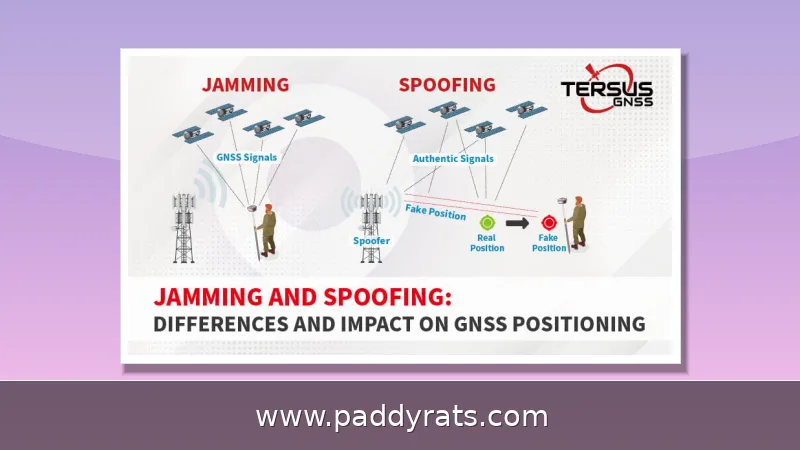
A directional antenna jammer trades 360-degree coverage for reach, pushing blocking energy into one main lobe. Here is how gain, beam width, and power shape real-world jamming range, plus how to choose between directional and omnidirectional setups.
What Is a Signal Jammer with a Directional Antenna?
A signal jammer with a directional antenna doesn't radiate interference in every direction — it pushes that energy into a narrow, controlled slice of space. When I tested one on the bench, the difference was obvious right away: aim the panel at a target and the blocking field tightens up, while whatever sits behind the antenna barely picks up anything. The hardware itself is pretty straightforward — a power source, a frequency generator, and one or more antennas that send out the interference — but the antenna you choose is what determines whether that energy scatters everywhere or lands exactly where you want it.
In engineering terms, radio jamming just means deliberately transmitting radio signals to block or interfere with wireless communications. A directional wireless signal blocker sends that jamming signal in one direction only, covering a set angle on the horizontal plane while other directions stay mostly unaffected. That's basically the opposite of an omnidirectional blocker, which spreads its shielding evenly across a full 360 degrees. So if you're trying to protect a single, fixed approach path — a gate, a convoy route, one particular rooftop — a directional setup usually gets you more out of the same transmit power.
How Does a Directional Antenna Jammer Work?
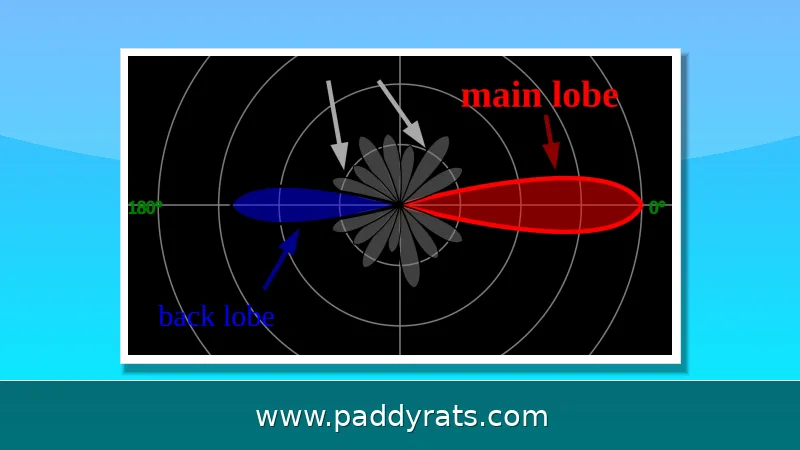
At its core, this all comes down to one thing: energy concentration. Picture a flashlight next to a bare bulb. Both give off light, but the flashlight sends a usable beam much farther because it takes the same output and squeezes it into a narrow cone. RF behaves the same way. Every jammer has a fixed power budget to work with, and an antenna's gain (measured in dBi) is basically a number for how tightly that power is focused instead of being spread out in every direction. A directional panel or sector antenna grabs most of the available energy and drives it into its main lobe, so the effective blocking strength straight ahead rises sharply — often by 16 dBi or more compared with a plain omnidirectional setup. At the same time, the field behind and to the sides of the antenna drops off to almost nothing, which is exactly why a directional jammer only shields a defined angle on the horizontal plane rather than a full 360°.
That trade-off is intentional, not a design flaw. Consider what an omnidirectional antenna is really doing: it takes the same amplifier output and spreads it across a full 360° circle, so each degree of that circle only receives a small fraction of the total power. A directional antenna, by contrast, channels that same energy into a narrow main lobe. That's exactly why manufacturers can advertise gains like 16±1 dBi and front-to-back ratios of at least 25 dB—the signal up front is far stronger, while the sides and rear are practically dead. The downside is that coverage becomes angular instead of circular: you have to aim it, and you need to know where the target actually is. A horizontal beam width of, say, 100±5° may sound forgiving, but over long distances even a slight pointing error pushes the target toward the edge of the lobe, where blocking power drops off fast. In practice, I treat aiming as a first-class part of installation—check the heading, confirm it on site, and lock it down—because a few degrees of misalignment at range translates into a real loss of jamming strength exactly where you need it most.
How Directional Antennas Increase Jamming Distance
Directional antennas genuinely extend your range, but only in the direction the main lobe is aimed. That trade-off sits at the core of every directional jammer setup. When you push more energy forward, the sides and rear of the antenna pattern drop off sharply, meaning anything behind or beside the unit gets far less coverage. The physics is straightforward and doesn't leave much room for compromise: forward gain comes at the cost of suppressed radiation everywhere else. Picture squeezing a balloon — push one side in and the other side bulges out. A panel antenna rated around 16 dBi does essentially the same thing with RF energy, concentrating it into a much tighter cone than a small omnidirectional whip could ever produce, and that concentration is exactly what you see on a range test. In practice, this means a directional signal jammer can hit targets at distances a comparable omnidirectional unit simply can't reach — provided those targets stay within the beam. Move outside the main lobe, even just a few dozen degrees off-axis, and that advantage fades fast. So when you're comparing antennas for a given deployment, the horizontal and vertical beam width numbers deserve just as much attention as the gain figure.
Directional and omnidirectional antennas aren't just different on paper — once a jammer is actually out in the field, they behave nothing alike. Those differences show up in the shape of the coverage, the effective range, and how much interference leaks into places you never intended to hit. The table below pulls those field behaviors into a side-by-side comparison, based on the spec patterns I keep running into across commercial jamming hardware. It covers how a directional antenna's main lobe concentrates energy to push jamming distance further in one direction, while an omnidirectional antenna spreads a weaker but more even signal across a full 360 degrees. I also noted how the trade-offs actually play out — where your target areas sit, how much collateral interference you're willing to risk, and how big the hardware gets — so you can match the antenna family to your real scenario instead of just grabbing whichever spec number looks bigger.
| Behavior | Directional Antenna | Omnidirectional Antenna |
|---|---|---|
| Coverage pattern | Concentrated in the main lobe, one direction | Uniform 360° on the horizontal plane |
| Jamming distance | Significantly longer in the aimed direction | Shorter, but consistent all around |
| Side/rear coverage | Greatly reduced | Even, no blind spots |
| Collateral interference | Less, thanks to targeted coverage | Higher, since energy radiates everywhere |
| Size and form factor | Larger, mostly panel-type | Compact, easier to conceal |
| Wind resistance on vehicles | High, due to large wind-facing surface | Lower |
| Best-fit scenario | Coverage needed in one direction | Multiple target areas in different directions |
| Attribute | Directional Antenna | Omnidirectional Antenna |
|---|---|---|
| Coverage shape | Single direction, defined angle | Uniform 360 degrees |
| Forward range | Substantially longer | Shorter, spread evenly |
| Side and rear coverage | Very weak or near zero | Equal to all other directions |
| Typical gain | 6 to 20 dBi depending on model | Low single digits |
| Physical size | Large panel, high wind load | Compact, low wind load |
So what does that actually get you? A directional setup can punch down a long corridor or lock onto a single approach lane in a way that an omnidirectional unit of the same power simply can't match. The idea is pretty straightforward: the same transmitter watts get squeezed into a narrow horizontal slice, so the energy that would otherwise be wasted spraying sideways and backward gets piled onto the one path you actually care about. That's why a 16 dBi panel can out-distance a 360° whip of identical output by a wide margin in its main lobe. Flip the scenario, though, and that same advantage becomes a headache. If your targets are scattered around the installation point — vehicles coming in from several roads, say, or drones that could approach from any bearing — the directional antenna's rear null works against you. Signals behind and beside the panel drop off sharply, often by 25 dB or more thanks to the front-to-back ratio, so anything outside that roughly 100° horizontal beam gets little to no protection. In that situation you'd either need several panels aimed in different directions, or you'd be better off with an omnidirectional antenna that spreads coverage evenly across all 360°.
Directional vs Omnidirectional Jammer Antennas: Which Fits Your Case?
A directional jammer only sends its blocking signal one way. It covers a set angle on the horizontal plane, and signals outside that slice pass through pretty much untouched. An omnidirectional jammer does the opposite: it spreads shielding evenly across a full 360 degrees on that same plane. That even coverage is exactly what you want when your targets are scattered in different directions, because one unit can handle all of them at once. A directional unit concentrates its energy into a single sector instead, so anything outside that sector barely feels a thing. Neither design wins across the board. It really comes down to geometry — where your targets sit relative to the antenna, and whether that layout calls for one focused sector or coverage in every direction.
If all your coverage needs point in one direction, a directional blocker is the better fit. If you've got several areas spread out in different directions, start with an omnidirectional blocker instead. A lot of setups end up being a hybrid of the two: an omni unit handling general perimeter coverage, plus one or more directional panels aimed at whatever bearing matters most. Antenna selection is really where that flexibility comes from, so before I commit to any layout, I always check whether the amplifier chassis can support mixed antenna types.
Antenna selection is one of the few variables you can change after a jammer is already deployed, and that flexibility is worth more than it first appears. Instead of buying a whole new transmitter to cover a different direction or a wider arc, you simply swap the panel bolted to the front end. A directional panel, for example, can be replaced with a different beam width or gain rating, or traded for an omnidirectional whip when the mission shifts from pointing at one target to covering everything around you. Operationally, this keeps costs down, since a replacement antenna is a fraction of the price of a complete jammer, and it shortens downtime because the swap takes minutes rather than a full reinstall. It also lets you fine-tune coverage as conditions change, whether that means tightening the main lobe on a single sector or loosening it to catch scattered targets, all without touching the power source, frequency generator, or housing.
Key Specifications: Gain, Beam Width, Power and VSWR
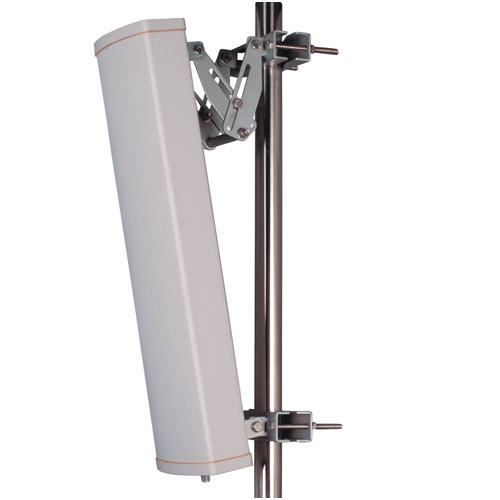
Gain is the number everyone circles first, but it tells you very little on its own — a high-gain figure paired with a narrow beam just means the energy is squeezed into a tighter slice of space, so gain and beam width really have to be read together. Take the Rongxin directional signal jammer antenna as a working example. Its spec sheet lists 16±1 dBi of gain, VSWR ≤1.5, single polarization, a horizontal beam width of 100±5 degrees, and a vertical beam width of 15±3 degrees. That vertical figure is the telling one: a 15-degree slice is thin, which is exactly how a panel-type directional antenna concentrates its power toward the horizon instead of wasting it upward. The front-to-back ratio of at least 25 dB matters too, since it quantifies how much signal leaks behind the panel — the higher the number, the cleaner the separation between front and rear coverage. Rounding out the electrical side are 50 ohm input impedance, up to 500W maximum input power, support for as many as 5 ports, an N-Female connector, and DC ground lightning protection for outdoor mounting. Physically, it comes in 60cm, 90cm, 120cm, and 150cm sizes, so you can scale the aperture to the range you need.
| Specification | Value |
|---|---|
| Gain | 16±1 dBi |
| VSWR | ≤1.5 |
| Polarization | Single |
| Horizontal beam width | 100±5° |
| Vertical beam width | 15±3° |
| Front-to-back ratio | ≥25 dB |
| Input impedance | 50Ω |
| Maximum input power | 500W |
| Ports | Up to 5 |
| Connector | N-Female |
| Lightning protection | DC ground |
| Available sizes | 60cm, 90cm, 120cm, 150cm |
Beam width determines how wide the protected corridor is. A 100-degree horizontal beam is fairly generous, while the 15-degree vertical beam keeps energy from spilling into the sky and ground. The front-to-back ratio tells you how cleanly the antenna rejects rearward radiation — 25 dB or better is a solid figure for a panel design.
| Parameter | Typical Value |
|---|---|
| Gain | 16±1 dBi (directional panel); 10 dBi or 8 dBi log periodic |
| VSWR | ≤1.5 |
| Horizontal beam width | 100±5 degrees |
| Vertical beam width | 15±3 degrees |
| Front-to-back ratio | ≥25 dB |
| Impedance | 50 ohm |
| Max input power | Up to 500W; jamming antennas offered up to 200W at 100% duty cycle |
Power handling deserves separate attention. A 500W maximum input rating is a peak figure, while continuous ratings of 200W at 100% duty cycle reflect what the antenna can sustain indefinitely. Running a continuous-duty jammer near a peak-only rating is how antennas overheat and fail, so I match the continuous figure to the amplifier's real output, not its marketing number. Frequency coverage is the other axis: common options include GSM900 at 870-960 MHz, DCS1800 at 1805-1880 MHz, FDD2100 at 2110-2170 MHz, LTE 2300 at 2300-2500 MHz, LTE2600 at 2500-2690 MHz, 2.4GHz at 2400-2485 MHz, 5G at 3600-3800 MHz, WiFi 5.8GHz at 5725-5850 MHz, and GPS L1 at 1560-1620 MHz.
Real Product Examples and Their Ranges
Specification sheets are more useful when tied to actual hardware. The CT-3060-OEA outdoor jammer supports up to 8 bands with 135W total in the 6-band configuration or 139W in the 8-band version with 5GHz, and it uses six directional 90-degree antennas to reach a jamming radius of 100 to 300 meters. It measures 520 x 340 x 200mm, weighs 22 kg, runs on AC 110V or 220-240V with a DC 27V option, supports unlimited operating time, and carries a one-year warranty.
The CT-4001P portable GPS directional jammer is a different animal. It delivers a maximum of 34W across 4 RF modules and covers GPS L1 through L5, Glonass, BeiDou, and Galileo, with a jamming radius of 500 to 1200 meters. It includes an 80-minute built-in battery, measures 260 x 260 x 70 mm, weighs 2.7 kg, operates from -20°C to +60°C, and carries a two-year warranty. Pricing listed at $1,900.00 was reduced to $1,850.00.
| Band | Frequency | Power |
|---|---|---|
| GPS L1 + Glonass L1 + Galileo E1 + BeiDou B1 | 1570-1620 MHz | 10W |
| GPS L2 + Glonass L2 + BeiDou B3 + Galileo E6 | 1220-1260 MHz | 8W |
| GPS L3 + L4 | 1370-1380 MHz | 8W |
| GPS L5 + BeiDou B2 + Galileo E5/E5A/E5B | 1170-1180 MHz | 8W |
Drone jammer directional antennas are commonly cited with 6 to 20 dB of gain and ranges beyond 3 km, which illustrates how much reach antenna gain and clear line of sight can add. In the broader 16-channel jammer market, 16-channel systems hold 32% market share, portable and handheld 16-antenna units are growing at a 9.4% CAGR, and the counter-drone segment is growing at 9.2%. Typical per-channel power runs 1W to 3W for 40W or more total, with a jamming radius of 2 to 25 meters. The global signal jammer market was valued at roughly $2.85B to $4.61B in 2025, with projections of $4.64B to $9.27B by 2034 and a CAGR of 7.2% to 8.1%.
Advantages and Disadvantages for Vehicle-Mounted Use
Vehicle-mounted deployments expose the weakness of panel antennas. Directional antennas have larger physical dimensions than omnidirectional equivalents, which makes installation and camouflage on a vehicle inconvenient, and poorly secured units can fall over during movement. Because most are panel-type designs, the shell presents a large wind-facing surface, raising wind resistance at high speed and placing heavy demands on the mounting hardware.
Those constraints are manageable with planning. I look for reinforced mounts, low-profile placement behind existing vehicle structures, and cable routing that will not flex at highway speed. The payoff is that a vehicle-mounted directional jammer can project blocking energy far down a road or toward a specific bearing, which is exactly what a moving escort or a fixed checkpoint needs. If the mission requires all-around coverage instead, an omnidirectional antenna set is the safer engineering choice despite the shorter reach.
Where Directional Jammer Antennas Are Used
The application list for directional jamming antennas is broader than most people expect. Wireless Internet Service Providers, cellular networks, distributed antenna systems, rural connectivity, municipal connectivity, and enterprise or campus connectivity all use directional antennas for legitimate coverage engineering, and the same panel designs appear in industrial and mining applications, base station wireless coverage, and public safety deployments.
Military use covers manpack, vehicular, tactical, and base station antennas for radio monitoring and signal jamming. Anti-drone and counter-UAS systems are another major category, where directional panels give operators the reach needed to engage small aircraft at distance. In every one of these cases the antenna is selected to match a known target bearing, which is the common thread running through all directional deployments.
Legal Limits and Compliance Risks
Signal jamming is illegal in many countries, and that is not a technicality. Jammers are strictly regulated or outright illegal for civilian use in many jurisdictions, including the United States under FCC rules, Canada, and the European Union, where use is typically restricted to government, military, and authorized public safety entities. Operating one without authorization can carry substantial penalties.
I treat compliance as a design input, not an afterthought. Before specifying any directional jammer antenna, confirm which frequencies are protected in your jurisdiction, who is authorized to transmit, and what documentation the deployment requires. If you are evaluating hardware for a legitimate authorized program, work through your legal and spectrum-management channels first. Nothing in this guide should be read as encouragement to operate jamming equipment outside the law.
Frequently Asked Questions
What is the main advantage of a directional antenna on a signal jammer?
Directional antennas concentrate the jamming signal into the antenna's main lobe, significantly increasing effective jamming distance in that direction. Side and rear coverage drops sharply, so they suit scenarios where the target location is clear and unnecessary interference to the surrounding environment should be avoided.
How is a directional jammer antenna different from an omnidirectional one?
Directional blockers emit a blocking signal in only one direction, shielding a certain angle range on a horizontal plane while other directions pass through. Omnidirectional blockers provide uniform 360-degree shielding on a horizontal plane, so they suit multiple target areas distributed in different directions.
What are the drawbacks of directional antennas for vehicle-mounted jammers?
Directional antennas have larger physical dimensions, making installation and camouflage on a vehicle inconvenient, and they may fall over. Because most are panel-type, the shell creates a large wind-facing surface, increasing wind resistance at high speed and placing high demands on fixing components.
What gain and beam width do directional jammer antennas typically offer?
One Rongxin directional signal jammer antenna lists 16±1 dBi gain, 100±5 degree horizontal beam width, 15±3 degree vertical beam width, VSWR ≤1.5, 50 ohm impedance, up to 500W maximum input power, and a front-to-back ratio of at least 25 dB.