Signal jammer range is decided by power density per MHz, antenna gain, waveform strategy, target link strength, and terrain — not by the wattage on the box. This guide breaks down each factor with practical reference tables.
Signal Jammer Range: What Really Determines Jamming Distance?
For all the lofty rhetoric about data versus power, jamming is a receiver-dominance game. Where the deviant signal needs to raise up target receiver noise floor high enough that original data cannot recover anymore. It is why so many buyers are led astray by headline wattage figures: average power per unit bandwidth reflects how efficiently you can drown out a given frequency. Imagine the way water travels through pipes — forcing a singular volume of it down a narrow pipe provides much greater pressure than if that same amount were forced into an opening twice as wide.
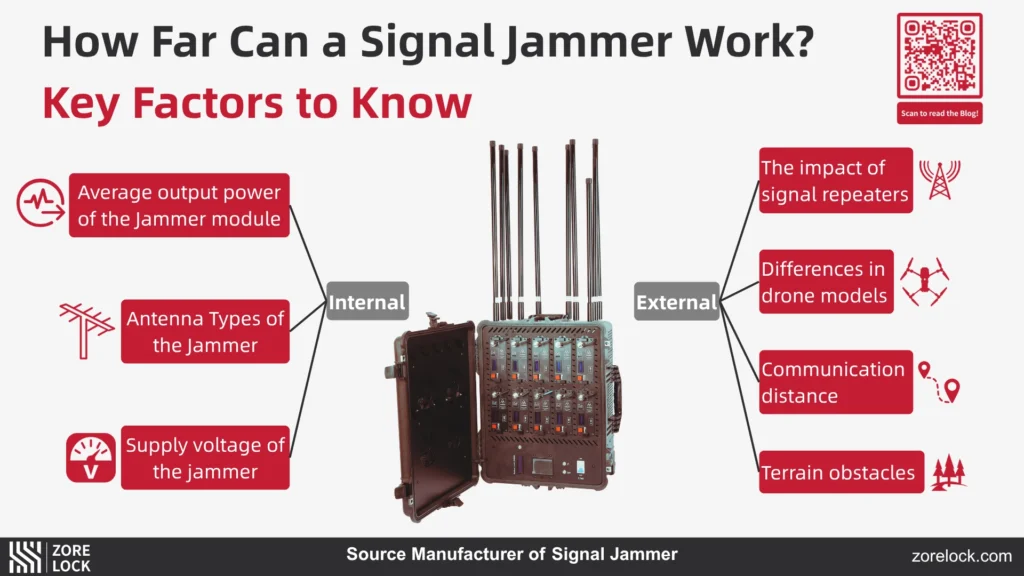
I sometimes had the opportunity to test my own equipment in its field of use, and a 100W unit directed through enough band-pass filtering always bettered an equally-sized spectrum-spreading device, intuitively even as measured by identical looking specifications on paper. The real jamming distance will depend on the average output power radiated by the interfering USR that actually rays into the target link and its environment, operating frequency of both links, antenna gain (G), terrain/x/y/z obstructions: ground level conditions as dictated from building terrain coverage maps and line-of-sight principles considering whether this link runs directly or through a repeater/base station. Knowing these variables up front is the difference between realistic planning and disappointment after deployment.
How Does Average Output Power per MHz Affect Jamming Distance?
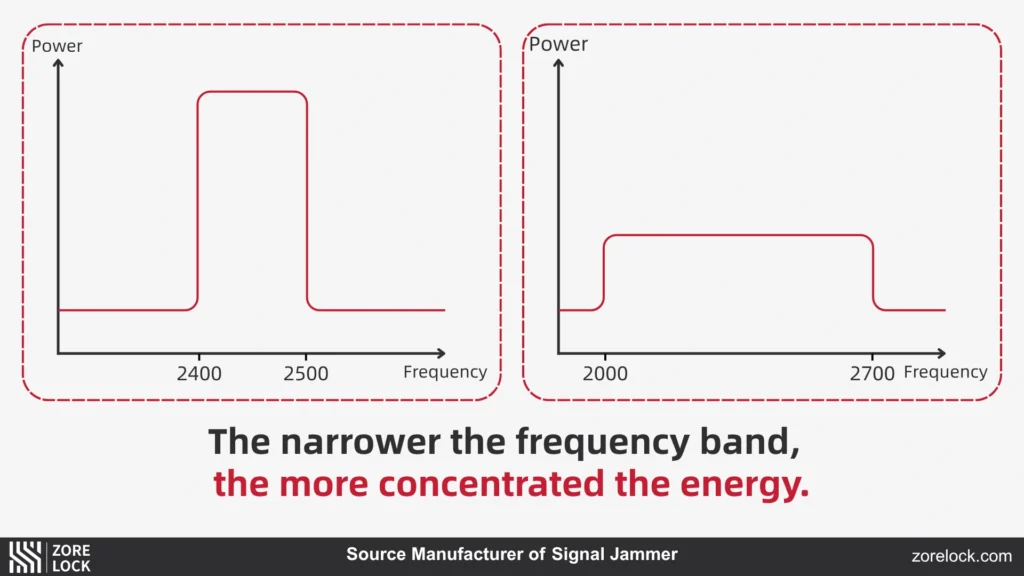
Average output power is the most straightforward internal characteristic that translates to jamming range, and yet you almost never got an actual data sheet referencing what it is we actually want. That number typically refers to the overall output across the entire frequency range of the module, not how much energy strikes any one single slice within it. Thus the proper metric by which to assess actual performance is power per MHz — how much aggregate ballistic firepower must be dispensed over a certain bandwidth and range for a given signal: This ratio (if you will) describes overall jammer efficiency. For example, a 100W jammer focusing its power into the 2400–2500MHz band spits out roughly 1W per MHz which is more than sufficient to provide operational range against most common drones operating in that region. Disperse that same 100W across a wider band, and the power density per MHz drops as well — along with practical jamming distance.
| Total Power | Bandwidth Covered | Average Power per MHz | Practical Effect |
|---|---|---|---|
| 100W | 100MHz | ~1W/MHz | Strong range against a narrow target band |
| 100W | 700MHz | ~0.14W/MHz | Weak against any single 2.4GHz target |
| 50W | 50MHz | ~1W/MHz | Comparable density at lower total power |
Now imagine a second 100W jammer, this time spread across 2000–2700MHz. Same headline rating, but the energy diffuses to about 0.14W per MHz — roughly seven times thinner than the narrowband unit. On paper, the two devices look identical. In the field, though, the wideband unit struggles to jam a 2.4GHz drone anywhere near as far, simply because so little of its power actually lands on the frequency that matters. And honestly, even those clean calculations are flattering reality. Sweep speed, dwell time, amplifier gain flatness, and the nonlinearity of the control voltage curve all drag real-world results below the theoretical best. That gap between datasheet and dirt is exactly why power density tells a truer story than total watts.
| Total Power | Bandwidth Covered | Average Power per MHz | Practical Effect |
|---|---|---|---|
| 100W | 100MHz | ~1W/MHz | Strong range against a narrow target band |
| 100W | 700MHz | ~0.14W/MHz | Weak against any single 2.4GHz target |
| 50W | 50MHz | ~1W/MHz | Comparable density at lower total power |
| Total Power | Bandwidth Covered | Average Power per MHz | Practical Effect |
|---|---|---|---|
| 100W | 100MHz | ~1W/MHz | Strong range against a narrow target band |
| 100W | 700MHz | ~0.14W/MHz | Weak against any single 2.4GHz target |
| 50W | 50MHz | ~1W/MHz | Comparable density at lower total power |
How to Compare Spectrum Jammers This article is for those of you doing serious research on spectrum jammers, in particular multi-band frequency-jamming devices.The most useful question to ask a vendor when comparing are:> What's the average power per MHz - band by band. Skip the headline wattage. A 100W unit distributed over a very wide frequency response can, at any individual target frequency, produce woefully little power because that total gets divvied up across hundreds of megahertz. Instead, ask for the per-band numbers — this will show you at a glance what specific frequencies do to hit hard and which ones just nominally are covered. I have saved far more bad purchases from this one question than any other specification check, and it costs nothing but an email. Those who know their product will answer right away, to those that can't normally hide a poor design behind big figures.
| What to Ask | Why It Matters |
|---|---|
| Average power per MHz, by band | Reveals real energy density at each target frequency |
| Single headline wattage | Combined output across the whole band — tells you little about any one frequency |
Why Do Jamming Signal Type and Modulation Strategy Matter?
Jamming waveform design and how it is matched to the modulation scheme of a target often matters more than raw power as an indicator of success. Wireless system of now, they are designed to survive interference- frequency hopping spread spectrum (FHSS) hops on frequencies in rapid succession, direct sequence spread spectrum is hiding a transmission inside a wide band by using code structure and some special drones run fully custom protocols that have been hardened against interference. And this is also why a no frills wideband barrage jammer radiating noise across many megahertz of band can fail to catch any target at all — the signal energy just gets too spread out, and since it cannot track frequency-hopping targets one hops away quickly. Leaving aside the shouting louder bit, jamming is less a matter of volume than it is about speaking in the target's native tongue on relevant channels and at optimal times; many protocol aware (Intelligence: its For and From nature), often classify as specific targets waveforms outperforming their generic full-power wide-beam counterparts across lower output. This is also why you should never grade a jammer by watts only: an actual well designed unit will have its power and bandwidth operating; with any real strategy within, making it able to easily knockdown the most humble wifi-copter in open air as well as reducing stubborn courses flying outdoors hiding amongst clutter.
When a drone relies on FHSS, it doesn't stay put on a single frequency — it jumps around a wide band quickly, and the pattern looks random. A fixed-channel jammer runs into trouble here, since the drone has usually moved on by the time the jammer locks onto one frequency. A cleverer design might try to predict the hop sequence, or it could use a protocol-aware waveform that mirrors how the target actually communicates. What's notable is that this kind of target-specific approach often delivers better results at lower power than a generic full-power wide-beam method.
A well-engineered jammer does not just spray energy everywhere and hope. It puts its power and bandwidth to work around an actual strategy, which is what delivers performance you can count on whether you are facing a hobbyist quadcopter in open air or a stubborn commercial drone hiding in clutter. The best jammers are not only powerful — they are smart about how they use that power.
What Role Does Antenna Gain Play in Jamming Range?
The antenna is every bit as important to jamming range as the amplifier sitting behind it. The electronics generate the jamming signal, but the antenna decides how far and how widely that signal actually travels. An omnidirectional antenna radiates power evenly across all horizontal directions, giving you full 360-degree coverage. That makes it the right pick when you don't know where the target is or when signals may arrive from several directions at once — an open field, a large outdoor venue, a perimeter with no fixed threat axis. The catch is that the same output power gets spread around the entire sphere instead of being concentrated into a beam. So while an omnidirectional setup covers more ground, its effective range against any single target is shorter than a directional antenna fed by the same amplifier. Directional designs trade coverage for reach: they focus energy into a narrower cone, which pushes the jamming distance out considerably, but only in the direction they're pointed. In practice, the choice comes down to what you're defending — a fixed approach corridor favors a directional panel, while wide-area or unknown-threat scenarios call for omnidirectional coverage, accepting the shorter standoff distance as the price of all-around protection.
Directional antennas work like a flashlight beam rather than a bare bulb: instead of scattering energy in every direction, they focus it into a narrow, collimated cone. That concentration is the whole point. With the same amplifier output, a high-gain directional antenna can push effective jamming distance several times farther than an omnidirectional radiator, simply because none of the power is spent illuminating directions you don't care about. The trade-off is coverage: a directional beam covers a narrow slice of the sky, so it must be pointed correctly, whereas an omnidirectional antenna blankets 360 degrees at the cost of shorter reach. In practice, the mission decides. A fixed perimeter or a wide, unobstructed area favors omnidirectional coverage, since threats can appear from any bearing. Tracking a single drone, or blocking a known approach corridor, favors directional range and precision.
This comes down to the classic trade-off between coverage and concentration: spread your power across 360 degrees and you cover more sky but reach less far in any one direction; focus it into a narrow beam and you sacrifice wide-area coverage for much deeper penetration along a single line. Understanding that balance usually pays off more than simply cranking up the wattage, because doubling power buys you only a modest gain in distance, while tightening the beam can multiply effective range against a specific threat vector. In my experience, swapping an omnidirectional antenna for a directional one on the same 100W unit extended usable range against a single approaching drone far more than any power upgrade would have — the amplifier stayed identical, only the way its energy was distributed changed.
How Do Repeaters, Base Stations, and Terrain Impact Jamming?
External factors can change the game completely, and the single biggest one is the path the target signal actually takes. When a link is direct — a drone talking straight to its remote controller, or two walkie-talkies facing each other — there is no middleman to help it. The transmitter runs at low power, often just a fraction of a watt, and its signal weakens quickly with distance. That makes direct links far easier to jam, since the jammer only has to overpower a weak signal at the receiver, and it can do so at much greater ranges than the raw numbers might suggest. Repeater-based links behave very differently. Here the signal gets picked up, amplified, and rebroadcast, so it arrives at the receiver stronger and more robust. A jammer now has to beat a boosted signal rather than a faint one, which can shrink effective range dramatically. Base stations work the same way, and terrain only complicates things further — hills, buildings, and foliage can block or reflect the jamming signal long before it reaches the target.
Mobile phones illustrate this. In an urban environment your phone does not talk directly to another phone; it connects to a nearby cell tower that may transmit anywhere from 50W to over 200W per base station. Portable jammers typically operate at powers up to 2W, a small fraction of that. Jamming a phone therefore means competing not with the small radio in someone's pocket but with a tower engineered to blanket entire neighborhoods. The result is that mobile phone jamming in a city may work only within dozens of meters, while drone jamming against a direct controller link can exceed a kilometer in open areas with clear line of sight.
Terrain and obstacles play a significant role as well. Jamming signals, like any radio wave, are blocked or attenuated by buildings, hills, and trees. A hill between the jammer and the target drone will significantly reduce effective range. When planning a jamming operation, assess the environment and position the jammer for a clear line of sight whenever possible — one reason drone jammers often achieve longer range in open fields than in urban canyons.
Why Do Different Drone Models Have Different Jamming Susceptibility?
Different drones respond differently to jamming because their transmission systems vary. DJI, a leading drone manufacturer, has used its proprietary OcuSync transmission system since 2018; as of 2026, the latest version is O4+, featured in the DJI Mavic 4 Pro. Each OcuSync version has different transmission power and anti-interference capabilities. Under FCC rules, the O4 version has a maximum image transmission power of 33dBm (2W), while the older O2 version has only 26dBm (0.4W). A jammer that effectively blocks an O2 drone may struggle against an O4 drone due to the latter's higher power and more advanced signal processing.
This is why it is essential to consider the specific drone model you intend to counter. A jammer that works well against older drones may not be effective against newer models with enhanced transmission systems. When selecting a drone jammer, check the specifications to see which drone models and transmission versions it is designed to counter. Some high-power jammers can jam multiple generations, but their effective range may vary depending on the target's transmission power and modulation scheme.
In practice, I treat drone generation as a first-class specification, not an afterthought. A unit rated for O2 links will not deliver the same distance against O4 hardware, and vendors who publish per-generation range figures are usually the ones worth buying from.
What Is the Difference Between Communication Distance and Jamming Distance?
In drone jamming, two distances are often confused: communication distance and jamming distance. Communication distance refers to the distance between the drone and its remote controller. Jamming distance is the distance between the jammer and the drone at which the drone's video and control signals are completely jammed. The closer the drone is to its remote controller, the stronger the signal between them, making it harder to jam. A drone flying near its pilot therefore requires the jammer to be closer to achieve the same effect as when the drone is far away.
This relationship is crucial for operational planning. If you need to jam a drone operating close to its controller, you may need a more powerful jammer or a directional antenna to overcome the strong signal. Conversely, if the drone is far from its controller, even a lower-power jammer might be effective. Understanding this dynamic helps set realistic expectations for jamming range and choose the right equipment for the mission.
Reference: Typical Jamming Ranges for Various Scenarios
The table below outlines typical jamming distances for different target types and environments. For drone jamming in open areas, a high-power jammer such as a 100W unit can achieve ranges over 1 kilometer, especially with directional antennas. In urban environments with obstacles this range may drop to a few hundred meters, while mobile phone jamming is significantly shorter due to powerful base stations.
| Target Type | Environment | Typical Jamming Range |
|---|---|---|
| Drone (direct controller link) | Open field, line of sight | Over 1km with high power and directional antenna |
| Drone (direct controller link) | Urban, obstacles present | A few hundred meters |
| Mobile phone | Urban, base stations nearby | A few meters to a few dozen meters |
| Walkie-talkie | Varies with frequency and power | Tens to hundreds of meters |
These are approximate values, and actual performance depends on many variables including power density, antenna choice, target transmission power, and terrain. Always conduct field tests to verify jamming range in your specific operational context, and consult a knowledgeable vendor when selecting equipment for a given mission profile.
How Should You Evaluate a Jammer Before Buying?
Start with average power per MHz in the band you actually need to cover, not the total wattage printed on the box. Next, match the antenna to the mission: omnidirectional for unknown or multi-directional threats, directional for maximum range against a known target. Then confirm the jamming waveform is suited to the target's modulation — FHSS, DSSS, or proprietary protocols like OcuSync — and check which drone generations the unit is rated to counter.
Finally, account for the environment. Direct drone-to-controller links in open terrain are the most favorable case; repeater-based cellular links in dense cities are the hardest. Field testing remains the only reliable way to confirm real range, and a vendor that can explain power density, antenna gain, and waveform strategy is far more useful than one quoting a single wattage figure. This article is for informational purposes only and does not constitute investment advice.
Frequently Asked Questions
How far can a drone jammer actually work?
Against a direct drone-to-controller link in open terrain with clear line of sight, a high-power jammer around 100W paired with a directional antenna can exceed 1 kilometer. In urban environments with buildings and other obstacles, that range typically falls to a few hundred meters. Real results depend on power density per MHz, antenna gain, the drone's transmission power, and terrain.
Does higher wattage always mean longer jamming range?
No. Total wattage is spread across the entire band the jammer covers, so what matters is average power per MHz. A 100W unit concentrated into 100MHz delivers roughly 1W per MHz, while the same 100W spread across 700MHz delivers only about 0.14W per MHz. The concentrated unit will jam a narrow target band far more effectively.
Why is mobile phone jamming range so much shorter than drone jamming range?
Phones connect through cell towers that may transmit 50W to over 200W per base station, while portable jammers typically operate up to about 2W. The jammer is competing with infrastructure built to cover entire neighborhoods, so urban phone jamming often works only within a few meters to a few dozen meters, whereas drone links are low-power direct connections that are much easier to overwhelm.
Which antenna should I choose for maximum jamming distance?
Directional antennas concentrate energy into a narrow beam and can extend effective jamming distance several times farther than omnidirectional antennas at the same output power, but they require aiming at a known target direction. Omnidirectional antennas give 360-degree coverage with shorter range, which suits unknown or multi-directional threats. Choose based on whether you need coverage or concentration.
What is the most important factor in determining signal jammer range?
Average power per MHz is the most important internal factor. Total wattage is misleading because it spreads across the entire frequency band. Dividing total power by bandwidth gives power density, which determines how effectively a jammer can overwhelm a target signal at a specific frequency. A 100W jammer over 100MHz provides about 1W per MHz, while the same power over 700MHz yields only about 0.14W per MHz, drastically reducing range.
How does antenna choice affect drone jammer distance?
Antennas shape coverage and range. Omnidirectional antennas radiate 360 degrees, giving broad coverage but shorter range because energy spreads in all directions. Directional antennas focus energy into a narrow beam, extending effective jamming distance several times farther with the same output power. The choice depends on the mission: wide-area coverage favors omnidirectional, while targeting a specific drone or direction favors directional antennas for maximum range.