A high power wideband frequency jammer floods a broad swath of spectrum with noise so target receivers can no longer decode legitimate signals. This guide breaks down how wideband RF jamming works, what power and bandwidth specs really mean, and which factors decide real-world range.
What Is a High Power Wideband Frequency Jammer?
A high power wideband frequency jammer is basically a transmitter that blasts radio energy across a broad stretch of spectrum rather than locking onto one narrow channel. The idea behind it is pretty straightforward: flood the receiver with so much noise that the real signal gets buried and can't be decoded. To pull that off, these systems cover a lot of ground at once, from VHF and UHF all the way up through SHF, and they do it with enough output power to drown out distant or weak links.
Most buyers don't realize how much the wideband-versus-narrowband distinction actually matters. A wideband RF jammer spreads its energy thin across hundreds of megahertz, whereas a spot jammer puts everything it has onto a single frequency. That trade-off between coverage and intensity is the most important design decision in any jamming system—it ends up shaping everything from how many modules you need to how big the battery has to be.
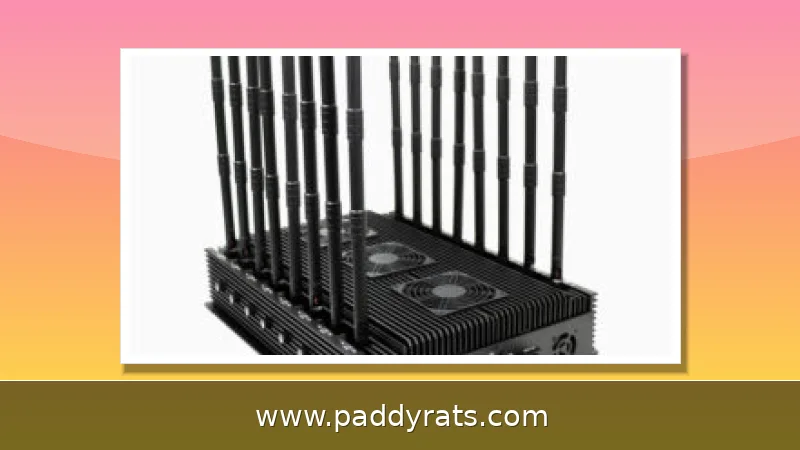
These aren't the kind of thing you pick up at a big-box store. A high-power portable full-band jammer usually starts at a nominal RF transmission power of 50W, and it does that with 15 or more RF modules working together, which adds up to somewhere between 600W and 1000W of combined module output. Now factor in efficiency: at roughly a 1:3 ratio of RF output to power consumption, the whole unit pulls about 2000 to 3000W. That's the part people miss. Once you're drawing that much juice, the hard problems stop being about radio and start being about batteries and heat, and those two constraints end up shaping the entire design.
How Does Wideband RF Jamming Work?
RF jamming comes down to a simple power play: the jammer broadcasts on the same frequency as the target signal, but at a higher power, so the receiver ends up locking onto the jammer's transmission instead of the real one. This drops the signal-to-noise ratio at the receiver. In plain terms, the jammer floods the air with an electromagnetic disturbance — basically engineered noise — strong enough that the target receiver can no longer tell the actual signal apart from the background.
How well that attack works usually comes down to the jam-to-signal (J/S) ratio. The higher the J/S ratio, the more the jammer dominates at the receiver's front end. This is also where LNA gain compression matters: if enough interference hits the low-noise amplifier, it can be driven into saturation, and once that happens, even a strong legitimate signal can't be recovered.
Research keeps pushing this principle further, though. UWB electromagnetic pulse jamming is now being talked about as a new class of electromagnetic attack, one that stands apart from the traditional barrage and deception approaches. In a 2023 study by Li Yonglong and his co-authors, a single 0.7 ns pulse was enough to suppress a navigation signal by nearly 400 ns after the LNA, and once the pulses were repeated, suppression became complete. The mechanism here is fundamentally different from just throwing more power at the problem.
Jamming Techniques: Noise, Barrage, Spot and Deceptive
Not every jammer floods the spectrum in the same way. Barrage jamming spreads noise across a wide frequency range, which lets it disrupt several channels at once. Spot jamming, by contrast, focuses on a single specific frequency. Then there's noise jamming, which simply sends out continuous noise. Deceptive jamming works differently — instead of drowning out the target, it feeds it misleading signals, confusing the receiver without fully blocking it.
There are a couple of other techniques worth knowing about, too. Sweep and frequency-hopping jamming take a narrowband signal and spread it across the spectrum, which produces a wideband effect without actually transmitting across the whole range at once. Selective jamming, by contrast, goes after specific frequencies or devices rather than blanketing everything. Adaptive jamming takes this idea even further: it reads the signal strengths it detects and adjusts its own parameters on the fly.
The table below breaks down how the main jamming techniques compare in terms of coverage, mechanism, and typical use.
Power, Bandwidth and Average Power per MHz
Total wattage is mostly a marketing number. What really decides performance on any given band is average power per MHz — that is, total power divided by bandwidth. Take a 100W jammer spread across 2400–2500MHz: it puts out 1W/MHz. Spread that same 100W across 2000–2700MHz, though, and you're down to just 0.14W/MHz. Same amplifier, but the punch it lands is dramatically different.
Most jammer modules put out either 50W (47dBm) or 100W (50dBm) across the entire band they cover. So if you take a 100W module and spread it over a 700MHz span, you're really only getting about 0.14W per MHz on any given channel within that range. That's the trade-off in a nutshell: wide coverage and long range don't usually fit inside the same box.
This is the core reason a high-power wideband jammer may not always outperform a lower-power targeted approach. If the jamming signal is better matched to the target's bandwidth, signal pattern or protocol, a fraction of the power can do more damage than a broadband blast. Energy spread over a wide band is diluted, and dilution is the enemy of range.
What Determines Jammer Range and Effective Coverage?
Range depends on several interacting factors, and no single spec tells the whole story. Output power is the obvious one: higher transmitter power generally increases interference range. Operating frequency matters too, because higher frequencies tend to have shorter propagation distances while lower frequencies reach farther for the same power.
Antenna performance is the second lever. Higher gain and more directional antennas extend interference distance, which is why military jamming platforms pair modest transmitters with large log-periodic or wideband dipole arrays. Environment is the third: obstacles, building attenuation and stronger competing signals all reduce the effective interference area.
Installation and placement quietly decide more outcomes than spec sheets admit. Elevated, line-of-sight positions with clear paths to the target outperform higher-power units stuck behind terrain or concrete. The table below breaks down the main range factors and how each one moves the result.
Specifications and Comparable Hardware
Real-world hardware specs show how these principles translate into products. Trival Antene, a military jamming antenna maker, offers the AD-10/D wideband dipole covering 450-3000 MHz at 1-2.5 dBi and 500-200 W, the AD-22/G log-periodic covering 400-6000 MHz at 8 dBi and up to 2750 W, and the AD-22/F log-periodic covering 1-6 GHz at 9-11 dBi and up to 1.7 kW. Antenna choice often matters more than amplifier choice.
On the system side, Thales builds an electromagnetic attack jammer with wideband VHF/UHF/SHF coverage, high power above 1 kW, and a modular architecture that covers up to 500 square meters while projecting effects 15 km beyond the front line. Shoghi Communications in India offers a VHF/UHF frequency hopping jamming system spanning 30 MHz to 3 GHz, with a 12 km operational range on land, the ability to jam up to 20,000 hops per second and up to 10 networks simultaneously, plus upgrade paths for SATURN and LINK-16 bands.
For fixed installations, the Hocell JD-F0601E intelligent high power outdoor signal jammer blocks 2G/3G/4G/5G plus optional WLAN and GPS, with remote monitoring via built-in Ethernet, per-band power control, LED status indicators, a die-casting chassis with intelligent heat dissipation, and rainproof and lightning protection for indoor and outdoor use. Its signaling-level interference and adaptive algorithms use TD-LTE/TD-SCDMA baseband decoding synchronization to jam only downlink slots, achieving zero interference to TDD base stations while tracking GSM carrier signals to reduce useless transmission power.
Smaller and more specialized units fill out the market. Stratign's drone jammer detects, locates, identifies and disrupts UAV navigation and data links up to 1000 m. Foshan Anlong Communication Equipment produces anti-drone and power amplifier modules, including a 100W wideband module for stadiums and large events designed to block drone ground station signal transmission, plus a 3100-3300MHz 32V 100W N female wideband drone FPV/UAV generator and a 1700-1800MHz 1.8GHz sweep source 100W drone jammer module. Jammer Master lists consumer-facing pricing such as the Desktop 5G Cellular Signal Jammer JM006 at $1,839.99, the Handheld 16-antenna JM018 at $699.00, the 4G JM021 at $520.00 and the High-Power Portable JM022 at $780.00.
Military, Law Enforcement and Security Applications
Military use centers on denying the enemy reliable communications and navigation. Wideband systems like the Thales electromagnetic attack jammer are built to cover VHF/UHF/SHF simultaneously, and frequency hopping jammers such as Shoghi's are designed specifically to defeat FHSS radios that would otherwise slip away from a fixed-frequency attack. Radio reconnaissance and jamming stations from Shoghi cover 25 to 1000 MHz with audio monitoring, technical analysis, monopulse bearing finding and signal scanning, combining detection and disruption in one platform.
Law enforcement and corrections use jammers to cut off contraband communications. Fixed installations like the Hocell JD-F0601E are aimed at prisons and secure facilities where cellular access must be denied without disrupting legitimate TDD base stations nearby. The selective, downlink-only approach exists precisely because blanket jamming in populated areas causes unacceptable collateral interference.
Counter-drone work has become the fastest-growing category. Stratign's systems detect, locate, identify and disrupt UAV navigation and data links up to 1000 m, while Anlong's 100W wideband modules target drone ground station signal transmission at stadiums and large events. The signal jammer market reflects that demand: it was estimated at USD 1.8 billion in 2026 and is expected to reach USD 3.6 billion by 2033.
Legality remains the hard boundary. In the United States, transmitting jamming signals is prohibited under federal communications law, and equipment may not be marketed, sold or operated by the public. Authorized government and military users operate under strict licensing, and even then, coordination is required to avoid interfering with protected spectrum. Anyone evaluating this hardware should treat legal authorization as the first specification, not an afterthought.
FAQ: Wideband Jammer Power, Range and Legality
The questions below cover the points readers ask about most often when comparing high power wideband frequency jammers, from how the technology works to what actually limits range and where the legal lines sit.
Frequently Asked Questions
How does a high power wideband frequency jammer work?
It transmits high-powered radio signals across a broad spectrum, raising noise above the legitimate signal so receivers cannot decode it. Techniques include noise, barrage, spot and deceptive jamming. Effective results depend on output power, frequency coverage, antenna gain and the target signal's strength.
What determines the jamming range of a wideband jammer?
Range depends on output power, operating frequency, antenna gain, target signal strength, obstacles and installation. Higher frequencies generally travel shorter distances than lower ones. Average power per MHz matters more than total power, since energy spread over a wide band is diluted.
Why is average power per MHz important for wideband jammers?
Total power is divided across the covered bandwidth. A 100W jammer over 100MHz gives 1W/MHz, while 100W over 700MHz gives only 0.14W/MHz. Concentrated energy produces longer effective range on the targeted band than the same total power spread wider.
How much power do high power portable signal jammers need?
Practical high-power full-band portable jammers are described as having 50W or more RF transmission power with 15 or more RF modules, giving combined output of 600W to 1000W. At a 1:3 RF-to-consumption ratio, total consumption is roughly 2000-3000W.