A 5G signal jammer floods cellular bands with RF noise to cut the link between phones and towers. Here is how the hardware works, what it costs, and why the FCC calls it illegal.
What Is a 5G Signal Jammer and What Does It Block?
A 5G signal jammer is exactly what it sounds like: a device that deliberately floods the same radio bands your phone uses for 5G—and older networks too—with RF noise, cutting off the voice, SMS, and data links between handsets and cell towers. Think of it as a denial-of-service attack at the radio level. It doesn't hack into your phone; it just drowns out the real signal until the phone can't hear the tower anymore. Companies like Hocell sell plug-and-play digital units that they say can cover as many as twelve 2G, 3G, 4G, 5G, and Wi-Fi bands in a single box.
Jamming itself isn't anything new. These devices got their start in military and law enforcement work, where the goal was countering threats like cell-phone-triggered explosives or hostage situations—moments when cutting off communications is a tactical necessity, not a convenience. But the same physics that protects a convoy can just as easily let a school, a theater or an exam hall silence every handset in range. That overlap is exactly why regulators come down so hard on the consumer market.
The frequencies a jammer goes after are, for the most part, the same ones your phone relies on every day. Vendors typically list cellular bands like 700MHz, 800MHz, 900MHz, 1800MHz, 1900MHz, and 2100MHz, along with the newer 2300–2675MHz and 3400–3600MHz ranges that carry 5G traffic. GPS is a different story — it sits closer to 1575MHz — while Wi-Fi operates up at 2.4GHz and 5GHz.
The simpler jammers only target a single frequency, and that alone is often enough to make a phone think there's no service at all. The more advanced ones go further: they use protocol jamming to mess with the control channels that handle handovers and paging, which means the handset can't ever get a solid lock on the network in the first place.
How Do 5G Signal Jammers Work?
Every jammer follows the same basic logic: it transmits RF noise on the very frequencies a telecommunications device relies on, then lets raw power do the rest—drowning out the original signal coming from a cell tower or satellite. Since the phone can't tell the noise apart from the legitimate downlink, it simply drops the connection. What you end up with is a local dead zone that looks and feels like a coverage hole, not a full network outage.
According to vendor documentation and academic write-ups, there are two main working principles. The first is high-power suppression, where a broad blast of energy just buries the carrier signal underneath. The second is signaling-level intelligent jamming, which actually reads the network's framing and interferes selectively rather than blanketing the whole spectrum. That second approach ends up being more efficient and causes less collateral interference.
Hocell's digital 5G cellular jammer shows what the smarter end of this market actually looks like. Instead of just blasting noise across a band, it relies on TDD baseband decoding synchronization and high-precision switches to tell the difference between uplink and downlink time slots. The jamming signal only goes out during the downlink slots. That's the whole trick: it avoids stepping on the operator's base stations while still cutting off service to the handsets sitting inside the target area.
In enterprise deployments, management features can matter just as much as raw power. Hocell's unit lets you monitor everything centrally over the internet using standard TCP/IP, configure it from a local PC, control each frequency channel independently, and even add an optional infrared remote with a timing function. For a facilities team, that last part is a big deal — you can set the device to run only during exams, hearings, or screenings instead of leaving it on all day.
Key Specifications: Bands, Power, Range and Antennas
Spec sheets are where the marketing talk runs into physics. Hocell lists a twelve-band setup that covers the older cellular ranges along with the Wi-Fi bands, and you can have the band coverage customized when you order. The table below pulls together the published numbers for that digital 5G jammer.
| Parameter | Published specification |
|---|---|
| Jamming frequencies | 869-880MHz, 930-960MHz, 1805-1880MHz, 1880-1920MHz, 2010-2015MHz, 2110-2170MHz, 2300-2390MHz, 2515-2675MHz, 3400-3600MHz, 2400-2485MHz (Wi-Fi), 5130-5330MHz (Wi-Fi), 5725-5835MHz (Wi-Fi); bands customizable |
| Max output jamming power | Wi-Fi 30±2dBm; other systems ≥33dBm (carrier signal strength ≥-75dBm) |
| Jamming distance | Greater than 10 meters when RSSI is at least -70dBm |
| Antennas | Integrated directional or omnidirectional |
| Interfaces and power | Power and Ethernet for debugging; AC 220V to DC 24V adaptor; consumption ≤110W |
| Weight and dimensions | 4.5kg; 333 x 245 x 70mm |
| Typical venues | Conference rooms, courts, churches, libraries, schools, exam rooms, cinemas, hospitals, gas stations, oil depots, securities and command centers |
Range is the spec everyone zeros in on, and it's also the one that misleads the most. The reach a manufacturer prints depends on three things: how much power the jammer has, what kind of antenna it's using, and how crowded the airwaves are around it. Hocell, for instance, rates its jamming distance at more than 10 meters when the RSSI sits at -70dBm or better — but the same company notes that the effective radius can drop from 10 meters down to 5 as conditions shift. Put a concrete wall in the way, or park yourself near a strong cell tower, and that number falls off in a hurry.
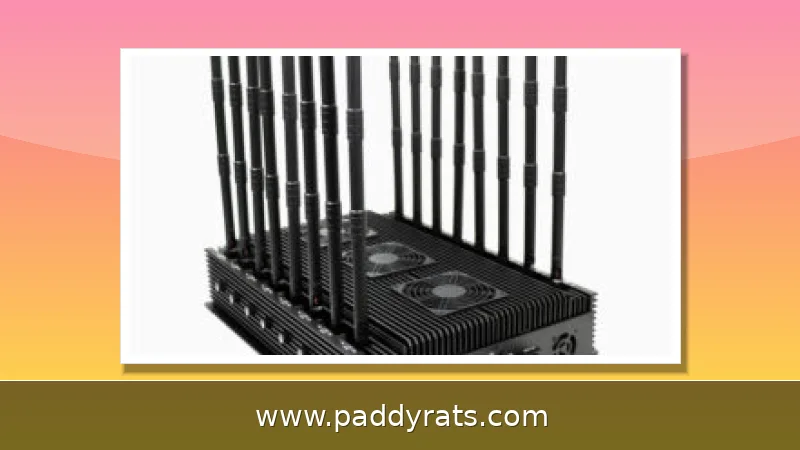
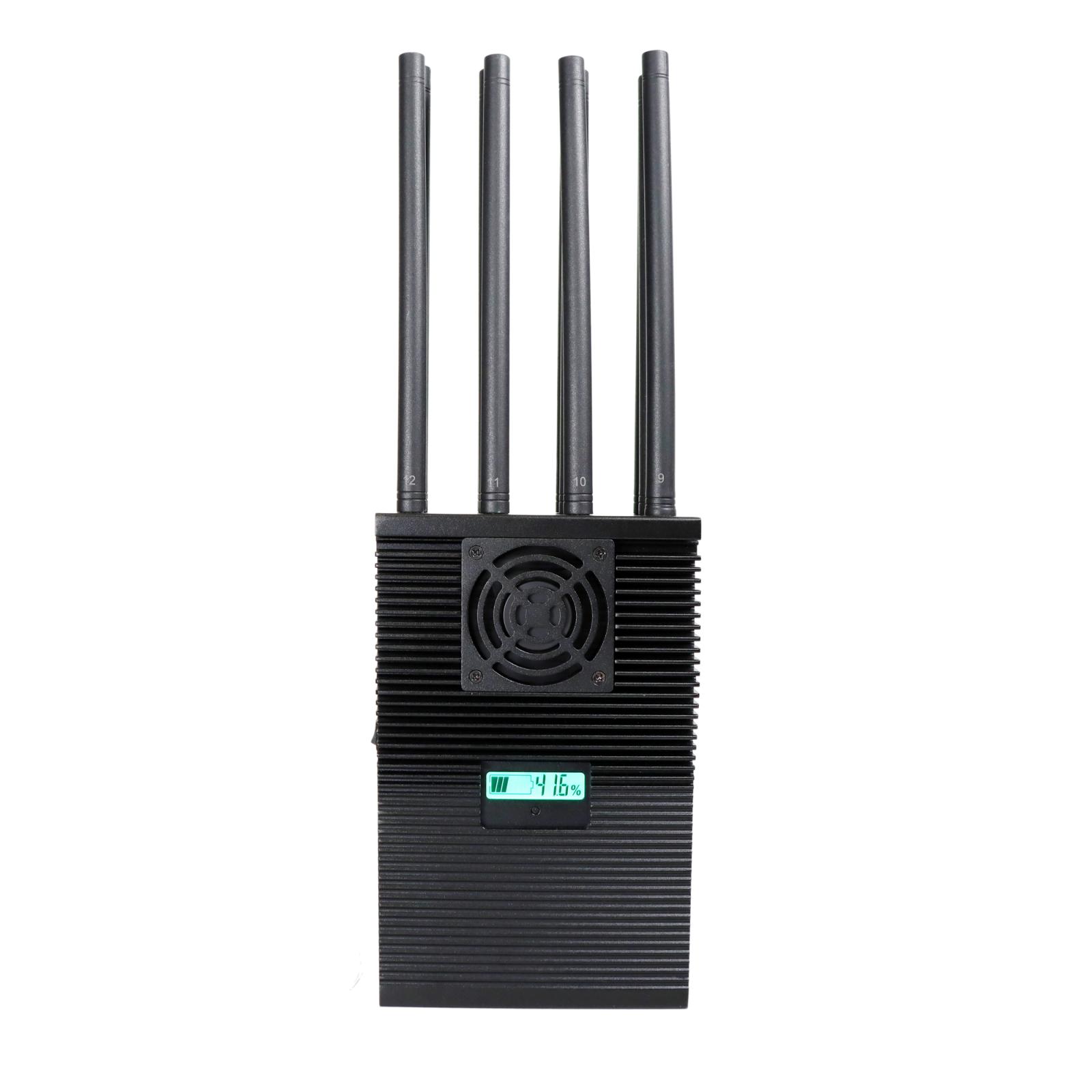
Power ratings are all over the place in this category. Hocell's product page, for instance, lists maximum jamming power per radio frequency anywhere from 1W to 100W, while still claiming the device won't interfere with base stations. If you look at third-party marketplace listings, the range in both price and capability becomes pretty obvious: a Stalker 5G 12-band portable unit with twelve antennas goes for $850, an HPJ1000-5G desktop jammer runs $999, and an HPJ20-H all-frequencies desktop model covering 130 to 5900MHz costs $2,190. Then there's the cheaper end of things—an Alligator 10-band 10W unit at $720, an Albatross Pocket 3G/GPS/GSM jammer at $179, a GP5000 car anti-tracking GPS blocker at $119.99, a Colibri Y3 portable 2.4/5.8GHz Wi-Fi and Bluetooth mini jammer at $250, an Altron-4 4-band 35W unit at $840, and a Spectrum handheld wide-range drone jammer at $2,250. As for compact mobile phone silencers, they're usually quoted at 8 to 15 meters of coverage.
Types of Jammers: Portable, Desktop, Drone and Wi-Fi
Not every jammer is a rack-mounted box in a server room. The market splits into a few recognizable form factors, each with a different use case and a different legal exposure. Portable signal jammers are handheld and battery-powered with short range, which makes them easy to carry and easy to misuse.
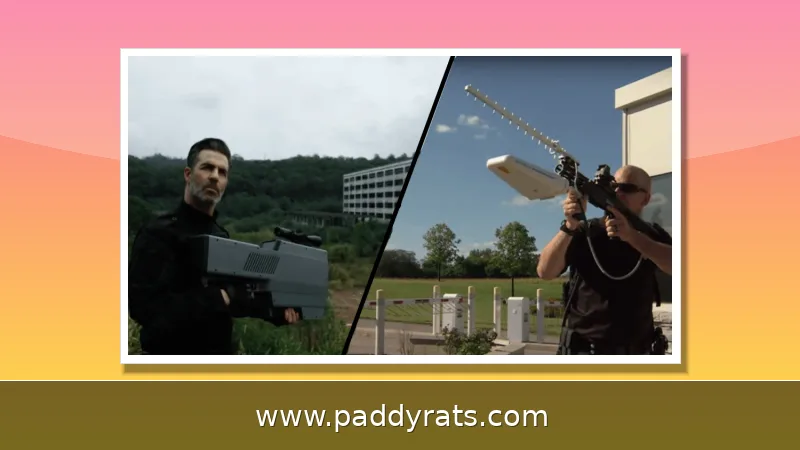
Drone signal jammers target the ISM bands and navigation signals a quadcopter relies on, forcing the aircraft into a failsafe hover or a return-to-launch sequence. Wi-Fi jammers cover the 2.4GHz and 5GHz bands and knock out wireless LAN access rather than cellular service. Cell phone jammers span roughly 700MHz to 2100MHz and block voice, SMS and mobile internet in one shot.
Price points track the form factor closely. Jammer Master's catalog lists a 4G phone jammer JM021 at $520, a handheld 16-antenna mobile phone jammer rated to 25 meters at $699, a handheld Wi-Fi and Bluetooth jammer covering 2.4/5.2/5.8GHz at $569.99, and a built-in directional antenna drone UAV jammer at $2,399.99. Those numbers are marketplace listings, not recommendations, and none of them change the regulatory picture.
For anyone evaluating hardware, the practical question is not which unit is strongest but what the installed environment actually needs. A conference room, a courthouse and a prison wing have very different coverage requirements, and a device that is overpowered for the space creates interference well beyond the property line.
Upgrading Old Jammers for 5G Phones
Plenty of organizations bought jammers years ago and now find they do not touch 5G handsets. The first step is an inventory check: confirm whether the old unit is still serviceable, identify its model and manufacturing location, and contact the original manufacturer about upgrade paths. Documentation and spare parts availability vary enormously between brands.
Age is the deciding factor. Jammers bought four to five years ago often have no upgrade options at all, because most manufacturers only started reserving internal space for upgrade modules two to three years ago. If the chassis has no room for additional boards, the honest answer is that the device will keep blocking 2G, 3G and 4G signals and nothing more.
There is an external workaround, but it is clumsy. You can add a dedicated full-band 5G jammer next to the existing device, which generally only works with standalone models that can accept an extra power supply. Network-version jammers are hard to integrate this way because their control and power architecture is not designed for bolt-on hardware.
This upgrade treadmill is one reason the enterprise jamming market keeps churning. Each new band generation forces a hardware refresh, and the resale value of a 4G-era unit collapses the moment 5G coverage becomes the default in a given region.
Is a 5G Signal Jammer Legal? FCC Rules and Penalties
No. The FCC warns that using a phone jammer, GPS blocker or any other signal jamming device to intentionally block, jam or interfere with authorized radio communications violates federal law, and there are no exemptions for business, classroom, residence or vehicle use. The restriction is not a gray area that a private property argument can solve.
It is also illegal to sell, advertise, distribute or operate cell signal jammers in the United States and much of the world. Advertising, selling, distributing, importing or marketing RF jamming devices to non-federal entities in the United States is unlawful on its own, separate from whether anyone ever switches the device on. Radio frequencies are protected under The Communications Act of 1934.
The penalties are real. Unauthorized users may face substantial civil penalties, seizure of the illegal equipment and criminal sanctions including imprisonment. The FCC's stated concerns go beyond commercial disruption: jammers can block 9-1-1 and other emergency calls and interfere with law enforcement communications, which is why the agency treats the category as a public safety matter rather than a consumer electronics question.
Detection is the other half of the risk story. Regulators and carriers can identify jamming through spectrum monitoring and interference complaints, and a jammer that bleeds outside its intended footprint tends to generate exactly that kind of complaint. For anyone weighing a purchase, the compliance answer is straightforward even if the technology is interesting.
What About Jamming Detection and Real-World Enforcement?
Enforcement usually starts with a complaint, not a raid. When a cell site reports interference or a venue's neighbors notice dropped calls, carriers and regulators can deploy spectrum monitoring equipment to locate the source. Directional antennas make that triangulation faster than most people assume.
Detection also comes from the network side. Carriers track abnormal uplink noise floors and failed handover patterns, and a persistent localized anomaly is a strong signal that something is transmitting where it should not be. Because jammers affect every handset in range, the evidence trail tends to be broad rather than subtle.
For enterprises, the safer path is to solve the underlying problem instead of jamming it. Managed Wi-Fi with proper access control, physical device policies, RF-shielded rooms for sensitive meetings, and lawful signal boosters where coverage is genuinely weak all achieve the operational goal without creating federal liability.
That trade-off is the real takeaway. The hardware is well documented, the specs are public, and the prices are easy to find, but the legal exposure is the part that actually decides whether a 5G signal jammer belongs anywhere near a commercial deployment.
Frequently Asked Questions
What is a 5G signal jammer?
A 5G signal jammer is a device that deliberately transmits radio frequency noise on the same bands used by 5G and other cellular networks, disrupting voice, SMS and data links between phones and base stations. Enterprise models such as Hocell's digital 5G jammer are plug-and-play and can cover up to twelve 2G, 3G, 4G, 5G and Wi-Fi bands.
How does a 5G signal jammer work?
Jammers work by transmitting RF noise on the same frequencies as cell phones, a denial-of-service attack that overpowers legitimate signals from towers. Two common principles are high-power suppression and signaling-level intelligent jamming. Advanced units use TDD baseband decoding synchronization so jamming signals are sent only in downlink time slots, avoiding interference to operator base stations.
Are 5G signal jammers legal?
No. The FCC states that using a phone jammer, GPS blocker or similar device to interfere with authorized radio communications violates federal law, with no exemptions for business, classroom, residence or vehicle use. Unauthorized users may face civil penalties, equipment seizure and criminal sanctions including imprisonment; advertising, selling, distributing or importing jammers to non-federal entities is also unlawful in the United States.
How far can a 5G signal jammer reach?
Range depends on power source and location. Portable jammers can cover roughly 30 feet, while larger devices may reach up to 1 mile. Hocell's digital 5G jammer specifies a jamming distance greater than 10 meters when RSSI is at least -70dBm, and the shielding radius can shrink from 10 meters to 5 meters as conditions change.