Federal law bans jamming devices for private users, yet a narrow set of government agencies may deploy them under strict authorization. Here is how authorized deployment actually works, which frequencies drone jammers hit, and what unauthorized use now costs.
What Are Authorized Signal Jammer Deployment Rules?
Authorized signal jammer deployment rules are really just narrow legal exceptions that allow certain government agencies to transmit interference on purpose. The default rule is simple: it's banned. Under the Communications Act of 1934 — specifically 47 U.S.C. 301, 302a, and 333 — the FCC prohibits operating, marketing, or selling any device built to block, jam, or interfere with authorized radio communications. Anything else in this space amounts to an exception stacked on top of that ban, whether it comes from a statute, federal authorization, or agency certification.
That distinction matters, because "authorized jammer" gets tossed around like it's a product category. It isn't. The exact same hardware a certified federal team can legally power up is contraband if it's sitting in a private office or the trunk of your car. What makes it legal is who's operating it and why—not what's inside the box. In practice, the rules cover four things: who's allowed to operate the equipment, which frequencies and power levels they can use, what testing and paperwork have to be in place, and what consequences follow when someone breaks the rules.
Who Can Legally Operate a Signal Jammer?
Federal authority here is actually pretty narrow — only a handful of agencies can operate jammers legally. The core group includes the Department of Defense, the Department of Homeland Security (CBP and the Secret Service fall under this), the Department of Justice (including the FBI), the Department of Energy, and the Coast Guard. Within that structure, you've also got the FBI's National Counter-UAS Training Center down in Huntsville, Alabama, along with JIATF-401, which put out updated guidance in January 2026. But these two aren't licensing bodies with independent authority — they function more as training and coordination hubs that support the agencies already on the authorized list.
The SAFER SKIES Act, which got folded into the FY2026 NDAA, is the first change in a while that actually widens the circle of who's allowed to jam. Under it, state and local law enforcement can now operate jammers once they've gone through FBI training, and the same goes for correctional agencies that meet certification requirements and agencies tasked with protecting National Special Security Events. At the same time, though, the FEMA C-UAS Grant Program holds a pretty hard line: you can't use grant money to buy weapons, and mitigation equipment stays off-limits unless you're certified law enforcement.
For anyone else, the answer is no. A school, a landlord, a retailer, or a rideshare driver can't just decide to jam signals on their own because something is bothering them. India's system is a useful comparison here: approved jammer models, like those from ECIL and BEL, are tied to specific institutional users rather than sold to whoever walks in off the street. Authorization works like a chain of custody, running from the statute down to a certified operator, and that chain snaps the moment someone without certification takes control of the device.
How Do Drone Jammers Work and Which Frequencies Do They Target?
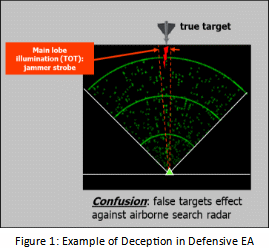
A drone jammer is essentially an RF transmitter built to drown out the link between a drone and whoever's flying it. It blasts a powerful signal on the same frequencies the aircraft relies on for command, control, video, and navigation, so the drone's receiver can't tell the real signal apart from all that noise anymore. At that point, most flight controllers drop into a fail-safe mode—returning to launch, hovering in place, or descending. And modern jammers seldom stick to just one band; they usually sweep several at the same time.
Target selection is what separates a blunt instrument from a controlled one. Smart jamming systems use directional antennas to focus energy toward the detected target, and they can jam only the specific bands that drone is actually using rather than flooding everything at once. Airsight's Smart and Autonomous Jammer is a good reference design here: it offers 360-degree coverage out to 1.9 miles, operates across the key drone frequency bands, supports both manual and automatic activation, and can be mounted on fixed positions, tripods, or vehicles, with integration into the AirGuard detection platform.
Here's a breakdown of the frequency bands you'll run into and what each one actually controls.
| Band | Primary Use | Jamming Effect |
|---|---|---|
| 433 MHz / 900 MHz | Commercial and DIY control links | Breaks low-cost remote control |
| 1.2 GHz / 1.5 GHz | Video transmission and telemetry | Cuts live feed and data backhaul |
| 2.4 GHz / 5.8 GHz | Primary command-and-control (DJI and most commercial drones) | Forces fail-safe or loss of control |
| GNSS bands (GPS, GLONASS, Galileo, BeiDou) | Navigation and positioning | Disrupts waypoint and return-to-home logic |
Interference range isn't some fixed number you can just look up. It really comes down to four things: output power, operating frequency, antenna performance, and whatever's going on in the environment around you. Higher frequencies don't travel as far, while lower ones can reach much farther out. Antennas with higher gain and more directional focus will push that effective distance further, but obstacles and building attenuation will cut it right back down. This is exactly why two jammers with the same wattage can behave completely differently depending on whether you're in a stadium parking lot or out on an open airfield.
What Technical Requirements and Testing Apply to Authorized Jammers?
Authorized jammers have to meet real engineering limits — the kind of stuff unauthorized devices simply ignore. For one thing, output power has to be controlled, since that's what keeps the interference range inside whatever footprint you're actually authorized to cover. The equipment also has to stay within its specified frequency ranges, in line with spectrum management rules, and it needs enough immunity to outside interference that it won't start acting unpredictably in a crowded RF environment. On top of that, testing is supposed to be done by authorized or regulatory bodies, not just by the vendor that's selling the thing.
Emission measurement uses calibrated test equipment, spectrum analysis relies on a spectrum analyzer or scanning receiver, and immunity testing uses simulated interference or injected test signals. The relevant standards stack is well established: MIL-STD-461 for US military equipment, the IEC 61000 series including the IEC 61000-6-x family, CISPR standards such as CISPR 11 and CISPR 22, and FCC rules. Office jammers follow a related logic at much lower power, flooding local frequencies with radio noise so spy equipment cannot hold a stable connection, targeting LTE, 5G, and 2.4/5.8 GHz wireless networks.
| Requirement | Purpose | Typical Evidence |
|---|---|---|
| Output power control | Limit interference range | Power calibration records |
| Frequency confinement | Stay within assigned spectrum | Spectrum analyzer plots |
| Immunity to external interference | Predictable behavior in dense RF | Injected-signal test results |
| Independent testing | Verify vendor claims | Regulatory or authorized lab reports |
One practical detail I have seen trip up procurement teams: adjustable power outputs per frequency band are not a convenience feature, they are a compliance control. A jammer that cannot be tuned down cannot be deployed near a hospital, an airport, or a public safety network without creating exactly the collateral interference the rules exist to prevent. Effective radius also varies with nearby cellular tower signal strength and wall materials, so site surveys matter as much as spec sheets.
What Are the Legal Penalties for Unauthorized Jamming?
Federal penalties are steep and per-incident. FCC violations carry fines up to $112,500 per incident plus potential criminal prosecution, which means a device left running for days can generate exposure far beyond its purchase price. States have moved in parallel, and the trend is toward criminal rather than administrative treatment. California SB 701, chaptered on October 7, 2025, makes it a crime to manufacture, import, market, purchase, sell, or operate a signal jammer unless authorized by the FCC.
California's penalty ladder is worth reading closely. A first offense is an infraction; a second offense is a misdemeanor. Operating a jammer in conjunction with a misdemeanor or felony is punishable by a fine up to $1,000 or imprisonment. Willful or malicious use to block state or local public safety communications, if likely to result in death or great bodily injury and such injury occurs, is punishable as a misdemeanor or felony. Forfeiture of the device is required upon conviction, so the hardware does not come back.
Indiana Senate Bill 26 of 2025 makes it a Level 6 felony to knowingly or intentionally use a device to interfere with, block, or jam cellular, Wi-Fi, radio, or GPS signals. The charge can be elevated to a Level 5 felony if the interference disrupts critical infrastructure or public safety agency communications, and possession with intent to use is a Class A criminal misdemeanor. Georgia has added a state-level felony banning manufacture, sale, possession, and use, with fines up to $10,000.
| Jurisdiction | Offense | Penalty |
|---|---|---|
| Federal (FCC) | Unauthorized operation, marketing, or sale | Up to $112,500 per incident plus criminal prosecution |
| California SB 701 | First offense / second offense | Infraction / misdemeanor; device forfeiture on conviction |
| Indiana SB 26 | Knowing interference with cellular, Wi-Fi, radio, or GPS | Level 6 felony; Level 5 if critical infrastructure or public safety hit |
| Georgia | Manufacture, sale, possession, or use | State felony with fines up to $10,000 |
What Are Legitimate Application Scenarios for Signal Jammers?
The legitimate use cases all share one trait: they protect a defined perimeter or event rather than a private commercial interest. Authorized users prevent drone incursions over restricted airspace, block contraband device communication inside correctional facilities, and support layered physical-electronic security at high-value sites. Smart jamming versus blind jamming is the operational distinction that makes this tolerable: directional antennas and selective frequency targeting reduce collateral interference, which is the whole reason regulators allow the practice at all.
The contrast with unauthorized use is stark. Unauthorized jamming interferes with emergency communications, disrupts public services, violates the privacy and rights of individuals, and can disrupt nearby aircraft or knock out wireless infrastructure. A jammer that looks surgical on a spec sheet becomes a public safety hazard the moment it is aimed without coordination.
Market context explains why enforcement is tightening rather than loosening. The signal jammer market was valued at $2.8 billion in 2025 and is projected to reach $5.6 billion by 2034, growing at an 8.1% CAGR. A second source projects growth from $4.98 billion in 2026 to $9.27 billion by 2034, also at 8.1% CAGR. Terminology in this space is loose, so expect to see signal jammer, RF jammer, cell phone jammer, mobile phone signal blocker, GPS blocker, drone jammer, office jammer, cellular signal jammer, jamming device, RF jamming equipment, and signal suppression used interchangeably.
If you are evaluating a deployment, the compliance sequence is straightforward. Confirm the operator holds the required authorization, verify the device has documented power and frequency controls, check that testing was performed by an authorized or regulatory body, and confirm the site survey accounts for nearby public safety and aviation infrastructure. Skip any of those steps and the exposure is not just regulatory; it is criminal in a growing number of states.
How Do You Stay Compliant When Jamming Is Not an Option?
Most organizations that want jamming cannot legally have it, so the practical path is detection and coordination instead. RF signal detection and geolocation tools from vendors such as Hocell let a site identify an intruding drone or a hidden transmitter without transmitting interference, and that evidence can be handed to law enforcement that does hold authorization. This is the model the FEMA C-UAS Grant Program effectively pushes: buy detection and mitigation support for certified personnel, not weapons.
For office environments, the same logic applies to counter-surveillance. A Prodefence office jammer or similar low-power device is marketed as a way to flood local frequencies and stop spy equipment from holding a connection, but operating one without FCC authorization is still a violation regardless of intent. Detection, physical sweeps, and policy controls carry none of that legal risk. If a genuine threat exists, the compliant move is to document it and route it to an authorized agency rather than self-help.
One last point on procurement: ask vendors for the authorization pathway in writing. Reputable suppliers of authorized equipment can explain which agencies may operate the product and under what certification. If a seller markets a jammer to private buyers with no authorization discussion, that is a signal about the product's legal posture, not a bargain.
What Should Buyers and Operators Verify Before Deployment?
Verification is where authorized deployment rules become operational rather than theoretical. Before any device is switched on, the deploying agency should be able to produce the statutory or certification basis for its authority, the specific frequency ranges and power limits approved for the site, and the test documentation showing the equipment meets those limits. Without those three items, the deployment is unauthorized no matter how legitimate the mission feels.
Documentation should also cover the fail-safe behavior of the target systems and the coordination record with local public safety and aviation authorities. Because interference range varies with antenna gain, terrain, and building attenuation, the approved footprint should be based on a site survey rather than a datasheet maximum. Re-verify after any hardware change, firmware update, or relocation, since each of those can move the device outside its authorized envelope.
Finally, treat device forfeiture as a real operational risk. California requires forfeiture upon conviction, and federal enforcement can seize equipment as part of a violation case. Agencies that document authorization, testing, and coordination up front are the ones that can answer an FCC inquiry in hours instead of months. That paperwork is not bureaucracy; it is the difference between a lawful counter-drone program and a criminal exposure.
How Is the Enforcement Landscape Changing?
Two forces are moving in opposite directions. On one side, the SAFER SKIES Act and updated JIATF-401 guidance from January 2026 are expanding who may lawfully operate jamming equipment, adding trained state and local law enforcement, certified correctional agencies, and agencies protecting National Special Security Events. On the other, states like California, Indiana, and Georgia are criminalizing private manufacture, sale, possession, and use with felony exposure and five-figure fines.
The result is a sharper line rather than a looser one. Authorized operators gain clearer legal footing and better training pipelines through the FBI's National Counter-UAS Training Center in Huntsville, while unauthorized users face penalties that now include device forfeiture and, in the worst cases, felony charges tied to public safety harm. The compliance burden shifts onto documentation, certification, and coordination.
For anyone tracking this space, the practical takeaway is that authorization is the product. Hardware from Airsight, Hocell, Prodefence, ECIL, or BEL is only as lawful as the operator holding it and the paperwork behind it. Read the statute before the spec sheet, and confirm the authorization pathway before the purchase order.
Frequently Asked Questions
Who is legally allowed to operate a signal jammer in the United States?
Under federal law, only authorized government entities may operate RF jamming equipment. That includes the Department of Defense, DHS, DOJ, Department of Energy, and Coast Guard. The SAFER SKIES Act in the FY2026 NDAA newly authorizes state and local law enforcement after FBI training, correctional agencies meeting certification, and agencies protecting National Special Security Events.
What frequencies do drone jammers target?
Modern drone jammers target multiple bands simultaneously: 433 MHz and 900 MHz for commercial and DIY control systems, 1.2 GHz and 1.5 GHz for video and telemetry, 2.4 GHz and 5.8 GHz for primary command-and-control, and GNSS bands including GPS, GLONASS, Galileo, and BeiDou to disrupt navigation and positioning.
What are the penalties for unauthorized signal jamming?
FCC violations carry fines up to $112,500 per incident and potential criminal prosecution. Under California SB 701, unauthorized manufacture, sale, or operation is an infraction for a first offense and a misdemeanor for a second. Indiana makes use a Level 6 felony, elevated to Level 5 if critical infrastructure or public safety communications are disrupted.
What technical requirements apply to authorized jamming devices?
Authorized jammers must operate only under specific authorization, provide output power control to limit interference range, operate within specified frequency ranges per spectrum management rules, and show sufficient immunity to external interference. Testing should be performed by authorized or regulatory bodies using calibrated equipment, spectrum analysis, and injected-signal immunity tests.