Faraday bags passively seal a device off from wireless signals and are legal to own, while signal jammers actively blast radio noise and are illegal for civilians in the US. Here is how each one works, what they actually block, and which fits your threat model.
What Is a Faraday Bag and How Does It Work?
Think of a Faraday bag as a passive shield, not a device. There's no battery inside, no antenna, no transmitter—so it isn't broadcasting anything, and it won't mess with the networks around you. What it does is use conductive materials like copper, silver, or aluminum mesh and fabric to spread electromagnetic energy across the bag's outer surface, where eddy currents and electrostatic induction cancel out incoming fields. The whole idea traces back to Michael Faraday, the 19th-century scientist who showed that a conductive enclosure can shield whatever you put inside it.
The real engineering challenge here is the enclosure itself. A Faraday bag only does its job when the conductive layer wraps around a device as one continuous, gap-free shell. Even a slit as thin as a human hair is enough for radio waves to sneak through, which is why the RF-tight seal at the closure matters far more than how thick the fabric is. I've watched a phone fall off its network the second the flap was folded over and secured, then jump right back to full bars once it was opened again. Honestly, that little back-and-forth tells you everything you need to know about how these bags work.
Since the blocking is purely physical, a Faraday bag only isolates whatever you put inside it, not an entire area. Your Wi-Fi router keeps running, your neighbor's cell service doesn't skip a beat, and public safety radio traffic carries on as usual. That one-device-at-a-time scope is exactly why regulators treat these pouches like any other consumer product, and why they're legal to own and use in the US and most other countries.
What Is a Signal Jammer and How Does It Work?
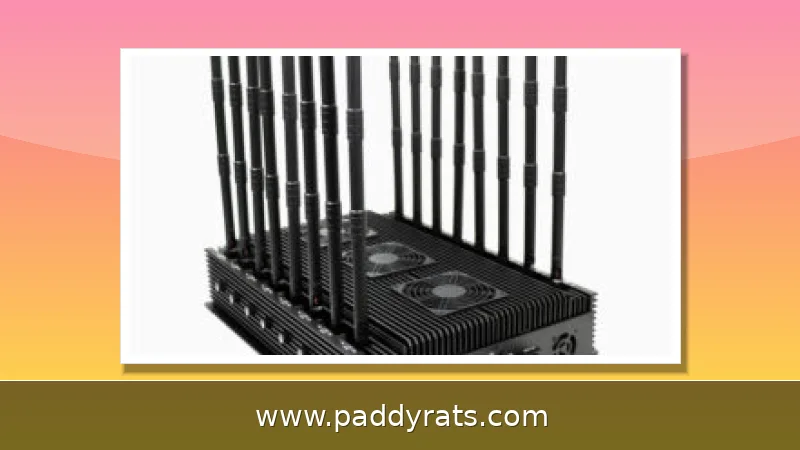
A signal jammer doesn't block anything—it drowns things out. It's an active device that broadcasts radio frequency energy across a specific band, flooding the airwaves with noise until receivers can't tell real signals apart from the interference. The whole point is to overpower legitimate communications within a broadcast radius, and the size of that radius depends on the device. A cell phone jammer, for instance, can shut down cellular traffic in a single room or across an entire building, while a GPS jammer interferes with location tracking within its range. Either way, the device isn't shielding your phone from the outside world. It's attacking the shared airspace that everyone around you is relying on.
The table below lists the frequency bands these devices typically go after, pulled from specs published by MOS Equipment. Take a close look at the cellular range—it's wide—and you'll see how one jammer can end up covering several services at the same time.
Signal Jammer vs Faraday Bag: The Legal Difference
Legally speaking, this is where the two products really part ways. In the United States, the Federal Communications Commission flat-out bans the marketing, sale, and use of signal jammers, since they interfere with licensed communications — including emergency services. That's not a slap-on-the-wrist situation either: violators can face hefty fines and even criminal penalties. So for ordinary civilians, jammers are basically off the table, no matter how tempting the capability might sound.
Faraday bags work the other way around. They don't transmit anything, they don't mess with any public network, and you can legally own and use one in the US and most other countries. Here's how I think about it: a jammer basically steals a shared resource from everyone around you, while a Faraday bag just takes your own device off the grid. That's not just a nitpick. It's the whole reason one of these things sits on a store shelf and the other one is a matter for federal enforcement.
The legal trouble with jammers isn't just a theoretical worry. When you interfere with licensed communications, you can knock out emergency calls and public safety radio, and federal authorities have gone after both the people using jammers and the ones selling them. So if what you're really after is privacy or protection from tracking, a passive pouch gets you there without putting you at risk of fines or criminal charges.
Practical Differences in Everyday Use
In everyday situations, these two devices really aren't solving the same problem. A Faraday bag is all about isolating one thing at a time — your phone during a confidential meeting, a key fob while you're sitting at a restaurant, a passport with an RFID chip, or a laptop you're carrying around town. A signal jammer, on the other hand, shuts down an entire area, which is exactly why the only legitimate uses for it fall under law enforcement, the military, and other authorized government operations — like making sure someone can't remotely wipe evidence before investigators get to it.
Faraday bags turn up in a pretty wide range of everyday situations. People use them for digital privacy, to block key fob relay attacks on cars, to secure data, and to stay safe while traveling. They're also handy for preventing RFID skimming on credit cards and passports, for a little digital detox, and as part of EMP prep. Forensic investigators rely on them to keep seized devices from picking up a remote wipe command. Travelers use them so a phone doesn't quietly reconnect at a border or back in a hotel room. Different crowds, sure, but the thread running through all of it is the same: keeping one specific device from talking to the outside world.
The tradeoffs really come down to scope. A Faraday bag won't do anything about your phone getting dropped, crushed, or soaked—its whole job is electromagnetic shielding, not physical protection. And it won't stop someone from figuring out that your phone has gone dark; a missing signal is its own kind of tell. A jammer is a different story entirely. It doesn't just silence one device, it drowns out everyone within range, which is exactly why civilians can't legally use one and why they're so risky near hospitals, airports, and first responders.
Which Signals Do Faraday Bags Block? Frequencies Explained
A properly sealed Faraday bag blocks both incoming and outgoing signals, which means cellular, Wi-Fi, Bluetooth, GPS, and RFID traffic all stop at the conductive layer. GoDark states that its Faraday bags block EMF signals between 200 MHz and 40 GHz, a span that covers 4G, 5G, GPS, cell, Wi-Fi, and Bluetooth, and the company also markets protection against EMP. Mission Darkness bags carry independent certification to MIL-STD-188-125 and IEEE 299-2006 shielding effectiveness standards, which is the kind of third-party validation worth looking for.
The table below lays out the frequency ranges that matter most for consumer devices, using MOS Equipment's published specifications. Use it as a checklist when you compare a bag's stated shielding range against the gear you actually carry.
Faraday Bag Limitations and Common Misconceptions
The most persistent myth is that a Faraday bag blocks every signal and frequency. Effectiveness varies by product, so check the manufacturer's specifications and any third-party lab certification for the exact bands you need to shield. A related myth holds that any metal-lined bag performs as well as a purpose-built Faraday bag. In reality, performance depends on the metal type, the weave or mesh density, the overall design, and the RF-tight closure seal. Aluminum foil does not guarantee the same protection, and it tears.
Another misconception is that these pouches are only for tech professionals. Travelers, ordinary consumers, and forensic investigators all use them, and the use cases keep expanding as key fobs and passports gain wireless features. It is equally wrong to assume that blocking cell signals means blocking everything, since different services operate on different frequencies. And no bag is 100% foolproof: wear, tiny gaps or holes, and improper sealing all compromise effectiveness, with a poorly closed flap being the most common cause of failure.
Testing evidence supports that cautious view. SLNT ran four tests with a spectrum analyzer: a Bluetooth speaker test where music stopped once the phone was sealed, a Wi-Fi test where an enclosed phone disconnected from the router, an RF test where a transmitter 12 times more powerful than a Bluetooth or Wi-Fi module was blocked, and a cellular connection test. In the RF test the signal disappeared when the bag closed and reappeared when it opened. A Reddit user reported that a Faraday cage effectively turns everything off, including keyless entry, and a Quora answer noted that a smartphone sealed inside an SLNT Faraday bag will not receive emergency signals, phone calls, or texts, including emergency alerts such as Amber alerts.
That last point deserves emphasis. If you seal a phone to escape notifications, you also cut yourself off from emergency alerts. I test my own pouch periodically by sealing a phone inside and calling it, then checking that the call fails. If it rings, the seal is compromised and the bag needs replacing. For anyone weighing a jammer instead, remember the risks: fines, criminal penalties, and interference with licensed communications and emergency services. Faraday bags carry none of that exposure because they never touch the public network.
Which Should You Choose?
For almost every civilian use case, a Faraday bag is the correct choice. It is legal, it does not interfere with surrounding networks, and it isolates exactly the device you want to silence. Pick a model with a documented shielding range that covers your gear, look for independent certification such as MIL-STD-188-125 or IEEE 299-2006, and verify the closure seal before you trust it with anything sensitive.
Signal jammers remain a law enforcement and military tool in the United States, and the FCC's prohibition on marketing, sale, and use applies to civilians. The FBI's 2024 Internet Crime Report, which recorded more than 859,000 IC3 complaints and reported losses exceeding $16 billion, a 33% increase over 2023, illustrates why device-level privacy matters, but it does not change the legal calculus. A passive pouch addresses that threat without breaking the law.
My own routine is simple: a Faraday bag for the phone during focused work and for the key fob at night, plus a periodic call test to confirm the seal still holds. That combination delivers most of the privacy benefit people imagine a jammer provides, with none of the fines, none of the emergency-service interference, and none of the legal exposure.
Frequently Asked Questions
What is the main difference between a signal jammer and a Faraday bag?
The biggest difference is legality and mechanism. A Faraday bag is a passive shielding pouch that blocks signals to and from a device inside it without transmitting anything. A signal jammer is an active device that broadcasts radio frequencies to disrupt communications around it, which is illegal for civilian use in the United States.
Are signal jammers legal to use?
No. The Federal Communications Commission strictly prohibits the marketing, sale, or use of signal jammers because they interfere with licensed communications, including emergency services. Using one can result in substantial fines and even criminal penalties, making them a nonstarter for most people.
Do Faraday bags block all signals and frequencies?
Not necessarily. Effectiveness varies by materials, design, and construction. Generally they block RF signals such as Wi-Fi, cellular, Bluetooth, and GPS, but the exact range varies by product. Check the manufacturer's specifications and third-party lab certification for the specific frequencies you need to shield.
Can a Faraday bag fail to block signals?
Yes. No solution is entirely foolproof. Wear and tear, tiny gaps or holes, or an improperly sealed closure can compromise effectiveness. The most common cause of failure is an improperly sealed closure, so always fold and secure the flap fully and periodically test by placing a phone inside and calling it.