signal jammers cannot pass EMC or FCC technical standards because blocking authorized radio traffic is their entire purpose. Here is how jammers work, what the FCC and Canada's ISED actually enforce, how RF hardware is tested, and which PCB design rules keep emissions under control.
What Is a Signal Jammer and How Does It Work?
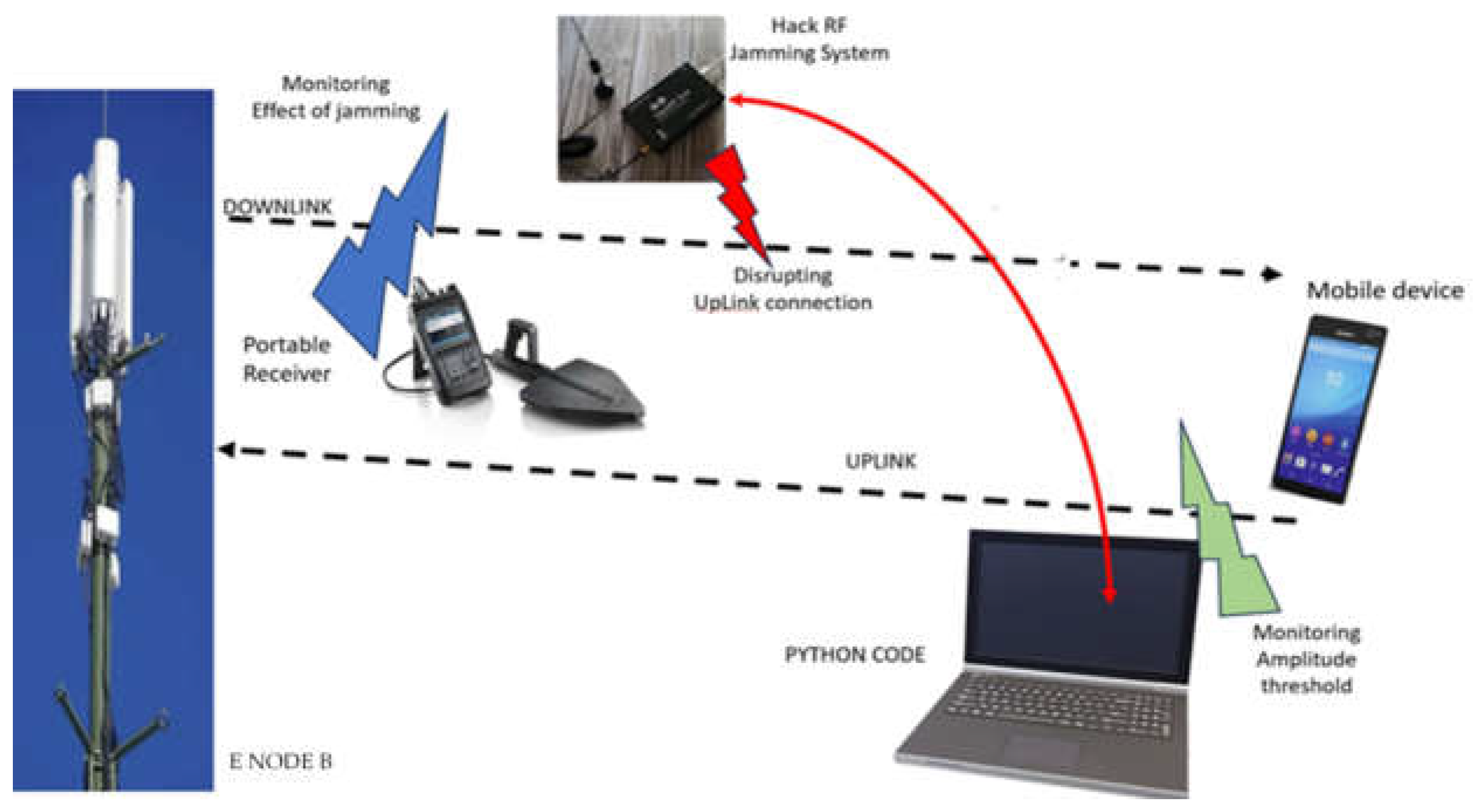
A signal jammer is basically a radio transmitter designed to overpower other radio transmitters. It puts out electronic noise on the same frequencies that legitimate devices rely on, so by the time the signal reaches a receiver, the interfering noise is stronger than the real transmission and the connection just breaks down. What really matters here isn't how much raw power the jammer puts out, but the ratio between the jammer's signal strength and the legitimate signal's strength at the receiver. If the jammer's noise comes through louder, the link fails.
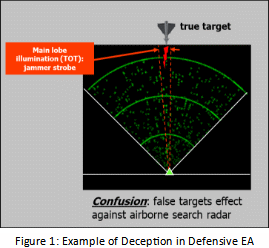
Every jammer comes down to the same four pieces: a power source, an oscillator that produces the interfering signal, an amplifier that strengthens it, and an antenna that sends it out. What changes from one design to the next is the target band and the deception method. A DRFM jammer, for instance, takes in the incoming RF signal, stores it digitally, recreates it, and then alters some or all of its parameters to generate a false return. A repeater jammer works differently: it pulls its electronic countermeasures signal from the victim radar signal it receives, then delays, modulates, and amplifies that signal before sending it back out.
GPS jammers don't win by brute force—they win by exploiting physics. GPS satellite signals reach the ground at incredibly low power, around negative 120 dBm, which means a handheld device putting out less than 1 watt can knock out GPS receivers within a few dozen meters. Cell phone jammers, by contrast, go after the roughly 700 MHz to 2600 MHz range, and the lower bands (700–900 MHz) tend to travel farther and push through walls more effectively. Wi-Fi jammers cover 2.4 GHz, 5 GHz, or 6 GHz, though Wi-Fi is actually tougher to jam from a distance since the transmitters are both powerful and close by. Drone jammers cut off the control link, which forces the aircraft to land, hover, or return to launch. Radar jammers take a different approach altogether, flooding receivers with noise that looks just like background static.
People often mix up jamming and spoofing, but the distinction actually matters when you're testing. Jamming drowns out a signal, so the receiver just loses it. Spoofing is different — it sends a fake version of the signal, like bogus GPS data that makes the receiver report a location that isn't real. That's why a spoofed receiver might not flag any error at all. How far a jammer reaches depends on a few things: output power, the strength of the target signal, obstacles in the way, and the frequency band. A low-power unit covers a single room, and you'd need about three or four of them to block cell signals across roughly 400 square meters. Step up to a medium-power jammer running 10–20 watts per frequency module, and you're looking at 1,000 square meters or more.
Why Jammers Cannot Meet EMC and FCC Technical Standards
The FCC doesn't leave much room for interpretation here: operating, marketing, selling, importing, distributing, or shipping RF jammers is a violation of federal law. There are no exceptions carved out for personal, commercial, educational, or in-vehicle use. The only parties allowed to use them are certain military and federal law enforcement agencies, and even they have to follow strict guidelines. But beyond the legal ban, there's a technical problem that's just as fundamental. Jamming devices can't be certified or authorized in the first place, because their whole purpose is to block or interfere with authorized radio communications. That kind of interference would undermine the integrity of the nation's communications infrastructure, which is exactly what the equipment approval process exists to protect.
EMC compliance starts from the idea that a device can share the same electromagnetic space with everything else around it. A jammer is built to do exactly the opposite, so it doesn't fail because of some measurement quirk—it fails at the level of intent. Even in the rare authorized situations where jamming is allowed, the operator still has to keep output power in check so the interference stays within a limited range, stay inside the frequency bands set by spectrum management rules, and make sure the device has enough immunity to outside interference that it doesn't produce unintended emissions. These are the same engineering habits that civilian EMC testing is meant to enforce, except here they're being applied to a device that would never receive a grant of equipment authorization in the first place.
If you're building RF hardware, the practical takeaway here is that EMC first-time pass rates tend to hover around or below 50%. That's a number worth taking seriously when you map out a project schedule. Plan for the possibility that your first attempt fails, set aside time for a redesign cycle, and treat pre-compliance measurement as a routine part of engineering rather than just a box to check. The teams that get it right on the first try are usually the ones who thought about emissions and immunity starting at the schematic stage, not the ones who tried to patch things up with filters at the very end.
Jammer Enforcement: FCC, Canada and Penalty Cases
Enforcement isn't just a warning on paper, either. The FCC hit R&N Manufacturing, Ltd (RNM) with a $29,000 fine after repeated violations involving a signal jammer at its Houston, Texas manufacturing plant, where the interference disrupted cellular and PCS communications. Then there's the separate case of Ravi's Import Warehouse, Inc. in Dallas, Texas. In FCC 22-10 (2022), the Commission upheld a $22,000 fine against the company, itemized as $10,000 for operating without authorization, $7,000 for causing interference, and $5,000 for egregious conduct. And in yet another case, an employer used a jammer simply to keep employees off their phones during work hours.
In Canada, jammers are outright prohibited under sections 4, 9, 10, and 15.1 of the Radiocommunication Act. ISED has the authority to hand down administrative monetary penalties, and those penalties climb fast. The table below breaks down how the fines are structured for individuals versus businesses.
| Jurisdiction | Authority | First violation | Subsequent violation |
|---|---|---|---|
| United States | FCC | Civil fines, equipment seizure, criminal sanctions | Escalating fines; see RNM ($29,000) and Ravi's Import Warehouse ($22,000) |
| Canada | ISED | Up to $25,000 (individual) / up to $10 million (business) | Up to $50,000 (individual) / up to $15 million (business) |
What stands out when you look at both countries is that the penalties apply to operating, importing, and distributing these devices—not just to actually causing measurable interference. If you're caught using one without authorization, you could be looking at serious civil fines, your equipment getting seized, and even criminal charges. And for businesses, the fine scales with revenue, not with how big the device is. That's exactly why compliance teams treat buying even one jammer as a governance matter rather than something facilities can just decide on their own.
Market projections for jammers are all over the place, so it's worth taking them with a grain of salt. Depending on which report you read, you'll see figures like USD 913.05 million for 2025, or $2.8 billion in 2025 growing to $5.6 billion by 2034 at an 8.1% CAGR. Another puts things at $2.85 billion in 2025 reaching $4.64 billion by 2032 at 7.2% CAGR, while yet another claims $4.98 billion in 2026 climbing to $9.27 billion by 2034, also at 8.1% CAGR. There's even one citing a 5.66% CAGR between 2023 and 2028. The reason these numbers diverge so much comes down to definitions — what actually counts as a jammer varies widely, ranging from consumer phone blockers to counter-drone and CUAS systems, DRFM jammers, deceptive jammers, repeater jammers, and smart jammers.
Counter-drone and CUAS devices sit in a different regulatory lane than a phone jammer bought online, because military and federal law enforcement use is carved out under strict guidelines. That carve-out does not transfer to private operators, event organizers or critical infrastructure owners who buy similar hardware. If a procurement document describes a device as blocking, silencing or interfering with radio communications, it belongs in the prohibited category regardless of the label on the box.
EMC and EMI Standards Relevant to Jamming Devices
EMC means electromagnetic compatibility, EMI means electromagnetic interference, and RFI means radio frequency interference. The standards landscape splits into military, international and regional layers. MIL-STD-461 is the US military standard specifying emission and susceptibility requirements across conducted and radiated emissions and conducted and radiated susceptibility. The IEC 61000 series covers industrial, commercial and household equipment, with IEC 61000-6-x defining immunity and emission requirements for different environments, IEC 61000-4-3 covering radiated immunity and IEC 61000-4-2 covering electrostatic discharge.
CISPR standards address product families: CISPR 11 for industrial, scientific and medical equipment, CISPR 22 for IT equipment and CISPR 32 for multimedia equipment. In the United States, FCC Part 15 governs radiofrequency devices and covers both intentional and unintentional radiators. In Europe, EN 55032 and EN 55035 apply to media devices and other electronics, alongside EMC Directive 2014/30/EU of the European Parliament.
| Standard | Scope | Region or body |
|---|---|---|
| MIL-STD-461 | Emissions and susceptibility, conducted and radiated | US military |
| IEC 61000-6-x | Immunity and emission requirements by environment | IEC, international |
| IEC 61000-4-3 / 61000-4-2 | Radiated immunity / ESD | IEC, international |
| CISPR 11 / 22 / 32 | ISM, IT and multimedia equipment | CISPR, international |
| FCC Part 15 | Intentional and unintentional radiators | United States |
| EN 55032 / EN 55035 | Media devices and other electronics | Europe |
Reading these standards together explains why a jammer has no compliant configuration. FCC Part 15 authorizes intentional radiators on the condition that they do not cause harmful interference and accept interference received. A jammer is defined by causing harmful interference, so certification is structurally impossible rather than merely difficult. The same logic runs through the Canadian framework and through European equipment rules, which is why the compliance question for jammers is answered by law before it is ever answered by a test lab.
Testing Methods for RF Jammers and EMI Measurement
Authorized jammer programs still require rigorous testing, and the methods mirror mainstream EMC practice. Emission measurement uses calibrated equipment across the specified frequency range. Spectrum analysis relies on a spectrum analyzer or scanning receiver to characterize what the device emits and where. Immunity testing simulates interference environments or injects test signals to confirm the device behaves predictably when the electromagnetic environment turns hostile. Organizations such as Rohde & Schwarz supply much of the instrumentation used in these labs, and the Academy of EMC publishes practical guidance on method selection.
For DRFM and repeater architectures, testing goes beyond emissions. Engineers must verify that the sampled RF signal is stored and recreated faithfully, that parameter modifications produce the intended deception effect, and that delay, modulation and amplification stages behave as designed before retransmission. DHS Science and Technology and NTIA ITS have published work on jamming and GPS interference measurement that is worth reading if you are building a test plan, because it shows how field measurement differs from bench measurement.
The practical lesson for product teams is that pre-compliance testing pays for itself. Emissions problems cluster in the 9 kHz to 6 GHz range. Above 6 GHz, interference usually stays within a single board and is treated as a signal integrity problem rather than a system EMC problem. That split tells you where to spend lab time: radiated emissions and immunity below 6 GHz, and controlled-impedance, low-loss layout work above it.
PCB Design Guidelines for EMC Compliance
Good EMC design starts in the stack-up. Build a layer arrangement with solid, adjacent reference planes for every signal layer, so every trace has a defined return path directly beneath it. Avoid routing sensitive traces near board edges, where the reference plane is discontinuous and fields fringe outward. Minimize trace length and loop area, because loop area is what turns a quiet net into an efficient unintentional antenna.
Terminations matter as much as routing. Never leave traces, test points or unused IC pins floating, since a floating node can pick up and re-radiate energy. Use decoupling capacitors and EMI filters at noisy entry and exit points, and place them as close to the connector or device pin as the layout allows. Where filtering alone is not enough, use shielded enclosures to contain emissions rather than trying to suppress them at the source.
These rules apply to any RF hardware, and they are exactly what a jammer cannot satisfy in principle. A clean design still has to pass the emissions limits that a jamming signal deliberately exceeds. If your goal is compliant RF product development, treat the 9 kHz to 6 GHz band as the primary battleground, run pre-compliance scans early, and keep a redesign budget in the schedule. That approach is far cheaper than discovering the problem during certification.
Frequently Asked Questions
Are signal jammers legal in the United States?
No. The FCC states that the operation, marketing, sale, importation, distribution or shipment of RF jammers violates federal law, with no exceptions for personal, commercial, educational or vehicular use. Only certain military and federal law enforcement agencies may use them, and only under strict guidelines. Penalties have included a $29,000 fine against R&N Manufacturing and a $22,000 fine upheld against Ravi's Import Warehouse in 2022.
Why can't jamming devices pass FCC technical standards?
Jamming devices cannot be certified or authorized because their primary purpose is to block or interfere with authorized radio communications. FCC Part 15 permits intentional radiators only if they avoid harmful interference and accept interference received, which is the exact opposite of a jammer's function. Because their use would compromise the integrity of the nation's communications infrastructure, they cannot comply with FCC technical standards and cannot be operated lawfully.
How does a signal jammer actually block communication?
A jammer transmits electronic noise on the same frequencies used by legitimate devices, drowning out the real signal. The key measurement is the ratio of jammer signal strength to legitimate signal strength at the receiver; if the jammer's noise is louder, communication fails. GPS is especially vulnerable because satellite signals arrive at roughly negative 120 dBm, so under 1 watt can disable receivers within a few dozen meters.
What penalties can result from illegal jammer use?
Unauthorized users may face substantial civil penalties, seizure of illegal equipment and criminal sanctions. In Canada, ISED can impose administrative monetary penalties up to $25,000 for a first individual violation and up to $10 million for a first business violation, rising to $50,000 and $15 million respectively for subsequent violations. US enforcement has produced five-figure fines for both manufacturers and importers.