A signal jammer is a device that deliberately disrupts the link between a wireless device and its signal source, usually by transmitting a stronger signal on the same frequency. This guide breaks down the meaning, real-world examples, jamming techniques, and the FCC and Canadian rules that make cell phone jammers illegal to sell or operate.
What Is a Signal Jammer? Meaning and Simple Definition
A signal jammer is a device designed to deliberately cut off the connection between a wireless device and the signal source it relies on. The example most people are familiar with is a cell phone jammer, which blocks communication between a cell tower and a mobile phone by transmitting on the same radio frequencies the phone is trying to pick up. That's the simple definition, and it's what sets jamming apart from ordinary interference.
The key word here is deliberate. Jamming means someone is intentionally interfering with or blocking wireless communications — it's not the same as the static, dropped calls, and dead zones we usually chalk up to bad weather or overcrowded airwaves, which are examples of unintentional interference. You'll come across plenty of related terms in product listings and news stories: cell jammer, mobile phone jammer, signal blocker, GPS jammer, text stopper, signal silencer, radiocommunication jammer, and jamming antenna. They all point to the same basic concept — a transmitter powerful enough to drown out the weaker signal that a target device is trying to pick up.
When I tested this with consumer radio gear, the pattern held every time: the jammer doesn't need to decode anything at all. It just has to be louder at the receiver. That's the whole trick. It explains why a cheap handheld device can take down a far more sophisticated phone or GPS unit without ever understanding the data it's blocking.
How Do Signal Jammers Work? Denial-of-Service Explained
A jammer works by transmitting on the very same radio frequencies the target device uses, and because the jammer's signal is stronger, it drowns out the original one at the receiver. Think about a cell phone that's picking up two signals on the same frequency: it has no way to tell which is which, so it grabs the stronger one and the weaker one just gets lost in the noise. Security researchers call this a denial-of-service attack, except it happens over the air instead of over a network.
Since the interference targets the downlink signal, your phone has no clue that anything out of the ordinary is going on. All it sees is zero bars, so you naturally assume you're just stuck in a dead zone. Cheaper jammers only take out a single frequency, which is enough to convince a device that no signal exists at all, while more advanced models can sweep across multiple bands simultaneously.
Frequency range and power go hand in hand. Jammers can target GSM, Wi-Fi, GPS, and general radio signals, and the wider the range a jammer has to cover, the more power it burns to stay effective. Radar jamming usually gets a range advantage, because jammer-to-radar signals run into 1/R2 path loss while radar returns run into 1/R4 loss. In plain terms, the jammer's energy fades out more slowly than the echo it's trying to drown out.
Real-World Examples of Signal Jamming
The examples below come from public reporting, regulatory filings, and electronic-warfare literature, and together they show just how wide the practical use cases really are. But each one comes down to the same basic principle: flood the receiver with energy on the frequency it cares about.
| Example | What Gets Disrupted | Typical Context |
|---|---|---|
| GPS jamming | Satellite positioning and timing | Vehicle theft, toll evasion |
| Wi-Fi jamming | Home or business networks, cameras | Disabling security cameras and internet access |
| Bluetooth jamming | Short-range audio links | Public events or protests to cut sound to speakers |
| Radar jamming | Radar receivers | Electronic warfare using concentrated energy signals |
| Counter-drone jamming | Drone-to-controller links | Disrupting or spoofing drone control signals |
GPS jamming is probably the most economically significant example, since it's been used in vehicle theft and to dodge road tolls. Wi-Fi jamming is the type most people run into without even realizing it—a single device can take out home or business networks, security cameras, and internet access all at once. Then there's Bluetooth jamming, which tends to pop up at public events or protests where someone wants to cut the sound to speakers.
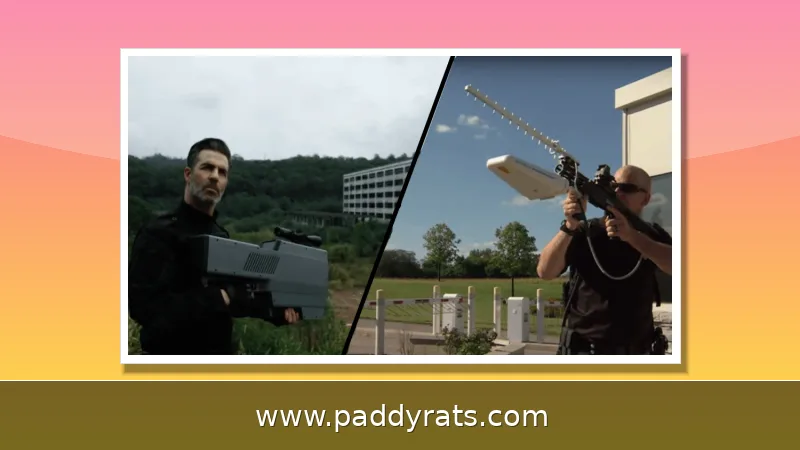
Radar jamming is still the textbook military example: a jammer floods a receiver with highly concentrated energy so the operator can't make out the return. Counter-drone devices are the newest mainstream version of this, disrupting the link between a drone and its controller or sending spoofing signals that convince the drone it's somewhere it isn't. I've watched demo units at trade shows pull this off in under a second, which is a good reminder of just how fragile wireless control links really are.
Types of Jamming Techniques: Noise, Repeater, and Radar Jamming
In electronic warfare, jamming usually gets sorted into two big categories: noise and repeater. Noise jamming is pretty much what it sounds like — you flood a frequency with energy until nothing else gets through. There are three common versions of it. Spot jamming throws every bit of available power onto a single frequency. That works great against a fixed target, but against frequency-agile radar it's basically a waste of effort. Sweep jamming moves that full power across a range of frequencies in rapid succession, while barrage jamming hits several frequencies at the same time. The trade-off with barrage is obvious: spread your power across more frequencies, and each one gets less of a punch.
Repeater jamming is smarter. DRFM, short for digital radio frequency memory, captures incoming radar energy, alters it, and re-transmits it with a changed pulse delay to create false targets on the operator's screen. Instead of hiding the aircraft, it invents phantom ones.
Other modes worth knowing include set-on jamming, swept-spot jamming, stand-off jamming where an aircraft stays far from the threat, stand-in jamming, and transponder jamming. The trade-off across all of them is the same: broader coverage costs power, and precision costs flexibility.
Are Signal Jammers Legal? FCC and Canada Rules
In the United States, it is illegal to sell, advertise, distribute, or operate cell signal jammers. The FCC states that jamming equipment poses serious risks to critical public safety communications, can prevent 911 and other emergency calls, and interferes with law enforcement communications. The Communications Act of 1934 outlaws interference with authorized radio broadcasts, and penalties may include fines up to $11,000, seizure of equipment, and criminal sanctions including imprisonment. Cell phone detectors, by contrast, are legal in the US.
Canada takes a similarly hard line. Jammers are prohibited under sections 4, 9, 10, and 15.1 of the Radiocommunication Act, and subsection 4(4) specifically prohibits installation, use, possession, manufacture, importation, distribution, lease, offer for sale, or sale. Administrative monetary penalties reach up to $25,000 for a first individual violation and $50,000 for subsequent ones, while businesses face up to $10 million for a first violation and $15 million afterward. Ministerial exemptions under subsection 14(1) are handled case by case for national security and public safety.
There are narrow exceptions and ongoing debates. US state lawmakers have called to legalize jamming in correctional facilities, and federal law enforcement use is authorized only in limited exceptions. Brazil, New Zealand, and Sweden have considered exceptions for correctional facilities, and in the United Kingdom, law enforcement, intelligence agencies, and jails have employed signal jammers since 2012 under strict regulation. For ordinary consumers, though, the practical answer is simple: do not buy, import, or switch one on.
How to Detect and Respond to Signal Jamming
The most common symptom is dropped service in an area with otherwise good coverage. Before assuming jamming, rule out faulty equipment, physical obstructions, and lawful devices operating on the same frequencies. Apps that claim to detect jamming are largely unproven and need a working signal to function at all, which is a problem when the signal is exactly what is being blocked.
Spectrum analyzers can detect jammers, but they are uncommon outside professional settings and require specialized knowledge to interpret. The Department of Homeland Security lists jamming indicators such as an inability to communicate where coverage is typically good, and notes that jamming can be blocked or weakened by physical barriers including vehicles, buildings, and heavy metal. If you suspect illegal jamming, contact your wireless network provider, consult your device owner's manual, and then reach out to law enforcement or file a complaint with the FCC.
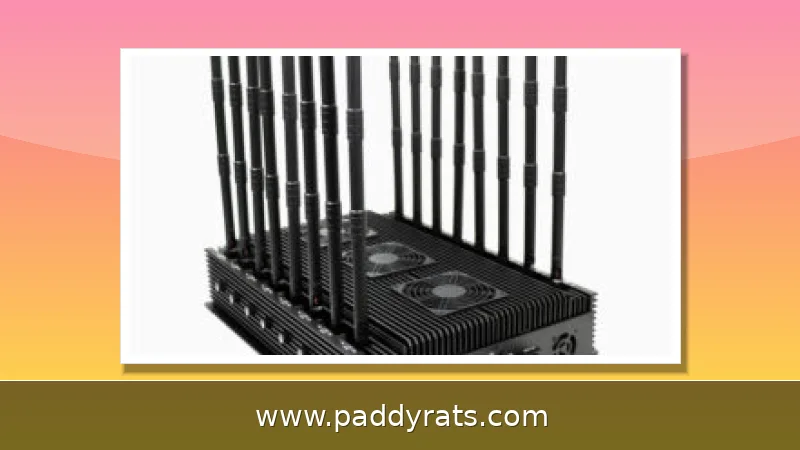
Physically locating the jammer is hard, even though the devices often resemble a walkie-talkie, cell phone, or wireless router. Switching frequency may help depending on how sophisticated the jammer is, and relocating may restore reception since jamming range is usually no more than about 30 square feet in consumer scenarios. One important distinction: a signal jammer will interfere with a cell phone signal booster, because boosters amplify an existing signal and there is nothing left to amplify once jamming begins. Signal amplifiers are not an effective defense, and any signal jammer is also a signal booster jammer.
For readers curious about the hardware side, a basic cell phone jammer circuit needs three subcircuits: an RF amplifier, a voltage controlled oscillator, and a tuning circuit. Components include transistors, capacitors, inductors, and resistors, and the tuned circuit acts as an oscillator producing high frequency with minimum damping. Building or operating one in the US or Canada is illegal, so treat that as educational context rather than a project plan. Radar fundamentals follow a similar logic: resolution is limited by pulse width, a 1-microsecond pulse spans 150 meters, chirp modulation improves distance resolution, and second-time-around echo creates ambiguity because pulse repetition frequency trades off range against speed detection.
Jammers vs Boosters: Why Amplifiers Do Not Save You
People often assume a signal amplifier will punch through a jammer. It will not. A booster works by taking a weak but readable signal and making it stronger, so if the original signal is being drowned out, the booster is amplifying noise along with everything else. In practice, a jammer and a booster are fighting over the same physics, and the jammer usually wins because it is closer to the receiver.
That is why any signal jammer is also, by definition, a signal booster jammer. If you rely on a booster for coverage in a rural area or a metal-framed building, a nearby jammer will take that coverage away entirely rather than just degrading it. The practical takeaway is that boosters and jammers should never be discussed as complementary tools; they are direct opponents.
Frequently Asked Questions About Signal Jammers
The questions below cover the searches readers make most often after learning what a signal jammer is, including legality, detection, and how the disruption actually happens at the receiver.
If you take one thing away, make it this: jamming is deliberate interference, it is illegal for consumers in the US and Canada, and the only reliable responses are reporting it to your carrier, law enforcement, or the FCC rather than buying counter-equipment of your own.
Frequently Asked Questions
What is a signal jammer in simple terms?
A signal jammer is a device that purposefully disrupts the connection between a device and its signal source. For example, a cell phone jammer blocks communication between a cell tower and a mobile phone by transmitting on the same radio frequencies, so the phone sees no usable signal even when coverage should be strong.
What are examples of signal jamming?
Examples include GPS jamming used in vehicle theft and toll evasion, Wi-Fi jamming that disables security cameras and internet access, Bluetooth jamming at events or protests, radar jamming in electronic warfare that blocks a receiver with concentrated energy signals, and counter-drone devices that cut or spoof the link between a drone and its controller.
How does a signal jammer actually work?
Jammers transmit a stronger radiofrequency signal on the same frequency as the target device. When a phone receives two signals at the same frequency, it cannot distinguish them, picks the stronger one, and the weaker signal cancels out. Because jamming hits the downlink, the phone simply shows no signal bars.
Are signal jammers legal in the United States?
No. It is illegal to sell, advertise, distribute, or operate cell signal jammers in the United States. The FCC cites risks to public safety communications and 911 emergency calls, and the Communications Act of 1934 outlaws interference with authorized radio broadcasts. Penalties can include fines up to $11,000, equipment seizure, and imprisonment.