A signal jammer floods the same radio frequencies your phone, GPS, or WiFi uses with noise, so the receiver cannot tell the real signal from the interference. Here is how RF jamming works, what it blocks, and why it is illegal in the US.
What Is a Signal Jammer and What Does It Do?
A signal jammer is a device that deliberately breaks the link between a wireless device and its signal source. With a cell phone jammer, that means cutting off the conversation between your phone and the nearest cell tower. It doesn't hack your phone or read your data — it just makes the connection unusable by transmitting radio energy on the same frequencies the phone is trying to use. Security researchers and regulators call this a denial-of-service attack, since the point is to deny service, not intercept it.
The effects kick in almost immediately, and they're pretty obvious when they do. Because the jamming targets the downlink — that's the signal coming down from the cell tower to your phone — your handset never gets a usable carrier, so those signal bars just disappear. Calls cut out mid-sentence, texts pile up unsent in your outbox, and data either slows to a crawl or stops working entirely. Cheaper, more basic jammers only go after one frequency at a time, but that's usually enough to convince a phone there's no network anywhere in range. Essentially, it's a denial-of-service attack aimed at the airwaves. And this technology didn't originate in classrooms or movie theaters — it was first built for military and law enforcement, including early attempts to stop cell phone-triggered explosives and to manage hostage situations where an outside call could cost lives.
How Does a Signal Jammer Work at the RF Level?
At the RF level, jamming is really just a tug-of-war over signal-to-noise ratio. Here's the idea: a call only goes through when your phone can pick out the tower's transmission from all the other noise floating around it. To cut that link, a cell phone jammer broadcasts its own RF signal on the same frequency — but much stronger than whatever's coming from the nearest base station. Now the phone's receiver is getting two transmissions on the same channel, and it has no way to tell which one is which. So it just locks onto the louder one, and the weaker legitimate signal gets drowned out, essentially canceled. That's why a phone sitting in a jammed area shows no service even though the tower is still up and broadcasting like nothing's wrong. As far as the phone is concerned, the network has just vanished. People usually call this a denial-of-service attack on the radio link. Lower-end jammers take an even blunter approach, targeting a single frequency, which can fool a phone into thinking there's no signal at all.
Every jammer boils down to the same three-part chain. First, an RF signal generator creates the jamming waveform—basically the noise or fake signal that's going to compete with the real transmission. Then a power amplifier cranks that waveform up to a level that actually matters in the air. Finally, one or more antennas broadcast it across whatever frequencies you're targeting. How far the signal reaches comes down to two things: power output and the surrounding environment. Inside a small room, a few meters of coverage may be plenty. Out in open terrain, where there are fewer obstacles and less signal attenuation, the same setup can stretch for several kilometers. Jammers aren't all built alike, either. Wide-band full spectrum jammers take out multiple bands at once, which comes in handy against devices that hop between frequencies. And the more advanced models go a step further with protocol jamming, hitting the control channels phones use to register with a network—so the device never even gets a chance to connect in the first place.
What Frequencies Do Jammers Target?
Any jammer lives or dies by how well it matches the bands used by the device it's targeting. Get the frequency wrong and nothing happens, no matter how much power you throw at it. Here in the US, and in plenty of other countries too, cell networks run on a mix of low, mid, and high bands — 700MHz, 800MHz, 900MHz, 1800MHz, 1900MHz, and 2100MHz — spread across 2G all the way up to 5G. GPS is way off on its own at 1575MHz, and WiFi hangs out much higher, in the 2.4GHz and 5GHz ranges. None of these slices of spectrum overlap, which is the whole point: a jammer built for one band has zero effect on another. That's precisely why multi-band and full spectrum units exist — wide-band models take out several bands at once, so they can knock out more devices in a single shot.
The table below breaks down the main bands and what each one carries.
| Service | Common frequency bands | Typical use |
|---|---|---|
| Cellular (2G/3G/4G/5G) | 700MHz, 800MHz, 900MHz, 1800MHz, 1900MHz, 2100MHz | Voice calls, texts, mobile data |
| GPS | 1575MHz | Navigation and timing signals |
| WiFi | 2.4GHz and 5GHz | Wireless networking and Bluetooth |
Cellular networks aren't built on one tidy chunk of spectrum. Instead, they're spread across the 700MHz, 800MHz, 900MHz, 1800MHz, 1900MHz, and 2100MHz bands, and a carrier might rely on different bands depending on where you are. That fragmentation explains why a single-frequency jammer can take out one carrier, or even just one slice of a carrier's service, while everything else keeps running like nothing happened. Wide-band full spectrum jammers go the other way and hit several bands at once. The trade-off here is pretty simple: they're much harder to avoid, but they also wipe out more of the surrounding airwaves, which makes them the more disruptive choice. GPS jamming is a whole different concern. The 1575MHz band doesn't just power your map directions — it also carries the timing signals that financial networks, cell towers, and navigation apps quietly depend on, so interference there can cause problems far beyond a lost route.
Types of Jamming Techniques: Noise, Spot, Barrage, Sweep and DRFM
Jamming techniques generally fall into two camps: noise techniques and repeater techniques. Noise jamming is pretty straightforward in concept — you flood a frequency with so much interference that the receiver can't pull out the actual signal buried underneath. Within that camp, spot jamming throws every available watt onto a single frequency. That makes it brutal against a fixed target, but close to useless against frequency-agile radar that keeps hopping between channels. Barrage jamming goes the other way, spreading one jammer's power across a bunch of frequencies at once. You cover more ground, but you hit with less punch at any one frequency. Sweep jamming lands somewhere in between, shifting full power from one frequency to the next in rapid succession, catching a receiver off guard as the interference sweeps past its channel.
| Noise Jamming Type | How It Works | Trade-Off |
|---|---|---|
| Spot | All power focused on a single frequency | Potent against fixed targets; ineffective against frequency-agile radar |
| Barrage | One jammer's power spread across multiple frequencies | Covers more ground; less powerful at any single frequency |
| Sweep | Full power shifts from one frequency to another in quick succession | Catches receivers off guard as interference sweeps past their channel |
Repeater jamming works on a completely different principle. Rather than blasting noise to drown out a signal, it listens in first and then transmits something back. The classic example is Digital Radio Frequency Memory, or DRFM: it picks up incoming radar energy, alters it, and retransmits it. Since that return signal is derived from the original pulse, the radar has a tough time separating the fake from the genuine echo. That's where things get interesting — you can make the radar register a target at the wrong range, or even create phantom targets that don't actually exist. DRFM isn't the only player in this category, though. Several other named variants belong to the same family. A deceptive jammer keeps transmitting nonstop, coaxing nearby nodes into a receive state so they quit sending. A reactive jammer — sometimes called a CTS jammer — stays quiet until it detects an RTS message, then strikes. Pulse-noised jammers hop across channels to save energy while still hitting multiple ones simultaneously. A channel-hopping jammer goes after the CSMA algorithm directly, remaining silent during the discovery phase before attacking along a pseudorandom sequence. And a proactive jammer skips the waiting game entirely, transmitting whether or not any data is being exchanged.
Types of Jammers: Portable, Drone, WiFi and Cell Phone
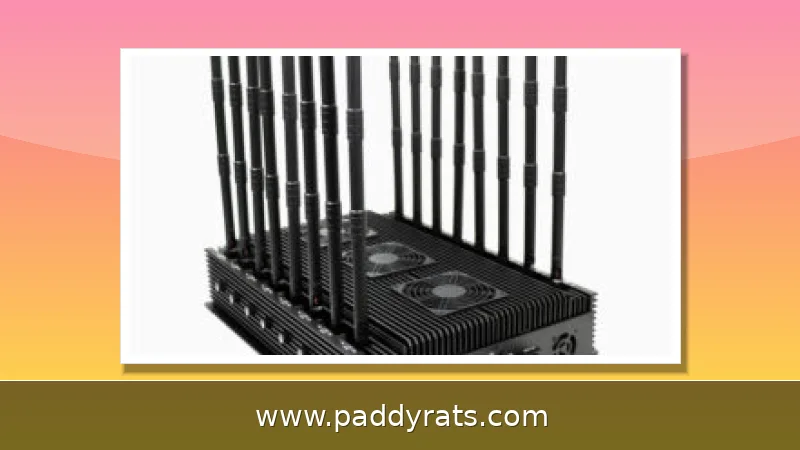
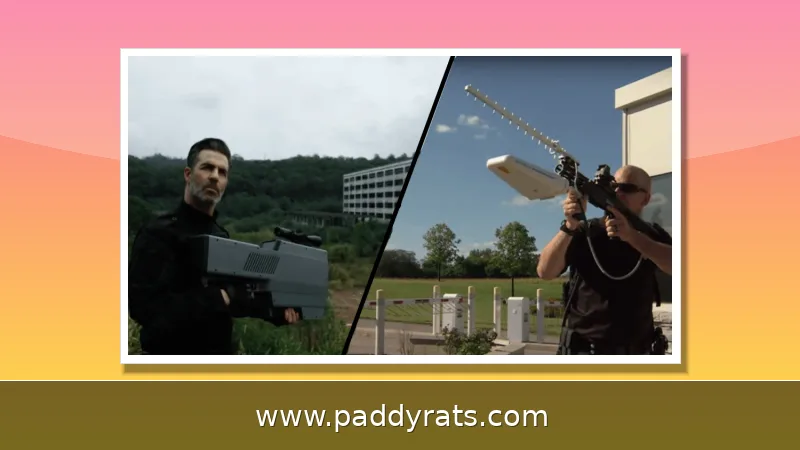
Jammers come in form factors that match their mission, and that mission usually decides how much power they carry and which bands they hit. Portable signal jammers are the smallest option: handheld, battery-powered, and cordless, with built-in antennas instead of external ones. You'd use one for a small room, inside a vehicle, or in a localized outdoor spot where you only need to cover a short distance. Drone signal jammers work differently — they go after the control and GPS bands a drone relies on to stay linked and know where it is. Cut those links and the aircraft can go unresponsive, then drop into a failsafe hover or return-to-launch, depending on how it's programmed. WiFi jammers, meanwhile, block the 2.4GHz and 5GHz bands that wireless networks and Bluetooth both use, which makes them a broad tool rather than a surgical one.
Cell phone jammers cover the 700MHz to 2100MHz range to hit 2G, 3G, 4G, and 5G service. Product listings give a sense of the market. The Drone UAV Signal Jammer JM004 is listed at $2,399.99, the Handheld WiFi Bluetooth Signal Jammer 2.4/5.2/5.8GHz JM012 at $569.99, the Handheld Mobile Phone Jammer 16 Antennas 25 Meters JM018 at $699.00, and the 4G Phone Jammer JM021 at $520.00. Prices and availability shift over time, and in the US these devices cannot legally be sold, advertised, or operated for consumer use.
Does a Jammer Block Signal Boosters and GPS?
Yes, and the reason is straightforward. A signal booster works by capturing an existing weak signal, amplifying it, and re-broadcasting it inside a building or vehicle. If a jammer is flooding the frequency, the booster has nothing clean to amplify. Any signal jammer is effectively also a signal booster jammer, which is why buildings that rely on boosters for coverage can go dark the moment jamming begins.
GPS is vulnerable for a different reason. The 1575MHz band carries very weak signals from satellites, and those signals arrive with little margin above the noise floor. A relatively low-power jammer can therefore drown out GPS reception across a wide area, affecting navigation, timing, and any service that depends on precise clocks. This is one reason regulators treat GPS jamming as a serious public safety and infrastructure risk rather than a minor nuisance.
Are Signal Jammers Legal in the United States?
No. It is illegal to sell, advertise, distribute, or operate cell signal jammers in the United States and much of the world. The FCC states that jamming equipment poses serious risks to critical public safety communications, can prevent 911 and other emergency calls, and interferes with law enforcement communications. Radio frequencies are protected under the Communications Act of 1934, which outlaws interference with authorized radio broadcasts. Penalties can include fines of up to $11,000, seizure of equipment, and criminal sanctions including imprisonment.
Federal law enforcement use is authorized only under limited exceptions. Some countries, including Brazil, New Zealand, and Sweden, have considered exceptions for correctional facilities. In the United Kingdom, law enforcement, intelligence agencies, and jails have used signal jammers since 2012 under strict regulation. Cell phone detectors, by contrast, are legal in the United States, which creates an odd asymmetry: you generally cannot jam a signal, but you can sometimes detect that one is being used nearby.
Where Are Jammers Used, and How Do You Detect One?
Legitimate applications are narrow and usually institutional. Military and law enforcement units use jammers to disrupt enemy communications or prevent remote detonation of improvised explosive devices. Prisons and government offices use them to block unauthorized communications. Schools and theaters have used jammers to create quiet environments, subject to local law, and corporations may shield conference rooms against wireless espionage under special permission. Proponents argue jammers are needed where cell phone etiquette is hard to enforce, such as in schools, theaters, vehicles, or quiet train rides.
Detecting a jammer starts with symptoms. Dropped service is the most common sign, though bad network connections can also come from faulty equipment, physical obstructions, or lawful devices operating on the same frequencies. Apps that claim to detect jammers are largely unproven and require a working signal to function at all. Spectrum analyzers can identify jamming by analyzing frequencies, but they are not commonly available and demand specialized knowledge. A jammer usually looks like a walkie-talkie, a cell phone, or a wireless router.
If you suspect jamming, practical steps come before technical ones. Jamming range is usually no more than about 30 square feet, so relocating a few rooms away may restore reception. Switching frequency or band may work depending on how sophisticated the jammer is. You can also report suspected jamming to law enforcement or file a complaint with the FCC, which is the agency that tracks interference complaints in the United States.
What Should You Take Away From All This?
Signal jamming is a brute-force technique, not a clever exploit. It works by overpowering legitimate signals with noise on the same frequencies, which is why it affects phones, GPS, WiFi, and boosters alike. The hardware is simple in principle: a generator, an amplifier, and antennas tuned to the target bands. The consequences, however, are not simple, because the same spectrum carries emergency calls, navigation timing, and public safety traffic.
For most readers, the practical takeaway is legal rather than technical. In the US and much of the world, operating a cell phone jammer is illegal, penalties are real, and detection is often as simple as noticing that service vanished in one specific spot. If you run into suspected jamming, document what you see, move away from the affected area, and report it to the proper authorities rather than trying to counter-jam on your own.
Frequently Asked Questions
How does a signal jammer work?
A jammer transmits radio frequency noise on the same frequencies a device uses, overpowering the original signal from a tower or satellite. The receiver cannot distinguish the stronger jamming signal from the legitimate one, so communication fails and the device shows no usable signal.
Are signal jammers legal in the United States?
No. It is illegal to sell, advertise, distribute, or operate cell signal jammers in the United States and much of the world. The FCC cites risks to public safety and emergency 911 calls, and the Communications Act of 1934 outlaws interference with authorized radio broadcasts.
What frequencies do signal jammers block?
Jammers target the bands used by the device they block. Cellular networks use 700MHz, 800MHz, 900MHz, 1800MHz, 1900MHz and 2100MHz; GPS uses the 1575MHz band; WiFi uses 2.4GHz and 5GHz. Wide-band full spectrum jammers block multiple bands at once.
Can a signal jammer block a cell phone signal booster?
Yes. A signal booster amplifies an existing signal, but if a jammer blocks that signal, the booster has nothing to amplify and will not work. Any signal jammer is effectively also a signal booster jammer.