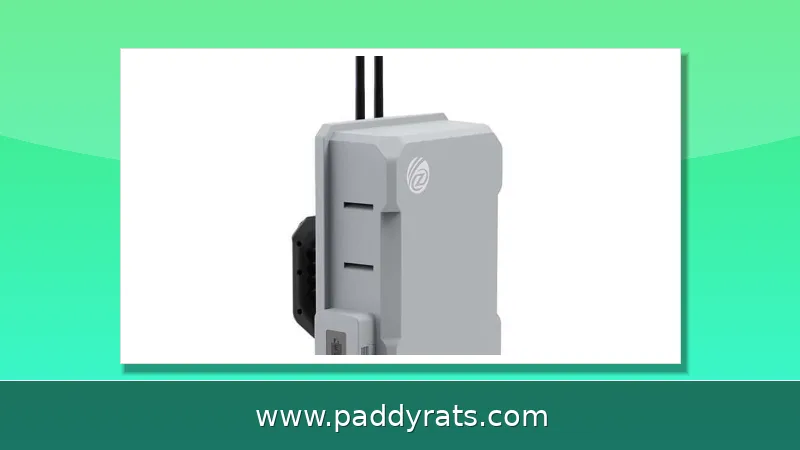
Home drone signal blockers are illegal for private homeowners in the US, but the technology behind them is worth understanding. Here is how jamming and spoofing actually work, which RF bands they hit, and the detection-first privacy setup that keeps you on the right side of the FCC.
What Is a Home Drone Signal Blocker and How Does It Work?
A drone signal blocker is basically an RF transmitter that drowns out the link between a drone and whoever's flying it. It blasts noise, or some kind of blocking waveform, over the same channels the aircraft relies on for command, control, video, and navigation, so the receiver can't tell a real instruction apart from the interference anymore. Once that link falls apart, most flight controllers drop into a fail-safe mode: return to home, hover in place, or just land right where they are.
That's the whole mechanism in a nutshell, and it's exactly why jammers are such a blunt tool. A jammer won't tell you where the pilot is standing, won't map out the flight path, and won't identify the drone model or whatever it's carrying. It also has no way of knowing whether the aircraft was just passing over a neighbor's roof or was already locked onto a fixed target and programmed to get there no matter what. So as a countermeasure, it's only half the picture—which is why any serious counter-UAS program pairs jamming with detection.
Drone Jamming vs Spoofing: Key Differences Explained
People tend to use "jamming" and "spoofing" as if they mean the same thing, but that's not quite right. Jamming is basically blasting noise over the airwaves so that radio signals become garbled and unreadable, which cuts the connection between a drone and whoever's flying it. Spoofing works differently. Instead of drowning out the signal, it impersonates the remote control and sends out compatible signals strong enough to take the original's place. Once that happens, a third party can seize control of the drone or feed it fake location data.
The real-world outcomes aren't the same, either. When you jam a drone, it tends to do something predictable and relatively harmless, like heading back to where it launched. Spoofing is a different story: the drone may take orders from the attacker, stream its camera feed to them, or hand over flight data. If you're a homeowner worried about privacy, neither approach is something you can legally use, but the gap between them still matters when you're sorting through what counter-drone vendors promise.
| Technique | What it does | Typical outcome |
|---|---|---|
| Jamming | Floods the link with noise | Fail-safe: return, hover, or land |
| Spoofing | Impersonates the remote control | Takeover, data download, false GPS |
| Smart jamming | Targets only detected bands | Less collateral interference |
| Detection only | Passive RF, radar, camera sensing | Alerts and evidence, no interference |
Is It Legal to Jam Drones Near Your Home?
A modern drone jammer doesn't just hit one frequency—it goes after several at once, and that's because drones split their communications across different bands. The 433 MHz and 900 MHz ranges are where you'll find most commercial and DIY control links. Video and telemetry typically travel on 1.2 GHz and 1.5 GHz. Then there's 2.4 GHz and 5.8 GHz, which is what DJI and most commercial command-and-control systems rely on. And if you want to cut off navigation entirely, you target the GNSS bands—GPS, GLONASS, Galileo, and BeiDou—which operate somewhere between 1164 MHz and 1610 MHz. Blocking all of these at once is what makes a jammer effective against a wide range of drones.
Most drone transceivers run on 1.2 GHz, 1.3 GHz, 2.4 GHz, or 5.8 GHz, so a single-band device usually won't get you very far against a modern aircraft. High-power jammers take a different approach: they blast far-reaching noise in every direction and saturate a wide frequency range, covering RF and GPS alike, which effectively creates a communications dead zone. The catch is that this approach is typically reserved for wartime use, since it knocks out everything nearby, not just the drone you're actually worried about.
| Band | Typical use |
|---|---|
| 433 MHz / 900 MHz | Commercial and DIY control links |
| 1.2 GHz / 1.5 GHz | Video and telemetry |
| 2.4 GHz / 5.8 GHz | DJI and most commercial C2 |
| 1164-1610 MHz | GPS, GLONASS, Galileo, BeiDou |
Is It Legal to Jam Drones Near Your Home?
No — not legally, anyway. The Communications Act of 1934, specifically 47 U.S.C. 301, 302a, and 333, gives the FCC authority to prohibit operating, marketing, or selling any device that blocks or interferes with authorized radio communications. Break that rule and you're looking at fines of up to $112,500 per incident, plus the possibility of criminal prosecution. Jammers are reserved for authorized federal agencies only, which is why the FCC keeps a dedicated jammer enforcement page on its site.
The list of who's actually allowed to do this is pretty short. The Department of Defense and military installations fall under Title 10, and that authority got expanded by JIATF-401 guidance back in January 2026. Then you've got DHS, which covers CBP and the Secret Service, DOJ including the FBI, the Department of Energy for protecting nuclear facilities, and the Coast Guard for maritime security. That's basically it. Now, the SAFER SKIES Act, tucked into the FY2026 NDAA, adds some new names to the list: state and local law enforcement, but only after they complete training at the FBI's National Counter-UAS Training Center in Huntsville, Alabama. The same law also covers correctional facility security and the agencies responsible for protecting NSSEs and SEAR-rated events — think the FIFA World Cup 2026.
Private companies, individual property owners, and private security firms aren't authorized to jam drones either — unless they've been contracted by an agency that is. There's one more wrinkle worth knowing about: the FEMA C-UAS Grant Program actually bars recipients from using grant funds to buy weapons, and mitigation equipment is reserved for certified law enforcement personnel only. So if you're a homeowner wondering where that leaves you, the honest answer is detection and documentation. Not interference.
DIY Drone Disabler Projects: Raspberry Pi and Homemade Jammers
Search long enough and you will find build guides: a Make project for a Raspberry Pi Wi-Fi Drone Disabler aimed at the Parrot AR.Drone 2.0, and an Instructables walkthrough titled How to Build a DIY Signal Jammer for Drones, Wi-Fi, and 4G Networks. They exist, they are readable, and building or operating them in the US puts you squarely inside the FCC's enforcement scope.
This is where first-hand experience matters. I have watched hobbyists test Wi-Fi deauth tricks on their own hardware in a shielded room, and the moment a signal leaves that room it is regulated radio transmission. The Communications Act does not carve out an exception for small power levels or for drones you believe are trespassing over your yard. A DIY build is a federal offense waiting to be logged, not a privacy tool.
Detection-First Privacy Setup: RF, Radar, and Camera Sensors
The lawful alternative is a detection-first setup: passive RF sensors, radar, and camera systems that identify and log drone activity without transmitting interference. Dedrone, now part of Drone Violations, offers DedroneTracker.AI for detection, while AirSight pairs its AirGuard detection platform with the Smart and Autonomous Jammer, which provides full 360-degree coverage out to 1.9 miles and can mount on fixed positions, tripods, or vehicles.
On the hardware side, MADDOS builds portable jammers in handheld or ManPack form with omni- and directional antennas, up to 9 bands, up to 1 hour of battery, up to 3 km range, and RADHAZ certification; stationary units with sector or omni coverage up to 12 km and selective jamming; and reactive units with a directional antenna on a pan-and-tilt unit, over 8 km range, 9 fixed bands plus 4 programmable, spanning 400 MHz to 6000 MHz. NQDefense sells stationary and portable anti-drone jamming plus a GPS spoofing solution across models ND-BD003 through ND-BD018 and ND-BO004, ND-BG002.
For a homeowner, the realistic version of this is a passive RF receiver plus cameras and a log. That gives you evidence for police or the FAA without creating a federal violation. Smart jamming systems such as DedroneDefender 2 use AI to target only the protocols identified by DedroneTracker.AI, with a 20-degree targeting cone, GPS L-band coverage, and a high-gain multi-band custom antenna, and can reportedly jam drones from over 300 meters away even when they are out of sight. Those are agency tools, not consumer products.
Why High-Power Jammers Are Reserved for Government and Military Use
A high-power jammer is a communications dead zone generator. It broadcasts powerful, far-reaching noise in every direction and saturates a wide frequency range including RF, GPS, and beyond, which means it can knock out Wi-Fi, cellular, and navigation for everyone in the area, not just the drone overhead. That is why the military treats them as wartime equipment and why regulators treat civilian ownership as a crime.
Portable jammers, often called drone jammer guns, are handheld rifles that jam locally by firing streams of radio waves directly at a target. They are safer for inhabited areas because the energy is aimed, but they are harder to use practically and still illegal for private citizens. Drone jammer guns project a signal in a cone of roughly 15 to 30 degrees, while heavy-duty jammers can work from almost a mile away. Fortem Technologies takes a different route entirely, using drone interceptors rather than jammers and spoofers, and infiniDome builds GPSdome and GPSdome2 anti-jamming systems for UAVs that need to keep their own navigation intact.
Frequently Asked Questions
How does a drone signal jammer work?
A drone jammer is a radio frequency transmitter that overwhelms the communication link between a drone and its operator. It broadcasts a powerful signal on the same frequencies the drone uses for command, control, video, and navigation, forcing the drone into fail-safe mode so it returns home, hovers, or lands.
Can a private homeowner legally use a drone jammer in the US?
No. Under the Communications Act of 1934 (47 U.S.C. 301, 302a, 333), the FCC prohibits operating, marketing, or selling devices that block or interfere with authorized radio communications. Violations carry fines up to $112,500 per incident and potential criminal prosecution. Only authorized federal agencies may operate jammers.
What is the difference between jamming and spoofing a drone?
Jamming broadcasts noise to make radio signals unintelligible, disrupting the link between drone and pilot. Spoofing hijacks radio signals by impersonating the remote control, transmitting compatible signals strong enough to replace the source, letting a third party take over the drone or feed false location data.
What frequency bands do drone jammers target?
Modern jammers target multiple bands simultaneously: 433 MHz and 900 MHz for commercial and DIY control systems; 1.2 GHz and 1.5 GHz for video and telemetry; 2.4 GHz and 5.8 GHz for DJI and most commercial command-and-control; and GNSS bands (GPS, GLONASS, Galileo, BeiDou) for navigation.