Signal jammers work by flooding the same frequencies your phone, GPS, or WiFi uses with RF noise, and the bands they cover decide what actually gets blocked. Here is how the bands break down, how range and power interact, and what to check before choosing a unit.
What Are Signal Jammer Frequency Bands?
A signal jammer's frequency band is just the chunk of radio spectrum it's designed to transmit into. Every wireless service you use — cell calls, GPS, WiFi, Bluetooth, even your garage door opener — lives on its own set of assigned frequencies, and a jammer can only disrupt the bands it was built for. That's why picking the right bands matters more than chasing raw wattage. A unit rated for 700 MHz to 2100 MHz cellular traffic won't do a thing to a 2.4 GHz WiFi link, and a GPS-only device will leave your phone calls completely alone.
What really matters here is that "signal jammer frequency bands" boils down to one thing: coverage. Manufacturers list their bands in MHz or GHz, and each one lines up with a specific technology and region. Take U.S. mobile bands — you've got low-band 5G sitting at 617–652 MHz, the 700 MHz range (Bands 12, 13 and 17), 850 MHz (Band 5), PCS Band 2 from 1850–1995 MHz, AWS Bands 4 and 66 at 1710–1755 and 2110–2155 MHz, Band 41 at 2496–2690 MHz, C-Band between 3700–3980 MHz, and mmWave stretching from 24–39 GHz. So the first step in any legitimate evaluation is simple: match those numbers to the environment you're actually dealing with.
How Does a Signal Jammer Work Across Bands?
A jammer works by transmitting RF noise on the very same frequencies the target device is using, which drags down the signal-to-noise ratio at the receiver until the legitimate signal can't be decoded anymore. Picture trying to hold a conversation in a crowded room while someone keeps shouting over you — the words are still there, but they get buried in the noise. This is what's called radio jamming, or more precisely noise jamming, and the important thing is that it never has to crack any encryption. It just drowns the conversation in interference. How well it performs usually comes down to two numbers. The first is the J/S ratio — the ratio of jamming power to signal power at the victim receiver — and the higher that ratio goes, the more completely the target signal gets suppressed. The second is average power per MHz, which tells you how much energy the jammer actually puts into each slice of spectrum. A jammer that spreads a fixed amount of power across a wide swath will have less punch per MHz than one focused on a narrower range, and that difference often decides whether a device goes quiet or keeps working.
| Metric | What It Measures | Why It Matters |
|---|---|---|
| J/S ratio | Jamming power vs. signal power at the victim receiver | Higher ratio means the legitimate signal is more thoroughly suppressed |
| Average power per MHz | Energy available in each slice of spectrum | Determines how effectively a jammer covers a given frequency range |
This is why two jammers with identical total output can act like totally different machines. Take a 100W unit covering 2400–2500 MHz: it puts about 1W of noise into every MHz it touches. Now take another 100W unit spread across 2000–2700 MHz, and that same power gets stretched so thin it only delivers around 0.14W per MHz — a seven-to-one gap in intensity. The narrower unit jams 2.4 GHz much more effectively, simply because its energy is concentrated where it matters. That's the whole point of the J/S ratio: raw wattage alone doesn't tell you much — what counts is how much of it actually lands on the target's frequency. It's also why wide-band full-spectrum jammers give up per-band punch in exchange for coverage. Spread-spectrum technologies like FHSS and DSSS fight back by hopping or smearing energy across a wide swath, which means a jammer either has to blanket the entire hop range at once with barrage-style noise or react fast enough to chase the signal. Against a fast hopper, that's a race that's hard to win.
| Jammer Configuration | Frequency Coverage | Total Power | Average Power per MHz | Effectiveness at 2.4 GHz |
|---|---|---|---|---|
| Narrow-band unit | 2400–2500 MHz (100 MHz) | 100W | ~1W per MHz | Strong — power concentrated |
| Wide-band unit | 2000–2700 MHz (700 MHz) | 100W | ~0.14W per MHz | Weak — power spread thin |
Common Frequency Bands: Cellular, GPS, WiFi, Bluetooth and ISM
Coverage lists vary from one model to the next, and regional network rollouts always seem to add their own wrinkles, but a handful of bands keep showing up in both commercial and defense-oriented specs. Cellular service by itself covers several slices, from the older 2G and 3G allocations all the way up through 4G LTE and 5G NR. GPS and the other GNSS constellations sit near 1.2–1.6 GHz, with the L1 signal at 1575 MHz being the best-known example. Consumer wireless then fills in the 2.4 GHz and 5 GHz ISM ranges, which is where WiFi and Bluetooth live. Remote controls, sensors, and RFID readers, meanwhile, tend to cluster down in the sub-1 GHz ISM bands. The table below pulls all of these groupings together so you can compare them at a glance.
| Category | Typical Frequency Bands |
|---|---|
| Cellular (2G–5G) | 700, 800, 850, 900, 1800, 1900, 2100, 2600 MHz; 5G NR 600/700/3500 MHz (varies by region) |
| GPS / GNSS | L1 1575 MHz, L2, L5; GLONASS, Galileo, BeiDou near 1.2–1.6 GHz |
| WiFi / Bluetooth | 2.4 GHz and 5 GHz ISM; Bluetooth 2.402–2.480 GHz |
| Sub-1 GHz ISM | 315, 433, 868, 915 MHz (remote controls, sensors, RFID) |
| Technology | Typical Bands |
|---|---|
| GSM | 850 / 900 / 1800 / 1900 MHz |
| CDMA | 800 / 1900 MHz |
| 3G | 850 / 900 / 1900 / 2100 MHz |
| 4G LTE | 700 / 800 / 1800 / 2600 MHz |
| 5G NR | 600 / 700 / 3500 MHz (varies by region) |
| GPS / GNSS | L1, L2, L5 plus GLONASS, Galileo, BeiDou |
| WiFi and Bluetooth | 2.4 GHz and 5 GHz; Bluetooth 2.402–2.480 GHz |
| ISM remote control | 315 / 433 / 868 / 915 MHz |
Some models go even further, covering VHF, UHF, LoRa, RFID, and even satellite links. That broader reach is precisely why wide-band full-spectrum jammers exist: rather than targeting one service, they block several bands at once, so a single unit can take down multiple device types simultaneously. But here's the catch, and it's the same power-per-MHz trade-off we touched on earlier. When a fixed output gets spread across more spectrum, each band ends up with less energy, which means a jammer that covers everything may not jam any one thing as well as a narrower unit would. For buyers who want both breadth and depth, the practical fix is usually per-band power adjustment instead of relying on one fixed total. That lets you push more power into the bands that matter most while still keeping coverage across the rest.
Jamming Techniques: Spot, Sweep, Barrage and DRFM
What really separates jamming techniques is how they distribute power across time and frequency, and that trade-off is what makes each one useful in different situations. Spot jamming concentrates every watt on one frequency, so if you already know the target and it stays narrowband, you get the strongest J/S ratio possible. Sweep jamming races full power across a range of frequencies one after another, hitting each one only for a moment. That works well against signals that hop around, though if the timing is slightly off it can miss a fast FHSS or DSSS link entirely. Barrage jamming goes after several frequencies at the same time, but the same power gets split among them, so each channel ends up with less energy—which is exactly why average power per MHz matters so much in this case. DRFM repeater jamming doesn't even work like the others: rather than transmitting noise, it grabs incoming radar energy, modifies it, and sends it back out to create false targets.
| Technique | How power is used | Best against | Main drawback |
|---|---|---|---|
| Spot | All power on one frequency | Known narrowband target | Fails if target changes frequency |
| Sweep | Full power shifted across frequencies in quick succession | Signals moving within a band | Each frequency is hit only briefly |
| Barrage | Multiple frequencies hit at once | Wideband or multi-channel targets | Power spreads thin per channel |
| DRFM repeater | Captures, alters and re-transmits radar energy | Radar and EW systems | Complex, radar-specific approach |
GPS jamming is a good case in point. Most consumer receivers lock onto the L1 civilian signal, so that is exactly where jammers concentrate their energy. Chirp jammers, for instance, sweep roughly 1565–1585 MHz — a range wide enough to catch L1 yet narrow enough to keep power dense where it matters. Power levels vary just as much as designs. A simple cigarette-lighter jammer might broadcast on L1 at only about 10 mW, enough to disrupt a nearby handheld, while a hedgehog jammer pushes around 10W on L1 or L2 and can reach much farther. A University of Texas at Austin Radionavigation Lab study examined 18 commercially available jammers by morphology and found wide variation in signal characteristics. In plain terms, two products advertised for the same band can behave very differently once they are switched on.
What Determines Jamming Range and Effective Power?
Effective jamming range is not a single fixed number — it is the product of several interacting variables, starting with the jammer's output power and the frequency it operates on. Higher frequencies propagate shorter distances, while lower frequencies travel farther and penetrate obstacles more effectively. That is why a 400 MHz link can be disrupted from much farther away than a 5 GHz one running at the same power. Obstacles such as walls, terrain and foliage attenuate higher bands more aggressively, so a signal that travels freely across an open field may fade quickly inside a building or behind a hill. Antenna gain and installation matter just as much: placement height, orientation and cable loss can shift real-world performance as much as the amplifier behind them. The target's own signal strength also sets the bar — the stronger the legitimate signal, the more jamming power is needed to overcome it.
Power ratings on a spec sheet can be misleading, because raw wattage tells you nothing about how that energy is actually distributed. Consider two jammers that both advertise 100W of total output. One concentrates its power into a narrow 100 MHz slice, giving it 1W per MHz, while the other spreads the same 100W across a wide 700 MHz span, leaving only about 0.14W per MHz. At 2.4 GHz, the narrowband unit will outperform the wideband one every time, since each megahertz of target signal faces far more competing noise. This is exactly why experienced buyers look past the headline number and compare average power per MHz and per-band output instead. The same logic shows up in product specifications: modules are commonly rated at 50W (47 dBm) or 100W (50 dBm) total across the band, and adjustable multi-band units may offer up to 65W total RF output, paired with smart cooling, per-band power adjustment and per-band on/off switches so users can direct energy where it matters most.
Portable vs Fixed Jammers: Band Count and Coverage
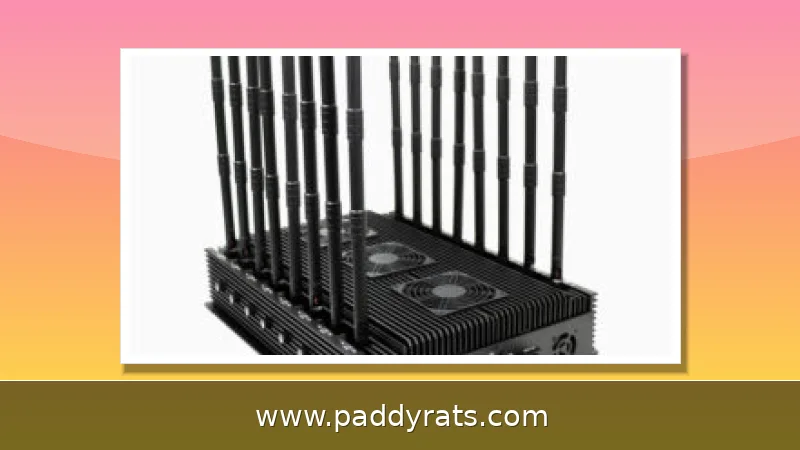
Portable signal jammer bands typically come in tiers. Basic handheld and briefcase units cover 8–12 bands, mid-range models offer 12–16 bands spanning cellular plus GPS and WiFi, enhanced units reach 18–24 bands for worldwide compatibility, and comprehensive systems list 28–32 bands. Portable systems may support anywhere from 8 to 20 bands including VHF, UHF, GPS and satellite links, depending on the enclosure, battery and cooling design.
When comparing portable units, the deciding factors are frequency coverage, output power, battery capacity, cooling system, antenna design and portability — in roughly that order. A 30-band list is meaningless if the battery dies in 40 minutes or the cooling cannot handle continuous operation. For fixed installations, military and electronic-warfare systems go much further: the Shoghi VHF/UHF Frequency Hopping Jamming System covers 30 MHz to 3 GHz with an operational range of 12 km on land, jams up to 20,000 hops per second across up to 10 networks simultaneously, and can be upgraded for SATURN and LINK-16. A Radio Reconnaissance and Jamming Station covers 25 to 1000 MHz with audio monitoring, technical analysis, monopulse bearing finding and signal scanning.
Testing, Standards and Real-World Measurements
Verifying jammer behavior requires calibrated equipment: emission measurement, spectrum analysis with a spectrum analyzer or scanning receiver, and immunity testing. Relevant standards include MIL-STD-461, the IEC 61000 series, CISPR 11 and CISPR 22, along with FCC rules in the United States. These frameworks matter because emissions do not always stay neatly inside the intended band, and out-of-band energy can affect services far from the target.
A NTIA measurement of a contraband wireless device found four jammed CMRS bands between 730 MHz and 2.155 GHz, with emissions measured from 300 MHz to 4.34 GHz — a much wider footprint than the operator likely intended. That gap between intended and actual coverage is one reason jamming equipment is generally restricted to authorized government or defense use. Market estimates reflect steady demand: one analysis valued the signal jammer market at $2.8 billion in 2025 and projected $5.6 billion by 2034 at an 8.1% CAGR, while another placed it at USD 1.8 billion in 2026 heading toward USD 3.6 billion by 2033. The VHF/UHF segment dominated with a 30.81% share in 2025, driven largely by military and public safety coverage.
Is It Legal to Use a Signal Jammer?
In many jurisdictions, unauthorized jamming of radio communications is illegal and can bring severe penalties. The FCC maintains jammer enforcement, and symptoms of interference include the inability to transmit or receive cellular service in areas that otherwise have good coverage. Jamming equipment is generally restricted to authorized government or defense use under applicable spectrum rules, and operating one without authorization can trigger fines, seizure or criminal exposure depending on the country.
There is also a practical safety dimension. Jammers deployed in crowded areas may unintentionally affect emergency services, public safety radios and navigation systems, which is precisely why regulators treat the spectrum as a shared resource rather than private property. Anyone evaluating jamming hardware for research, testing or procurement should confirm the applicable licensing regime first and work with authorized partners. This article is informational and does not constitute legal advice.
Frequently Asked Questions
What frequency bands do signal jammers use?
Common jamming bands include cellular 700/800/900/1800/1900/2100 MHz, GPS around 1575 MHz (L1) and L2, WiFi 2.4 GHz and 5 GHz, and ISM remote-control bands at 315, 433, 868 and 915 MHz. A jammer only affects the bands it is designed to cover, so coverage lists should always be matched to the target technology.
Does a signal jammer block every signal?
No. Jammers are built to counter specific signal types and frequency bands. A jammer covering cellular bands will not necessarily disrupt GPS, WiFi or frequency-hopping radios, so band selection must match the target communication. Wide-band full-spectrum models cover more services at once, but each band receives less power than a dedicated narrowband unit would deliver.
Why does higher frequency mean shorter jamming range?
Higher frequencies tend to have shorter propagation distances, while lower frequencies reach farther. Range also depends on output power, antenna gain, target signal strength, obstacles and installation conditions, not output power alone. A 400 MHz link can often be disrupted from much farther away than a 5 GHz link using the same transmitter power.
Is using a signal jammer legal?
In many jurisdictions unauthorized jamming of radio communications is illegal and can bring severe penalties. The FCC lists jammer enforcement, and jamming equipment is generally restricted to authorized government or defense use under applicable spectrum rules. Anyone evaluating such hardware should confirm the licensing regime in their country before proceeding.