A multi-band signal jammer blocks several wireless frequencies at once by flooding them with radio noise, cutting the link between devices and base stations. Here is how the technology works, which bands it covers, and which specs actually matter.
What Is a Multi-Band Signal Jammer?
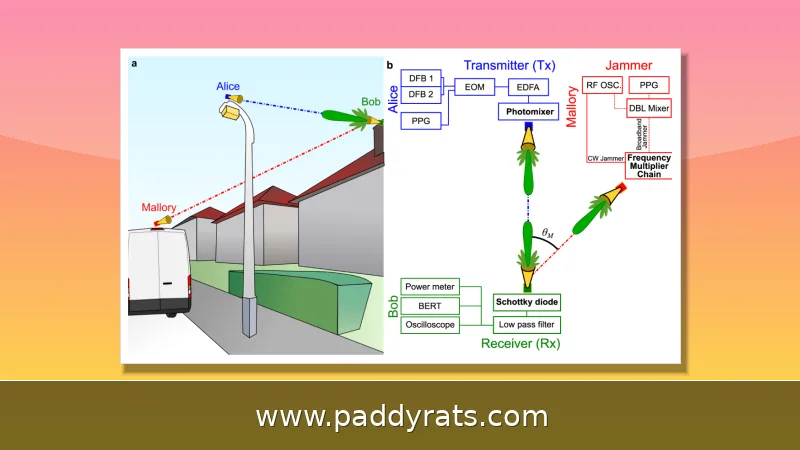
A multi-band signal jammer blocks several communication frequencies at once. It works by emitting radio noise or interference on the same frequencies that phones and other wireless devices use, which breaks the link between a handset and the base station serving it. The key word here is deliberate: jamming is intentional interference, and that's what sets it apart legally from the unintentional kind caused by bad wiring or a crowded spectrum. In practice, a multi-band unit packs several single-frequency transmitters into one chassis, so a single box can take out 2G, 3G, 4G, 5G, Wi-Fi, GPS, and UHF/VHF radios all at the same time.
Since every wireless service occupies its own little slice of the spectrum, a jammer doesn't have to decode a protocol to shut it down. All it really needs to do is push enough energy onto that same frequency so the receiver can't separate the original transmission from the noise anymore. This also explains why you'll see labels like "blocker" or "wideband jammer" sitting right next to "multi-band jammer" in vendor catalogs — and why the exact same hardware gets marketed as a handheld jammer, a portable jammer, or a rack-mounted wideband jammer, depending on how much power it puts out and how it's built.
How Does a Multi-Band Jammer Work?
Every wireless device runs on a specific frequency, and a jammer goes after that same frequency with a stronger, more disruptive signal. Once the receiver gets swamped by that interfering energy, the nearby user can't send or receive data anymore. Jamming techniques fall into two broad families: noise techniques, which just broadcast interference, and repeater techniques, which capture a signal and re-transmit it in a distorted form. Within the noise family, engineers further distinguish spot, sweep, and barrage jamming based on how the available power gets allocated across the spectrum.
Spot jamming throws every bit of the transmitter's power onto a single frequency. That makes it deadly against one narrow target, but it does nothing for you anywhere else on the spectrum. Sweep jamming takes a different approach: it moves full power from one frequency to the next in quick succession, so it can cover a lot of ground fast, though it never hits all those frequencies at the same moment. Barrage jamming goes wide instead, hitting multiple frequencies at once. The trade-off is that spreading power across several frequencies means each one gets a weaker share of the total. Then there's DRFM, which stands for digital radio frequency memory. It's a repeater technique rather than a noise-based one, and instead of just blasting interference, it captures incoming radar energy, alters it, and sends it back out to create false targets.
Which Frequency Bands Can a Multi-Band Jammer Block?
The frequency bands you'll see on most multi-band jammers aren't random — they mirror the services people actually rely on every day, which explains why the same handful of ranges keeps popping up on product listings and academic write-ups alike. Take a typical handheld unit: it usually covers 758–830 MHz for 5G and low-band 4G LTE, 920–965 MHz for GSM900, 1800–1920 MHz for DCS/GSM1800/PHS/PCS/CDMA1900, and 2100–2170 MHz for UMTS, 3G, WCDMA, TD-SCDMA, and CDMA2000. Then there are the higher bands, which take care of data and positioning — 2400–2500 MHz for Wi-Fi and Bluetooth, 2570–2690 MHz for high-band 4G LTE, 3400–3800 MHz for 5G, and 1570–1620 MHz for GPS L1 and GLONASS L1.
Vendors also throw in some practical extras you won't usually find on a consumer spec sheet — things like LoJack at 164MHz, car remote bands at 433MHz or 868MHz, and that 5.1–5.9GHz Wi-Fi range. The table below rounds up the bands listed for a ten-antenna portable unit, and it's a handy reference point: one device, after all, covering everything from legacy voice to modern data to satellite navigation.
| Band | Frequency | Primary services |
|---|---|---|
| Low cellular | 758-830MHz | 5G, 4G LTE low |
| GSM900 | 920-965MHz | GSM900 voice |
| DCS/PCS | 1800-1920MHz | DCS, GSM1800, PHS, PCS, CDMA1900 |
| 3G/UMTS | 2100-2170MHz | UMTS, WCDMA, TD-SCDMA, CDMA2000 |
| Wi-Fi/Bluetooth | 2400-2500MHz | Wi-Fi 2.4GHz, Bluetooth |
| 4G LTE high | 2570-2690MHz | 4G LTE |
| 5G | 3400-3800MHz | 5G, 5G LTE |
| GPS/GLONASS | 1570-1620MHz | GPS L1, GLONASS L1 |
One design detail that's actually worth digging into comes from a granted US patent, US7697885B2 (published as US20090237289A1), credited to inventor Robert Eugene Stoddard. The patent covers a method for jamming communications that rely on digital bursts, GSM being the classic example, where every link has both a transmit band and a receive band. Here's the gist: a tone comb generator spits out repeated jamming signals, and the intervals between those repetitions create frequency separation. Each jamming signal is built with a dwell time that's substantially shorter than the burst period, and the signals for the transmit and receive bands get generated at the same time, then sent out as RF jamming energy. As for the paperwork side, the priority date is September 15, 2006, and the patent was granted on April 13, 2010. The assignees include Aeroflex Powell Inc, Aeroflex Wichita Inc, and Aeroflex High Speed Test Solutions Inc. The patent itself is now expired, with a fee-related lapse date of January 17, 2029.
Portable vs High-Power Multi-Band Jammers: How Do Specs Compare?
The gap between a pocket-sized jammer and a rack-mounted system is massive, and honestly, that difference is what drives both the price and the coverage you get. Take a ten-antenna portable unit like the SRD-JN10FJ: it goes for about US$118.00 to US$126.70, with a minimum order of just one piece. It weighs 1.2 kg, measures 145x95x45mm, and can run off AC100-240V or a 12V car charger. Total output sits at 10.0W, which works out to 1.0W per band, and each band can be switched on or off independently. The Ni-Mh 8000mAh battery lasts roughly 2.0 hours, the shielding radius falls between 10-30m, and it comes with a one-year warranty. Shenzhen Ruicen Technology Co., Ltd. makes it under the RDSignal brand, and you'll typically see it used in classrooms, meeting rooms, libraries, and movie theaters.
The N12P is a twelve-band portable 5G jammer priced at $768.88, marked down from $1285.20, which puts it somewhere in the middle of the pack. It puts out 37W of total power, supports up to 45 standards, and can cover up to 40 meters. On the blocking side, it handles 5G, 4G LTE, Wi-Fi at both 2.4GHz and 5GHz, GPS/GLONASS, UHF/VHF radios, and LOJACK, and you get selective frequency control via DIP switches. The 5200mAh rechargeable battery gives you up to 70 minutes of standalone runtime, and there's a built-in display for checking battery status in real time. For heat, it relies on triple-fan cooling plus an aluminum heat sink. The housing is aluminum alloy and paired with high-gain antennas, and a protective carrying case comes in the box. The vendor also claims it delivers more than three times the output power of typical twelve-antenna portable jammers like the PJ-123 or PJ-12S, which run around 12W. You get a one-year warranty and free worldwide shipping.
At the high end of the range, the ATJ8-78-28 is a high-power adjustable multi-band jammer that puts out up to 65 watts of total RF power and can cover an area of roughly 150 meters, though that figure depends on how dense the local signal environment is. It runs eight channels: CH1 at 2500–2570MHz and 38.5 dBm; CH2 at 1805–1920MHz and 39 dBm; CH3 at 925–960MHz and 42.3 dBm; CH4 at 2400–2500MHz and 38.4 dBm; CH5 at 2110–2170MHz and 38.5 dBm; CH6 at 790–826MHz and 39.2 dBm; CH7 at 2620–2690MHz and 39.2 dBm; and CH8 at 851–894MHz and 40.8 dBm. It draws power from AC220V and consumes 200W, weighs 10 kg, measures 300x200x150mm, and is rated to operate between -20 and +55 Celsius at 30%–95% humidity. Every band can be adjusted and switched on or off independently, VSWR circuit protection comes built in, and you can order custom versions with four, five, or six bands. Optional blocking extends to AM/FM radio, LoJack 173MHz, VHF, UHF, walkie-talkie, remote control, iDEN, CDMA, GSM, GPRS, DCS, PCS, AWS, WCDMA, UMTS, 3G, 4G, LTE 700/800/2300/2600, GPS L1/L2, Galileo, Compass, GLONASS, Wi-Fi, Bluetooth, spy camera, WIMAX, and UAV/drone signals. The unit is manufactured by Shenzhen Action Technologies Co., Ltd.
Key Features to Compare: Power, Antennas, Battery and Cooling
When I compare multi-band jammers, I start with total output power and the per-band split, because 37W spread across twelve bands is not the same as 37W concentrated in three. The next question is antenna count and gain, since omnidirectional antennas give a roughly circular footprint while directional or high-gain antennas trade coverage shape for reach. Battery capacity and runtime matter for portable work: an 8000mAh Ni-Mh pack at 2.0 hours is fine for a short session, while a 5200mAh lithium pack rated at 70 minutes suits quick deployments. Cooling is the spec buyers overlook most often, and triple-fan designs with aluminum heat sinks exist precisely because sustained high-power output generates serious heat.
Adjustability is the feature that separates professional gear from consumer gadgets. DIP switches or per-channel controls let an operator disable bands that must stay live, such as emergency or navigation services, and independent channel switching makes it possible to test one service at a time. VSWR protection, working temperature range and humidity tolerance also signal whether a unit was built for a climate-controlled room or a vehicle. Finally, warranty length and shipping terms tell you how much confidence the vendor has in its own hardware, and a one-year warranty is the common baseline across this category.
| Feature | SRD-JN10FJ | N12P | ATJ8-78-28 |
|---|---|---|---|
| Total output | 10.0W (1.0W per band) | 37W | 65W max |
| Bands/channels | 10 antennas | 12 bands | 8 channels |
| Coverage | 10-30m | Up to 40m | Up to 150m |
| Battery | Ni-Mh 8000mAh, 2.0h | 5200mAh, up to 70 min | AC powered |
| Cooling | Passive | Triple fan + heat sink | Not specified |
| Weight | 1.2 kg | Portable alloy housing | 10 kg |
How Far Can a Portable Multi-Band Jammer Reach?
Coverage depends on the model and the local signal strength, so published ranges are best treated as estimates rather than guarantees. A ten-antenna handheld unit lists a radius of 10-30 meters at -75dBm with omnidirectional antennas, while the N12P twelve-band 37W unit claims up to 40 meters. High-power rack models can reach 20-150 meters, with the wide spread reflecting how much the environment matters. In a strong-signal urban area, a jammer has to overcome more ambient energy, so effective range shrinks; in a rural setting with weak base-station coverage, the same unit reaches farther.
Antenna type, mounting height and obstacles all shift the result. Walls, metal shelving and reinforced concrete absorb or reflect RF energy, which is why an in-building system such as the JM33-F988 uses twelve independent channels and careful placement rather than raw power alone. Its user manual stresses legal usage, because cellular jammers can interfere with emergency communications, and that warning applies to every device in this category. Anyone comparing range claims should assume the real number is closer to the low end of the published window unless a site survey proves otherwise.
Typical Use Scenarios and Deployment Notes
Vendors market multi-band jammers for controlled environments where silence or signal denial is the point. The ten-antenna portable unit lists classrooms, meeting rooms, libraries and movie theaters, while the high-power ATJ8-78-28 lists prisons, military facilities, schools, detention houses, government buildings, meeting rooms, museums, theaters, restaurants, factories, banks and trains. The pattern is consistent: fixed or semi-fixed sites where a facility owner wants to control wireless traffic inside a defined perimeter, and where staff can supervise the equipment.
Deployment is not just about switching a box on. Operators need to think about which bands must remain available, how far the coverage bleeds beyond the property line, and how to document the installation. Because jamming is deliberate interference, regulators treat it differently from accidental spectrum pollution, and an in-building manual that emphasizes legal usage is a reminder that the compliance question comes before the technical one. Academic work in this space follows the same logic: a 2025 paper by S Nakul on a controlled multi-band signal jammer for cellular networks uses a voltage-controlled oscillator, RF amplifier and tuning circuit, while a 900-1900MHz project covers GSM900, GPS and GSM1800. A 2015 Auburn thesis by George Douglas Hughes addresses the design, fabrication and characterization of a short-range multi-band frequency jammer, and a DIY circuit targeting ISM and SRD bands at 315, 433 and 868MHz runs at 3.3V input with a maximum operating speed of 500kbps and support for 2-FSK, GFSK and MSK modulation.
| Deployment | Typical setting | Practical consideration |
|---|---|---|
| Portable handheld | Classrooms, libraries, theaters | Short runtime, supervised use |
| Portable 12-band | Meetings, temporary sites | Battery life, selective band control |
| High-power fixed | Prisons, government, factories | Bleed-over, cooling, AC power |
| In-building system | Multi-floor facilities | Channel planning, legal review |
What Should Buyers Verify Before Purchasing?
Before buying any multi-band jammer, confirm the exact frequency list rather than trusting a headline like "blocks 5G." A unit that covers 3400-3800MHz for 5G may not touch the 758-830MHz low band, and a device sold as a 4G blocker may miss LTE 2300 or 2600. Ask for per-band output in watts or dBm, the antenna count and gain, and whether each channel can be switched independently. Those three answers separate a serious tool from a rebadged gadget.
Then check the operational details: power source, runtime, weight, cooling design and warranty. A 10Kg rack unit with 200W consumption needs proper AC220V service and ventilation, while a 1.2 kg handheld with a two-hour battery is a different kind of product entirely. Finally, verify the legal status in your jurisdiction before ordering, because the rules governing deliberate interference vary widely and the manufacturer's spec sheet is not legal advice. This article is not investment advice, and nothing here should be read as an endorsement of unlicensed operation.
What is a multi-band signal jammer?
A multi-band signal jammer is a device that emits radio noise or interference on several frequency bands at once, blocking multiple wireless services such as 2G, 3G, 4G, 5G, Wi-Fi, GPS and UHF/VHF radios. It disrupts the link between a phone and a base station within its coverage radius, and the interference is deliberate rather than accidental.
How does a multi-band jammer work?
Every wireless device operates on a specific frequency, and a jammer targets that same frequency with a stronger or more disruptive signal that overpowers the original transmission. Multi-band units run several channels in parallel, and some use barrage or sweep techniques to cover many frequencies. Barrage jamming hits multiple frequencies at once, while sweep jamming moves full power between frequencies in quick succession.
What frequencies can a multi-band jammer block?
Typical bands include 758-830MHz for 5G and 4G LTE low, 920-965MHz for GSM900, 1800-1920MHz for DCS, 2100-2170MHz for 3G and UMTS, 2400-2500MHz for Wi-Fi and Bluetooth, 2570-2690MHz for 4G LTE high, 1570-1620MHz for GPS L1, and 3400-3800MHz for 5G. Vendors often add LoJack, car remote and 5GHz Wi-Fi coverage on higher-end models.
How far can a portable multi-band jammer reach?
Coverage depends on the model and local signal strength. A ten-antenna handheld unit lists a radius of 10-30 meters at -75dBm with omnidirectional antennas, while the N12P twelve-band 37W unit claims up to 40 meters. High-power rack models can reach 20-150 meters. Walls, mounting height and ambient signal density all change the real-world result.
Frequently Asked Questions
What is a multi-band signal jammer?
A multi-band signal jammer is a device that emits radio noise or interference on several frequency bands at once, blocking multiple wireless services such as 2G, 3G, 4G, 5G, Wi-Fi, GPS and UHF/VHF radios. It disrupts the link between a phone and a base station within its coverage radius, and the interference is deliberate rather than accidental.
How does a multi-band jammer work?
Every wireless device operates on a specific frequency, and a jammer targets that same frequency with a stronger or more disruptive signal that overpowers the original transmission. Multi-band units run several channels in parallel, and some use barrage or sweep techniques to cover many frequencies. Barrage jamming hits multiple frequencies at once, while sweep jamming moves full power between frequencies in quick succession.
What frequencies can a multi-band jammer block?
Typical bands include 758-830MHz for 5G and 4G LTE low, 920-965MHz for GSM900, 1800-1920MHz for DCS, 2100-2170MHz for 3G and UMTS, 2400-2500MHz for Wi-Fi and Bluetooth, 2570-2690MHz for 4G LTE high, 1570-1620MHz for GPS L1, and 3400-3800MHz for 5G. Vendors often add LoJack, car remote and 5GHz Wi-Fi coverage on higher-end models.
How far can a portable multi-band jammer reach?
Coverage depends on the model and local signal strength. A ten-antenna handheld unit lists a radius of 10-30 meters at -75dBm with omnidirectional antennas, while the N12P twelve-band 37W unit claims up to 40 meters. High-power rack models can reach 20-150 meters. Walls, mounting height and ambient signal density all change the real-world result.