RCIED jamming blocks the radio trigger signal that detonates a remote-controlled bomb, buying convoys and dismounted teams precious seconds. Here is how active, reactive and hybrid jammers actually work, plus the frequency ranges, power levels and export rules that shape real-world deployments.
What Are RCIEDs and Why Do They Matter?
A radio-controlled improvised explosive device, or RCIED, is basically a homemade bomb that goes off the moment someone sends it a radio command. That command could be a phone call, a key fob click, a garage-door opener, a cordless handset, or a transmitter built specifically for the job. Since the trigger travels through the air, the attacker can be hundreds of meters away and never once touch the device. That standoff is what makes RCIEDs so deadly, and it's the reason counter-RCIED (C-RCIED) work now sits at the heart of modern force protection.
The scale here isn't just a statistic. One IJECCE paper cited in the source material puts the toll at roughly 80,000 civilians killed and about 150,000 more fatally injured by IEDs and RCIEDs over a five-year span, and the United States alone has poured enormous sums into countering them. Reading through the program documents, the same pattern kept jumping out at me: cheap commercial radios on one side, pricey electronic protection on the other. That lopsided equation is exactly why jamming, rather than armor alone, still counts as the first line of defense.
How RCIED Jamming Works: Blocking the Trigger Signal
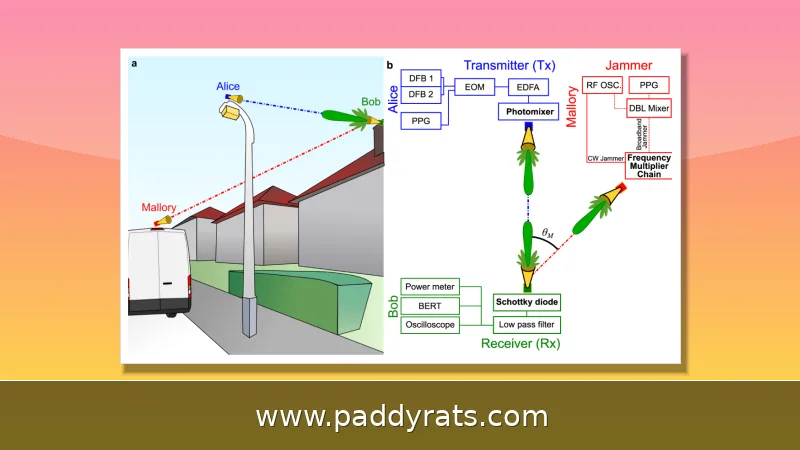
RCIED jamming works by pushing extra radio energy at the enemy receiver, essentially drowning out the detonation command before the device can respond to it. The jammer isn't blowing up the bomb or disabling it physically—it's making the bomb deaf at the exact moment it needs to hear that signal. And that's really the whole point. If the receiver can't pick up the trigger, the trigger never goes off, and the threat gets neutralized without a disposal team having to walk up and deal with it face to face.
Broadly speaking, these techniques fall into two families. Noise jamming floods the target with interference, and it comes in three flavors: spot jamming puts all the available power on one frequency, sweep jamming slides that power across a band, and barrage jamming hits many frequencies at once — though it has to spread its power thinner across them. Repeater jamming works differently. It usually relies on DRFM (digital radio frequency memory) hardware to capture an incoming signal and retransmit a doctored copy, which confuses the receiver. Then there's wideband signal generation, which takes the simplest route of all: it just denies reception across the triggering bands.
Once you've spent time watching a spectrum analyzer, this trade-off starts to feel obvious: power is a finite resource, and the more you spread it out, the weaker it gets at any single frequency. That tension sits at the heart of every RCIED jammer design out there.
Active vs Reactive Jamming: Which Approach Fits Which Threat?
Active jamming just keeps transmitting, nonstop, across whatever bands you've preset it to hit. That simplicity is the whole appeal — it's predictable and always on. But that's also where it falls short: it works fine against threats you already know about, yet it drains power the entire time it's running and can end up drowning out friendly radios in the process. Plain old static jamming is the crudest form of this approach, and when something unexpected pops up outside its preset list, it usually can't do much about it.
Reactive jammers work the other way around. Instead of broadcasting noise all the time, they watch the electromagnetic spectrum in real time and only fire up when they spot a signal that looks threatening. Horus Technologies points out that this approach tends to be more effective overall—it cuts down on unnecessary interference and makes better use of the system's energy. For a convoy on the move, that translates into a couple of very practical perks: own-force comms stay clearer, and the battery isn't drained nearly as fast.
Hybrid jamming is basically what you get when you combine both approaches, and Netline Technologies has made the case that this mixed model has become the go-to solution for dealing with improvised explosive devices. As for which method is actually better, the honest answer, in my experience, is that it really depends on the threat you're facing. If you're up against static, known emitters, active coverage tends to do the job just fine. But when the triggers are agile or unfamiliar, that's when a reactive layer starts to earn its keep.
Key Specifications: Frequency Coverage, Power and Protection Radius
Specs vary a lot from one system to the next, and the figures I'm citing here come directly from vendor datasheets and published project reports. Frequency coverage is usually the first thing to check, since a jammer that can't reach the band the attacker is using is basically just dead weight in a backpack. After that, you look at output power and protection radius — though keep in mind that the effective radius really depends on the terrain, the antennas you're running, and how sensitive the receiver on the other end happens to be.
| System | Frequency Coverage | Power / Range | Notes |
|---|---|---|---|
| HENSOLDT GMJ9500 | 20 MHz to 6000 MHz | Not published | Man-portable, modular, software-defined |
| Shoghi Manpack | 20 to 2600 MHz | 40 m protective range | Backpack, vehicle-mountable |
| Shoghi Vehicular | 20 to 6000 MHz | Up to 1300 W | RF shielding, shock-proof |
| Shoghi Portable Multi-Band | Multi-band | 20 m+ radius, 1-hour battery | Barrage jamming with scanning |
| Phantom Technologies RCJ | Up to 3, 4, 5 or 6 GHz | Up to 1.4 KW | Mixed-signal modulation, Toyota option |
A widely shared 2023 Facebook post put the numbers at 25–6000 MHz and up to 1300 watts, which is right in line with the vehicular-class systems described above. On the other end of the spectrum, a Scribd student project needed only two voltage-controlled oscillators and a power amplifier to jam CDMA, GSM, DCS, and 3G bands, with an effective range of just 2 to 25 meters. That spread — from a bench prototype to a 1.4 kW vehicle-mounted unit — is really what the RCIED jammer spec sheet is telling you.
Deployment Formats: Manpack, Vehicular and Convoy Protection
The HENSOLDT GMJ9500 family is the clearest example of the man-portable philosophy: 20 MHz to 6000 MHz coverage, lightweight, modular and software-defined, able to jam drone-controller links and cellular/ISM bands while still integrating with own-force communications. Software-defined architecture matters here because it lets operators update waveforms instead of replacing hardware.
Shoghi's manpack covers 20 to 2600 MHz with a 40 m protective range in a backpack configuration that can also be vehicle-mounted, while its vehicular system jams 20 to 6000 MHz with integral power up to 1300 watts, plus RF shielding and shock-proof construction. The portable multi-band unit adds a one-hour battery and a 20 m+ protection radius using barrage jamming with scanning.
Phantom Technologies' RCJ series for convoy protection reaches up to 3, 4, 5 or 6 GHz with output power up to 1.4 KW, and the company offers a Toyota vehicle option with special antennas and a generator. SecIntel's Programmable Jammer takes a different route: user-selectable bands, a monolithic module-free design, Direct Digital Synthesis firmware and no factory setting required.
Regulation, Export Controls and Operational Limits
None of this is off-the-shelf consumer gear. SecIntel states plainly that it is illegal to jam any radio signal in the United States, and that all bomb, IED, RF and RCIED jamming devices are regulated by the US Department of State under ITAR, 22 CFR Parts 120-130. An export license is required outside the US, sales are subject to license approval, and an End User Certificate is mandatory.
Shoghi is equally direct: its systems are for government or Ministry of Defence end-usage only, not private or commercial. For anyone researching this topic, that is the practical takeaway. Reactive jamming offers greater precision and fewer interferences, but no amount of technical elegance changes the legal reality that these are controlled defense articles.
The published research timeline reinforces how mature this field has become: Wilgucki and Pesci in 2012, Mietzner in 2012, Magiera in 2018, Mileusnić in 2020, Stratign in December 2023, Netline in May 2023 and Ochijenu in 2023. The technology keeps evolving, but the compliance framework around it has stayed strict by design.
Frequently Asked Questions
How does RCIED jamming work?
RCIED jammers transmit interfering radio signals toward the receiver of a remote-controlled improvised explosive device, blocking reception of the trigger signal. By radiating higher power on the target frequency, the jammer prevents the device from receiving the command to detonate, neutralizing the threat before it can be activated.
What frequency range do RCIED jammers cover?
Coverage varies by system. The HENSOLDT GMJ9500 covers 20 MHz to 6000 MHz. Shoghi's manpack jammer covers 20 to 2600 MHz, while its vehicular system jams 20 to 6000 MHz with up to 1300 watts. Phantom Technologies' RCJ series covers up to 3, 4, 5 or 6 GHz.
What is the difference between active and reactive jamming?
Active jamming transmits continuously across predefined bands, while reactive jammers analyze the electromagnetic spectrum in real time and activate only when a potentially dangerous signal is detected. Reactive jamming improves effectiveness, reduces unnecessary interference and optimizes energy consumption, according to Horus Technologies.
Are RCIED jammers legal to buy?
RCIED jamming devices are strictly regulated. SecIntel notes it is illegal to jam any radio signal in the United States, and all bomb, IED, RF and RCIED jamming devices are regulated by the US Department of State under ITAR, 22 CFR Parts 120-130. Export licenses and End User Certificates are required.