Deception jamming feeds a radar convincing false echoes so it tracks phantom targets instead of real ones. Here is how repeater jammers, DRFM hardware, range-gate pull-off, and modern countermeasures actually work.
What Is Deception Jamming and How Does It Differ From Noise Jamming?
Deception jamming falls under electronic countermeasures (ECM), which is itself part of the larger field of electronic warfare. Rather than blasting a radar with raw energy, a deception jammer sends out RF signals that feed the radar false information, steering its attention away from the targets that actually matter. Having read through a fair amount of the literature, I think the simplest way to put it is this: noise jamming hides the target, while deception jamming replaces it.
Why does that distinction matter? Because the two approaches put very different demands on the jammer itself. A noise jammer — sometimes called a cover jammer — has to keep radiating for the entire duty cycle of the radar signal. A deception jammer, also known as a repeater jammer, only transmits when it actually has something useful to send. That single difference shapes everything downstream: power efficiency, system weight, and how easily the jammer can be detected in the first place.
Here's something that's easy to overlook but worth remembering: a jamming signal doesn't have to be stronger than the target of interest (TOI) echo to create a convincing false target. All it needs to do is cross the radar's detection threshold, and the radar will accept it as a real return. In other words, the jammer isn't trying to shout over the target — it just has to be loud enough to be heard.
That efficiency, though, doesn't come for free — there's a real hardware cost attached. Deception jammers need substantial memory capacity and high sensitivity to track and replicate incoming radar echoes accurately in real time. Skimp on either one, and the copied pulse won't match well enough to fool the radar. One of the most common operational uses is breaking radar lock-on to shield aircraft from missile-guided threats. In that self-protection role, the jammer basically takes over as the target of interest, so the radar ends up chasing the false return instead of the aircraft it was supposed to track.
| Requirement | Why It Matters |
|---|---|
| High memory capacity | Stores the incoming radar pulse long enough to replicate it accurately |
| High sensitivity | Detects and tracks faint radar echoes in real time |
| Common operational use | Disrupting radar lock-on to protect aircraft from missile-guided threats |
| Self-protection role | The jammer assumes the role of the target of interest |
Core Techniques: Range-Gate Pull-Off, Velocity-Gate Pull-Off, and Inverse Gain
Three deception techniques come up again and again in the literature: range-gate pull-off (RGPO), velocity-gate pull-off (VGPO), and inverse gain. On paper they can sound like variations on the same idea, but each one goes after a different piece of the radar's tracking loop. RGPO targets the range gate, slowly dragging the radar's range estimate away from where the real target actually is. VGPO pulls the same trick in the Doppler domain, yanking the velocity gate off the true return. Inverse gain takes a different route altogether—it messes with the radar's automatic gain control so the tracking loop misjudges signal strength. What ties them together is finesse. Instead of dumping noise into the receiver and hoping to blind it, these methods walk the radar off the true target one step at a time, so it never catches on that it's been fooled.
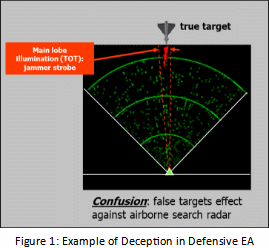
Tracking deception is really the umbrella category here, and it covers more ground than any single trick. Rather than just sowing clutter across the screen, the jammer works to mislead the radar into estimating a false target trajectory — so the radar believes it's holding onto a coherent moving object, when in reality it's chasing a signal the jammer is deliberately steering. Think of it as a kind of electronic puppet master: the tracking loop stays locked, the display looks stable, and nothing seems obviously broken, yet the return being followed answers to the jammer rather than to any real aircraft. That's what sets it apart from crude noise tactics. Beyond trajectory deception, a jammer can also spin up multiple false targets at once, flooding the radar's processing chain with phantom returns until real detection becomes a struggle. In that case the goal is less about subtlety and more about overload — bury the genuine target in a crowd of fakes that the radar has no easy way to sort through.
Angle deception jamming is a technique built specifically to defeat conical scanning radars—systems that figure out which direction a target is in by comparing return strength as the antenna beam sweeps around a central axis. The jammer sends out a false signal timed to match the radar's own scan pattern, which messes up that comparison and tricks the angle-tracking logic. The antenna then drifts toward a phantom direction, pointing somewhere that isn't the real target. What makes this so sneaky is that the radar has a hard time noticing the error at all, because from the receiver's perspective, nothing looks off. Compound deception jamming pushes things even further by stacking multiple techniques into one attack. Take a scheme that fires off CRDJ and ISRJ at the same time—now the jammer is hitting both the range and velocity dimensions at once, which makes the false target that much tougher to tell apart from a real echo.
Active deception false target jamming doesn't work the way noise jamming does. Rather than drowning the radar in static, the jammer sits there and listens for the incoming radar pulse, then forwards a copy of it back — it's not synthesizing a signal from scratch. That forwarded echo is what the radar ends up seeing as a target. Most active deception false target echoes are point-like: small, discrete returns that look like a real aircraft or missile, not some smeared patch of interference. And that's precisely what makes them so convincing. Since they mimic the shape and behavior of genuine returns, they slide right into the radar's normal processing chain instead of sticking out as something obviously foreign, which means the system might track them as real targets without ever flagging anything as wrong.
How DRFM Jammers Generate False Targets
Digital Radio Frequency Memory — DRFM — is the hardware backbone of modern deception jamming. The basic idea works like this: a DRFM jammer listens for an incoming radar pulse, captures it, and holds it in memory just long enough to make deliberate changes, whether that means shifting its Doppler frequency, stretching or compressing its time delay, or both. Then it retransmits that modified pulse back toward the radar. Since the copied signal still looks like a legitimate echo, the radar processes it as a real return and reports a phantom target sitting at the wrong range, or moving at the wrong velocity. To the operator, the track looks perfectly normal — nothing obviously wrong. That coherence is precisely what makes DRFM so effective against pulse-Doppler radars, which depend on the phase relationship of returns to tell real targets apart from clutter. And because the jammer mimics the radar's own waveform instead of drowning it in noise, the deception can slip right through processing chains that would otherwise flag interference.
DRFM-based deception jamming is particularly effective against pulse-Doppler radars, which rely on the coherent phase relationship of returns to distinguish real targets from clutter. The reason has to do with how the jammer handles that coherence. A DRFM jammer doesn't just copy the pulse and send it back—it captures the signal digitally, then retransmits it with a deliberate shift in Doppler or time delay. Because the original coherence is preserved and only shifted, the false target inherits the same phase structure the radar expects from a genuine echo, which is precisely why the radar accepts it as real. That's what makes transponder-style deception jamming implemented by DRFM so convincing: the fabricated return shows high similarity to real target radar echoes, often close enough that the radar's own processing chain treats the phantom as a legitimate contact.
Range deception is one of the simplest tricks a DRFM jammer can pull off. The idea is straightforward: the jammer digitally captures the incoming RF signal and retransmits it with a controlled delay. That delay pushes the false echo out to a different apparent range, which makes the radar see a phantom target sitting somewhere that nothing real exists. It's a clean, effective way to mislead a radar without ever needing more power than the real target's echo. The table below breaks down how the main jammer types stack up against each other on the dimensions that actually matter in the field.
| Jammer Type | Method | Key Advantage | Main Trade-Off |
|---|---|---|---|
| Noise jamming | Overlays broadband or narrowband noise | Simple, covers many frequencies | Low power efficiency, easily detected |
| Spot jamming | Concentrates high-power noise on a single known frequency | Strong effect on one frequency | Fails if radar shifts frequency |
| Barrage jamming | Spreads lower spectral density across a wide band | Wide coverage | Reduced power per frequency |
| Sweep jamming | Cycles spot energy rapidly across frequencies | Balances coverage and peak density | Limited dwell time per frequency |
| Deception jamming | Replaces the target with a false one via DRFM | Radar may never realize anything is wrong | Requires high memory capacity and sensitivity |
Anti-Deception Jamming: Prevention, Detection, and Mitigation
A survey of the field categorizes current anti-deception jamming research into three key areas: prevention strategies, detection strategies, and mitigation strategies. Prevention hinders the ability of jammers to alter radar processing in the first place. Detection alerts the system to deception and may classify the type of attack. Mitigation aims to reduce or suppress the impact of jamming once it is present.
Prevention commonly uses pulse diversity to counter deception jamming by modifying radar signal parameters, making it harder for a repeater to predict and replicate the next pulse. Detection approaches look for inconsistencies between the received signal and expected physical behavior. Mitigation then filters, weights, or otherwise suppresses the contaminated returns so the tracker can recover.
Key avenues for further research emphasize distributed, cognitive, and AI-enabled radar systems. A distributed multiple-radar system has natural advantages in anti-deception jamming, because a false target generated for one radar geometry rarely looks correct from every other vantage point. The caveat is that most anti-jamming methods are proposed in full spatial conditions, which is not always how real deployments look.
Identifying Deception vs Suppression Jamming With the Signal Cone Method
Patent CN103760530A, filed by Xidian University on January 15, 2014, published April 30, 2014, and granted February 10, 2016, with anticipated expiration January 15, 2034, discloses a signal cone-based method to identify suppression jamming and deception jamming. It is a useful concrete example of how classification can be done with geometric reasoning rather than brute-force signal processing.
The steps are straightforward. First, obtain the baseband signal of the target or interference. Second, calculate the interference signal error angle mu between the interference and the real target echo. Third, set a threshold angle theta of 80 degrees as the cone angle, with the real target echo as the central axis, to form a signal cone. Interference outside the cone is defined as suppressive interference and interference inside the cone as deceptive interference. Finally, compare mu with theta to determine the interference type.
The extracted feature is robust and works under both high and low interference-to-noise ratio, which is the practical appeal of the approach. It does not depend on the jammer being strong or weak, only on where the interference sits relative to the real echo's angular neighborhood.
Performance Data, Limitations, and Open Research Directions
Several published results give a sense of what these systems achieve in practice. Detection of DRFM deception jamming, based on simulations and experimental results, shows a correct detection rate reaching 92% at a jamming-to-signal ratio (JSR) and SNR of 0 dB. That is a notable figure because 0 dB is a hard regime, where the jamming and signal are comparable in strength.
An active deception jamming discrimination experiment used a false target released by the jammer as a distance-velocity composite false target, initially about 1,650 meters away from the reference target. Ninety sets of real target data, out of 360 sets total, were collected in each jamming background, with 300 used in the analysis. Range deception jamming performance evaluation also introduces a statistical variance data fusion algorithm that can check whether jamming tracks in the same coordinates are homologous.
The limitations are as real as the results. Radar clutter from terrain, weather, and sea surface complicates jammer recognition, because broadband clutter returns can resemble some noise-jamming signatures. That ambiguity is precisely why prevention, detection, and mitigation are treated as separate problems rather than a single fix.
Noise Jamming Variants and Why the Trade-Offs Matter
Deception jamming does not exist in isolation; it competes and sometimes combines with several noise-jamming variants, each with its own trade-off between peak density and coverage. Understanding these trade-offs is what lets an operator choose the right tool for a given threat picture.
The table below lays out the main comparison points across the jammer families. The pattern is consistent: techniques that concentrate energy in a narrow dimension buy effectiveness at the cost of coverage, while techniques that spread energy buy coverage at the cost of density.
Countermeasures and ECCM: Where the Field Is Heading
Electronic counter-countermeasures (ECCM) are the radar's answer to jamming, and the modern direction is unmistakably toward cognition and distribution. Pulse diversity, waveform agility, and multi-static geometries all attack the same weakness: a repeater jammer has to predict what the radar will do next, and a radar that changes its behavior unpredictably makes that prediction expensive.
Cognitive and AI-enabled radar systems push this further by adapting in real time based on what the receiver observes. Distributed multiple-radar networks add a spatial dimension that a single self-protection jammer struggles to spoof convincingly. In my view, the most interesting open question is not which single technique wins, but how these layers compose when a jammer is itself adaptive.
For anyone tracking this space, the practical takeaway is that deception and counter-deception are locked in a continuous cycle. Each advance in DRFM fidelity raises the bar for detection, and each advance in detection forces jammers toward more sophisticated waveform replication. The performance numbers cited above are snapshots in that ongoing contest, not final verdicts.
Comparison Table: Jammer Types at a Glance
The following table summarizes how the major jamming approaches differ on power behavior, coverage, and concealment. Use it as a quick reference when reasoning about which technique fits a given scenario.
| Jammer Type | Signal Behavior | Coverage | Concealment |
|---|---|---|---|
| Noise (cover) jamming | Broadband or narrowband noise | Wide | Low |
| Spot jamming | High-power noise on one known frequency | Narrow | Low |
| Barrage jamming | Lower spectral density across a wide band | Very wide | Low |
| Sweep jamming | Spot energy cycled rapidly across frequencies | Wide | Low |
| Deception jamming | Replicated radar waveform with controlled delay or Doppler shift | Targeted | High |
The contrast with noise jamming is the key insight: noise jamming overlays energy and hopes the receiver cannot separate signal from interference, while deception jamming replaces the target with a false one and, done properly, the radar never realizes anything is wrong. That is why deception jamming generally achieves far better concealment for the same or lower transmit power.
Frequently Asked Questions
How does deception jamming work against radar?
Deception jamming replicates the radar waveform and retransmits it with controlled modifications, feeding the radar a convincing false echo. Because the false target can be generated without exceeding the real target echo power, as long as it surpasses the detection threshold, the radar may track a phantom target in range, velocity, or angle.
What is the difference between noise jamming and deception jamming?
Noise jamming, also called cover jamming, raises background noise at the receiver to mask legitimate signals. Deception jamming instead injects false information that diverts attention, and done properly the radar never realizes anything is wrong. Deception jammers do not transmit over the entire duty cycle, which improves power efficiency and concealment.
What is DRFM deception jamming?
Digital Radio Frequency Memory jammers digitally capture an incoming radar pulse, alter its Doppler shift or time delay, and retransmit the modified pulse. The radar then processes a false return indicating a phantom target at an incorrect range or velocity. DRFM-based deception is particularly effective against pulse-Doppler radars, which depend on coherent phase relationships.
How can radar detect and counter deception jamming?
Anti-deception jamming is grouped into prevention, detection, and mitigation. Prevention uses pulse diversity to hinder jammers altering radar processing; detection alerts the system and may classify the attack type; mitigation reduces or suppresses jamming impact. Research highlights distributed, cognitive, and AI-enabled radar systems as key directions.
What is DRFM and why is it important for radar jamming?
Digital Radio Frequency Memory (DRFM) is the hardware backbone of modern deception jamming. It samples an incoming radar pulse, digitally alters its delay or Doppler shift, and retransmits the modified pulse. Because it preserves phase coherence, the false target inherits the structure pulse-Doppler radars expect, making it very hard to distinguish from a real return.
What countermeasures exist against deception jamming?
Anti-deception jamming splits into prevention, detection, and mitigation. Prevention uses pulse diversity and waveform agility so a repeater cannot predict the next pulse. Detection looks for inconsistencies between the received signal and expected physical behavior. Mitigation filters or suppresses contaminated returns. Distributed, cognitive, and AI-enabled radar networks add a spatial dimension that a single jammer struggles to spoof.