Signal jammers emit non-ionizing RF radiation, and the same physics that makes them work also sets the safety rules you need to follow. Here is what the FCC, ICNIRP, and NCRP limits actually say, plus how time, distance, and shielding cut your exposure.
What Is a Signal Jammer and How Does It Emit Radiation?
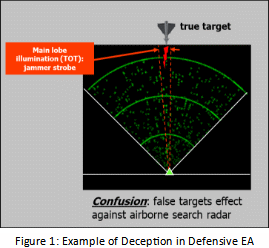
A signal jammer is basically a transmitter that blasts a strong signal on the same frequencies a target device is using, drowning out the legitimate link in noise. For the jamming to actually work, the jammer's power at the receiver has to match or exceed the wanted signal—usually by at least a factor of ten. That one engineering fact explains why people even ask about radiation: this isn't some passive box sitting in the corner. It's an intentional, high-power RF source sharing the same room, vehicle, or building as the people it affects.
A signal jammer's energy is radiofrequency (RF) radiation, which falls on the non-ionizing side of the electromagnetic spectrum. That's the same broad family that covers everything from AM radio to Wi-Fi and cell signals, spanning roughly 3 kHz to 300 GHz. The ICNIRP guidelines, for their part, set exposure limits from 100 kHz up to 300 GHz (Health Phys. 54:115-123; 1988), so most jammer hardware lands well inside that range. The key word here is "non-ionizing": unlike X-rays or gamma rays, RF photons just don't carry enough energy to break molecular bonds or directly damage DNA. That said, high-power RF isn't harmless. At high enough power densities, the real hazard is heating of body tissue, which is why regulators write exposure limits in terms of absorbed energy and power density—SAR (Specific Absorption Rate), for example—rather than DNA damage. Bottom line: the worry with jammers isn't broken strands of genetic code, it's how much energy your body absorbs and turns into heat.
What surprises most people when I show them a bench transmitter is how boring a jammer looks up close. No eerie glow, no ominous buzzing—just a 300-watt output unit sitting there with its 208 VAC three-phase input and 2,500 BTU/h nominal cooling capacity. Strip away the casing and it's basically a rack of amplifiers that needs serious thermal management. And that 2,500 BTU/h figure isn't just spec-sheet padding. It tells you something: the box is converting a good chunk of its input power into heat, and the rest into an RF field. You can feel one of those with your hand. You can't feel the other at all—which is exactly why any safety plan has to account for both.
Terminology gets messy fast, because the same piece of hardware turns up under a bunch of different names depending on who's writing the rules. You'll see RF radiation, radiofrequency electromagnetic fields, EMF, non-ionizing radiation, SAR (Specific Absorption Rate), jammer, signal blocker, RF jammer, and even the DUKE system, which is an Army radio jammer. That overlap isn't just careless wording, either — regulators, health agencies, and safety committees each lean toward their own vocabulary, so one device can show up under several names across different documents. The takeaway is pretty simple: search any of those terms alongside FCC, ICNIRP, NCRP, the ARRL RF Safety Committee, EPA, OSHA, DHS, Health Canada Safety Code 6, or the Stanford Radiation Safety Manual, and you'll land in the same family of regulatory and safety guidance. Once you know the vocabulary shifts but the underlying subject stays the same, you stop chasing what looks like a dozen separate topics when it's really just one.
RF Radiation Safety Rules: Time, Distance, and Shielding
Every solid RF safety program I've seen keeps coming back to the same three controls: time, distance, and shielding. Time means cutting down how long you actually spend in the field. Distance means putting more space between you and the source. Shielding means getting some kind of barrier in place between you and the transmitter. Fancier guidance like OSHA's Hierarchy of Hazard Controls and the ALARA principle (As Low As Reasonably Achievable) doesn't really replace any of this—it just sorts it into a cleaner framework.
Distance is the control most people overlook, and it's also the one that costs nothing to use. The reason comes down to the inverse-square law: as you move away from a transmitter, the energy spreads out over a larger area, so the power density hitting your body drops fast. Double your distance from an RF source and exposure usually falls by about 75 percent; run the pure inverse-square math and the dose ends up at a quarter of what it was. Go further, say ten times the original distance, and the drop gets even more dramatic. Now compare that to shielding, which might mean buying some kind of barrier material, or to time limits, which depend on how long a job takes. Distance just asks you to step back. For anyone working around a jammer, that's why the most effective move often isn't about equipment at all. It's simply not standing next to the antenna.
Shielding is where things get pretty straightforward. Since jamming is itself a signal, it can be blocked or at least weakened by physical barriers — vehicles, buildings, heavy materials like metal. With RF, what matters is density: put lead, concrete, or water between you and the source, and the field gets attenuated. Gamma rays are a whole different story, though. Hazmat suits won't do a thing against them, since that kind of high-energy radiation cuts right through standard chemical defense layers.
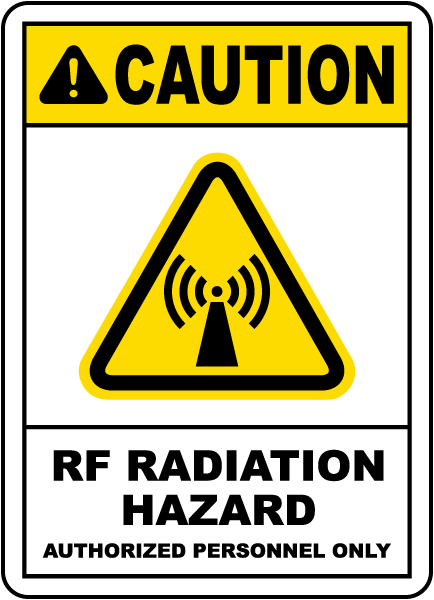
Warning signage is part of the rules, not just a formality. Blue, yellow, and red signs tell you whether something is a notice, a caution, or a warning about RF hazards, and the instruction that follows is always the same: stay out of unauthorized areas. If you're putting together a site safety plan, the three controls and the signage line up pretty neatly, and the table below is the one-page version I keep on hand for briefings.
| Control | What You Do | Expected Effect |
|---|---|---|
| Time | Limit or minimize exposure duration | Reduces cumulative dose |
| Distance | Move farther from the source | Doubling distance cuts exposure roughly 75 percent |
| Shielding | Insert lead, concrete, or water barrier | Attenuates the field before it reaches you |
| Signage | Heed blue, yellow, and red RF signs | Keeps unauthorized people out of high-field areas |
ALARA—As Low As Reasonably Achievable—is one of those principles worth actually taking to heart, because it's more of a mindset than a checklist. Even when you're comfortably inside a legal exposure limit, the point is to keep pushing exposure down whenever it's realistic to do so. That mindset plays out in small, everyday choices: shorter shifts near the antenna, running cables away from work areas, and treating the edge of a warning zone as a hard line instead of a suggestion. It also lines up with the OSHA Hierarchy of Hazard Controls, which puts elimination, substitution, and engineering controls ahead of administrative controls or PPE. So ALARA isn't really about any single rule—it's about getting into the habit of asking, "Can I do this with less exposure?" and then actually doing something about the answer.
FCC and ICNIRP Exposure Limits for RF Energy
If you live in the US, there's a good chance the only radiation exposure number you've ever actually laid eyes on is the one printed in your phone's manual. The FCC caps public exposure from cell phones at an SAR of 1.6 watts per kilogram (1.6 W/kg). SAR stands for Specific Absorption Rate, and it measures how much RF energy gets absorbed in a wireless handset user's head—so it's really a dose measurement, not a raw transmitter power figure. That one number has ended up shaping how the public thinks about RF dose, mostly because it's the figure regulators force manufacturers to disclose right at the point of sale. It also gives people a familiar reference point for sizing up the much stronger fields jammers throw off, which is exactly why any conversation about jammer radiation safety usually starts right here.
Once you move past consumer devices like phones and Wi-Fi routers, RF exposure standards get much messier, since there's no single agency calling the shots for everyone. ICNIRP, the International Commission on Non-Ionizing Radiation Protection, puts out guidelines that cover exposure limits for radiofrequency electromagnetic fields across an enormous stretch of the spectrum, from 100 kHz up to 300 GHz. Those guidelines first appeared in Health Phys. 54:115-123 back in 1988 and have been revised several times since as the science has developed. The NCRP, for its part, has argued for a limit of 0.2 mW/cm² for nonoccupational exposure in the much narrower 30-300 MHz band. What's interesting is that the two groups don't even measure things the same way: one thinks in terms of frequency ranges and field strengths, the other in power density. Different organizations, different metrics, but the same basic goal, which is keeping tissue heating below the level where it could do harm, while still leaving some cushion for the people who are most vulnerable.
Resonance is the detail that explains why exposure limits have to change with frequency instead of staying fixed across the board. When an RF field hits a frequency close to the body's natural resonant point, the body soaks up that energy far more efficiently than it would at other frequencies — much like a tuning fork that rings loudly only when struck at its own pitch. For an adult standing on the ground, that resonance sits at about 35 MHz; lift the same person off the ground (insulated, say on a dry floor or in rubber-soled boots) and the resonant frequency roughly doubles to 70 MHz. Body parts have their own hot spots too: an adult head resonates near 400 MHz, while a baby's smaller head resonates up near 700 MHz. This is why a field strength that seems trivial at one frequency can be far more consequential at another, and why a single blanket number for all RF exposure would be misleading.
Occupational and emergency frameworks add another layer. The federal limit for public exposure is often set at 100 millirem per year, while EPA guidelines allow first responders to absorb up to 25,000 millirem (25 rem) in emergency conditions. Army RF safety programs are required for devices exceeding Maximum Permissible Exposure limits under DODI 6055.11. These are different units and different scenarios, but they all rest on the same principle: define the limit, then control the exposure.
Health Effects of Jammer Radiation: What Research Shows
The honest answer is that RF energy is non-ionizing and lacks sufficient energy to break molecular bonds or damage DNA directly, but that does not make high-power exposure harmless. At sufficiently high power densities, RF energy can injure tissue through heating, the so-called thermal effect. That is the mechanism regulators are most confident about, and it is the basis for most exposure limits worldwide.
Below the thermal threshold, the picture gets murkier. Athermal effects at lower energy levels are studied through epidemiological and laboratory research, and the epidemiological studies have been inconclusive. The IARC classifies RF radiation as possibly carcinogenic to humans, based on limited evidence of a possible increase in risk for brain tumors among cell phone users and inadequate evidence for other cancer types. That classification is a hazard signal, not proof of causation.
One finding deserves specific attention because it is unusually direct. Short-term exposure to mobile jammer radiofrequency radiation for durations as low as one hour has been reported to adversely affect human hearing, and the authors argued that stricter regulations are needed. I treat that as a flag rather than a settled conclusion, because single-study results need replication, but it is a strong argument against casual, prolonged proximity to an active jammer.
For context, the exposure scenario matters enormously. A person standing beside a 300-watt jammer is in a completely different situation from someone using a phone at SAR 1.6 W/kg. The inverse-square relationship means the field falls off fast, and the difference between one meter and ten meters can be the difference between a regulated occupational exposure and a background-level one.
How to Protect Yourself from Jammer RF Exposure
Protection starts with knowing where the field is strong, which in practice means knowing where the antennas are and which direction they point. Directional antennas concentrate energy, so the beam axis is the worst place to stand and the area behind the mounting structure is often dramatically better. Before anything else, map the high-field zones and mark them with the appropriate blue, yellow, or red signage.
Then apply the controls in order of effectiveness, following the OSHA Hierarchy of Hazard Controls. Elimination or substitution comes first: if jamming is not required, do not run it. Engineering controls come next, such as barriers, interlock systems, and physical separation. Administrative controls follow, including shift limits and access rules. Personal protective equipment is the last line, not the first.
For tactical and emergency scenarios, protective equipment has evolved. Tactical radiation protection uses targeted shielding around bone marrow in the pelvic region to preserve the regenerative center while maintaining mobility, an approach associated with gear such as StemRad 360. That is a very different use case from RF jamming, and it is important not to confuse the two: a gamma-ray shield is not an RF shield, and an RF barrier is not protection from ionizing radiation.
Practical field habits close the loop. Keep transmit time short, keep distance generous, and keep a physical barrier between you and the source whenever the geometry allows. If you work around jammers regularly, treat exposure as a cumulative budget rather than a series of isolated events, and document your controls so the next person on site inherits a plan instead of a guess.
| Protective Measure | Practical Action | Notes |
|---|---|---|
| Time | Shorten transmit and proximity windows | Reduces cumulative dose |
| Distance | Increase separation from antennas | Exposure falls with the inverse square of distance |
| Shielding | Use metal, concrete, water, or vehicle bodies | Effective against RF, not a substitute for ionizing radiation shielding |
| Signage and access | Post blue, yellow, and red warnings | Keep unauthorized personnel out |
Legal and Regulatory Status of Signal Jammers
Jammers do not comply with FCC rules, and that is not an oversight in the rules, it is the point of them. The devices are designed to jam or disrupt authorized communications, so selling, marketing, or operating them in the US violates federal law. The FCC's jammer enforcement pages are updated regularly, and enforcement actions continue, which tells you the agency treats this as an active priority rather than a legacy rule.
The public safety argument is the strongest one. RF jamming devices can intentionally or unintentionally pose serious risks to public safety and disrupt essential communications. Jammers may interfere with public safety communications and leave first responders without vital communications, which is why the objections go well beyond spectrum etiquette. A jammer near an emergency scene is a direct threat to the people trying to manage it.
Regulatory guidance is also moving. Health Canada Safety Code 6, which sets radiofrequency exposure guidelines, was updated on April 4, 2024. The Stanford Radiation Safety Manual was last updated on September 19, 2025, the DHS jamming page on September 3, 2025, and the EPA non-ionizing radiation page on March 24, 2026. FCC jammer enforcement material was refreshed within the past week as of this writing. The direction of travel is more scrutiny, not less.
For anyone evaluating whether to deploy jamming hardware, the compliance question and the safety question point the same way. The device is illegal for civilian use in the US, it can degrade emergency communications, and it creates an RF field that you then have to manage with time, distance, and shielding. If you encounter one in the field, the correct move is to avoid the high-field area, document what you observed, and report it to the appropriate authority rather than trying to work alongside it.
Frequently Asked Questions
Do signal jammers emit radiation?
Yes. A jammer device usually emits radiation, and people who attend places where jamming is active are exposed to it. When jamming is effective, the jammer power will be equal to the signal power at the receiver, so the jammer must transmit at comparable or higher power. That is why the device is treated as an RF source, not just an interference problem.
What are the three basic rules of radiation safety?
The three basic protective measures are time, distance, and shielding. Limit or minimize exposure time, move farther away because dose drops with distance, and insert a barrier of lead, concrete, or water between you and the radiation source. Doubling your distance from an RF source typically reduces exposure by roughly 75 percent.
Is RF EMF harmful to humans?
The International Agency for Research on Cancer (IARC) classifies RF radiation as possibly carcinogenic to humans, based on limited evidence of a possible increase in risk for brain tumors among cell phone users, and inadequate evidence for other types of cancer. RF is non-ionizing, so the established hazard at high power densities is tissue heating rather than direct DNA damage.
What is the FCC limit for public RF exposure from cellular telephones?
The FCC limit for public exposure from cellular telephones is an SAR level of 1.6 watts per kilogram (1.6 W/kg). SAR corresponds to the relative amount of RF energy absorbed in the head of a user of a wireless handset. This is the consumer-facing benchmark most people encounter, and it is separate from the power-density limits applied to occupational RF environments.