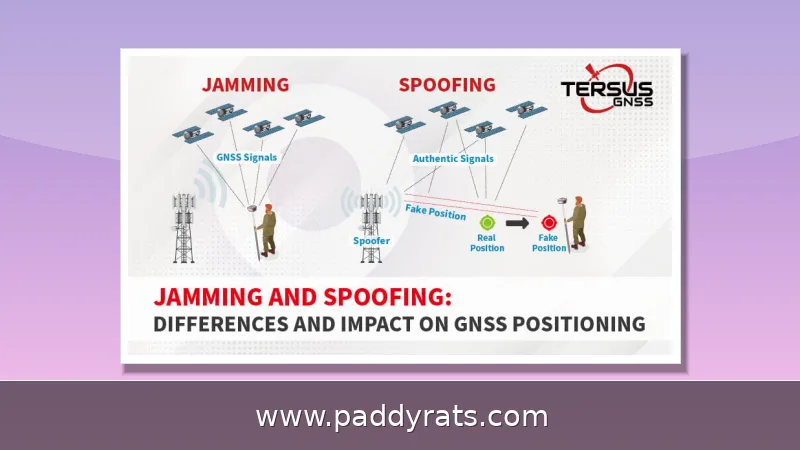
Signal jammers are illegal in the US yet seizures keep climbing, so the practical question is detection and reporting, not counter-jamming. Here is what actually works, what fails, and how to file an FCC complaint.
What Is a Signal Jammer and How Does It Work?
A signal jammer is really just a radio transmitter built to drown out other radio traffic. It floods the same frequencies your phone, WiFi router, GPS receiver, or alarm sensor depends on with RF noise, so the signal from a cell tower or satellite gets buried in the mess. Cell jammers put out electromagnetic signals on the exact bands mobile phones use, cutting the link back to the tower. WiFi jammers are a little different: they blast strong RF energy across the 2.4 GHz and 5 GHz bands, creating digital noise that keeps devices from reaching the router.
The frequency bands involved are surprisingly narrow and well documented, and that's precisely what makes jammers so effective. Cell jammers usually go after 700MHz, 800MHz, 900MHz, 1800MHz, 1900MHz, and 2100MHz, a range that covers everything from legacy 2G networks all the way up to 5G. GPS devices occupy their own slice of spectrum around 1575MHz, while WiFi runs on the 2.4GHz and 5GHz bands. So a single device blasting noise on just the right slice of spectrum can take out an entire category of gadgets at once. Cheap units only block one frequency, but even that is often enough to trick a handset into thinking there's no network nearby. Move up to more advanced models and you get protocol jamming aimed at control channels, which is much harder to work around. Wide-band full spectrum jammers go further still, hitting multiple bands at the same time.
| Technology | Targeted Frequency Bands |
|---|---|
| Cellular (2G–5G) | 700MHz, 800MHz, 900MHz, 1800MHz, 1900MHz, 2100MHz |
| GPS | 1575MHz |
| WiFi | 2.4GHz, 5GHz |
The range is smaller than most people assume. Wilson Amplifiers says typical jamming coverage maxes out at around 30 square feet, while a Scribd overview puts common devices at a 30-foot radius. Why does that matter? Because it means the jammer has to be close by, usually inside the building or just outside it. And that's exactly why hunting down the device itself is the fastest way to get your service back.
This isn't some niche annoyance or a passing fad — it's a real and growing problem, and the numbers bear that out. Since 2021, U.S. Customs and Border Protection has logged roughly an 830% jump in signal jammer seizures, a spike that points to rapidly rising demand for these devices. And over the past year, officials, police, and security experts in Los Angeles have issued warning after warning that burglars are using WiFi jammers to take down home networks before breaking in — after all, a dead connection often means a dead camera feed or alarm link too. This pattern isn't just a coastal thing, either. Back in June, the Department of Homeland Security reported that jamming devices were used in a string of Vermont bank robberies, and jammers also turned up in an attempted jewelry store heist in La Verne, California. Taken together, these cases make one thing clear: jamming has gone from a technical curiosity to a tool for serious crime, and it got there fast.
How to Tell If a Cell or WiFi Jammer Is Active Nearby
Detection usually comes down to spotting patterns, not running out to buy some fancy gadget. The classic giveaway is a bunch of phones all dropping service at the exact same moment, while anything plugged into Ethernet just keeps humming along like nothing happened. WiFi looks a little different: your router might simply vanish from the device list, latency spikes, packet loss starts climbing, or video calls freeze in a way that keeps happening around the same time every day. And since jammers only mess with wireless links, that wired connection staying alive is honestly one of the strongest clues you've got.
Before you jump to conclusions, look for a pattern. Are several devices on different carriers all having trouble at once? Does the problem follow you from room to room, and then clear up once you leave the property? If it's just one phone acting up, that's more likely a handset issue or a carrier problem than any kind of interference. And those apps that claim to detect jammers? They're mostly unproven, and here's the catch—they need a working signal to do their job in the first place.
Honestly, the most reliable way to find an active jammer is still to go look for it yourself. No app or diagnostic tool comes close to a trained pair of eyes in the right spot. Wilson Amplifiers says to watch for something that resembles a walkie-talkie, a cell phone, or a wireless router — a device that blends into normal surroundings but tends to sit near a window, stay hidden in a closet, or get mounted on a wall facing the exact area it's meant to disrupt. That placement isn't random. RF noise fades with distance, so a jammer performs best when nothing solid sits between it and its targets. And since portable jammers are battery-powered, cordless, handheld units with built-in antennas, they're small enough to tuck behind a curtain or inside a drawer, and light enough to carry from room to room in seconds. A burglar could plant one near a front door while casing a home, then drop it in a pocket once the job is done.
If you do find a suspicious transmitter, don't just unplug it, throw it in a drawer, and forget about it. That reaction makes sense in the moment, but it can weaken your case down the road. Treat the device like evidence instead: take photos of it from a few different angles, write down exactly where it was and when you found it, and keep the unit itself rather than getting rid of it or smashing it. Law enforcement and the FCC both handle jammer cases as regulatory violations, so that paperwork and the hardware can really matter later on. It's also worth understanding why these devices get that level of attention. A jammer can knock out 9-1-1 calls and other emergency traffic, and it can interfere with the radio channels police depend on to coordinate. So a small device hidden somewhere in your building isn't just a nuisance for you and your neighbors — it's a public safety problem that can put people in real danger.
| What to do | Why it matters |
|---|---|
| Photograph the device from multiple angles | Creates a visual record of what was found and how it was set up |
| Write down where and when you found it | Establishes a timeline and location for investigators |
| Keep the device itself | Law enforcement and the FCC handle jammers as regulatory violations, so the hardware serves as evidence |
| Do not simply unplug it and walk away | Premature removal can weaken the case and leave the underlying problem unresolved |
Can You Block a Signal Jammer? What Actually Works
Let's be honest: physically blocking a jammer is really difficult, and there's no way around the bottom line—you can't legally counter-jam one yourself. Most jammers are just transmitters, plain and simple, and the only genuine ways to beat a transmitter are to overpower it with a stronger signal or to track the device down and shut it off. Both of those options run into the exact same wall. Transmitting on those frequencies is already illegal to begin with, so building your own jammer to fight back would only make you the second lawbreaker in the room. That leaves you with the practical playbook instead: detect the interference, relocate if you're able to, shield whatever you can, and report the incident to the proper authorities rather than trying to fight noise with more noise. Sure, it feels less satisfying than jamming the jammer, but it's the only approach that actually holds up.
Honestly, the most reliable fix is to stop leaning so hard on the connection that's being jammed in the first place. If a desktop or point-of-sale terminal is plugged into wired Ethernet, it'll keep humming along through a WiFi jamming attack, since the interference only messes with wireless devices talking to a router over the air. Wired connections are actually one of the few defenses a jammer can't really touch, because the data never rides on radio waves at all. And if the jammer happens to be low power or directional, you might not need to change a thing — simply moving to another room, another floor, or the far side of the building can put enough distance or material between you and the device to get your signal back. Switching the WiFi channel or hopping between 2.4 GHz and 5 GHz is sometimes enough to slip past a cheap single-frequency jammer that only blocks one narrow slice of spectrum. That trick has its limits, though, and you shouldn't count on it against a wide-band full spectrum jammer, which blankets several bands at once and doesn't leave you many places to hide.
Shielding a phone or a room from a jammer’s signal is possible in theory, but the results are partial at best and come with genuine tradeoffs. The physics here are simple: RF-absorbing materials soak up radio energy, and that energy has to end up somewhere. Depending on how resistive the material is, the captured signal may be re-radiated back out like an antenna, shunted into a grounded mass, or simply converted into heat. That means a shield can quietly become a weak transmitter of its own, which is why effective RF enclosures are engineered, tested, and grounded rather than improvised. Among amateur radio operators, you’ll hear DIY suggestions like wrapping a crude Faraday-style cage around the jamming source or severing its antenna feed. Both ideas can work on paper, but tampering with a jammer you don’t own exposes you to legal risk, so the safer play is to document what you’re seeing and let law enforcement or the FCC take it from there.
For a home or business, the smartest approach is layered rather than relying on any single fix. Start with the outside: perimeter lighting, fences or gates, and video surveillance can deter intruders before they ever reach a door, which is exactly what Post Alarm Systems recommends. Then harden the connection itself. Alarm panels should lean on cellular or wired connections whenever possible, since those are far harder to silence than a WiFi link — a burglar with a cheap WiFi jammer can knock out a wireless camera or sensor feed, but cutting a cellular or hardwired path takes much more effort. And if the jamming doesn't stop? Document what's happening — times, symptoms, affected devices — and escalate it to law enforcement or file a complaint with the FCC. One thing you should not do is go out and buy some counter-jammer gadget, because that product simply doesn't exist.
Why Signal Boosters and Amplifiers Cannot Beat a Jammer
A signal booster amplifies an existing signal, and that is precisely why it fails against jamming. If the incoming signal is already buried under RF noise, amplifying the mess does not recover the call. Any signal jammer is also, by definition, a signal booster jammer, so amplifiers are not an effective defense against interference, no matter how much gain the spec sheet advertises.
This is the most common misconception I run into when readers describe their setup. People buy a booster after a bad experience with dropped calls, then assume it will also protect them from a deliberate attack. The two problems look similar on a signal meter but have opposite causes: one is too little signal, the other is too much noise on the same frequency.
The table below summarizes how the main defenses actually behave when a jammer is running.
| Defense | Works against a jammer? | Why |
|---|---|---|
| Signal booster or amplifier | No | Amplifies the jammed signal along with the noise |
| Wired Ethernet | Yes | Jammers only disrupt wireless links |
| Changing WiFi channel or band | Sometimes | Helps only against single-frequency jammers |
| Relocating devices | Often | Escapes a low-power or directional field |
| Shielding or enclosure | Partially | Absorbs RF but can re-emit or convert it to heat |
| Reporting to the FCC | Yes, legally | The only sanctioned way to remove the device |
The takeaway is that money spent on more gain is money wasted. If you suspect deliberate jamming, put the budget into redundancy instead: a wired backup path, a second carrier for the alarm panel, and a documented complaint trail that gives regulators something to act on.
Legal Steps: Reporting Jammers to Law Enforcement and the FCC
Federal law prohibits operating, marketing or selling any jamming equipment that interferes with authorized radio communications, including cellular, PCS, police radar and GPS. There are no exemptions for businesses, classrooms, residences or vehicles, and even local law enforcement lacks independent authority to deploy jammers, though federal agencies may be authorized in specific instances. The Communications Act of 1934 outlaws interference with authorized radio broadcasts, which is the foundation these enforcement actions rest on.
The FCC's Jammer Enforcement guidance walks consumers through a practical sequence. Start by checking device and network settings for updates, confirm signal modes such as airplane mode, and verify configurations are correct. Restart the device. If the problem persists, go to the FCC complaint form, select Interference in the Phone Issues box, then choose Signal Jammers as the Phone Interference Sub-category and submit the details.
Wilson Amplifiers offers a parallel field checklist: physically locate the jammer, disable it if it is safe and lawful to do so, try switching frequency depending on how sophisticated the device is, relocate equipment to restore reception, and contact law enforcement or file an FCC complaint. Post Alarm Systems adds that perimeter lighting, fences or gates, and video surveillance deter threats before they reach doors, which reduces the odds of a jammer being planted in the first place.
One caution I always give readers: do not advertise that you have found a jammer on social media before you report it. Timing matters. CBP seizures have risen sharply since 2021, DHS flagged jamming in Vermont bank robberies in June, and the La Verne jewelry store attempt shows how quickly these cases move from nuisance to felony. Report early and keep your documentation intact.
Physical and Layered Defenses Against Alarm Signal Blocking
Because you cannot legally jam back, defense has to be architectural. The goal is to make sure a single blocked frequency does not take down your security posture. That means alarm panels with dual paths, one cellular and one wired or IP, so a WiFi jammer cannot silence the whole system. Cameras should record locally as well as to the cloud, because a jammed uplink turns a cloud-only camera into a paperweight.
Portable jammers are battery-powered, cordless and handheld with built-in antennas, designed for small rooms, vehicles or localized outdoor use. Drone jammers use built-in directional antennas against ISM bands and navigation signals, forcing drones into failsafe hover or return-to-launch. Knowing the form factor helps you search a space: these devices are small, they need line of sight to be effective, and they are usually placed near the target rather than far from it.
For homes, the practical checklist is boring but effective. Keep a wired access point for critical devices, use a second carrier on the alarm communicator, place cameras so their footage captures approach routes, and add lighting and gates that make the property a harder target. For small businesses, add a documented incident log with timestamps, because regulators and insurers both ask for it.
None of this guarantees immunity. A determined attacker with a wide-band full spectrum jammer can still create a window of silence. What layered defenses buy you is a shorter window, better evidence, and a faster route to enforcement, which in practice is the difference between a nuisance and a loss.
The Bottom Line on Blocking a Signal Jammer
There is no consumer product that reliably beats a jammer, and the ones marketed that way are either boosters that cannot help or apps that need a working signal to run. The realistic strategy is detection, redundancy and enforcement: find the device, keep a wired path alive, and file a complaint with the FCC and local law enforcement so the transmitter is removed legally.
If you take one thing from this guide, make it the sequence. Confirm that multiple devices are affected, check for a walkie-talkie-sized transmitter nearby, preserve evidence, and report it through the FCC's Interference complaint path. Jamming is illegal in the United States and much of the world, and the enforcement machinery exists precisely because counter-jamming is not a lawful option for you.
Quick Reference: Jammer Types and Targeted Frequencies
Different jammers attack different layers of your connectivity, which is why a single fix rarely covers everything. The table below maps the common device types to the frequencies they target and what stops working when they are active.
| Jammer type | Targeted bands | What it disrupts |
|---|---|---|
| Cell phone jammer | 700-2100MHz | Voice calls, SMS, mobile internet |
| WiFi jammer | 2.4GHz and 5GHz | Wireless devices reaching the router |
| GPS jammer | 1575MHz | Navigation and timing receivers |
| Drone jammer | ISM bands and navigation signals | Drone control, forcing failsafe hover or return |
| Full spectrum jammer | Multiple bands at once | Most wireless links in range |
A DIY cell phone jammer circuit is sometimes described as needing three subcircuits: an RF amplifier, a voltage controlled oscillator and a tuning circuit, with components such as resistors R1-R2, capacitors C1-C7, transistor Q1 and inductor L1, capable of blocking UMTS, 3G, CDMA, GSM and PHS. Building or operating one is illegal in the US, so treat that knowledge as context for understanding what you are up against, not as a project plan.
Product listings on sites like Jammer Master show the commercial reality: a 4G Phone Jammer JM021 at $520.00, a Drone UAV Signal Jammer JM004 at $2,399.99, a Handheld WiFi Bluetooth Signal Jammer JM012 at $569.99, and a Handheld Mobile Phone Jammer with 16 antennas rated to 25 meters, the JM018, at $699.00. These prices are useful only as a reminder of how cheap and accessible the hardware has become, which is exactly why reporting matters.
How to Document and Escalate a Suspected Jamming Incident
Good documentation is what turns a complaint into an enforcement action. Write down the date, time, location and duration of each outage, list which devices and carriers were affected, and note whether wired connections kept working. Screenshots of signal strength, router logs and speed tests add weight, and a photo of any suspicious device is the single most valuable piece of evidence you can collect.
Keep the log factual and free of speculation about who is responsible. Regulators work from observable interference, not motive. If the jamming coincides with a break-in attempt or a pattern of suspicious activity, say so plainly and let law enforcement connect it to the broader case, as happened with the Vermont bank robberies and the La Verne jewelry store attempt.
Finally, know the limits of what you can do yourself. Local police may not have independent authority to seize a jammer, but they can document the incident and coordinate with federal partners. The FCC complaint route exists for exactly this scenario, and it is the only path that can result in the device being legally removed and the operator penalized.
This article is for informational purposes and does not constitute legal advice. If you believe a jammer is endangering safety or blocking emergency calls, contact law enforcement immediately rather than attempting to disable the device on your own.
Frequently Asked Questions
Can you actually block a signal jammer?
Physically blocking a jammer is very hard. Most jammers are just transmitters, and the only real way to defeat one is to have more power than the jammer or to locate and disable it. You cannot legally block a jammer yourself, so report it to law enforcement or the FCC instead.
How do I know if a signal jammer is being used near me?
Common signs include dropped service on multiple phones, erratic signal strength, WiFi disconnections near the router, high latency and packet loss. Wired Ethernet connections keep working because jammers only affect wireless links. Confirm that several devices are affected before you suspect a jammer.
Does a signal booster stop a jammer?
No. A signal booster amplifies an existing signal, but if a jammer blocks that signal, the booster will not work. Any signal jammer is also a signal booster jammer, so amplifiers are not an effective defense against jamming.
Is it legal to use a signal jammer?
No. In the United States, federal law prohibits operating, marketing or selling jamming equipment that interferes with authorized radio communications, including cellular, PCS, police radar and GPS. There are no exemptions for businesses, classrooms, residences or vehicles, and even local law enforcement lacks independent authority to use jammers.