GPSPATRON is a Warsaw-based engineering company whose neural-network platform detects, classifies and localizes GNSS jamming and spoofing. Its three-channel probes and GP-Cloud software protect timing, navigation and GNSS-dependent infrastructure worldwide.
What Is GPSPATRON and What Problem Does It Solve?
GPSPATRON is an engineering-driven company that builds a platform for detecting, classifying, and localizing GNSS interference. It was founded in Warsaw, Poland, in mid-2018, at 20 Prosta Street, after a client came to the team with concerns about GNSS spoofing, jamming, and interference affecting their operations. Their response was to build a dedicated monitoring stack from the ground up, rather than bolting GNSS protection onto some generic cybersecurity product.
The problem GPSPATRON tackles is pretty straightforward: GNSS signals are weak, unencrypted, and easy to drown out. According to the company, the cost of pulling off a GNSS spoofing attack has fallen from around $100,000 to roughly $100 over the past decade, thanks to cheap software-defined radios and open-source projects floating around on GitHub. In other words, spoofing is no longer something only nation-state labs can afford to do—it has slipped into hobbyist territory. That's exactly why continuous monitoring matters for anyone who depends on GPS for timing or positioning.
How Does the GP-Probe and GP-Cloud Architecture Work?
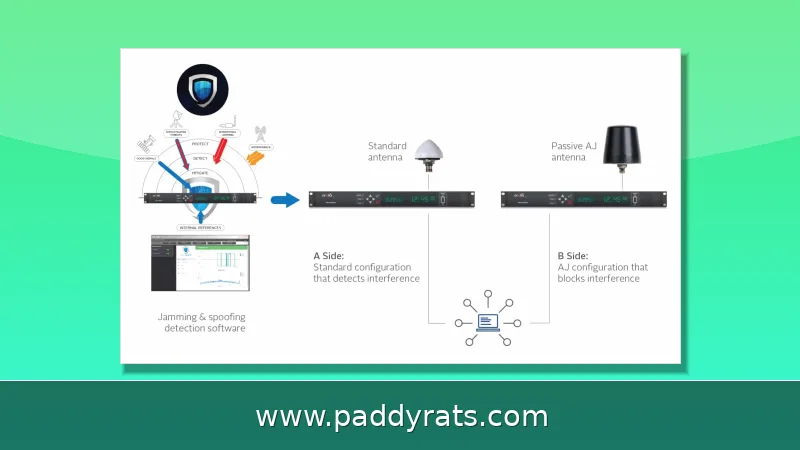
The whole thing runs on a distributed, neural network-based platform. On the hardware side, a GP-Probe takes GNSS signal measurements across three RF channels, which lets it estimate the spatial parameters of the signal, and then it sends that raw data off to GP-Cloud for processing in real time. From there, GP-Cloud handles the heavy lifting: it works out signal quality and accuracy, spots anomalies, sorts them into spoofing or jamming, and logs everything in a database so it can be dug into later.
That division of labor actually matters. The edge probes grab raw RF and spatial data—stuff a standard receiver would just throw away—while the cloud layer runs models across a whole network of sensors at once. GP-Cloud handles NMEA, RTCM and SBF data streams, and it scales horizontally without any real ceiling, so growing a deployment means adding probes, not swapping out some central appliance. And according to the company, spoofing detection latency comes in at under three seconds.
Which GNSS Threats Can GPSPATRON Detect and Classify?
GPSPATRON picks up on GNSS jamming, spoofing, RF interference, signal anomalies, and drops in position accuracy. From there, it sorts the interference by type, tracks down where the source is, and keeps a record of GNSS and RF data you can go back to when investigating an incident. That applies whether you're dealing with fixed infrastructure or out in the field with mobile equipment.
GPSPATRON splits these attacks into two categories. The first type, non-coherent (or asynchronous) attacks, are pretty straightforward to pull off — they produce bogus coordinates or time readings, but they're also fairly easy to catch because the parameters jump around so noticeably. The second type is trickier. Coherent, or synchronous, attacks mimic the real signal almost perfectly and then gradually shift coordinates, altitude, or time. Since a standard receiver can't tell the difference, GPSPATRON determined that looking at the spatial characteristics of the GNSS signal is really the only dependable way to detect a deliberate coherent spoof. In the anti-drone world, this approach is commonly referred to as electronic wind.
What Are the Key Products: GP-Probe TGE2, DIN L1, Nano and GP-Blocker?
The hardware lineup includes fixed, portable, and mobile detectors, along with testing and protection accessories. The GP-Probe TGE2 is a high-performance three-channel GNSS probe with a built-in RF signal analyzer, built to detect, classify, and localize GNSS spoofing and jamming while also guarding against PPS time base degradation. Those three RF channels allow for spatial signal analysis, which is what makes coherent spoofing detection possible. A 60 MHz RF signal analyzer handles spectrum analysis, and embedded FPGA-powered RF processing does the heavy lifting right at the edge.
The GP-Probe DIN L1 handles detection and classification of GNSS interference, along with PPS accuracy monitoring, signal quality analysis, and logging. You install it between the GNSS antenna and a receiver or time server, and the moment it picks up an event, it cuts the GNSS and PPS outputs right away so no counterfeit signal can slip through to the system. Then there's the GP-Probe Nano L1, a very compact portable detector for GNSS jammers. The GP-Blocker takes a different approach: it's an RF switch offering 110 dB of RF isolation with a built-in GNSS jammer, meant to shield time servers from high-power or military-grade spoofing. For testing purposes, GP-Simulator is an SDR-based tool that checks how vulnerable a GPS setup is to spoofing, and it's aimed at cybersecurity people who don't have deep GNSS expertise. Its RF jammer simulation spans 70 MHz to 6 GHz and comes with an open-source interference library. Finally, GPSPATRON Connect is a mobile app that works alongside the GP-Probe to detect and analyze GNSS interference, and you can get it on Google Play.
| Product | Primary role | Notable spec |
|---|---|---|
| GP-Probe TGE2 | Detect, classify and localize spoofing and jamming | Three RF channels, 60 MHz RF analyzer, FPGA processing |
| GP-Probe DIN L1 | Inline protection for receivers and time servers | Cuts GNSS and PPS outputs on detected events |
| GP-Probe Nano L1 | Portable jammer detection | Highly compact form factor |
| GP-Blocker | Protect time servers from strong spoofing | 110 dB RF isolation, on-board GNSS jammer |
| GP-Simulator | Spoofing vulnerability testing | 70 MHz to 6 GHz simulation, open-source library |
How Is GNSS Interference Localized with TDOA?
GPSPATRON pinpoints GNSS interference using Time Difference of Arrival, or TDOA. Here's the basic idea: you spread several probes out over an area, and when an interfering signal shows up, each probe stamps the exact moment it arrives. Those arrival times won't be identical — the signal reaches closer probes a hair sooner — and those tiny gaps trace out hyperbolas that cross each other right at the source. Since the platform is already streaming raw measurements up to GP-Cloud, there's no extra hardware step involved; localization just becomes another software function running across the sensor network you've already got in place.
The company supports multiple source localization as well as localization of moving sources, which matters when a jammer is mounted in a vehicle or carried by a person. Localization turns a detection alert into an actionable map pin for regulators, law enforcement or security teams. For operators, that is the difference between knowing an incident happened and knowing where to send someone to stop it.
What Did the JammerTest 2022 Study in Norway Reveal?
GPSPATRON's system was tested during JammerTest 2022 in Norway, alongside other participants in a live interference trial. Field exercises like this are the closest thing the industry has to a controlled stress test: real jammers, real terrain, real receivers, and no ability to cherry-pick favorable conditions.
The exercise validated the core design choice behind the platform, namely that spatial signal analysis catches coherent spoofing that parameter monitoring alone would miss. It also reinforced why distributed sensing plus centralized processing is the practical architecture for wide-area monitoring. The company has also collaborated on research with Gdynia Maritime University's Faculty of Navigation, an environment where GNSS disruption has direct safety consequences.
Where Is GPSPATRON Deployed and Who Uses It?
The platform targets GNSS-dependent infrastructure: airports, telecom networks, ports, defense facilities, financial services, data centers and similar operations. Partners and customers listed by the company include the Office of Electronic Communications in Poland, Airbus in France, Boskalis Group in the Netherlands, the Communications Regulatory Authority in Qatar, the Main Office of Geodesy and Cartography of Poland, the Ministry of Defence in India, Motorola Solutions Danmark A/S, NMHH in Hungary, the Polish National Police, the Swedish Post and Telecom Authority (PTS), the Swedish Naval Forces and TTJA in Estonia. CEO Maxim Borodko leads the company.
Financial services in Europe and the US must comply with time synchronization requirements based on MiFID II and SEC 613, and GNSS spoofing can cause timestamp shifts that affect banking transaction integrity. 5G time synchronization accuracy requirements are described as the most challenging in the industry, while data centers require sub-millisecond precision timing. In each case, a spoofed clock is not a minor glitch; it is a compliance and settlement risk.
How Does the Platform Handle Monitoring, Dashboards and Integration?
Platform functions include real-time monitoring, event detection and alerting, interference classification, analysis and localization, plus historical data, maps, dashboards and API integration. Dashboards provide statistics for the last day, week, month or a user-defined period, which helps teams separate a one-off event from a persistent pattern near a specific site.
The platform supports fixed, portable and mobile detectors as well as third-party GNSS receivers, so operators can mix existing hardware with purpose-built probes. Because everything lands in one database, incident investigation becomes a query rather than a manual log review. For teams new to the problem, the practical starting point is usually a single monitored timing source, then expansion to a TDOA-capable network once the first incidents are catalogued.
What Does GNSS Interference Cost Operators Who Ignore It?
The business case rests on dependency. A telecom network, port or exchange that loses trustworthy time does not degrade gracefully; it either fails over to a backup clock with unknown accuracy or keeps running on corrupted data. GPSPATRON's approach is to make that failure visible within seconds, classify what caused it, and point to where the source is.
That combination of detection, classification and localization is what separates monitoring from compliance theater. Teams get evidence they can hand to a regulator, a carrier or law enforcement, and they get it from the same system that raised the alert. For infrastructure that cannot move away from GNSS, continuous spatial monitoring is the practical mitigation.
Frequently Asked Questions
What does GPSPATRON detect and monitor?
GPSPATRON detects GNSS jamming, spoofing, RF interference, signal anomalies and position accuracy degradation. It classifies interference types, localizes sources, and logs GNSS and RF data for incident investigation, covering both fixed infrastructure and mobile field operations.
How does GPSPATRON detect coherent GNSS spoofing?
GPSPATRON uses three-channel GNSS probes that measure spatial signal parameters such as RF angle-of-arrival. Because coherent spoofing mimics the genuine signal and slowly shifts coordinates or time, only spatial signal analysis can reliably detect it. Raw data streams to GP-Cloud for real-time processing.
What hardware and software make up the GPSPATRON system?
The system combines GNSS probes such as GP-Probe TGE2, GP-Probe DIN L1 and GP-Probe Nano with the GP-Cloud software platform, plus mobile apps and GP-Simulator testing tools. GP-Cloud centralizes data, classifies interference, and supports dashboards, maps and API integration.
How fast does GPSPATRON detect spoofing?
GPSPATRON reports true real-time operation, with spoofing detection latency of less than three seconds. GP-Cloud can process NMEA, RTCM and SBF data streams and scales horizontally across distributed deployments.