Jamming employee phones in an office is flatly illegal in the United States, and the FCC has upheld five-figure fines against employers who tried it. Here is what federal law says, what enforcement actually costs, and what lawful tools employers can use instead.
What Is a Cell Phone Jammer and How Does It Work?
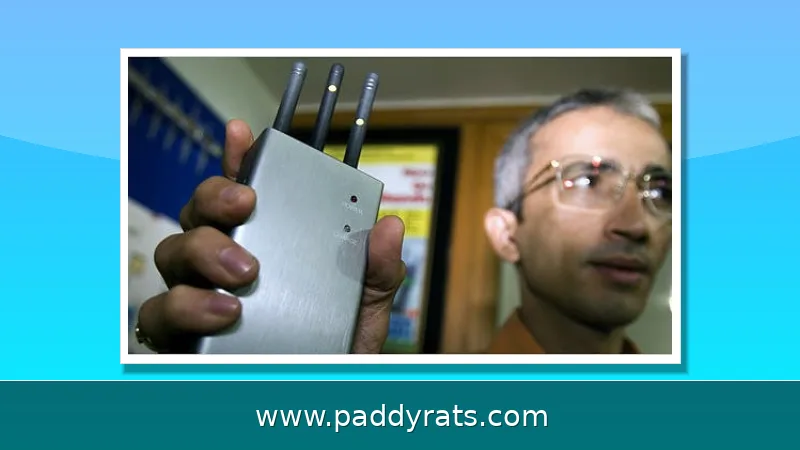
A cell phone jammer is basically a device that blasts RF energy strong enough to drown out the signal coming from cell towers nearby. Your phone grabs whichever signal is strongest on a given frequency, so the jammer wins and the tower's signal gets wiped out. Think of it as a denial-of-service attack on the airwaves: no bars show up on the handset, and it just can't pull anything from the network.
The technical side of jammers is actually what makes the legal side so clear-cut. These devices work by targeting the downlink—the signal path that runs from the cell tower to your phone—which happens to be the very same path that carries 911 calls, first-responder dispatches, aviation and maritime safety traffic, GPS, Wi-Fi, and police radar. That's precisely why no jammer can ever earn FCC certification. Even a basic, low-end model that only blocks a single frequency band can knock out emergency communications across a surprisingly wide area, especially in a crowded office building where signals are already bouncing around.
Range claims vary a lot depending on the model and the space you're in. According to Wilson Amplifiers, real-world jamming range usually tops out around 30 square feet. That might not sound like much, but think about it: one conference room or break area is all it takes to kill every carrier's signal in the building. There's also a common misconception that a signal booster will save you. It won't. Boosters amplify legitimate tower signals, but they can't do anything about a jammer that's already overpowering both the uplink and downlink in the same space.
Is It Legal to Use a Cell Phone Jammer in an Office?
Nope. Under federal law, it's illegal to operate, market, sell, import, distribute, or ship RF jammers—and there's no exception carved out for private businesses, schools, homes, or vehicles. The FCC's jammer enforcement page doesn't mince words on this: jamming devices can't comply with FCC technical standards, because interfering with authorized radio communications is literally what they're designed to do. That means there's no way to operate one lawfully anywhere in the United States.
The main law here is the Communications Act of 1934, as amended (47 U.S.C. 151 et seq.). There are a few exceptions, but they're limited to specific federal government uses, and even those require explicit authorization. For a private employer, there's really no way to operate a jammer legally—it doesn't matter how reasonable the goal behind it might seem.
FCC Chairwoman Jessica Rosenworcel put it about as plainly as it can be put: "You cannot make them, import them, sell them, ship them, or operate them. It does not matter if you are using them in a business, classroom, home, or vehicle." And no, sticking a designated 911 phone in the lobby doesn't get you around that rule. A jammer doesn't care who's calling or why — it will still block emergency calls from visitors, contractors, or anyone else who never agreed to your phone policy in the first place.
FCC Enforcement: Real Fines Against Employers
The FCC doesn't just wave off workplace jamming as some minor rule violation. If you look at how these cases actually play out, there's a pretty predictable script: a carrier notices interference and files a report, the Enforcement Bureau opens an investigation, and the employer winds up paying a fine that makes the price of the jammer itself look like pocket change. The table below lays out the cases that have been made public, along with a breakdown of how each penalty was calculated.
| Company | Location | Penalty | Key facts |
|---|---|---|---|
| Ravi's Import Warehouse | Dallas, TX | $22,000 upheld Jan 27, 2022 | $10,000 for operating without authorization, $7,000 for interference, $5,000 for egregious conduct; owner Anita Bhatia admitted jamming to stop employee phone use after an AT&T complaint in 2017 |
| R&N Manufacturing, Ltd (RNM) | Houston, TX | $29,000 issued March 28, 2014 | Repeated violations; AT&T reported interference in March 2013 |
| The Supply Room | Oxford, AL | Fine issued April 2013 | $10,000 for operating without FCC authorization, $5,000 for unauthorized equipment, $7,000 for interference, plus $16,000 per day for jamming violations; amount reduced after cooperation |
| Taylor Oilfield Manufacturing Inc. | Broussard, LA | Fine issued April 2013 | Same penalty structure as The Supply Room, reduced after the company cooperated with the investigation |
Those numbers come straight from FCC enforcement records and news coverage from the time, and they fit the legal picture laid out below. One thing worth keeping in mind, though: the headline fines don't tell the whole story. Add in attorney fees, hours lost to the investigation, whatever it costs to fix the problem, and the general disruption of having regulators poking around your business, and the real price tag climbs well past the forfeiture amount itself.
Penalties Under the Communications Act of 1934
Jamming isn't just a minor rule violation—it runs afoul of the Communications Act, and that means the consequences can stack up fast. The FCC has several tools at its disposal: it can hit you with monetary forfeitures, seize the equipment outright, and even hand the case off for criminal prosecution, which could land someone behind bars. When the agency sends out enforcement letters, it usually breaks things down into separate violations—operating without authorization, using unauthorized equipment, and causing interference—and each one comes with its own price tag.
How much you could actually be fined depends on who you ask. Cellbusters puts the figure at up to $11,000, while prodefence.io says operating a cellular jammer can land you a fine as high as $112,000—plus time behind bars. That's a pretty wide spread, and it comes down to two things: whether you're looking at the base amount per violation or the statutory maximum, and the fact that if the violation keeps going, the FCC can tack on penalties for each day it continues.
The practical takeaway for employers is that the downside is open-ended. A device bought online for a few hundred dollars can trigger a forfeiture in the tens of thousands, and repeat or ongoing conduct multiplies the exposure. That asymmetry is the single strongest argument for choosing a policy-based approach instead of hardware.
Detection and Response: What to Do If You Suspect Jamming
A dropped signal is usually the first sign, but it is not proof. Faulty equipment, physical obstructions such as new construction or coated glass, and lawful devices operating on the same frequencies can all produce similar symptoms. Apps that claim to detect jammers are largely unproven, and spectrum analyzers, which can genuinely identify interference, are not commonly available to office managers.
If you suspect jamming, the correct response is to escalate rather than investigate on your own. Contact the wireless network provider, notify law enforcement if emergency communications are affected, or file a complaint with the FCC. Carriers have the tools and the legal standing to identify interference sources, and their reports are what typically trigger formal enforcement.
For employers, the more important response is preventive. Document your cell phone policy, train managers on it, and make sure no one in the organization has purchased or deployed a jammer as a shortcut. If a device is already on site, stop using it immediately and remove it before a carrier complaint turns into an investigation.
Canada and International Jammer Rules
The United States is not an outlier. Canada prohibits jammers under sections 4, 9, 10, and 15.1 of the Radiocommunication Act, and subsection 4(4) specifically bans installation, use, possession, manufacture, importation, distribution, lease, offer for sale, or sale. Counter-drone devices that emit RF signals and are capable of causing interference are treated as jammers too. Ministerial exemptions under subsection 14(1) are granted case by case for national security and public safety.
Canadian penalties are steep: individuals face up to $25,000 for a first violation and $50,000 for subsequent ones, while businesses face up to $10 million for a first violation and $15 million for subsequent violations. Other jurisdictions take a similar line, as the comparison below shows.
| Country | Legal status | Notes |
|---|---|---|
| United Kingdom | Owning is technically legal; using is a criminal offense | Law enforcement, intelligence agencies, and jails have used jammers since 2012 under strict regulation |
| France | Banned completely since 2012 | Brief allowance in cinemas and theaters was eliminated |
| Australia | Illegal to operate or possess | Requires a specialized carrier license |
| India | Strictly illegal | Reserved for security agencies and the military |
| Malaysia | Illegal | Fines up to RM500,000 or five years in jail |
| Brazil, New Zealand, Sweden | Generally prohibited | Recognized exceptions for correctional facilities |
The pattern is consistent across jurisdictions: jamming is reserved for state actors with explicit authorization, and private employers are excluded. A multinational company drafting a global device policy should assume that workplace jamming is off the table everywhere it operates.
Legal Alternatives to Jamming Employee Phones
Employers do have lawful options, and they are more effective than jamming because they survive legal scrutiny. The NLRB previously upheld an employer policy prohibiting employee phone use at work for safety and security reasons (Cott Beverages Inc., 369 NLRB No. 82 (2020)), which gives employers a defensible foundation for written rules.
The Supply Room, one of the companies fined in 2013, later implemented a compliant approach: a written policy restricting phones to lockers, posted signs, and zero tolerance. Employees caught using phones were sent home without pay, with termination for repeat offenses. The company achieved the same operational goal without transmitting a single watt of interference.
Cell phone detectors are another legal tool in the United States, unlike jammers, and they can support enforcement of a policy without blocking anyone's signal. The practical playbook is straightforward: publish a clear policy, provide secure storage, post visible signage, train supervisors on consistent enforcement, and escalate to HR rather than to hardware. Documented, evenly applied policies hold up; DIY radio interference does not.
If the underlying concern is distracted driving, sensitive-area photography, or confidential meetings, targeted rules and physical controls solve the problem. If the concern is emergency access, note that a policy-based approach keeps 911 fully available to everyone in the building, which is precisely what a jammer destroys.
Frequently Asked Questions
Is it legal to use a cell phone jammer in an office in the United States?
No. Federal law prohibits operating, marketing, selling, importing, distributing, or shipping RF jammers, with no exception for private businesses. Jamming devices cannot be certified because their purpose is to interfere with authorized radio communications, so they cannot be operated lawfully anywhere in the U.S. Employers who use them risk FCC fines, equipment seizure, and criminal sanctions.
Can an employer legally jam employee cell phones if a 911 phone is provided?
No. Providing an emergency phone does not create an exception. The FCC has upheld fines against employers who used jammers to stop employee phone use, because a jammer can block 911 calls, interfere with first responders, and disrupt aviation and marine safety communications. Anyone in or near the building, including visitors, can be affected regardless of your internal policy.
What penalties can a business face for using a signal jammer at work?
Penalties include significant monetary forfeitures, seizure of the unlawful equipment, and criminal sanctions including imprisonment. Reported FCC fines include $22,000 upheld against Ravi's Import Warehouse, $29,000 against R&N Manufacturing, and fines against The Supply Room and Taylor Oilfield Manufacturing. Continuing violations can be assessed on a per-day basis, so total exposure can far exceed the headline number.
What can employers do instead of jamming employee phones?
Employers can adopt and enforce written cell phone policies. The NLRB previously upheld an employer policy prohibiting employee phone use at work for safety and security reasons. The Supply Room restricted phones to lockers, posted signs, and enforced zero tolerance without using a jammer. Cell phone detectors are also legal in the U.S. and can support enforcement without blocking signals.