A signal jammer floods the same radio frequencies your phone, GPS, or Wi-Fi uses, raising the noise floor until legitimate signals can no longer be decoded. Here is how that interference is generated, which techniques exist, and why operating one in the US is illegal.
What Is a Signal Jammer and What Does It Do?
A signal jammer is a device designed to deliberately cut the link between a wireless device and whatever signal source it's talking to—a cell tower, a GPS satellite, a Wi-Fi router, or a drone controller. It doesn't block any physical path; instead, it goes after the air interface itself, pumping out energy on the same radio frequencies the target relies on. Engineers call this a denial-of-service attack at the physical layer, since the point isn't to decode or steal traffic—it's simply to make reception impossible.
You'll know it right away when a jammer is running. The signal bars on your phone might vanish completely, calls won't go through, texts just sit there and never send, and a GPS receiver can lose its position fix altogether. Consumer-grade units don't reach very far—usually no more than about 30 square feet—but higher-power systems can throw interference across several kilometers, depending on output power, antenna gain, and the terrain in between.
How Does a Signal Jammer Work at the Frequency Level?
Every wireless service operates within a specific frequency band, and a jammer does its job by pumping out energy right inside that same band. Now the receiver is hearing two things at once: the real signal coming from the tower or access point, and the jamming signal coming from a source much closer by. Since they're sitting on the same frequency, the radio front end has no way to tell them apart. Instead of a clean decode, you just get interference.
This all comes down to signal-to-noise ratio. The jammer basically floods the local airwaves with noise until the signal you actually want drops below the level your phone's demodulator needs to make sense of it — that's why people call jamming a deliberate hit to the signal-to-noise ratio. A cell phone jammer puts out an RF signal that's stronger than whatever's coming from the nearest base station, so your phone grabs the stronger carrier and the legitimate weaker one just gets drowned out. Cheaper jammers only block a single frequency, which is enough to make a device think there's no network in range at all. The more advanced, programmable ones are a different story — they actually watch the RF environment and adjust their output as conditions shift.
What Are the Main Components Inside a Signal Jammer?
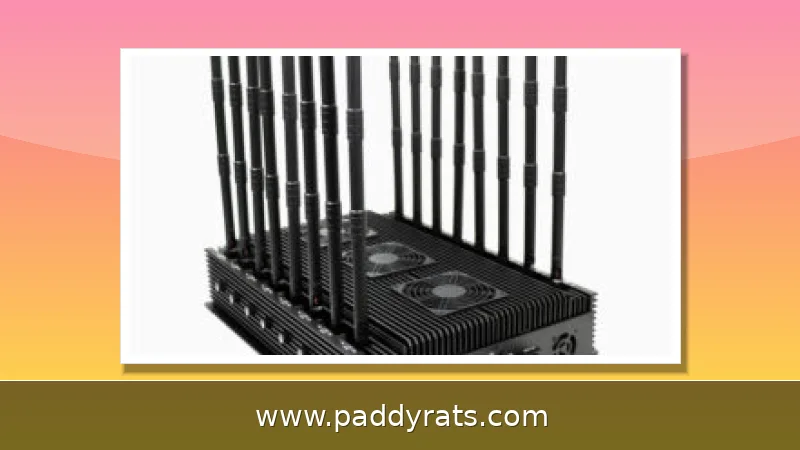
A commercial jammer isn't some mysterious black box—it's really just a small radio chain made up of three functional blocks. First, an RF signal generator creates the interfering waveform. Then a power amplifier boosts that waveform up to a useful level. Finally, antennas broadcast it across the frequencies you're targeting. And honestly, the antenna choice matters just as much as the electronics themselves, since a mismatched antenna ends up wasting output power and shrinking the effective coverage area.
DIY builds work on the same principle, just on a smaller scale. A basic jammer circuit is really just three subcircuits stitched together: an RF amplifier, a voltage controlled oscillator, and a tuning circuit. The tuning stage sets which frequency the oscillator settles on, the amplifier brings that tone up to a level the antenna can actually radiate, and what you end up with is a narrowband noise source. The parts list below shows how those three blocks translate into real components in one simple published design.
Which Jamming Techniques Are Used: Spot, Barrage, Sweep, and DRFM?
Jamming techniques basically come in two flavors: noise and repeater. Noise jamming is the blunt approach—it just pumps out energy on the target frequency until the real signal gets buried. Repeater jamming is a bit sneakier: it listens to the incoming signal first, then sends back a modified version of it. Which one you'd use depends on what you're trying to jam and how much power you're willing to burn.
Spot jamming puts every bit of available power onto one frequency. Against a fixed-frequency link, that's brutal—but point it at frequency-agile radar and it falls apart, since the radar just hops somewhere else. Barrage jamming takes the opposite approach, spreading its power across several frequencies at once. You cover more spectrum that way, but you lose punch on any single frequency. Sweep jamming is a third option: it shifts full power from one frequency to the next in rapid succession, hitting the target intermittently across a wide band. Then there's Digital RF Memory, or DRFM, which works differently from all three. It's a repeater technique—it grabs radar energy, modifies it, and sends it back out, convincing enough to plant false targets on an enemy's display.
There are more jammer types than that basic taxonomy suggests. A deceptive jammer sends out signals continuously rather than random bits; a reactive jammer stays quiet until it sees an RTS message, then starts jamming; a channel-hopping jammer overrides the CSMA algorithm and hits several channels at the same time; and a proactive jammer just keeps transmitting whether or not any data communication is going on. Pulse-noised jammers, meanwhile, mix features from both families.
How Does a Cell Phone Jammer Disrupt the Downlink Signal?
When a cell tower talks to your phone, that path is called the downlink — and it's exactly where consumer jammers do their damage. The phone is the receiver getting flooded, so it has no way to flag the problem or tell you something's wrong. All you notice is the symptom: no bars, no service, no clue why. Meanwhile, the uplink — your phone talking back to the tower — barely matters here. That's the whole trick. A jammer can shut a phone up without ever laying a finger on the carrier's network.
Frequency coverage determines which services die first. Effective jamming has been demonstrated against UMTS, 3G, CDMA, GSM, and PHS networks, and the same principles extend to GPS systems, Wi-Fi networks, and drone control links. Range is a function of power and physics: a wider frequency range requires more power, and higher frequencies with complex modulation demand greater sophistication to jam effectively. The table below summarizes the practical spread.
How Far Does Jamming Reach and What Does It Take to Build One?
Range claims in marketing material should be read carefully. A jammer rated for a few meters indoors will behave very differently outdoors, where walls no longer contain the signal and the receiver may have a clearer line to the tower. Power output, antenna gain, the target band, and the local RF environment all move the number, which is why published figures range from a few meters to several kilometers.
For readers curious about the electronics rather than the operation, a basic DIY circuit is a useful illustration of how the blocks connect. The parts list below comes from a simple published design and shows the oscillator, amplifier, and filtering stages that make a narrowband noise source.
Are Signal Jammers Legal and What Are the Penalties?
In the United States, it is illegal to sell, advertise, distribute, or operate cell signal jammers. The Federal Communications Commission states that these devices interfere with authorized radio communications, and the agency maintains a dedicated enforcement page that was updated as recently as this month. Radio frequencies are legally protected under The Communications Act of 1934, which is the statutory foundation the FCC relies on when it acts.
Penalties are not trivial. Violations can bring fines up to $11,000 per violation, seizure of the equipment, and criminal sanctions including imprisonment. The public-safety argument is central: jammers can interfere with emergency 911 calls and law enforcement communications, which turns a nuisance into a potential hazard. Some countries have taken a narrower path. Brazil, New Zealand, and Sweden have considered exceptions for correctional facilities, and in the United Kingdom, law enforcement, intelligence agencies, and jails have used signal jammers since 2012 under strict regulation.
A common point of confusion is the difference between jammers and boosters. Signal boosters amplify existing signals but cannot defeat jammers, and cell signal amplifiers will not stop a jammer either. Cell phone detectors, by contrast, are legal in the US, which is why venues that want to enforce quiet zones often deploy detection rather than jamming. Misuse of a jammer can also cause unintended interference well beyond the intended target.
How Do You Detect or Escape a Jammer in Practice?
Detection starts with symptoms. Dropped service across multiple devices in one location, calls that fail immediately, and GPS units that lose lock simultaneously all point toward interference rather than a network outage. A spectrum analyzer can confirm the diagnosis by showing elevated energy inside the band your service uses. If you do not own test equipment, contacting your wireless network provider is the fastest legitimate route, since carriers can check for interference in the area.
Escaping jamming is mostly about distance and physics. Relocating away from the jammer restores service as signal-to-noise ratio recovers, and switching frequency helps only if your device supports a band the jammer is not covering. If the interference is deliberate and persistent, contacting law enforcement is the appropriate step, because operating a jammer in the US is a federal violation rather than a neighborly dispute.
Building a jammer is technically straightforward and legally hazardous. The same three blocks, an RF amplifier, a voltage controlled oscillator, and a tuning circuit, appear in nearly every design, which is exactly why regulators treat the finished device as contraband rather than as a curiosity.
How Do Modern Networks Change the Jamming Equation?
Modern communication technologies use higher frequencies and complex modulation schemes, which raises the bar for anyone trying to jam them. Wider bands, beamforming, and adaptive coding mean a jammer must either spread its power thin across more spectrum or track a moving target, and both approaches cost power and complexity. That is why the gap between military-grade electronic warfare systems and consumer gadgets keeps widening.
Jammers were originally developed for military and law enforcement use, aimed at countering cell phone-triggered explosives and managing hostage situations where remote communication posed a direct threat. Those legitimate government applications still exist under strict authorization, but they do not transfer to civilian use. For anyone evaluating the technology, the honest summary is that the physics is simple, the engineering is well documented, and the legal exposure in the United States is severe.
Frequently Asked Questions
How does a signal jammer work?
A jammer transmits radio frequency signals on the same frequencies used by wireless devices, creating interference that lowers the signal-to-noise ratio. When a phone receives two signals at the same frequency, it cannot distinguish them, so the stronger jamming signal cancels out the legitimate one and service drops. Jamming typically targets the downlink, which is why the handset shows no visible bars.
Are signal jammers legal?
In the United States it is illegal to sell, advertise, distribute, or operate cell signal jammers. The FCC states they interfere with authorized radio communications and can block 911 and law enforcement calls. Violations can bring fines up to $11,000, equipment seizure, and criminal sanctions including imprisonment. A few countries have considered narrow exceptions for correctional facilities.
What are the main components of a signal jammer?
Signal jammers typically consist of three main components: an RF signal generator that creates the jamming signal, a power amplifier that boosts its strength, and antennas that broadcast it over the targeted frequencies. A basic DIY circuit also uses a voltage controlled oscillator, an RF amplifier, and a tuning circuit to select the frequency that will be radiated.
What is the difference between spot, barrage, and sweep jamming?
Spot jamming focuses all power on a single frequency but is ineffective against frequency-agile radar. Barrage jamming spreads power across several frequencies at once, making it less powerful at any one frequency. Sweep jamming shifts full power from one frequency to another in quick succession, hitting a wide range intermittently rather than continuously.