A signal jammer floods the same radio frequencies your phone uses, drowning out the cell tower so calls, texts, and data stop working. Here is how jamming works, what it hits beyond cellular, and why it is illegal in the US.
What Is a Signal Jammer and What Does It Do to a Phone?
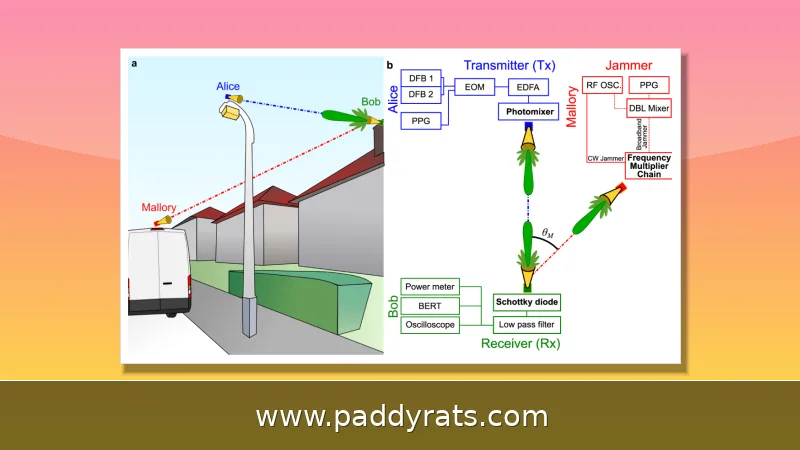
A signal jammer is a device made to deliberately cut the link between a wireless device and its signal source. With a phone, that means breaking the connection between the handset and the nearest cell tower. The jammer transmits on the same radio frequencies the carriers use — basically a denial-of-service attack, except it happens over the air instead of across a network.
Once a phone is within jamming range, it usually just stops working altogether. The screen might still light up and your apps will still open, but calls won't go through, texts sit there unsent, and mobile data slows to a crawl or cuts out entirely. Simpler jammers only block a single frequency band, and that's often enough to fool a handset into thinking there's no network around at all, so it quietly gives up searching.
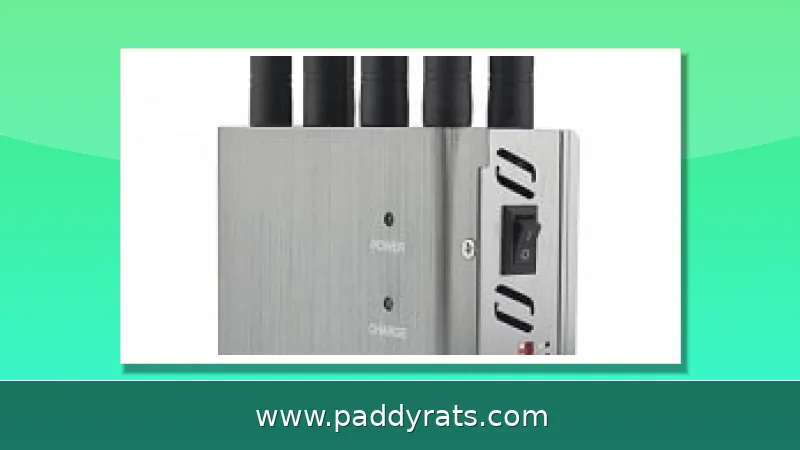
The first time I saw a signal jammer in action, what surprised me wasn't the tech — it was how completely normal the thing looked. No antenna array, no rack of gear, nothing that screamed "restricted device." Just a handheld unit about the size of a walkie-talkie, sitting on a table like any other gadget you'd pick up at a store. And then, within seconds, every phone in the room went dead: no bars, no texts getting through, no data. What makes that happen has nothing to do with what's going on inside the phones. Nobody installed malware, nobody touched the devices, and nobody changed any settings. The phones were doing exactly what they were built to do. What changed was the space around them — the airwaves got flooded with interference, so the phones had nothing usable to listen to. It's kind of like standing in a room where everyone's shouting at once; your ears work fine, but you can't pick out a single voice. That gap between the unassuming device and its huge effect is really the whole story here — jamming doesn't attack your phone, it attacks the connection your phone relies on.
How Cell Phone Jammers Work: Frequencies and Denial-of-Service
At its core, jamming is really just a numbers game—signal strength and frequency overlap. A cell phone jammer puts out a radiofrequency (RF) signal stronger than whatever is coming in from the nearest cell tower, and it does this on frequencies that sit right on top of the carrier's own. So when a phone picks up two signals on the same frequency, it has no way to tell which one is which. It grabs the stronger signal, and the weaker one basically gets wiped out.
Jamming mainly goes after the downlink — the part of the connection that runs from the cell tower down to your phone. That direction is what makes it work, since your phone spends most of its idle time just listening for the tower instead of transmitting back. Once a jammer drowns out that incoming signal, the phone has nothing to grab onto, so the bars disappear — even though the tower is still sitting there broadcasting like nothing happened. On the tower's end, everything looks normal; your phone has just gone silent. Picture two people trying to talk in a room while someone stands next to one of them blasting a bullhorn. The message never gets through, so the receiver gives up. In plain terms, a jammer is just a device that floods wireless frequencies with loud noise, so a phone can't hear the tower and the tower can't hear the phone. There's a built-in trade-off here: the wider the frequency range a jammer covers, the more power it needs to pull it off. That's why compact units tend to target a narrow slice of spectrum, while larger setups go for broader coverage.
That power requirement is exactly why the range stays so limited. Here's the tradeoff: the wider the frequency range a jammer has to cover, the more power it burns, and the harder it gets to push that noise far enough to overpower a cell tower. Most consumer-grade jammers are nowhere near strong enough to blanket a large area, so they end up covering just a small bubble—often no more than about 30 square feet, roughly the size of a single desk or a couple of chairs pushed together. And even inside that bubble, effectiveness drops off fast. Walls, furniture, and plain old distance all eat into the signal, so a jammer that works fine in an open room may do almost nothing once a wall or two gets in the way. Step a few feet in the wrong direction, and your phone may suddenly find its tower again.
What Signals Can a Jammer Affect? Cellular, WiFi, GPS, and Radio
A mobile signal jammer doesn't just kill voice calls and texts. Its noise can bleed into a bunch of other bands at the same time, which is a big reason regulators treat these things as a public safety threat instead of a minor annoyance. Take GPS receivers — they rely on super faint satellite signals, so even a small burst of interference can wipe out navigation and tracking. wifi jammers are a different story: they flood the 2.4 GHz and 5 GHz bands with digital noise until laptops and smart devices can't reach the router, though a wired Ethernet connection keeps working without a problem. Police radar and two-way radio traffic on VHF and UHF channels can get drowned out too. The table below shows the usual targets.
| Signal type | What gets disrupted | Notes |
|---|---|---|
| Cellular (2G, 3G, 4G, 5G) | Calls, texts, mobile data | Primary target of most jammers |
| WiFi and Bluetooth | Wireless devices talking to a router | 2.4 GHz and 5 GHz bands; wired Ethernet keeps working |
| GPS and tracking systems | Positioning and fleet tracking | Often hit by multi-band units |
| Radio communications (VHF/UHF) | Two-way and dispatch radio | Raises public safety concerns |
WiFi jammers flood the 2.4 GHz and 5 GHz bands with digital noise, which keeps wireless devices from talking to a router. Here's the detail that gives them away: a wired Ethernet connection keeps humming along just fine while every wireless device in the room starts struggling. That split is one of the clearest ways to tell a WiFi jammer apart from a run-of-the-mill network problem, because a bad router or an internet outage would usually knock out wired and wireless connections alike. Cellular jamming casts an even wider net. A mobile signal jammer blocks voice, text, and data across every generation of network still in service, from 2G and 3G all the way up to 4G and 5G. Put simply, a jammer doesn't care whether you're trying to make a call, send a text, or load a webpage. If the signal falls inside the frequencies it targets, that connection just isn't getting through.
How effective a jammer is depends on four main factors: the output power of the device, how far it is from the target phones, physical obstacles like walls, and the type and strength of the original signal it's trying to override. Power is the most obvious one—a stronger transmitter just puts out louder noise over a wider area—but distance matters just as much, because a jammer's reach drops off fast the farther away you get. Walls, floors, and other solid barriers absorb and scatter RF energy, so a device that kills every phone in one open room might barely make a dent in the next one over. The original signal counts too: a weak carrier signal is easier to drown out than a strong one, and a nearby tower broadcasting at high power will put up a lot more resistance. That's why results can vary so much from one spot to the next.
Types of Signal Jammers: Portable, Fixed, and Multi-Band Systems
Jammers generally fall into a couple of recognizable form factors, and which one you pick usually comes down to what you actually need it for. Portable jammers are small and lightweight, designed for temporary operations, off-site meetings, or mobile environments where the device has to travel with the user. Fixed jammers, on the other hand, are installed permanently and deliver higher power and broader coverage, which makes them a better fit for executive offices, conference rooms, and high-security facilities.
More advanced signal control systems can integrate with detection devices, so a facility can sense an unwanted transmission and respond automatically. Multi-band devices manage several frequencies at once, which matters because a single phone may hop between bands as coverage changes. On the open market, pricing scales with band count and power: Jammer Store lists the Colibri Y3 at $250, the GP5000 at $119.99, the Albatross Pocket 3G (GPS) GSM Jammer at $179, the Alligator 10-band 10W at $720, the Stalker 5G 12-band at $850, the Altron-4 4-band 35W at $840, the HPJ1000-5G at $999, the HPJ20-H 20-band unit covering 130-5900 MHz at $2,190, and a Spectrum handheld drone jammer at $2,250. Portable phone silencers generally reach up to 8-15 meters.
Building a DIY cell phone signal jammer isn’t nearly as complicated as it sounds. The circuit relies on three subcircuits working in tandem: an RF amplifier, a voltage controlled oscillator, and a tuning circuit. Together, they generate the interfering signal, boost it to a usable strength, and dial it in to the right frequency. A build like this blocks UMTS, 3G, CDMA, GSM, and PHS — a surprisingly broad sweep for something assembled on a workbench. What really stands out, though, is the parts list. It calls for nothing more exotic than resistors, capacitors, a transistor, and an inductor, all of which are cheap and easy to source online or at any electronics shop. There’s no specialized lab equipment required, no rare components, no advanced degree. That low barrier to entry is exactly why enforcement matters: when the knowledge and materials are this accessible, jamming stops being a theoretical threat and becomes something almost anyone could attempt.
Are Cell Phone Jammers Legal? FCC Rules and Penalties
It is illegal to sell, advertise, distribute, or operate cell signal jammers in the United States and much of the world. The FCC states that jamming equipment poses serious risks to critical public safety communications, can prevent 911 and emergency calls, and interferes with law enforcement communications. Radio frequencies are protected under The Communications Act of 1934, which is the legal backbone behind enforcement.
The penalties here are not just a slap on the wrist. Under federal law, operating a jammer can bring fines of up to $11,000 per violation, seizure of the equipment itself, and criminal sanctions that can include imprisonment. What surprises a lot of buyers is that there is no exemption for a business, a classroom, a residence, or even a vehicle. People often assume that because the setting is private—their own store, their own home, their own car—the device must be acceptable. It is not. The FCC treats jamming as a serious offense regardless of where it happens or who is doing it, so the idea that a "private" location creates a legal loophole simply does not hold up.
Local law enforcement lacks independent authority to authorize jamming, and only federal agencies may be permitted in limited instances. In the UK, law enforcement, intelligence agencies, and jails have used signal jammers since 2012 under strict regulation. Brazil, New Zealand, and Sweden have considered exceptions for correctional facilities. Meanwhile, cell phone detectors are legal in the US, so a venue can lawfully check whether jamming is present even though it cannot jam back.
How to Detect a Signal Jammer and What to Do
The most common symptom is dropped service, especially when several devices lose connectivity at once in an area that normally has good reception. Signal strength may fluctuate erratically rather than fading smoothly. Apps claiming to detect jammers are largely unproven and, awkwardly, require a working signal to function in the first place.
Spectrum analyzers can detect jammers by analyzing frequencies, but they are not commonly available and require specialized knowledge to interpret. It is also worth ruling out innocent causes of bad connections: faulty equipment, physical obstructions, and lawful devices operating on the same frequencies. If multiple devices are affected and the location is a potential target, a jammer may be nearby.
The signs differ by technology. For WiFi, watch for bad signal quality, disconnections, high latency, packet loss, and reduced bandwidth while wired connections work fine. For cellular, look for loss of service across multiple devices and erratic signal fluctuations.
Countermeasures are limited but practical. Physically locating and disabling the jammer is the direct route, and the device usually looks like a walkie-talkie, a cell phone, or a wireless router. Switching frequency may work depending on how sophisticated the jammer is. Given the short range, relocating is often the best bet. Contact law enforcement or file an FCC complaint. Signal boosters and amplifiers do not stop jammers, so do not count on them.
Why Jamming Is a Growing Security Concern
This is no longer a theoretical problem. Since 2021, Customs and Border Protection (CBP) has seen a roughly 830% increase in signal jammer seizures. Los Angeles leaders and law enforcement have warned about a rise in burglars using WiFi jammers to knock out connected cameras and alarms before breaking in.
The Department of Homeland Security reported jamming devices in Vermont bank robberies, and jamming devices were recovered in an attempted jewelry store robbery in La Verne, California. The pattern is consistent: cheap hardware, short range, and a target that depends on wireless connectivity for safety.
For anyone running a home or small business security setup, the practical takeaway is redundancy. Wired cameras, cellular backups on separate bands, and local recording all reduce exposure. No single wireless link should be the only thing standing between a property and an intruder.
Frequently Asked Questions
What does a signal jammer actually do to a phone?
It transmits radio frequency signals on the same frequencies your phone uses, overpowering the cell tower's signal. The phone picks up the stronger jamming signal, so it cannot send or receive calls, texts, or data, and often shows no signal bars even though the tower is working normally.
Does a signal jammer block WiFi and GPS too?
Yes. A mobile signal jammer does not only block voice and text; it also interferes with GPS, WiFi, and police radar. WiFi jammers specifically target the 2.4 GHz and 5 GHz bands, disrupting wireless devices communicating with a router while wired Ethernet connections keep working.
Are cell phone jammers legal in the United States?
No. It is illegal to sell, advertise, distribute, or operate cell signal jammers in the United States and much of the world. Violations can bring fines up to $11,000, seizure of equipment, and criminal sanctions including imprisonment, with no exemptions for businesses, classrooms, homes, or vehicles.
How can I tell if a signal jammer is being used nearby?
The most common sign is dropped service on multiple devices in an area with normally good reception, often with erratic signal fluctuations. Apps claiming to detect jammers are largely unproven, so contact law enforcement or file an FCC complaint if you suspect illegal jamming.