Signal jammer licensing requirements are strict nearly everywhere: in the US, jamming devices cannot be certified at all, while Malaysia and India run narrow licensing channels for government and defense users. Here is who may legally operate a signal jammer, and how authorization is actually obtained.
What Are Signal Jammer Licensing Requirements?
Signal jammer licensing rules exist for a pretty simple reason: a jammer doesn't broadcast anything of its own. Instead, it drowns out licensed radio traffic by blasting RF noise on the same frequencies. So when you ask who can legally operate a signal jammer, you won't find the answer at some licensing board. It comes down to national telecom and radio laws, which treat jamming equipment as something that can't be certified in the first place. In the US, that means 47 U.S.C. Sections 302a(b) and 333 of the Communications Act of 1934, which make it generally illegal to operate, manufacture, market, sell, import, distribute, or ship an RF jamming device designed to interfere with authorized radio communications. Only a few narrow exceptions apply.
Section 301 of the Communications Act says that anyone who operates or uses a radio transmitter has to hold a license or some form of authorization under FCC rules. Jammers don't fit into that system at all. They can't be certified or authorized, because their whole purpose is to block or interfere with authorized radio communications, not to transmit on an assigned frequency. Malaysia and India handle things differently, but the end result is similar: jammers stay legal only for approved government, defense, and law enforcement users who get a specific permit. So in every jurisdiction we looked at, the practical answer is the same—there's no civilian path to a jammer license.
Who Can Legally Operate a Signal Jammer in the United States?
In the US, federal authorization is limited to a pretty short list of agencies that have either a statutory or national-security mission. The Department of Defense and military installations fall under Title 10 authority, which JIATF-401 guidance expanded in January 2026. Then there's the Department of Homeland Security, which includes CBP and the Secret Service; the Department of Justice, including the FBI; the Department of Energy, which handles nuclear facility protection; and the Coast Guard for maritime security. That rounds out the federal list. As for state and local authorities, they generally aren't authorized to operate RF jamming equipment on their own. They'd need oversight and authorization from an appropriate federal authority first.
The table below gives you a quick snapshot of who currently counts as an authorized user in the US, including the new categories that the SAFER SKIES Act added under the FY2026 NDAA.
| Entity | Authorization basis | Status |
|---|---|---|
| Department of Defense / military installations | Title 10, JIATF-401 guidance (January 2026) | Authorized |
| DHS (CBP, Secret Service), DOJ (FBI), DOE, Coast Guard | Federal mission authority | Authorized |
| State and local law enforcement | SAFER SKIES Act, after FBI National Counter-UAS Training Center training | Authorized with training |
| Correctional facility security agencies | SAFER SKIES Act, federal certification required | Authorized with certification |
| Private companies, property owners, private security firms | None | Not authorized |
Private companies, individual property owners, and private security firms can't just go out and operate a jammer on their own. The only way they'd be in the clear is if an authorized agency contracts them — and even in that case, the operating authority stays with the agency, not the contractor. For procurement teams, this is an important line to keep in mind: purchasing jammer hardware for a private site doesn't give you any legal standing to actually turn it on.
How Do You Apply for a Signal Jammer License in Malaysia?
In Malaysia, jammers are illegal by default. That's the baseline under Section 231 of the Communications and Multimedia Act 1998, and the penalties for using one without authorization are steep: a fine of up to 100,000 RM (about 19,000 euros), up to five years in prison, or both. The Malaysian Communications and Multimedia Commission (MCMC) is the body in charge of all this. It regulates jammers, manages the radio frequency spectrum, registers telecommunications equipment, and issues the licenses that allow for legal use.
The application process is narrow, but it does exist. You file an application that spells out exactly what you plan to do with the jammer, including the frequencies and power levels involved, and the MCMC will only grant a license if it's satisfied that legitimate telecom signals won't get disrupted. In practice, this means you basically have to be an approved institutional user already—a prison authority or a security agency, for example—and you need to document precisely which bands will be affected and at what output level. If you just send in a vague request for blanket jamming coverage, it's not going to make it through review.
What Are India's Rules on Jammer Import and Possession?
India regulates jammers at two distinct stages: import and possession. Under the FTDR Act 1992, jammers are classified as restricted items, which means you need a license from the Directorate General of Foreign Trade (DGFT) just to bring them into the country. That's only half the picture, though—possessing and actually using a jammer calls for a separate license, and that one is issued in consultation with the Office of the Secretary (Security) under the Cabinet Secretariat. For anyone trying to figure out where the rules are written down, the Department of Telecommunications (DoT) under the Ministry of Communications put out a public advisory on July 1, 2022, and the full guidelines are available at cabsec.gov.in/others/jammerpolicy/.
In India, the only parties who can legally buy or use jammers are authorized entities: the defense forces, government-approved institutions, and law enforcement agencies. If you possess or operate one without that authorization, it's a punishable offense. There's another wrinkle people tend to miss, too. Import and possession are licensed separately, which means an entity can clear customs legally and still be in violation the moment the equipment is stored or switched on without that second approval.
Drone Jammers and the SAFER SKIES Act: Who Qualifies?
Drone jammer authorization is the fastest-moving part of this space. Under the SAFER SKIES Act in the FY2026 NDAA, state and local law enforcement may operate counter-drone jamming after training at the FBI's National Counter-UAS Training Center in Huntsville, Alabama. Correctional facility security agencies qualify if they meet federal certification requirements, and agencies protecting National Special Security Events and SEAR-rated events, including the FIFA World Cup 2026, are also covered.
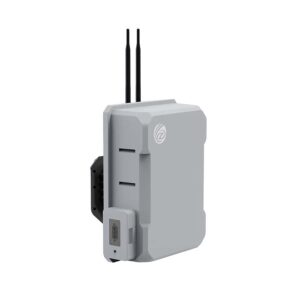
Drone jamming is technically distinct from blocking a prison cell signal. Target bands include 433 MHz, 900 MHz, 1.2 GHz, 1.5 GHz, 2.4 GHz, and 5.8 GHz, plus GNSS, and the equipment must discriminate between a hostile drone and ordinary Wi-Fi or Bluetooth traffic nearby. Vendors such as Airsight offer a Smart and Autonomous Jammer with 360-degree coverage out to 1.9 miles, mounted on fixed positions, tripods, or vehicles and integrated with the AirGuard detection platform. None of that hardware creates authority on its own; the operator must be a qualifying agency.
What Penalties Apply for Unauthorized Jammer Use?
US violations carry fines up to $112,500 per incident plus potential criminal prosecution. In the Matter of Ravi's Import Warehouse, Inc., Dallas Texas, FCC 22-10 (2022), the FCC upheld a $22,000 fine: $10,000 for operation without an instrument of authorization, $7,000 for causing interference to authorized communications, and $5,000 for egregious conduct. The FCC Enforcement Bureau opened the investigation after an AT&T interference complaint, which is a useful reminder that enforcement usually starts with a carrier or public-safety complaint rather than a random inspection.
Canada takes a similarly hard line. Jammers are prohibited and subject to offences and penalties under sections 4, 9, 10, and 15.1 of the Radiocommunication Act, per an ISED notice issued in January 2025. Malaysia's ceiling of 100,000 RM or five years imprisonment applies to unauthorized use there, and India treats unauthorized possession as a punishable offense. In every one of these regimes, the fine attaches to operation and possession, not just to sale.
Why Jammers Cannot Simply Be Certified
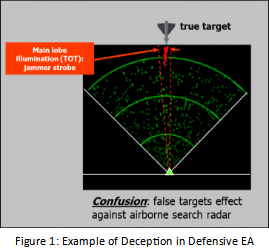
The reason there is no ordinary signal jammer license application in the US comes down to physics and radio law. A jammer transmits RF noise on the same frequencies as target devices, overpowering legitimate signals at the receiver. The core components are a power source, an oscillator, an amplifier, and an antenna, and the key metric is the ratio of jammer signal strength to legitimate signal strength at the receiver. Certification assumes a device can share spectrum without destroying other users' service; a jammer is built to do the opposite.
Some bands are far easier to jam than others. GPS is the easiest because satellite signals arrive around negative 120 dBm, while Wi-Fi is harder because routers sit close and deliver much stronger signals. Target bands in commercial hardware include cellular 700 MHz to 2600 MHz, GPS at 1575 MHz, Wi-Fi at 2.4, 5, and 6 GHz, Bluetooth at 2.402 to 2.480 GHz, and drone bands at 433 MHz, 900 MHz, 1.2 GHz, 1.5 GHz, 2.4 GHz, and 5.8 GHz, plus GNSS. This is also why Bluetooth jamming performs so unevenly across hardware classes.
| Hardware class | Real-world range | Power | Practical limitation |
|---|---|---|---|
| Handheld / portable Bluetooth jammer | 5-10 meters | Up to 1W | Ineffective against Adaptive Frequency Hopping in Bluetooth 5.0+ |
| Fixed / industrial module | 100-500+ meters line-of-sight | 10-100W | Requires spectrum licensing, cooling, RF shielding, trained operators |
Effectiveness data points the same direction. Static jammers achieve around 68% disruption, while AI-driven adaptive systems reach roughly 92% effectiveness. Higher effectiveness does not change the licensing position; it only raises the interference risk that regulators are trying to control.
What Do Prison and Facility Jammer Buyers Need to Confirm?
For correctional and facility deployments, procurement should start with the required jamming frequencies, confirmed in advance. 2G, 3G, 4G, and 5G bands vary by region, and drone coverage adds 2.4 GHz, 5.8 GHz, and GNSS. Coverage expectations also need to be realistic. In dense urban areas a 50W jammer covers only around 50 meters, while drone jamming can reach several hundred meters to 1 km depending on terrain and antenna choice.
Physical engineering matters as much as RF power. Outdoor units need rainproof air intake vents and bottom-mounted exhaust vents so water cannot pool inside the cabinet. 24/7 operation requires heat dissipation through aluminum heat sinks and fans, plus an independent SMPS per RF module converting AC 210V-240V to DC 28V. For centralized management, IoT control via RJ45 Ethernet or 433 MHz magnetic antennas allows LAN-based monitoring, which is also how administrators document that the system is running only within its authorized window and coverage area.
Can a private individual get a license to operate a signal jammer in the US?
No. Under the Communications Act of 1934 and FCC rules, jamming devices cannot be certified or authorized because their primary purpose is to block authorized radio communications. Only limited government and law enforcement uses are recognized, and those operations are tightly regulated and not available for civilian use. A private individual therefore has no application route, no matter how narrow the intended jamming footprint.
How do you get legal authorization to use a signal jammer in Malaysia?
Applicants must submit an application to the Malaysian Communications and Multimedia Commission (MCMC) with detailed information about the intended use, including the frequency and power of the device. The MCMC evaluates the application and issues a license only if it is convinced the jammer will not interfere with legitimate telecommunication signals. In practice, approved applicants are institutional users such as prison or security authorities rather than private parties.
Who can legally operate a drone jammer in the United States?
Authorized entities include the Department of Defense, DHS, DOJ, Department of Energy, and the Coast Guard. Under the SAFER SKIES Act, state and local law enforcement, correctional agencies, and agencies protecting National Special Security Events may qualify after required training and federal certification. Private companies and individuals are not authorized, even when they own the hardware or are contracted to support an agency.
What penalties apply for operating a signal jammer without authorization?
In the US, violations carry fines up to $112,500 per incident plus potential criminal prosecution. The FCC upheld a $22,000 fine against a Texas warehouse business, made up of $10,000 for operating without authorization, $7,000 for causing interference, and $5,000 for egregious conduct. Malaysia allows fines up to 100,000 RM or five years imprisonment, and India treats unauthorized possession as a punishable offense.
Frequently Asked Questions
Can a private individual get a license to operate a signal jammer in the US?
No. Under the Communications Act of 1934 and FCC rules, jamming devices cannot be certified or authorized because their primary purpose is to block authorized radio communications. Only limited government and law enforcement uses are recognized, and those operations are tightly regulated and not available for civilian use.
How do you get legal authorization to use a signal jammer in Malaysia?
Applicants must submit an application to the Malaysian Communications and Multimedia Commission (MCMC) with detailed information about the intended use, including the frequency and power of the device. The MCMC evaluates the application and issues a license only if it is convinced the jammer will not interfere with legitimate telecommunication signals.
Who can legally operate a drone jammer in the United States?
Authorized entities include the Department of Defense, DHS, DOJ, Department of Energy, and the Coast Guard. Under the SAFER SKIES Act, state and local law enforcement, correctional agencies, and agencies protecting National Special Security Events may qualify after required training and federal certification. Private companies and individuals are not authorized.
What penalties apply for operating a signal jammer without authorization?
In the US, violations carry fines up to $112,500 per incident plus potential criminal prosecution. The FCC upheld a $22,000 fine against a Texas warehouse business, made up of $10,000 for operating without authorization, $7,000 for causing interference, and $5,000 for egregious conduct. Malaysia allows fines up to 100,000 RM or five years imprisonment.