Signal jammer seizures have jumped roughly 830% since 2021, and jamming now undermines an estimated 25% of commercial and public safety tracking systems. Here is how RF jamming works, which bands it hits, what the law says, and how facilities detect and defend against it.
What Is a Signal Jammer and How Does It Work?
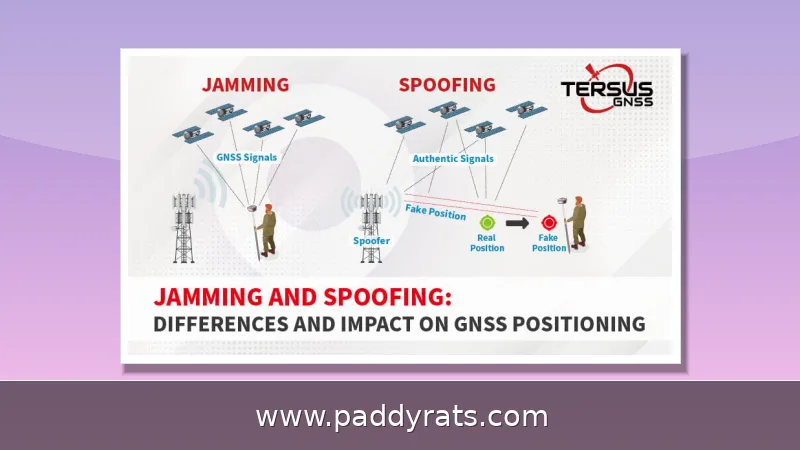
A signal jammer is really just an RF transmitter that deliberately raises the noise floor on whatever frequencies your wireless devices depend on. It's not hacking your phone or cracking encryption—instead, it floods the air with high-powered radio noise on the same band, pushing the signal-to-noise ratio down until receivers can't isolate legitimate traffic anymore. In its most basic form, a jammer blasts a strong RF carrier across 4G and 5G bands, drowning out the relatively weak downlink signal coming from cell towers.
Power level is what determines how much damage a jammer actually does. A high-powered unit blocks traffic in both directions at once: handsets can't reach the tower, and the tower can't reach handsets. That effectively takes out an entire cell sector along with everyone connected to it. Lower-powered units are sneakier, though. You'll notice noise or fading on calls, data that stalls out with packet loss, or phones that simply won't register on the network at all.
A jammer might be disrupting a network, but there's nothing mystical going on — it's just transmitting ordinary radio waves, which means the same physics that govern any RF signal govern this too. Throw up a concrete wall, line a room with metal sheeting, or even just park a car between the jammer and whatever it's targeting, and you'll genuinely weaken that signal. This is the practical reason why a facility's construction and layout can end up mattering just as much as the device itself. It also explains why jamming range specs vary so wildly from one product to the next. A 50W prison-grade unit might only cover about 50 meters in a dense urban setting where cell towers are packed close together, while drone jamming can stretch several hundred meters — even up to a full kilometer — simply because drone control links operate at far lower power than cell towers and are much easier to overwhelm. Same principle, completely different outcomes.
Pretty much any wireless network can be jammed. Cellular, GPS/GNSS, land mobile radio (LMR), WiFi — they all depend on RF links, and a jammer just drowns them out. The mechanics aren't complicated: the device blasts the same frequencies your gear is using, which crushes the signal-to-noise ratio until the receiver can't tell the real transmission apart from the noise. Even a relatively weak unit can leave you with choppy calls, data that won't load, or a phone that refuses to connect at all. More advanced models go beyond raw noise — they use protocol jamming to hit control channels directly, which can knock out an entire cell sector rather than just degrade it. And wide-band full-spectrum jammers take the brute-force approach, blocking several bands at once. From my own experience testing detection equipment, the giveaway is never a single dropped call. It's a bunch of unrelated devices all failing at the same time, in the same place.
Which Frequencies Do Secure Facility Jammers Target?
Secure facility jammers aren't built to just spray noise across the entire spectrum and hope something sticks. They're engineered to hit the specific bands that phones, WiFi equipment, and tracking devices actually rely on inside and around a controlled perimeter. That's what makes getting the frequency list right so important. Tune a jammer to the wrong band, and phones, WiFi, and tracking gear will just keep humming along like nothing happened. Cellular comes first on the list, since phones remain the go-to tool for smuggling messages and coordinating unauthorized activity in and out of a facility. WiFi is next, covering the 2.4 GHz and 5 GHz bands that laptops, cameras, and IoT devices depend on. GNSS, built around the GPS L1 frequency at 1575 MHz, completes the top three, because cutting off location and timing signals can throw off everything from delivery drones to GPS-tracked assets. The table below lays out the bands most commonly listed in jammer specs and what each one takes down.
| Band / Frequency | What It Disrupts |
|---|---|
| 700 MHz, 800 MHz, 900 MHz | Low-band cellular (2G, 3G, some 4G/LTE); wide coverage, penetrates buildings well |
| 1800 MHz, 1900 MHz, 2100 MHz | Mid-band cellular (4G/LTE, 5G); the workhorse bands for voice and data |
| 1575 MHz | GPS / GNSS L1; location, navigation, and timing signals |
| 2.4 GHz | WiFi, Bluetooth, many IoT devices, and some drone control links |
| 5 GHz | WiFi (including WiFi 6E); higher-throughput wireless networks |
| Band | Frequency | What It Disrupts |
|---|---|---|
| Cellular low band | 700 / 800 / 900 MHz | Voice, SMS, and wide-area LTE coverage |
| Cellular mid band | 1800 / 1900 / 2100 MHz | LTE and 5G data, most handset traffic |
| GNSS | 1575 MHz | GPS positioning, timing, and tracking |
| WiFi | 2.4 GHz and 5 GHz | Routers, IoT devices, wireless cameras |
| Control channels | Protocol-specific | Network registration and handover signaling |
Cell jammers work by broadcasting electromagnetic signals on the exact same frequencies that phones use to talk to cell towers. That overlap is the whole trick. Since the jammer's signal sits on the same channel as the real one, your phone has no way of knowing whether the network is being jammed or is just congested — all it sees is noise where a carrier signal should be. WiFi jammers pull the same move on the 2.4 GHz and 5 GHz bands, flooding the air with digital noise so laptops, security cameras, and IoT sensors can never complete their handshake with the router. GNSS jamming gets less attention, but it often causes more damage, because GPS doesn't just tell a device where it is — it also feeds precise timing to tracking systems, logging equipment, and the synchronized networks that plenty of facilities quietly depend on. Lose that timing reference and records start to drift, location data goes stale, and systems further downstream can fail in ways nobody catches until someone goes looking for the missing data.
Wide-band, full-spectrum units cram all those bands into a single chassis, which is exactly why prison and government procurement documents usually list output power per band rather than one big headline wattage. Honestly, whenever I'm going through a spec sheet, the per-band numbers and the antenna setup tell me far more about how a unit will actually perform in the real world than whatever range figure is printed across the front page.
That kind of range is exactly why jammers cause so much collateral damage. A single device sweeping across the 700 MHz to 2100 MHz cellular bands can't tell who's transmitting before it shuts them down—it just floods those frequencies with RF noise, and everyone sharing that spectrum pays for it. Which means the same slice of spectrum carrying a suspect's phone call is also carrying the radio traffic that police, fire, and EMS crews rely on when they respond to the very incident the jammer was supposed to help with. And we're not talking about a minor inconvenience. In a DHS survey of 4,933 first responders, 9% said frequency interference affects their communications to a great extent, and another 22% said it affects them to some extent. A July 2024 SAFECOM survey went even further, ranking interference third among all the factors that degrade first responder communications. The bottom line: when a jammer gets deployed carelessly, the disruption doesn't stay where it was aimed. It spills over and can weaken the radio links that an entire incident response depends on—turning a tool meant to isolate a threat into a hazard for the very people trying to stop it.
Are Signal Jammers Legal in the United States?
No — under federal law, the FCC prohibits operating, marketing, or selling jamming equipment that interferes with authorized radio communications such as cellular, PCS, police radar, and GPS. There's no exception for businesses, classrooms, homes, or cars. Local police departments can't simply choose to deploy jammers on their own authority, either — that power doesn't exist at the local level. This is federal law we're dealing with, not a city ordinance, and it applies just as much to the person selling the equipment as it does to the person switching it on.
Enforcement has gotten a lot tougher in recent years, and the numbers back that up. According to US Customs and Border Protection, signal jammer seizures have risen roughly 830% since 2021, while busts of jamming equipment jumped nine-fold between 2021 and 2025. The crackdown didn't stop there, either: in March 2024, the FCC opened an investigation into jammers sold online, and Amazon was among the retailers the FBI was looking at. The takeaway is pretty simple—ordering a cheap jammer from some overseas marketplace doesn't put you outside US jurisdiction.
The United States is hardly alone in restricting jammers, but the international picture is anything but uniform. Canada illustrates how quickly the rules can bend for a narrow, tightly controlled use case: in March 2025, it began permitting jammers inside prisons, and a pilot project there could eventually pave the way for widespread deployment across Canadian federal correctional institutions. The rationale is straightforward—correctional officials want to cut off contraband cellphones that inmates use to run drug operations, coordinate violence, or intimidate witnesses from behind bars. Yet the same device that a Canadian prison authority may install with official sanction could be flatly illegal—and subject to seizure—just a few hundred miles to the south, where U.S. law generally prohibits jamming outside a handful of federal exceptions. That contrast is the practical takeaway for anyone procuring equipment for a secure facility: legality is jurisdiction-specific, and approval in one country's correctional system offers no cover in another's. Buyers need to confirm the rules of the specific country, and often the specific state or province, before a purchase ever ships.
| Jurisdiction | Status for prison/correctional use | Timing |
|---|---|---|
| Canada | Jammers allowed in prisons; pilot project may lead to widespread use in federal prisons | March 2025 |
| United States | Generally prohibited, with only limited federal exceptions; devices can be treated as contraband | Ongoing enforcement (FCC investigation into online jammer sales, March 2024) |
For facility operators in the US, the practical takeaway is that detection and defense are the compliant path. You can monitor for jamming, harden your infrastructure, and coordinate with federal authorities, but you cannot legally jam your way out of a jamming problem.
How Do Criminals Use Jammers Against Alarm Systems?
Jammers have moved from novelty gadget to standard tool in a certain class of property crime. DHS reported jamming device use in several Vermont bank robberies in June, and jamming devices were recovered in an attempted jewelry store robbery in La Verne, California. These are not sophisticated cyber operations; they are physical crimes where a handheld device buys the crew a few extra minutes.
The scale of this problem is bigger than most people realize. More than a dozen bank heists across California have been linked to a single criminal gang, and in October 2024 the FBI charged ten individuals in connection with the spree. At least one of those runs added up to $2.5 million in stolen cash. What makes these crews so effective isn't brute force — it's timing. Before anyone walks through the door, someone outside is already pressing a button on a small RF device that floods the alarm system's wireless frequency with noise. The panel never gets its "all clear" check-in, or the sensors never get through at all, so the alarm company sees nothing unusual until it's far too late. Cut the wireless path first, and the alarm becomes a silent witness instead of a warning.
That is exactly why alarm panels that rely solely on cellular or WiFi communication paths are the softest targets in the building. When a jammer floods the panel's radio link with RF noise, the signal never reaches the central station, and the monitoring company sees nothing out of the ordinary—no alarm, no trouble condition, no hint that anything is wrong. The panel itself may not even realize it has been cut off, depending on how it is configured. Hardwired connections and redundant communication paths remain the most reliable countermeasure, because jammers only affect wireless devices. A landline or IP-based path that runs alongside the cellular radio gives the panel a second way out, so even if one route is drowned in interference, the alarm can still get through.
The commercial cost extends well beyond burglary. Signal jammers undermine about 25% of commercial and public safety tracking systems in major US and EU markets, costing an estimated $2.5 billion annually. Fleet telematics, asset trackers, and lone-worker systems all depend on the same bands a $200 jammer can silence.
How Do Criminals Use Jammers Against First Responder Communications?
First responder radio traffic is not immune, and the survey data is uncomfortable. In the SAFECOM Nationwide Survey published in July 2024, 31% of first responders reported being affected by interference, and frequency interference ranked third among all factors affecting first responder communications. A separate DHS survey of 4,933 first responders found that 9% said frequency interference affects communication to a great extent, while 22% said it does so to some extent.
The mechanism is the same physics that defeats a cell phone. LMR systems, GPS-based vehicle location, and the cellular links used by mobile data terminals all sit in or near bands that consumer jammers can reach. When a jammer is active near an incident scene, dispatchers may lose telemetry, automatic vehicle location can drift or drop, and handheld coverage can degrade exactly when coordination matters most.
This is where the anti jammer device category earns its budget. A properly deployed anti-jamming system detects the elevated noise floor, works out where the interference is coming from, and suppresses its effect so the receiver can keep using the legitimate signal. For first responders, that can mean the difference between a working channel and a dead one.
Search interest tells the same story. Queries for cheap anti jammer solutions spiked 150% since October 2025, which suggests agencies and facility managers are actively shopping for protection rather than assuming their licensed spectrum keeps them safe.
How to Detect a Cell or WiFi Jammer
Detection starts with anomaly patterns rather than exotic hardware. The classic signs are loss of service on multiple phones in an area with normally good coverage, erratic signal fluctuations, WiFi disconnections right next to the router, high latency and packet loss, and reduced bandwidth across unrelated devices. If wired Ethernet connections keep working normally while every wireless device struggles, that is a strong indicator of RF interference rather than a carrier outage.
Purpose-built detectors make the diagnosis faster and more defensible. JamAlert continuously monitors the radio frequencies used by major wireless carriers, and its proprietary algorithms distinguish normal network congestion from jamming patterns, then triggers a tamper alarm on the security panel. It connects directly to an alarm panel zone input and works with Honeywell, DSC, Bosch, and DMP panels without software reconfiguration, which is a meaningful detail for integrators who cannot afford a firmware project.
Handheld and fixed detectors cover the rest of the workflow. The RFD-12S is an affordable fixed anti-theft detector, the RFD-12W targets 2.4 GHz WiFi and cell phone jamming, the RFD-12 is an anti-theft detector for a local command center that catches mobile phone, WiFi, and 315/433/868 MHz jammers, and the RFD-19 is a portable handheld GPS jammer detector. Matching the detector to the bands you actually care about beats buying the widest catalog item.
One caution from experience: baseline your site first. A detector that alarms on normal congestion is worse than no detector, because staff learn to ignore it. Log a week of clean RF behavior, then tune thresholds against that baseline.
Anti Jammer Devices and Detection Systems for Secure Facilities
An anti jammer device is not a jammer in reverse. It detects the bad noise, figures out where it is coming from, and suppresses its effect so the receiver can keep using the legitimate signal. That distinction matters legally and operationally: you are protecting authorized communications, not blocking anyone else's.
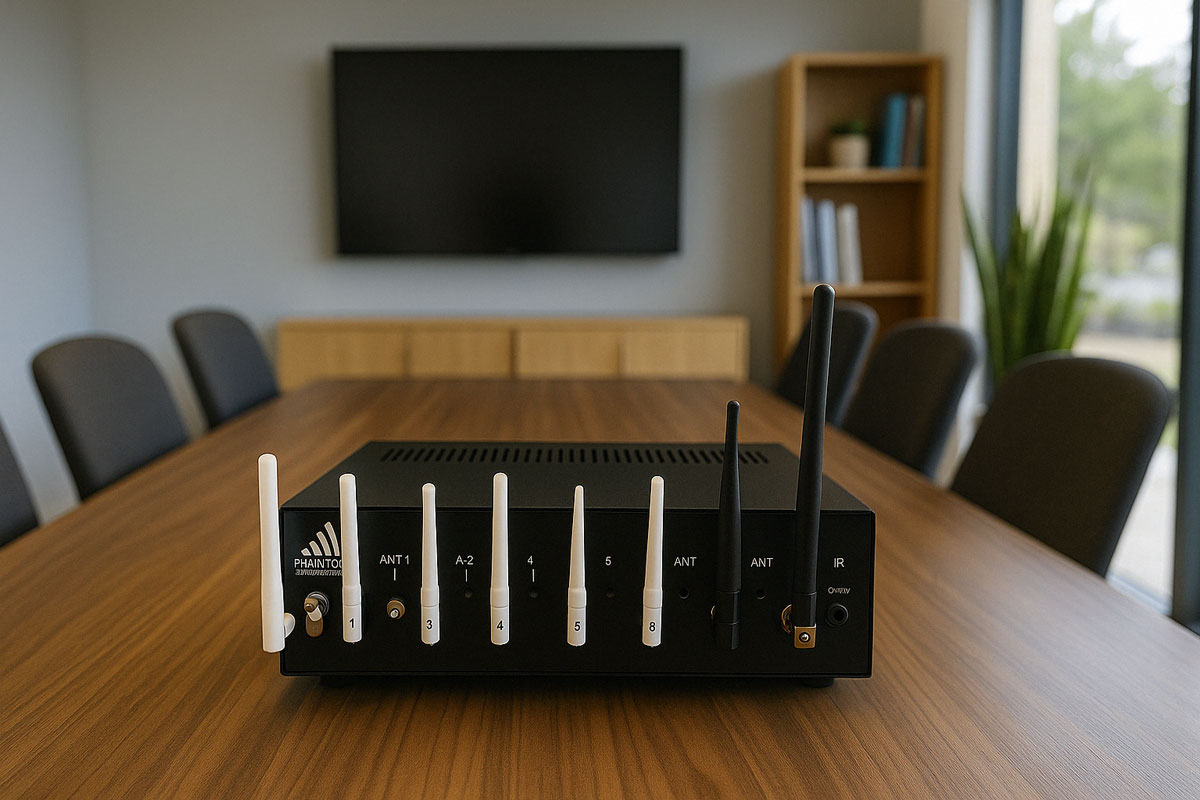
For facility design, the practical stack combines physical hardening, redundant communication paths, and continuous RF monitoring. Indoor jamming systems such as Phantom Technologies units block cellular (2G, 3G, 4G, 5G), WiFi (2.4/5 GHz), and GNSS signals within a defined radius, typically up to tens of meters indoors, which is why perimeter and room-level planning matters more than headline range.
Prison-grade hardware shows what serious engineering looks like. A 50W prison signal jammer typically covers around 50 meters in urban environments with densely deployed base stations. These units use switched-mode power supplies converting AC 210V-240V to DC 28V for the RF modules, with an independent SMPS per module for redundancy. Thermal design is equally deliberate: internal modules mount on a thick aluminum heat sink exposed at the back of the enclosure, and fans at the top and bottom push air across it. Weather resistance comes from rainproof air intake vents on the sides, with exhaust vents and connectors at the bottom perpendicular to the ground.
Networking and procurement round out the picture. Multiple jammers can be linked over LAN or the internet for centralized control through RJ45 Ethernet interfaces or 433 MHz magnetic antennas. On the commercial side, representative Jammer Master pricing includes the All-in-One Directional Signal Jammer JM030 at $1,220.00, the FM Radio/Cell Phones/WiFi 6E Jammer JM027 at $1,250.00, the Mini GPS Jammer & Power Bank JM015 at $599.00, the High-Power Portable Signal Jammer JM022 at $780.00, the 4G Phone Jammer JM021 at $520.00, the Handheld WiFi Bluetooth Signal Jammer JM012 at $569.99, the Handheld Mobile Phone Jammer with 16 antennas and 25-meter range JM018 at $699.00, and the Built-in Directional Antennas Drone UAV Signal Jammer JM004 at $2,399.99. Portable jammers average about 1.5 kg, noticeably lighter than desktop models.
Market context explains why this category keeps growing. One estimate puts the global signal jammer market at USD 2.85 billion in 2025, projected to reach USD 4.64 billion by 2032 at a 7.2% CAGR, while an alternative estimate cites USD 913.05 million in 2025 rising to USD 1,209.32 million by 2032. The anti-jamming market is larger still, valued at USD 5.43 billion in 2025 and projected to reach USD 12.97 billion by 2034. For secure facilities, the defensive side of that ledger is where the durable spending sits.
Can a Signal Booster Stop a Signal Jammer?
No, and this is the most common misconception I run into. Signal boosters amplify existing signals, but if a jammer is blocking that signal, the booster has nothing useful to amplify. It will happily amplify the noise along with whatever faint legitimate signal remains, which usually makes the situation worse rather than better.
Any signal jammer is effectively also a signal booster jammer, so amplifiers are not an effective defense against jamming. The same logic rules out antenna upgrades and higher-gain handsets as a primary countermeasure. If the signal-to-noise ratio at the receiver has collapsed, gain on the receive side does not restore information that was never distinguishable.
What actually works is layered. Physical barriers such as vehicles, buildings, and heavy materials attenuate jamming signals and help preserve coverage in shielded areas. Wired connections sidestep the problem entirely because jammers only affect wireless devices. Continuous RF monitoring turns a silent attack into a visible alarm, and detector hardware matched to your specific bands gives responders something actionable.
For secure facilities, the honest conclusion is that defense is about resilience, not immunity. You cannot make yourself un-jammable, but you can make sure that a jammer degrades your operation instead of disabling it. The facilities that handle this well assume interference will happen and engineer around it.
Frequently Asked Questions
How does a signal jammer work?
Jammers transmit high-powered RF noise on the same frequencies as target devices, lowering the signal-to-noise ratio so receivers cannot hear legitimate signals. A 4G or 5G jammer can drown out cell tower signals, shutting down a whole cell sector and every user connected to it.
Are signal jammers legal in the United States?
No. The FCC prohibits operating, marketing, or selling jamming equipment that interferes with authorized radio communications, including cellular, PCS, police radar, and GPS. There are no exemptions for businesses, classrooms, residences, or vehicles, and local law enforcement lacks independent authority to use them.
How can I tell if a jammer is being used nearby?
Signs include loss of service on multiple phones in areas with normally good coverage, erratic signal fluctuations, WiFi disconnections near the router, high latency and packet loss, and reduced bandwidth. Wired Ethernet connections keep working because jammers only affect wireless devices.
Can a signal booster stop a signal jammer?
No. Signal boosters amplify existing signals, but if a jammer blocks that signal, the booster has nothing to amplify. Any signal jammer is effectively also a signal booster jammer, so amplifiers are not an effective defense against jamming.