A 100W jammer does not automatically beat a 50W unit, and identical wattage can produce wildly different jamming distances. This comparison breaks down watts vs dBm, average power per MHz, antenna gain, and the J/S ratio that actually decides whether a link goes down.
Why Output Power Alone Does Not Determine Jamming Range
Whenever I hook up a jammer module to a power meter, the first thing people ask about is wattage. That number matters, sure, but it's really just the starting point. Output power tells you how much RF energy the amplifier puts out across the entire band—not how much actually reaches a specific target on a specific frequency. Real-world range comes down to a mix of things: power, antenna gain, frequency, how strong the target signal is, what's in the way, and how well everything is set up.
This is just the inverse-square law doing its thing. Double the distance, and the received signal strength falls off by about 75 percent. So going from a 20-meter jamming radius to 40 meters isn't a matter of doubling your power—it's closer to a fourfold increase, maybe more. A 10W blocker that covers 20 meters might need 40W or more just to hold 40 meters. That gap between theory and reality is exactly why field results so often fail to match what the marketing sheets promise.
Total Power vs Average Power per MHz: A Worked Comparison
Average power is just total power divided by bandwidth, and honestly, that one ratio clears up most of the confusion people run into when they're comparing jammer power to range. You'll see two modules both stamped 100W (50dBm) on the spec sheet, and they can behave like completely different devices once you break down how that energy actually gets spread across the frequency band.
The table below shows what happens when you feed the same 100W of total output into three different band plans, and it makes one thing clear: what really matters for the 2.4GHz band (2400–2485MHz) is how tightly that energy is packed, not the raw wattage on the label.
| Jammer | Coverage | Bandwidth | Average Power per MHz |
|---|---|---|---|
| Jammer A | 2400-2500MHz | 100MHz | 1W/MHz |
| Jammer B | 2000-2700MHz | 700MHz | 0.14W/MHz |
| Jammer C | 2200-2700MHz | 500MHz | 0.2W/MHz |
Jammer A puts out roughly seven times more energy per MHz than Jammer B within the 2.4GHz band, which is why it can jam WiFi and drone control links at a noticeably longer range even though both units are sold as 100W. Some engineers push back on this, arguing that a VCO generates one frequency at a time, so each individual frequency point should get the full amplifier gain. That sounds reasonable in theory, but in the real world you have to account for sweep speed, dwell time, gain flatness, and nonlinear control voltage curves. Once those factors come into play, dividing total power by bandwidth turns out to be the more practical number for planning purposes.
Common Jammer Power Ratings: 50W, 100W, and Handheld Classes
Most of the modules you'll see on the market put out either 50W (47dBm) or 100W (50dBm), and that number comes from hooking the module up to a power meter. But here's the catch: it's the total power spread across the whole frequency band, not the power for any single channel. Handheld jammers sit at the other end of the spectrum—they're compact, battery-operated units that typically run somewhere between 1 and 20 watts, with effective jamming radii of about 10 to 50 meters.
When you're actually picking hardware, comparing device classes tells you a lot more than staring at a single wattage number. The table below lays out typical output power and range for each class, pulled from vendor specs and field tests.
| Class | Typical Output | Effective Range |
|---|---|---|
| Portable / handheld | Under 1W to 20W | 5-50 meters |
| Remote control | 1-4W | 20-60 meters |
| High power | 5W and up | 50-300 meters |
| Backpack drone jammer | Over 200W | Up to 1500 meters |
Backpack drone jammers are the top tier in that lineup. You're looking at over 200W of output, enough to cut a drone's link in roughly 3 seconds at distances up to 1500 meters in real-world conditions, and the whole thing runs on a movable battery that holds up for about 80 to 90 minutes. A 300W unit could lock down a 500-meter radius, but keeping it alive means serious cooling and a very stable power supply. That's exactly why you won't find these things sold as casual handhelds.
Antenna Gain, Frequency Band, and the Distance-to-Power Ratio
Effective radiated power, or ERP, is just transmit power plus antenna gain. One jammer I looked at had an ERP of 39.03 dBm. Here's the thing: the antenna is usually the cheapest upgrade you can make, and it often delivers the biggest payoff. Take a 30W transmitter hooked up to a 4 dBi antenna at one kilometer. That setup gives you a J/S of 1 dB at the receiver, and honestly, that's already enough to break a lot of links.
Device A with 10W output and an omnidirectional antenna reaches roughly 15 meters indoors. Device B with the same 10W output and a 9 dBi directional antenna reaches beyond 40 meters. Both consume identical power, yet Device B performs nearly three times better. A 30W device with a poor antenna can underperform a well-designed 10W unit, which is why I always ask for antenna specs before wattage.
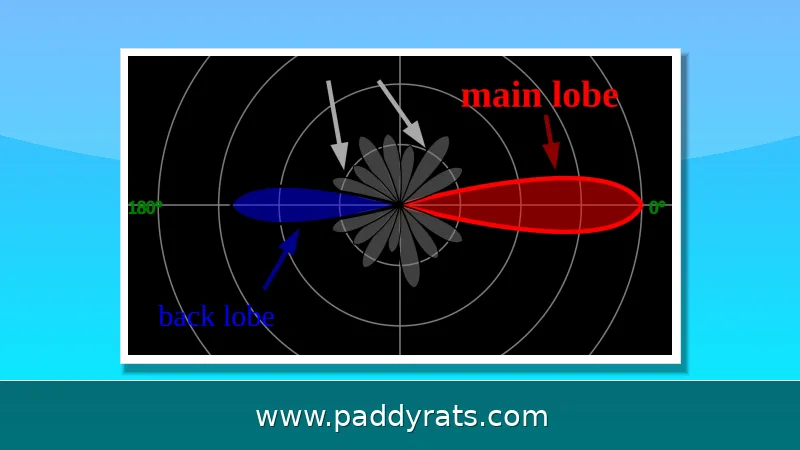
Frequency matters just as much. Lower frequencies such as 900MHz travel farther than higher ones such as 5.8GHz and need less power for the same range, while omnidirectional antennas cover 360 degrees horizontally for broad coverage and directional designs like parabolic or Yagi antennas focus energy for longer reach in one direction at the cost of coverage elsewhere.
How Much J/S Ratio Is Really Needed to Jam a Link?
The J/S ratio is the inverse of S/N, with jamming noise J replacing environmental noise N. Most transceivers need an S/N of several dB to decode reliably, so even a 0 dB J/S can disable decoding. That is the number that matters more than raw watts, because it accounts for geometry, antenna gain, and path loss on both the legitimate link and the jammer path.
A worked example: a portable jammer with a 5W transmitter and unity-gain omni antenna, 100 meters between transmitter and receiver, and 300 meters from jammer to receiver, yields J/S = 7 + 0 - 3 - (-5) + 40 - 50 = -1 dB, right at the edge of competition. Move the jammer 50 meters closer and the link collapses; move it 100 meters farther and the target keeps working.
Barrage jammers spread energy across a wide frequency range, so the effective energy received by a specific link may be lower than expected. Lower-power targeted jamming can outperform high-power wideband approaches, and adaptive power control, time-division interference, and multi-band allocation let designers give more energy to low frequencies for distance and less to high frequencies for precision.
Why Compact High-Power Jammers Cost More at the Same Wattage
A mini jammer can cost twice as much as a much larger model with similar advertised output power, and I have seen this repeatedly: around $500 for a compact unit versus $1,000 or more for a larger 20W-class device. The gap comes from tighter RF layouts, heat management, shielding, and precise engineering that keeps noise and harmonics under control in a smaller chassis.
Battery-powered portable jammers lose output power as lithium battery voltage drops, which quietly reduces jamming range over a session. Wide bandwidth jams more frequencies at once but spreads power and lowers effective power at any single frequency, so a 950mW modulated noise output across 2.4GHz and 5.8GHz behaves very differently from the same milliwatts concentrated in one narrow band.
External Factors That Shrink or Stretch Real Jamming Range
Signal repeaters change the game. Device-to-device links such as walkie-talkies, drones, and wireless headsets are easier to jam because the jammer only has to beat one path. Links routed through repeaters, including mobile phones and satellite phones, are much harder because the base station side keeps the connection alive. City base stations use panel antennas with power levels from 50W to 200W, often higher than the jammer itself.
Obstacles such as buildings, hills, trees, and walls attenuate signals, while heavy rain, fog, or snow absorb and scatter RF energy. Strong target signals from high-power transmitters or nearby sources require higher jammer power or closer proximity, and complex modulation or error-correction coding resists interference, demanding stronger output or a precise frequency match.
Hardware choice inside the jammer also matters. USRP platforms have much larger output power than the lower-cost HackRF One, making a big difference in distance reach when jamming, and CAST broadband noise jammers provide more than 130dB of interference signal power from nominal GNSS output levels. For reference, gotenna units operate in VHF around 150MHz with 2W radios and about -5 dBi omni antennas, delivering 4 miles of comms range in open, flat conditions, which shows how far a modest signal can travel when nothing is fighting it.
One legal note I will not skip: in many jurisdictions, unauthorized use of equipment designed to jam radio communications, including anti-drone jammers, is strictly illegal and can lead to severe penalties. Jammers in crowded areas may unintentionally affect emergency services, so treat every deployment as a regulated engineering decision rather than a plug-and-play purchase.
Frequently Asked Questions
Does higher output power always mean a longer jamming range?
No. Range depends on output power, operating frequency, antenna gain, target signal strength, obstacles, and installation. A 30W jammer with a poor antenna can underperform a well-designed 10W unit, and a 10W device with a 9 dBi directional antenna can reach beyond 40 meters versus about 15 meters with an omnidirectional antenna.
What is average power per MHz and why does it matter?
Average power equals total power divided by bandwidth. Two 100W jammers differ sharply: one covering 2400-2500MHz gives 1W/MHz, while another covering 2000-2700MHz gives only 0.14W/MHz. The concentrated-energy unit jams the 2.4GHz band better and achieves longer range at the same advertised wattage.
What output power do common jammer modules offer?
Most modules on the market offer 50W (47dBm) or 100W (50dBm) of output, representing total power across the entire frequency band and typically measured by connecting the module to a power meter. Handheld jammers usually run 1 to 20 watts with effective radii of 10 to 50 meters.
How much power is needed to double jamming distance?
Output power and signal reach follow the inverse-square law: when distance doubles, signal strength drops by roughly 75 percent. If a blocker covers 20 meters with 10 watts, reaching 40 meters might require 40 watts or more, so the relationship grows exponentially rather than linearly.