Vehicle mounted signal jammer prices range from under $100 for cigarette-lighter GPS blockers to six figures for military counter-IED systems, with most anti-drone vehicle units landing between $1,300 and $4,600. Here is what actually drives the cost, from RF output and band count to power draw and integration type.
What Is a Vehicle Mounted Signal Jammer?
A vehicle mounted signal jammer is really just an RF transmitter you install on or inside a car, truck, or armored vehicle to knock out wireless signals in the surrounding area. The products that fall under this label vary a lot — you've got cheap GPS blockers that plug into a cigarette lighter, mid-range anti-drone units, and heavy-duty military counter-IED systems like the L3Harris CREW Vehicle Receiver/Jammer and the SRC AN/VLQ-12 CREW Duke, both of which were deployed in Operation Iraqi Freedom and Operation Enduring Freedom.
When people search for a vehicle mounted signal jammer price, they usually have one of four missions in mind: convoy protection, counter-IED work, anti-drone defense, or VIP security. Each one pulls the specs in a completely different direction, which is exactly why two quotes for what sounds like the same product can differ by a factor of fifty. A $100 cigarette-lighter GPS blocker and a 20-channel tactical system aren't really in the same category, even though both get sold as "vehicle mounted." The cheap one just kills GPS reception in a single narrow band. A tactical platform like the Tactical Supply Pakistan system, on the other hand, covers 20 MHz to 6000 MHz across 20 RF channels, pushes up to 320W, and takes down drone links at beyond 500 m. So before you start comparing numbers, figure out which of those four jobs you're actually buying for. That one answer drives the frequency bands, the power budget, and ultimately the price you'll be quoted.
How Do Vehicle Mounted Jammers Work?
Vehicle-mounted jammers run on a pretty straightforward idea: they flood whatever frequencies a target device is using with artificial radio interference. Picture trying to carry on a conversation in a room where somebody keeps cranking up static through a loudspeaker — the noise floor climbs until the receiver can't tell the real signal apart from the garbage surrounding it anymore. Drone jammers designed for vehicles usually scan somewhere in the 300 MHz to 6 GHz range, which takes in most of the consumer and commercial drone traffic out there. They rely on spectral scanning and protocol analysis to identify the RF signatures drones emit, then target the control and navigation bands those aircraft depend on — 900 MHz, 1.2 GHz, 1.5 GHz, 2.4 GHz, 5.2 GHz, and 5.8 GHz. Timing matters just as much as the technique itself. Detection and alert can happen in under five seconds, and jamming typically kicks in about three seconds after that — fast enough to count when a drone is closing in at speed.
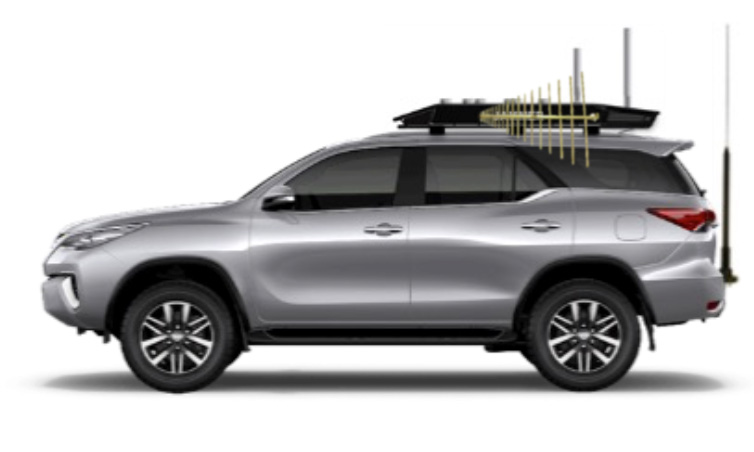
A tactical high-power vehicle setup isn't really a single box — it's more like a stack of subsystems that have to work together. Typically, you're looking at a DDS (Direct Digital Synthesis) module, a high-frequency interference subsystem, an RF antenna subsystem mounted on the roof, a feeder line subsystem, and then a control unit, a control panel, and a power supply on top of that. So why does all this matter when you're trying to figure out a price? Because the antenna array, the power supply, and the labor involved in integrating everything often cost more than the RF generator itself.
Key Specifications: Frequency, Power and Range
When you're comparing price quotes for a vehicle mounted signal jammer, three specs end up doing most of the work: frequency coverage, total RF output, and effective range. Take a 20-channel unit that covers 20 MHz to 6,000 MHz with up to 320W of total RF output—that's not really in the same category as a single-band GPS blocker. It's a completely different purchase with a completely different price tag. The table below lines up representative specs from systems described in vendor and defense documentation.
| System | Frequency coverage | RF output | Reported range |
|---|---|---|---|
| Tactical Supply vehicle jammer | 20 MHz to 6,000 MHz, 20 channels | Up to 320W | 70 m cellular, 500 m+ drone |
| SESP JAMKIT | Multi-band cellular, satellite, VHF/UHF, WLAN | 350W total | Not specified |
| YTS Jammer Vehicle | 20 MHz to 6,000 MHz, 26 bands | Up to 1,800W sweep mode | Not specified |
| Texin TX-CZX03 | 600 to 900 MHz, 3 channels | 150W (50W per band) | About 1,000 to 1,500 m |
| VT-505 SDR jammer | 8 MHz to 6,500 MHz | Not specified | Not specified |
Power draw is the spec that buyers tend to skip over, yet it can make or break an install. Take the Tactical Supply unit: it pushes up to 320W of RF output while pulling under 1,300W from the car battery, and it keeps running from -20C to +55C. The L3Harris CVRJ is another example, drawing up to 30 amps of vehicle power, and at roughly 69 lbs with a 13"H x 14"W x 19"D footprint, it's not something you toss in the trunk and forget about. Then there are the bigger systems, the ones that rely on a built-in 110AH/24-28VDC battery or a 220VAC supply and consume around 2,800W. Once you're in that territory, you're usually looking at a dedicated alternator or generator, not just the stock electrical system.
Vehicle Mounted Signal Jammer Price Ranges and Examples
If you browse enough vendor listings, a pattern starts to show up: vehicle mounted signal jammer pricing tends to fall into three rough tiers. At the bottom, you've got basic consumer-grade stuff—simple GPS blockers and low-power car jammers—going for under a few hundred dollars. These are usually single-purpose devices with limited range, meant for everyday privacy worries rather than professional security work. The middle tier is where vehicle anti-drone systems and multi-band jammers live, typically running somewhere between $1,300 and $5,000. That's the range where things get real: multiple frequency bands, higher output, and enough range to actually be useful in the field. Then there's the top end—military-grade counter-IED platforms and high-power tactical setups. You'll rarely see a price on those listings at all. Instead, you're asked to request a quote, since configuration, integration, and end-user requirements vary so much from one buyer to the next. One thing worth repeating: every number here comes from vendor listings and reflects list prices only. It doesn't account for whatever you negotiate off the top, shipping and handling, or the export licensing fees that tend to apply once you move into the higher tiers.
| Price Tier | Typical Price Range | What You Get | Example Listings |
|---|---|---|---|
| Low end (consumer) | Under a few hundred dollars | Basic single-purpose units, modest range, anti-tracking or GPS blocking | CM4 CDMA/GSM/GPS anti-tracking car blocker ($235.32); P6s OBD GPS jammer ($137.20); 2-band car cigarette lighter GPS jammer ($99.92) |
| Middle ground (anti-drone / multi-band) | About $1,300–$5,000 | Vehicle anti-drone systems, multiple bands, higher output and range | HD-3 3-band vehicle-mounted drone jammer ($1,895.20); HD-4 with remote antennas ($1,985.24); TAD-3 3-antenna anti-drone jammer ($1,943.32); PADF2 2-band portable suppressor ($1,342.30); DS-6 waterproof drone jammer ($4,598.52) |
| Top end (military / tactical) | Quote only | Counter-IED and high-power tactical platforms, custom configuration and integration | L3Harris CVRJ; SRC AN/VLQ-12 CREW Duke; Tactical Supply Pakistan vehicle-mounted jammer; SESP JAMKIT; YTS Jammer Vehicle |
| Product | Type | Listed price |
|---|---|---|
| JammerMFG HD-3 | 3-band vehicle drone jammer | $1,895.20 |
| JammerMFG HD-4 | 4-band vehicle drone system, remote antennas | $1,985.24 |
| JammerMFG TAD-3 | 3-antenna anti-drone jammer for vehicles | $1,943.32 |
| JammerMFG PADF2 | 2-band portable vehicle drone suppressor | $1,342.30 |
| JammerMFG DS-6 | Waterproof drone jammer | $4,598.52 |
| JammerMFG CM4 | CDMA/GSM/GPS anti-tracking car blocker | $235.32 |
| JammerMFG P6s | OBD GPS jammer | $137.20 |
| JammerMFG 2-band | Cigarette-lighter GPS jammer | $99.92 |
If you need more output power, Mobileboosterjammer (Shenzhen Sacon Telecom) is a good place to look for reference points. Their lineup includes 300W 6-band units rated for 30 to 500 m, 350W drone systems that reach up to 1,000 m, 120W 8-band units covering about 100 m, and 40W IP66 waterproof models with a 5 to 100 m range. You can see the pattern pretty clearly: doubling the band count at a lower wattage tends to shrink coverage, while a single-purpose high-power drone system pushes distance well past what the general-purpose units can do. All of these are priced by negotiation, with a minimum order of 5 pieces. The Tactical Supply Pakistan 20-channel system and the SESP JAMKIT work the same way — quote only. When a vendor won't post a number, it usually means configuration, licensing, and support terms are baked into the final figure, and those variables can move the price quite a bit.
| Model / Source | Total Output | Bands | Rated Range | Price |
|---|---|---|---|---|
| Mobileboosterjammer 6-band | 300W | 6 | 30–500 m | Negotiation (MOQ 5) |
| Mobileboosterjammer drone system | 350W | — | 1,000 m | Negotiation (MOQ 5) |
| Mobileboosterjammer 8-band | 120W | 8 | 100 m | Negotiation (MOQ 5) |
| Mobileboosterjammer IP66 waterproof | 40W | — | 5–100 m | Negotiation (MOQ 5) |
| Tactical Supply Pakistan | Up to 320W | 20 | 70 m+ (cellular) | Free quote |
| SESP JAMKIT | 350W | Multi-band | — | Request quote |
Military and Counter-IED Systems: CVRJ and CREW Duke
Military counter-IED jammers sit at the top of the price scale, and you won't find them on ordinary e-commerce sites—they move through defense contracts and government procurement channels instead. A good example is the L3Harris CREW Vehicle Receiver/Jammer, which offers wide receive and transmit coverage and can handle multiple threats at the same time. It draws up to 30 amps, weighs roughly 69 lbs, and measures 13"H x 14"W x 19"D, so it fits a vehicle mount without demanding a dedicated generator. The real selling point, though, is that it's reprogrammable without hardware changes. That matters more than it might sound: threat signatures evolve faster than vehicle fleets get replaced, so a jammer you can update in the field stays useful for years longer than one that needs new hardware every time a new trigger shows up.
The SRC AN/VLQ-12 CREW Duke is a vehicle-mounted, lightweight counter-RCIED (radio-controlled improvised explosive device) system built around a software-defined architecture — meaning its threat libraries and waveforms can be updated in the field rather than locked into fixed hardware. That flexibility earned it a place among the U.S. Army's Top 10 Greatest Inventions in both 2005 and 2009, a rare repeat recognition. Public contract values give a sense of scale: $49M in 2016, followed by $32M in 2017 plus $13M for spare parts that same year, and an earlier $13M award in 2013. These figures cover complete systems, spares, and ongoing support, which is exactly why per-unit pricing for this class of equipment is never a simple sticker figure.
| Contract Year | Value | Scope |
|---|---|---|
| 2013 | $13M | Systems and support |
| 2016 | $49M | Systems and support |
| 2017 | $32M | Systems and support |
| 2017 | $13M | Spare parts |
Vehicle Mounted Drone Jammers and Counter-UAS Use
Anti-drone work is the fastest-moving part of this market, and it is easy to see why: cheap drones have become a daily nuisance over bases, convoys, and airfields, so buyers want a countermeasure they can drive to the problem. A vehicle-mounted drone jammer typically scans from 300 MHz to 6 GHz, using spectral scanning and protocol analysis to pick out a drone's RF signature before it gets close. Once it has that signature, it hits the links that matter most — 900 MHz, 1.2 GHz, 1.5 GHz, 2.4 GHz, 5.2 GHz, and 5.8 GHz — which carry both the control commands and the video feed. Vendors describe operation at speeds up to 150 km/h with protection envelopes extending to roughly 3 km, and in a moving convoy that mobility is the whole point: the jammer travels with the assets it protects rather than waiting for the threat to enter a fixed site's coverage. Real-world results are rarely that clean, though. Terrain, the drone's altitude, and the sheer number of frequencies in use all shape how far and how reliably the system performs, so treat the advertised figures as a best-case baseline rather than a guarantee.
The numbers tell the story better than any sales pitch. According to UAV-defence reporting, Ukrainian and Russian forces were burning through 5,000 to 10,000 drones per week by early 2026 — a volume that turns drone defense from a niche concern into a standing operational requirement. The threat isn't limited to active war zones, either. German airport authorities logged 172 drone sightings in the first three quarters of 2025, up from 129 by the end of the third quarter of 2024, which shows how quickly civilian airspace is filling with cheap, hard-to-track UAVs. That combination — mass deployment abroad and rising incident counts at home — is exactly why analysts expect the vehicle-mounted segment to become the largest slice of the counter-UAS market. It also explains the flood of new SKUs landing at the $1,300 to $5,000 price point: buyers want mobile protection now, and vendors are racing to fill the gap.
How Much Power Does a Vehicle Mounted Jammer Draw?
Power draw determines whether a jammer can run from a standard 12V car electrical system or needs its own supply. A 320W RF output unit drawing below 1,300W from the battery is demanding but manageable with a reinforced alternator, and it operates from -20C to +55C. The Texin TX-CZX03 is far lighter on the vehicle: 6.5 kg excluding antenna, DC 12V external car battery, 24-hour working time, two cooling fans, and three LoRa digital modules for 360-degree protection across 600 to 900 MHz.
At the other end, systems such as the Alasartech 20-6000 MHz unit use a built-in 110AH/24-28VDC battery or 220VAC with roughly 2,800W consumption. The L3Harris CVRJ draws up to 30 amps. Before buying, confirm the vehicle's alternator output, whether the jammer needs a separate battery bank, and how cooling is handled, since thermal management is a common failure point in continuous operation.
Market Size and Where Prices Are Heading
Market research firms disagree on the exact size of the signal jammer market but agree on direction. Fortune Business Insights values the global market at USD 4.61 billion in 2025, projected to reach USD 9.27 billion by 2034 at an 8.1% CAGR. Market.us puts 2025 at USD 4.04 billion growing to USD 8.70 billion by 2035 at an 8.70% CAGR, with military jammers at 32.60% share, VHF/UHF at 30.81%, military and defense end users at 41.26%, and North America at 31.82% or USD 1.29 billion in 2025.
Other estimates are more conservative. Research and Markets sees USD 2.16 billion in 2025 rising to USD 2.37 billion in 2026 at a 9.4% CAGR and USD 3.36 billion by 2030 at 9.1%. Strategic Market Research puts vehicular jammers at 20.0% share, valued at USD 0.57 billion in 2025 with a 7.1% CAGR. Dataintelo models USD 2.8 billion in 2025 to USD 5.6 billion by 2034 at 8.1%, while Reanin tracks USD 913.05 million in 2025 to USD 1,209.32 million by 2032. The spread reflects different definitions of what counts as a jammer.
How to Choose and What Drives the Final Quote
Start with the threat, not the price. If the requirement is blocking cellular and GPS around a convoy, a 3-band or 4-band vehicle unit at roughly $1,900 to $2,000 is usually sufficient. If the requirement is counter-IED or counter-RCIED, the conversation shifts to reprogrammable military systems like the CVRJ or CREW Duke, where contracts, spares, and training dominate the cost. If the requirement is anti-drone, band coverage at 2.4 GHz and 5.8 GHz plus detection speed matter more than raw wattage.
Three integration types exist: full factory integration where the jammer is built into the vehicle, semi-integrated installations using roof antenna arrays and feeder lines, and portable kits supplied in Pelican cases with 5/8 high-gain omni antennas and wired remote control, as with the SESP JAMKIT. Key suppliers and integrators include L3Harris, SRC, SESP, YTS Systems, Tactical Supply, Texin, Shenzhen Sacon Telecom, JammerMFG, Jammer Master, Alasartech, and VT-505, alongside larger defense primes such as Lockheed Martin, Northrop Grumman, BAE Systems, Thales, Leonardo, Israel Aerospace Industries, Saab, Rohde & Schwarz, SPX, Kvertus, Mctech, Security Pro USA, and Jammers Pro. Always confirm local regulations before purchase, since jamming is restricted in most jurisdictions.
Frequently Asked Questions
How much does a vehicle mounted signal jammer cost?
Listed prices vary widely by power and band count. Examples include a 3-band vehicle-mounted anti-drone jammer at $1,895.20, a 4-band vehicle-mounted drone jamming system at $1,985.24, and a 2-band portable vehicle drone suppressor at $1,342.30. Simple GPS blockers start near $100, while many high-power and military-grade systems are quote-only.
What frequency range do vehicle mounted jammers cover?
Coverage depends on the model. Some systems span 20 MHz to 6,000 MHz across 20 RF channels, others cover 8 MHz to 6,500 MHz, and simpler units block 800 MHz to 3,000 MHz. Commonly targeted bands include 2G, 3G, 4G, 5G, Wi-Fi, GPS, and VHF/UHF radios.
How much power does a vehicle mounted jammer use?
Power draw varies considerably. One SDR-based unit outputs up to 320W of RF while drawing below 1,300W from the vehicle battery. The L3Harris CVRJ draws up to 30 amps of vehicle power. Some larger systems use a built-in 110AH/24-28VDC battery or 220VAC supply with roughly 2,800W consumption.
What is the jamming range of a vehicle mounted jammer?
Ranges differ by design and environment. Examples include a 100 to 200 meter coverage radius, 30 to 500 meters, up to 1,000 meters, and 1,000 to 1,500 meters for a 3-channel unit. Drone control and navigation links may be disrupted beyond 500 meters under favorable conditions.