FCC jammer enforcement bans selling or operating signal blockers in the US, with fines up to $16,000 per violation per day, device seizure, and prison time. Here is how jammers work, what the FCC has actually fined, and how to report one.
What Is a Jammer and Why Does the FCC Ban Them?
A jammer is a device that intentionally drowns out authorized radio communications by transmitting noise or a stronger signal on the same frequencies. The FCC files these products under a long list of marketing names: RF jammer, signal blocker, GPS jammer, cell phone jammer, Wi-Fi jammer, text blocker, and even drone jammer or CUAS equipment. No matter what you call it, the technical act is the same — a denial-of-service attack on the airwaves, carried out at the physical layer rather than through any software exploit.
There's nothing ambiguous about this ban. Under Section 333 of the Communications Act, willfully or maliciously interfering with licensed radio communications is prohibited. Section 301 says you need FCC authorization before you can operate transmitting equipment at all. And Section 302(b), together with Rule 2.803, makes it illegal to manufacture, import, sell, offer for sale, or ship non-compliant devices into the United States. On top of that, the FCC's Enforcement Advisory 2011-03 (DA 11-249) zeroes in on marketing and sales aimed at US buyers. So when a vendor slaps a "check local law" disclaimer on its site, that doesn't get them off the hook, it's not some clever loophole.
How Cell Phone and GPS Jammers Work
Here's the basic idea: a jammer puts out an RF signal on frequencies close to those of the nearest cell tower, but at a stronger power level. Your phone has no way to distinguish between the two, so it grabs the stronger signal — and once it does, the legitimate downlink from the tower gets cancelled out. Since the jamming goes after the downlink specifically, your phone reads zero bars even though the tower itself is still transmitting like nothing's wrong. On the cheaper end, you'll find units that only block a single band, while multi-band models are built to sweep across several carriers at the same time.
Jammers aren't all built the same, and the way they shape their signal is what sets them apart. A constant jammer just floods a frequency nonstop, while a reactive one stays quiet until it picks up traffic and only then fires. Deceptive jamming goes a different route, mimicking legitimate signaling so devices can't tell the difference. Then you've got random, barrage, spot, and sweep patterns, which basically trade raw power for wider coverage. On the network side, spotting any of this comes down to metrics like Packet Delivery Ratio, RSSI/SS, Bad Packet Ratio, Carrier Sensing Time, and Packet Inter-Arrival Time.
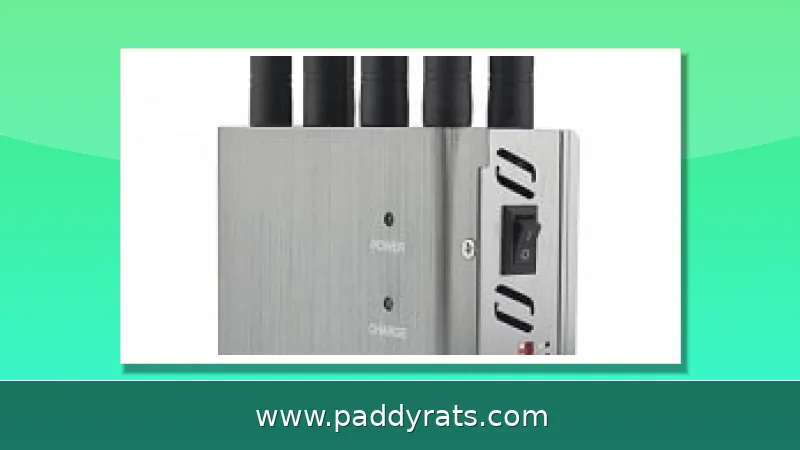
For most consumer-grade jammers, the effective range maxes out at roughly 30 square feet. Multi-channel models can pack in as many as 28 channels, though. Take the TX-H12K, for example—it's built with conferences in mind, offering 12 channels and a 5-to-40-meter radius. The CT-80M, by contrast, is an indoor wall-mount unit. And if you go with a 300W action-telecom system, you're looking at coverage of up to 100 meters. As for portability, Jammer Master's portable lineup averages around 1.5 kg, so it's fairly easy to carry around.
| Model | Type | Listed Price |
|---|---|---|
| JM027 | FM radio / cell / WiFi 6E jammer | $1,250 |
| JM031 | Cell phone CDMA / WiFi jammer | $1,050 |
| JM030 | All-in-one directional signal jammer | $1,220 |
| JM029 | Drone jammer gun | $5,200 |
| JM025 | Mini cell phone jammer | $420 |
| JM024 | Handheld signal blocker | $825 |
| JM023 | 5G mobile phone jammer | $980 |
| JM022 | High-power portable signal jammer | $780 |
FCC Rules and Laws That Make Jamming Illegal
The legal backbone here is the Communications Act of 1934, and it's still what the FCC points to today. Section 333 prohibits willful or malicious interference with any licensed radio communication. Section 301 makes it illegal to operate radio transmitting equipment without FCC authorization or a license. And Section 302(b), working together with Rule 2.803, bans manufacturing, importing, selling, offering for sale, or shipping any device that doesn't meet FCC compliance rules.
Nope — there's no consumer exception for your house, your car, a classroom, or a business. Retailers can't legally sell jammers to US consumers either, and the FCC has made it clear more than once that jamming doesn't discriminate: it takes out 911 calls, GPS, Wi-Fi, police radar, and signal boosters right along with whatever the person meant to silence. That's really the heart of it. The agency treats jammer marketing as an enforcement priority, not some quirky technical problem, precisely because the interference doesn't stop at the target.
A Data Catalyst paper from October 31, 2022 made the case for a limited right to block mobile signals in certain private spaces, but that's still just an academic idea, not actual law. As for federal law enforcement, they can only use jammers under a few narrow exceptions. The FCC's proposal from September 30, 2025 would change that for prisons, letting state and local facilities jam contraband phones for the first time by reinterpreting the 1934 statute. Cell phone signal detectors, on the other hand, are perfectly legal in the US and you'll find them all over correctional facilities.
A few other countries have looked at carving out similar exceptions for prisons, including Brazil, New Zealand, and Sweden. The United Kingdom has actually gone ahead and let law enforcement, intelligence agencies, and jails use signal jammers since 2012, though under tight rules. Georgia moved in the opposite direction, passing a state law that makes signal jamming a felony and bans manufacturing, selling, possessing, or using the equipment.
Penalties and Notable FCC Enforcement Cases
Even one violation can trigger penalties of up to $16,000 per violation, or per day if the violation continues, plus seizure of the illegal device and possible imprisonment. For a first offense, you're looking at up to $11,000 per violation and as much as a year behind bars. And remember, those figures apply per violation, so a device that's been marketed for months can quickly stack up into six or even seven figures.
The FCC upheld a $22,000 fine against Ravi's Import Warehouse, Inc. of Dallas, Texas in FCC 22-10, dated January 27, 2022. The breakdown was $10,000 for operating without authorization, $7,000 for causing interference, and $5,000 for egregious conduct. The agency also issued a record $34.9 million fine against a Chinese retailer for marketing illegal jammers, hit Marriott with a $600,000 penalty, and fined a Florida driver $48,000 for jamming communications.
Enforcement pressure is not only coming from the FCC. Customs and Border Protection reported roughly an 830% jump in jammer seizures since 2021, and DHS and the FCC released a Joint Jammer Infographic on April 10, 2025 to push awareness across agencies. Michele Ellison, chief of the FCC Enforcement Bureau, has framed these cases as consumer-protection actions because jammers can take down emergency calling.
| Case | Penalty | Reason |
|---|---|---|
| Ravi's Import Warehouse (FCC 22-10) | $22,000 | Unauthorized operation plus interference |
| Chinese retailer | $34.9 million | Marketing illegal jammers |
| Marriott | $600,000 | Jammer-related violation |
| Florida driver | $48,000 | Jamming communications |
How to Report Illegal Jamming to the FCC
If you suspect jamming, the first step is to contact your wireless network provider — carriers can often distinguish a local coverage problem from deliberate interference and may escalate on your behalf. If the problem persists, file a complaint with the FCC Enforcement Bureau using the online complaint form at www.fcc.gov/complaints, or call 1-888-CALL-FCC (1-888-225-5322).
For urgent situations where critical communications are at stake, call the FCC's 24-hour Operations Center at 202-418-112. Spectrum analyzers can detect jammers, but they are not commonly available to consumers, so a detailed description of the symptoms, location, and timing is usually more useful to investigators than a DIY measurement.
The FCC also publishes guidance for retailers caught up in enforcement. Companies should immediately stop marketing jamming devices in the US, decline to sell or ship to US addresses except for permitted US government sales, and ensure that US-manufactured jammers are designated for export only. Adding a 'check local law' disclaimer does not avoid liability.
| Channel | Best For | Contact |
|---|---|---|
| Wireless carrier | First check for local interference | Your provider's support line |
| FCC online complaint form | Standard jammer complaints | www.fcc.gov/complaints |
| FCC phone line | General complaints | 1-888-CALL-FCC (1-888-225-5322) |
| FCC Operations Center | Urgent, critical communications | 202-418-112 |
Prison Jamming Proposals and Legal Exceptions
The most active legal debate centers on prisons. The FCC's September 30, 2025 proposal would allow state and local prisons to jam contraband phones for the first time, reinterpreting a 1934 law that predates cellular technology. Contraband handsets inside correctional facilities are a persistent safety problem, and detectors are already legal and widely deployed, but active jamming remains restricted to limited federal exceptions.
The FCC's core position has not changed: jammers are indiscriminate and can block 911 emergency calls, interfere with GPS, Wi-Fi, police radar, and signal boosters, and disrupt public safety communications. A well-built jammer is hard to detect without military-grade spectrum equipment. That combination — easy to buy, hard to trace, and capable of cutting off emergency calls — is why penalties escalate so quickly.
For anyone weighing a purchase, the practical answer is simple. Jammers are not legal for consumers in the US, the FCC has no exception for homes, cars, classrooms, churches, hospitals, or courtrooms, and the enforcement record includes seven-figure fines and device seizures. The Communications Act Section 333 framework, the $16,000-per-violation ceiling, and the 830% rise in seizures since 2021 all point in the same direction.
Frequently Asked Questions About FCC Jammer Enforcement
These are the questions readers ask most often about jammer legality, penalties, and reporting. The answers below reflect the FCC's current enforcement posture and the Communications Act provisions the agency cites in its cases.
The short version: there is no consumer exception, penalties can reach $16,000 per violation or per day, and reporting starts with your carrier and the FCC complaint form at www.fcc.gov/complaints.
Frequently Asked Questions
Are cell phone jammers legal in the United States?
No. Federal law bans operating, marketing, or selling jamming equipment that interferes with authorized radio communications, including cellular, PCS, police radar, GPS, and Wi-Fi. The FCC states there is no consumer exception for homes, cars, classrooms, or businesses, and retailers cannot legally sell jammers to consumers.
What penalties can the FCC impose for using a jammer?
A single violation can bring monetary penalties up to $16,000 per violation or per day of a continuing violation, seizure of the illegal device, and imprisonment. The FCC has upheld a $22,000 fine against Ravi's Import Warehouse and issued a record $34.9 million fine against a Chinese retailer.
How do cell phone jammers actually work?
A jammer broadcasts an RF signal stronger than the nearest cell tower's signal on similar frequencies. The phone cannot distinguish the two signals, grabs the stronger one, and the weaker one is drowned out. Because jamming targets the downlink, the phone shows zero bars even though the tower is still transmitting.
How do I report a jammer to the FCC?
You can file a complaint with the FCC Enforcement Bureau using the online complaint form at www.fcc.gov/complaints, or call 1-888-CALL-FCC (1-888-225-5322). For urgent situations where critical communications are at stake, call the FCC's 24-hour Operations Center at 202-418-112.