Purpose-built shielded rooms typically start around $200,000, and RF-shielded SCIF space often runs $350 to over $1,000 per square foot. The biggest budget swings come from whether RF shielding is required, the construction method, and the doors, filters, and testing that come with it.
What Does Building a Shielded Room for Privacy Actually Cost?
If you are pricing a shielded room for privacy or signal isolation then the most important thing to understand is this: it is not an equipment purchase, it will be a construction project. Prices for a custom-designed shielded room typically start at $200,000 and go up depending on size, location and specification. That initial number is the lowest, not an average, and it assumes a fairly conservative footprint with benchmarked work range.
The more relevant metric for early stage planning is per square foot. Depending on the method of construction, RF-shielded SCIF space is sometimes estimated at about $350 to more than $1000 per square foot. In comparison, a small magnetically shielded room around 1.3 x 1.3 x2 m in size was quoted at about $150000 internally back when I researched it several years ago! Those two digits describe vastly different offerings — which is why people get sidetracked comparing quotes when the scopes don’t match up.
So it is important to know the range given real project types instead of a single blended number. Table 1 summarizes some of the commonly cited planning numbers from a non-RF-shielded SCIF to a large RF plus TEMPEST build. Think of these as published industry estimates — order-of-magnitude planning bands, not bids for your site specifically.
| Project type | Typical size | Cost per sq ft | Project range |
|---|---|---|---|
| Accredited SCIF, no RF shielding | ~500 sq ft | ~$150-$350 | ~$75,000-$175,000 |
| RF-shielded SCIF, foil/architectural | ~1,000 sq ft | ~$350-$700 | ~$350,000-$700,000 |
| RF-shielded SCIF, welded/modular steel | ~1,000 sq ft | ~$600-$1,000+ | ~$600,000-$1,000,000+ |
| Large RF + TEMPEST SCIF | ~2,500+ sq ft | ~$500-$900 | ~$1,250,000-$2,250,000+ |
| Compact magnetically shielded room | ~1.3 x 1.3 x 2 m internal | Not comparable | ~$150,000 |
This explains why per-square-foot pricing is so liberally bandied about, which is also somewhat highlighted by the table. That means that a very large RF plus TEMPEST SCIF can be considerably lower cost per square foot than even smaller welded steel room but fixed costs scale with area while the specs hold pretty constant. Smaller rooms divide the same door, penetration panel and testing drive over less floor area, which necessarily makes each unit rise in price even when the total is reduced.
Which Cost Drivers Move the Budget Most?
The single biggest variable, in fact, is whether RF shielding needs to be there at all. The TEMPEST countermeasures decision sets that determination and it can almost double or half a project before anyone has selected the construction method. When RF shielding comes into play, the type of construction method is more important — architectural foil or copper systems are less expensive whereas welded/modular steel provides higher more durable attenuation but at a premium price point.
The next lever is the required attenuation level. One method of construction may be fine for passing a modest shielding effectiveness target, but if the bar is set high, then one must rely on a costlier technique and stricter testing system. Shielding effectiveness is measured in dB and the general range of shielded construction spans approximately 70-140dB from 10kHz -[nbsp]– to so there are enormous pricing differences between low-end & high-end over this band as well.
Size cuts both ways. More massive rooms reduced the fixed cost per foot, but increase the overall — and increased penetrations (each one is costly) as well as door count. TEMPEST — outlines Zoning, RED/BLACK segregation and emanation controls. Testing, accreditation & security testing & certification — add an IEEE 299 shielding survey and TEMPEST screening/remediation, full Certification body/CDFI C5 processes in support of ever-increasingly hostile mobile threats. Everything from remote locations to retrofit constraints and structural limits can move a budget significantly where it never shows up on a spec sheet.
Shielded Room vs. Faraday Tent: Cost, Timeline, and Mobility
A standalone shielded room is a building project costing upwards of approximately $200,000; however walk-in Faraday tents are purchased as portable equipment for much less than that amount. Both are usable over the low MHz range through 40 GHz and can provide more than 80+ dB of attenuation, making any performance overlap literal. And it trades permanence and structural work for mobility at a lower cost, but there are no right answers.
So, the decision really boils down to how long you need that space and if it can fit inside an existing structure. A room needs to be designed, permitted, constructed and commissioned; it becomes a part of real estate. The tent can be placed in a room you are already occupying, moved as needs change, and depreciated as equipment. The tent always wins per overall price, in case your need is momentary or cell (or limited to 1 section of the program).
How Do Shielding Type and Attenuation Targets Change the Price?
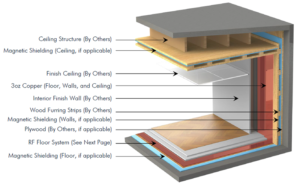
There are a few families of shielding construction, each with its own unique cost and durability characteristics. If put together with care, bolt-together rooms are tried and true technology that can give you 100 dB or more of attenuation at most frequencies. Welded rooms are *very* long-lasting, giving you the most attenuation but can also be expensive. Foil rooms are lightweight but with foil-taped seams that peel over time; however, the tape ages poorly and defects easily — consequently easy to poke holes through as well (the same problems exist for conductive wallpaper/paint).
This is where a lot of budget mistakes happen. Foil, wallpaper, or paint look inexpensive on the material line, but labor costs are almost the same as for bolt-together rooms, and you still must buy a standard shielded door, shielded vents, and accessories. The cheap material saves little on the installed cost and creates leak paths that are costly to trace and repair later. A fully shielded construction stops radiated electromagnetic waves from entering and stops signals generated inside from going out, and that two-way requirement does not care how inexpensive the wall covering was.
Full metal construction uses copper, steel, nickel, or brass with welded seams, corners, and joints, and doors use spring-loaded beryllium copper finger gaskets with special latching. Those details are where the attenuation actually lives. When you set a shielding effectiveness target, add at least 20 dB of margin for error, because real installations lose performance at seams, penetrations, and door gaskets as they age and as they are used.
What Do Doors, Penetrations, Filters, and Testing Add?
Doors and penetrations are the quiet budget killers. An RF door is a precision assembly with gaskets and latching, priced per unit, and a room needs at least one. Every cable that crosses the shield needs a waveguide or an EMI filter, and power lines need filtering so interference cannot ride in on the conductors. A penetration panel consolidates those entries, but it does not make them free, and each additional penetration adds cost and a potential leak point.
Testing is a smaller line item with outsized consequences. An IEEE 299 shielding survey verifies that the installed room meets its attenuation target, and TEMPEST testing and accreditation support may follow depending on the program. If the room fails, remediation means finding leaks at seams, gaskets, and filters, which is slow and expensive work. Budgeting for a first-pass test and a contingency for remediation is far cheaper than discovering the problem during accreditation.
What Does an MRI or X-Ray Room Budget Look Like by Comparison?
Medical shielding projects follow similar logic but with different physics. MRI room construction in the United States typically ranges from $500,000 to $2,000,000+ depending on field strength. Field strength and magnet type are among the largest drivers: a 3T or ultra-high-field magnet demands a more rigorous RF enclosure than 1.5T and is more likely to need passive magnetic shielding, which is often the single most expensive element. RF shielding blocks radio-frequency interference and is required on every project, while magnetic shielding contains the static fringe field and is only needed when that field would extend beyond controlled areas, typically using large quantities of carbon steel.
X-ray room radiation shielding is a much smaller line item by comparison. A standard diagnostic room typically ranges from $10,000 to $30,000+ for shielding, and older published figures for brachytherapy room shielding came in around $6,000 per room for one shielded wall and a shielded door using 4-6 inch concrete walls and 1/4 inch lead doors. Plan review fees are trivial in context, with one state environmental agency listing a shielding plan review fee of $62.50.
The X-ray budget shares are instructive because they show where the money actually goes. Shielding materials run 30-45 percent, doors and frames 8-15 percent, installation labor 15-25 percent, freight and logistics 10-25 percent, design and compliance 5-10 percent, permits, inspection, and commissioning 3-8 percent, and contingency 10-15 percent. Freight can rival material costs because lead is dense and a single pallet can weigh thousands of pounds, which is a logistics problem before it is a construction problem.
| Budget line | Share of project cost |
|---|---|
| Shielding materials | 30-45% |
| Doors and frames | 8-15% |
| Installation labor | 15-25% |
| Freight and logistics | 10-25% |
| Design and compliance | 5-10% |
| Permits, inspection, commissioning | 3-8% |
| Contingency | 10-15% |
How Should You Budget and Get an Accurate Quote?
Start by keeping the design simple. A shielded room needs a door, two vents, electrical power, and lighting per local building codes, and every added feature is another penetration to seal and test. Make the room freestanding to avoid accidental grounds, give it a separate ground using an isolation transformer, and avoid tying it to the building ground. The best ground is a rod driven through the floor into the soil down to the water table, because a long ground cable acts like an inductor at higher frequencies.
When you request quotes, specify the attenuation target in dB and the frequency range, name the construction method you will accept, and state whether TEMPEST requirements apply. Ask each bidder to break out doors, penetrations, filters, freight, testing, and commissioning as separate lines so you can compare scope rather than totals. Cite the relevant standards in the request, including MIL-STD-285, NSA 65-6, NSA 94-106, and NSA 73-2A, and ask how the contractor will verify compliance.
Finally, hold a contingency. Shielding projects routinely surface site conditions, gasket issues, or test failures that were not visible at bid time, and the remediation cost lands on the owner. A 10-15 percent contingency is normal for this category, and it is not padding; it is the price of a room that actually meets its attenuation target on the day it is commissioned.
Frequently Asked Questions
How much does it cost to build a shielded room for privacy?
Quotes for a purpose-built shielded room commonly start around $200,000 and climb from there, depending on size, location, and specification. RF-shielded SCIF space is often estimated at roughly $350 to over $1,000 per square foot, while a compact magnetically shielded room has been priced at roughly $150,000.
What drives the cost of an RF-shielded room the most?
The largest variable is whether RF shielding is required at all. Once in scope, the construction method matters most: architectural foil or copper systems cost less, while welded or modular steel delivers higher, more durable attenuation at a higher price. Size, RF doors, penetrations, filters, and testing also move the budget.
Is a shielded room cheaper than a Faraday tent?
A fixed shielded room is a construction project priced from around $200,000, while a walk-in Faraday tent is bought as portable equipment for a fraction of that outlay. Both can reach 80+ dB of attenuation from low MHz through 40 GHz, so the trade-off is permanence and structural work versus mobility and lower cost.
Why can't I just use foil or conductive paint to save money?
Foil, wallpaper, and conductive paint look inexpensive, but their labor costs are almost the same as bolt-together rooms, and you still must buy a standard shielded door, shielded vents, and accessories. Foil seams also peel over time and are easy to puncture, creating leaks that are costly to trace and repair.
How should I budget and get an accurate shielded room quote?
Specify the attenuation target in dB and frequency range, name the construction method you will accept, and state whether TEMPEST requirements apply. Ask bidders to break out doors, penetrations, filters, freight, testing, and commissioning as separate lines, cite relevant standards, and hold a 10-15 percent contingency for remediation.