DRFM radar jamming captures an enemy radar pulse, stores it digitally, and retransmits a manipulated copy that the radar trusts as a real echo. Here is how digital radio frequency memory deception works, what gets tested, and where the counter-DRFM gap still sits.
What Is DRFM and Why Does It Matter in Electronic Warfare?
DRFM, or digital radio frequency memory, is the jamming architecture that revolutionized electronic warfare. Rather than simply pressing play on raw noise at a threat radar, the DRFM receiver digitizes an incoming RF pulse and stores it in memory to be later transmitted—slightly delayed or phase-shifted, perhaps up- or down-converted—back to any of its inputs as something that appears just like a real echo. // // read more: One Of The ‘Holy Grails’ In Military Electronics Is To Effectively Eavesdrop On Enemy Radar Signals In its February 2026 review of DRFM, The Journal of Electronic Defense described it as the most capable jamming technology yet used against contemporary radar systems (247), and that characterization matches what I find in open source literature: it is de facto the deception engine for modern jammer suites.
The importance is in coherence. The real echo from the threat radar seeds a coherent copy, &nbpso the false return has similar waveform characteristics to that of true echos. Since the victim radar uses its full processing gain on such jamming, a jammer does not need to have an overpowering brute-force-energy solution over the target radar. All it has to do is look correct. It is that one property which makes DRFM the centrol feature in self-protection jamming, escort jamming and radar environment simulation as well.
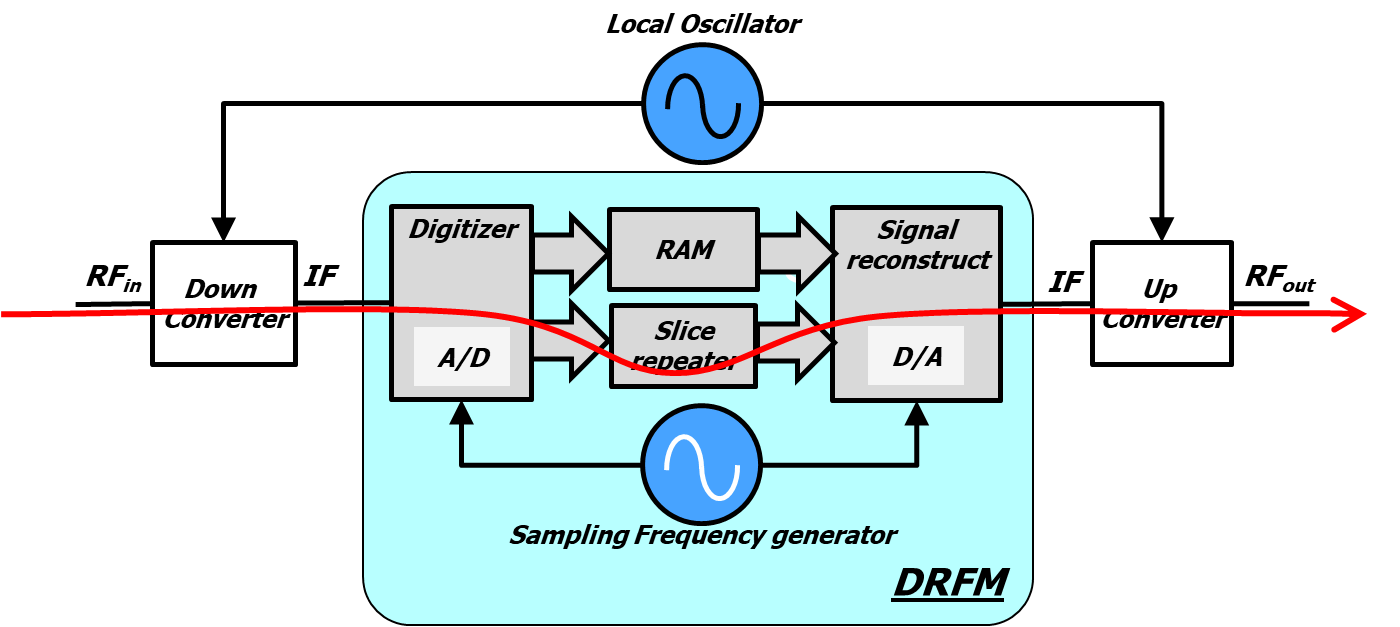
A DRFM from an architectural viewpoint is the heart of a super-heterodyne selective receiver, which is nothing more than one type of basic response channel design to process signals in jammer systems; where only narrow band signal periods are dealt with at once. It converts the incoming RF input to digital at whatever frequency and bandwidth is required for accurate representation, then reconstructs that RF signal whenever you request it. According to Microwave Journal (December 2025), Digital Radio Frequency Memory systems digitize incoming RF signals, store them and retransmit with exacting control of delay, phase and frequency. It is this precision, and not raw power, that is everything.
How Does a DRFM Jammer Capture and Retransmit Radar Signals?
Because that capture-and-retransmit cycle happens in microseconds, the hardware is as important (or more) than a technique. The DRFM front end downconverts an intercepted radar pulse into a digital signal, it is then sampled via analog-to-digital converters and placed in high-speed memory. And based on that, it figures out what to do with the waveform just sought from storage: delay it; shift its Doppler frequency term; modulate signal or repetition number. The altered samples then pass through a digital-to-analog converter and upconversion chain before being sent toward the threat radar.
For instance, Mercury Systems manufactures DRFM-based modular subsystems in this style and its published descriptions suggests that three common building blocks recur: broadband RF hardware; high-speed digitization modules; and low-latency FPGA processing boards. Mercury also lists broad instant bandwidth 5G-compatible broadband, which is particularly relevant since many of the radars for new threat applications are wideband themselves. If the radar's instantaneous bandwidth is such that a coherent replica cannot be covered by the jammer, it degenerates into something which can be filtered out anyway.
On the processing side a useful reference point is given by a DRFM-Modulator design cited in NATO STO, which discusses high-performance transformations of more than 131072 data points at 400 MHz. Those numbers are not marketing window dressing. They determined the amount of waveform history that the jammer could hold and manipulate before it had to make a decision, they directly constrained how convincing deception can be against agile (frequency hopping) radars.
The stored signal is also easily malleable, something that analog memories have never been. Accordingly, it can generate a noise modulation—referred toas coherent spot noiseto generate colored (white) noise synchronizedwith the radar’s instantaneous frequency bandwidth or Dopplerbandwidth. It does this while keeping within the radar's own processing chain, as opposed to forcing an external fight that can reduce Doppler target measure and track.
Which Jamming Techniques Does DRFM Enable?
DRFM is a platform rather than an individual trick and there are many methods in the books. Generate false targets the create phantom aircraft or decoys on radar scope. Both range gate pull-off and ranger give in drag the radar's cap course following entryway far away, from reality target. The velocity gate pull-off and pull-in perform the same operation on the Doppler gate. In coherent spoofing, the fake return is indistinguishable from the real echo and for Doppler measurement — a complete masking of traces with noise in frequency channels (coherent spot noise). Several of these rely on repeater jamming where the jammer just replays an intercepted pulse with some modifications.
The operators care in terms of practical effects. A deliberate range gate pull off will defeat both by walking the seeker's range gate away from the target to break a missile lock. Generating false targets can fill every inch of a surface-to-air missile operator's display with dozens to hundreds of returns, requiring human interpretation in seconds. There is no stable track established by the radar, this means velocity gate pull-off can be used to mask a seekers speed gate.
Here's a quick rundown of the main techniques DRFM makes possible and what each one is actually going after.
| Technique | What It Alters | Primary Effect |
|---|---|---|
| False target generation | Number of returns | Saturates operator displays and trackers |
| Range gate pull-off (RGPO) | Delay vs. true echo | Walks range gate off the target |
| Range gate pull-in | Delay vs. true echo | Pulls range gate onto the jammer |
| Velocity gate pull-off | Doppler shift | Breaks velocity tracking and missile lock |
| Velocity gate pull-in | Doppler shift | Captures the seeker speed gate |
| Coherent spoofing | Full waveform fidelity | Makes the false return indistinguishable |
| Coherent spot noise | Doppler bandwidth | Degrades Doppler measurement and tracking |
Coherent replicas shift the range by sending pulses that have a different time delay compared to the actual echo, and they would be able to change apparent velocity as well if they transmit signals with an altered Doppler shift. As both manipulations ride on top of a perfect copy of the original waveform, there is no direct amplitude or phase cue for rejection by radar. This is what distinguishes deception jamming from noise jamming, and it is why serious jammer programs have moved to DRFM based approaches rather than earlier analog RF memory techniques.
What Are the Key Performance Parameters of a DRFM System?
DRFM performance is judged on fidelity and timing, not just output power. Amplitude fidelity, phase coherence, time delay accuracy, spectral integrity, group delay, modulation quality measured through error vector magnitude and I/Q imbalance, and spur and intermodulation characterization are the recurring test parameters. Each one maps to a way the victim radar might notice that the return is not real. A phase error or an unwanted spur is a fingerprint, and modern radars are increasingly built to look for fingerprints.
Spectral purity deserves special attention because it cuts both ways. Eliminating spurious spectral components reduces the DRFM's own signature, which makes the deception harder to flag, and it also optimizes the power that actually lands inside the radar's receive band. Jamming energy that falls outside the band is wasted, and worse, it can be a detectable emission.
The table below lists the parameters that matter most when comparing DRFM subsystems.
| Parameter | Why It Matters |
|---|---|
| Amplitude fidelity | Preserves echo-like return strength |
| Phase coherence | Keeps the replica inside radar processing gain |
| Time delay accuracy | Determines range deception precision |
| Spectral integrity | Prevents spurs that reveal the jammer |
| Group delay | Affects wideband waveform distortion |
| Modulation quality (EVM, I/Q imbalance) | Bounds how clean the fake waveform looks |
| Spurs and intermodulation | Drives detectable out-of-band emissions |
Rohde & Schwarz publishes an analysis bandwidth of up to 8 GHz in single-channel mode and 4 GHz per channel in dual-channel mode on its FSWX signal and spectrum analyzer, which is the class of instrument needed to characterize these parameters on modern DRFM hardware. When I look at DRFM specifications, I read them as a chain: the weakest fidelity or timing stage sets the ceiling on the whole deception.
How Are Next-Generation DRFM Jammers Tested?
Testing a DRFM requires instruments that match or exceed modern radar signal dynamics, with synchronized phase-coherent measurement so input and output can be analyzed at the same time. You cannot characterize a coherent repeater by looking at its output alone, because the whole question is how faithfully the output relates to the input. That is why phase-coherent, dual-channel capture is the baseline setup rather than a nice-to-have.
Pulse analysis software does much of the heavy lifting. Rohde & Schwarz KM700 pulse analysis software turns signal and spectrum analyzers into pulsed signal analyzers for evaluating deceptive techniques that rely on pulse manipulation, and the VSE-K6 option covers pulse measurement in the same family. In practice, these tools let an engineer see whether a range gate pull-off ramp is smooth, whether Doppler shifts are applied cleanly, and whether any unintended artifacts appear between pulses.
A published DRFM testing workflow typically covers several parameter families. The table below is a practical checklist I would expect to see in a lab.
| Test Area | What Is Measured |
|---|---|
| Amplitude fidelity | Return strength consistency across pulses |
| Phase coherence | Phase relationship between input and output |
| Time delay | Range deception accuracy and linearity |
| Spectral integrity | Spur and out-of-band content |
| Group delay | Wideband waveform distortion |
| Modulation quality | EVM and I/Q imbalance |
| Spur and intermodulation | Detectable emission fingerprinting |
Radar environment simulators and EW training pods extend this work beyond the lab bench. Mercury Systems, for example, pairs modular DRFM-based subsystems with radar environment simulators and EW training pods, which lets crews rehearse against realistic deception rather than scripted noise. Testing is where the theory meets the threat library, and it is also where counter-DRFM detection techniques get validated against real hardware.
What Counter-DRFM Gaps and Detection Methods Exist?
DRFM jamming is difficult to eliminate once it enters a radar system through the main lobe, because the radar is receiving a signal that looks like its own. That is the core counter-DRFM problem, and JED's February 2026 piece on the counter-DRFM gap names it directly. As radars become more agile with frequency hopping, pulse compression, and complex modulation schemes, the demands on DRFM fidelity and timing precision rise sharply, but so do the demands on any countermeasure trying to separate real from fake.
Detection research is making progress. A 2025 MDPI study reported a correct detection rate of 92% at a jamming-to-signal ratio and SNR of 0 dB, which is a meaningful result because 0 dB is a hard regime where the jamming is not obviously louder than the signal. Reconstruction and cancellation of DRFM-based repeater jamming generally follows two steps: estimate the jamming parameters, then cancel the jamming. Get the first step wrong and the second step removes real target energy along with the deception.
Other detection paths do not rely on signal processing subtlety at all. A quantum radar system would automatically detect attempts at deceptive jamming, which might otherwise go unnoticed. Anti-radiation missiles, also called Home-On-Jam missiles, can home in when a target uses self-protective jamming, because transmitting jamming effectively broadcasts your position. That trade-off is why jamming doctrine is as much about when to radiate as it is about what waveform to transmit.
For radar engineers, the practical takeaway is that counter-DRFM is a layered problem. Signal-processing detection, waveform agility, multi-static geometry, and passive geolocation all contribute, and none of them alone closes the gap. The 2026 JED reporting suggests the gap is still open, and the open literature on jamming signal recognition and full-duplex oversampling points in the same direction.
DRFM vs. Analog RF Memory: What Changed?
DRFM is established as the alternative to earlier analog RF memories, and the differences are not cosmetic. Digital techniques improve the quality of the transmitted signal and the amount of jamming energy that the victim radar actually captures, because the replica can be generated with far tighter control. They also enrich the available modulation techniques, since arbitrary waveforms can be synthesized in the digital domain rather than approximated with analog delay lines.
Off-line processing is another advantage that analog systems could not match. A digital capture can be stored and analyzed later for electronic intelligence purposes, which turns a single intercept into a reusable threat library entry. Multi-threat performance also improves because the system can alternate reception and transmission across different radars, handling more than one emitter in a dense signal environment.
One comparison is worth stating plainly: using the received and stored signal as the RF carrier for coherent noise, instead of a locally synthesized RF carrier for non-coherent noise, increases jamming noise performance and matches the radar's bandwidth. For coherent radars, that bandwidth match is not optional. It is the difference between noise that enters the radar's processing chain and noise that the radar simply filters away.
The Bottom Line on DRFM Deception
DRFM radar jamming works because it stops fighting the radar's processing gain and starts exploiting it. By capturing a real pulse, storing it digitally, and retransmitting a coherent replica with controlled delay, phase, and frequency, a DRFM jammer makes the radar do the work of trusting a false return. Range gate pull-off, velocity gate pull-off, false target generation, and coherent spot noise are all applications of that same core capability.
The technology keeps improving on both sides. Radars are adding agility, pulse compression, and complex modulation, while DRFMs are adding bandwidth, fidelity, and faster processing. Testing has become a discipline of its own, with phase-coherent measurement, pulse analysis software, and radar environment simulators used to validate deception before it ever meets a real threat. The counter-DRFM gap remains an active research area, and the 2026 reporting suggests it will stay that way for some time.
Frequently Asked Questions
How does DRFM jamming work?
A DRFM captures an incoming radar pulse, stores it digitally, manipulates it with precise alterations to range, velocity, or angle, and retransmits it back to the radar as a coherent false return. Because the replica matches the original signal, the radar processes it with the same processing gain, which makes the deception far more energy-efficient than brute-force noise jamming.
What techniques can a DRFM jammer use?
DRFMs support false target generation, range gate pull-off and pull-in, velocity gate pull-off and pull-in, coherent spoofing, and coherent spot noise. These techniques can break missile lock, saturate a surface-to-air missile operator's scope with dozens of false targets, or mask a seeker's speed gate so the radar never establishes a stable track.
How are DRFM jammers detected?
A quantum radar system would automatically detect attempts at deceptive jamming, which might otherwise go unnoticed. Anti-radiation missiles, also known as Home-On-Jam missiles, can also home in when a target uses self-protective jamming, because transmitting jamming effectively broadcasts its position. Signal-processing approaches estimate jamming parameters first and then cancel the repeater jamming.
What parameters are tested in a DRFM jammer?
Key testing parameters include amplitude fidelity, phase coherence, time delay, spectral integrity, group delay, modulation quality via EVM and I/Q imbalance, and spur and intermodulation characterization. These measurements reveal whether the deception carries a detectable fingerprint that the target radar could use to reject the false return.