Deception jamming and false target generation let a jammer forge believable radar echoes instead of drowning the receiver in noise. Here is how DRFM-based false target generators work, what they cost in power and memory, and how modern radars fight back.
What Is Deception Jamming and False Target Generation?
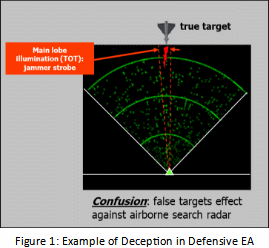
Radar electronic countermeasures (ECM) encompasses a category known as deception jamming, which provides bogus information to victim radar rather than just raw noise. That kind of false information turned into one or several phantom echoes is called False Target Generation, while the hardware that provides it for target generation purposes is a False Target Generator (FTG). Aimed at not over-cluttering the receiver, but instead misleading it — giving the radar energy (above its detection threshold) where there is none in reality, and leading its search / acqusition / tracking logic further astray.
But the true aspect that distinguishes normal spoofing from outright false target generation is geometry: where your fake return resides relative to the image it came from. Eventually, when the echoed signal sent back by a plane lands too far away from its actual target to appear as a blended imprint of an original echo anymore but rather like separate-looking track — one that could readily be confused for another aircraft by an operator. This is why the phrase is repeated near range gate pull-off (RGPO) and velocity gated pull-off (VGPO). Those are a slightly more classic techniques that will nudge the tracking gate slowly away from what is actually falling within it in either range or velocity, ultimately trapping the radar on this phantom and allowing said real target to slip completely out of your gated region. Effectively, the jammer doesn’t merely smudge out the image — it overwrites it to provide radar with an entirely different target against which to orient itself while its actual quarry vanishes into thin air.
How Does Deception Jamming Create False Targets?
A deception jammer won’t just ripple noise at a radar, it will listen first It captures the incoming radar signal and retransmits that pulse after applying a time delay, leveraging phase modulation to simulate so-called false Doppler shifts. That time delay moves the fake echo out to a distance where there is nothing for radar to see. As for the phase progression, it mimics motion and misguides radar into reading a velocity where there is none. Combining those two manipulations, a single pulse can generate false echoes in both range and velocity simultaneously. But the trick is cooperation: because the retransmitted copy so closely resembles an original waveform, it gets processed by a radar's matched filter in much the same way as if it were a genuine return. And that is exactly why this tactic works so well and it's also what makes the filtering out almost impossible.
Power is the part that seems counterintuitive here. You would think a jammer must scream over the real echo to mislead a radar, but that's not how deception jamming works. The power level of the false signal is not required to exceed that of a TOI echo but it must simply be greater than the radar detection threshold. What that single difference does is still a relatively low power transmitter makes it able to feature an believable target as long as the timing, frequency, pulse width and pulse repetition frequency matches the victim radar. And the jammer actually has to synchronize in frequency, pulse width and PRF with both of them to produce moving false targets at this point. Neglect all of those parameters and the illusion shatters, which is precisely why replication fidelity — not raw power — is the currency for deception jamming.
How Do DRFM Jammers Generate False Range and Doppler Targets?
DRFM (Digital Radio Frequency Memory) jammer receivers rapidly gather radar emissions, regenerate them with uncanny purity and modulate them for retransmission. Additionally, it also analyses how the radar's pulse repetition interval (PRI) changes over time and anticipates when to send its next pulse. This predictive ability is what means that the jammer can place fake targets at much farther or closer distances than where the actual target is, since when you retransmit a pulse, when it arrives determines how far away in range an echo will appear. Coherent repeat jamming based on this principle is a powerful artifice at generating false targets against LFM radars, where waveform agility would otherwise defeat simpler repeaters that completely lack the DRFM's memory and fidelity of signal reconstruction.
Within the signal-data processing deception techniques described in literature, 2 approaches are most commonly investigated by name. The first one is the False Range Target (FRT) which a jammer creates at an offset range from your true target — either more proximal or distal. The purpose is simple: generate false targets whose power at the signal processing output equals or exceeds that of a skin echo from real target, and preferably does so by enough margin to ensure radar thinks it appears as genuine returns. The second one is False Doppler Target, or FDT for short, and that travels a different path. Rather than migrating range, it produces one or more image phantoms each having a Doppler frequency that differs from the true target utilizing a coherent repeater producing signals with separation in frequency. The spacing can be given by pulsed FM or AM, normal, random modulation lines across the band of Doppler line width ({\textendash}1 kHz) or even a single {\emph{reiterated}} line crossed to multi vector through this extent.
Signal-Data Processing Deception Techniques: FRT, FDT, OOK, and Signal Enhancement
However, beyond the two ones that are more headline-grabbing methods for signal-data processing deception also fall under this umbrella: namely on-off keying (OOK) at a designated / specified data-processing rate and corresponding techniques of augmentations.
Shaped OOK can generate Data Rate Reduction(DRR) at the rate of an on-off keying waveform corresponding to either the AGC time constant or refresh time for acquisition logic, in which case we are modulating a square wave (or triangle). Signal enhancement reverses that logic: a repeater intercepts, amplifies and retransmit the target radar signal in an unmodified fashion to create some large replica echo than skin return of platform it defends. In reality, it is often used together with other techniques like cross-polarization or utilized to enhance the efficiency of countermeasures.The four previous signal-data processing deception techniques described in this section — FRT, and OOK at processing rate Signal Enhancement — are pulled together into the table below along with data on how they work as well as their intended effect on the victim radar. Remember this should be read as a two-pane screenshot and not an article: the FRT and FDT rows, for example, both rest on top of the same DRFM repeater but diverge in terms of what they stretch or compress (range) or shift Doppler freq. The line of the OOK row is different in nature: it actually focuses on not elucidating a real change picture but rather saturating acquisition logic [4; 5] and, vice versa with Signal Enhancement. Having them together makes the trade-offs easier to consider.
| Technique | Mechanism | Intended Effect |
|---|---|---|
| False Range Target (FRT) | DRFM generates false targets at distances greater or less than the true target | False targets with power at least equal to, and preferably greater than, the skin echo of the true target at the signal processing output |
| False Doppler Target (FDT) | Coherent repeater produces signals spaced in frequency; multiple frequencies via pulsed FM or AM; modulation lines regular or random, or a single line emphasized and moved in frequency across the Doppler band | One or more false targets whose Doppler frequency differs from that of the true target |
| OOK at processing rate | On-off keying waveform applied at a rate correlated to the AGC time constant or the refresh time of acquisition logics; envelope modulated with a square or triangular wave | Data Rate Reduction (DRR) |
| Signal Enhancement | Repeater receives, amplifies, and transmits the victim radar signal without modulation | False echo larger than the skin echo of the platform to be protected; used with other techniques (e.g., cross pol) or to boost decoy effectiveness |
| Technique | Mechanism | Primary effect |
|---|---|---|
| False Range Target (FRT) | DRFM delay places echo at a different range | Phantom tracks ahead of or behind the real target |
| False Doppler Target (FDT) | Coherent repeater with frequency-spaced signals | False velocities in the Doppler band |
| OOK at processing rate | On-off keying correlated to AGC or acquisition refresh | Data rate reduction in tracking logic |
| Signal enhancement | Unmodulated receive-amplify-transmit repeater | Echo larger than the protected platform's skin return |
These techniques are seldom used in individual scenes. Here, the jammer stands in for the target of interest and engages with deception strategies to not be discovered as a jamming platform stays out of an engagement envelope. One typical application is breaking radar lock-on to protect an aircraft against missile-guided weapons, where a difference of seconds between break and maintain can be life or death.
Why Are Deception Jammers More Power-Efficient Than Noise Jammers?
Deception jammers do not transmit during the entire duty cycle of the radar signal, which improves power efficiency and reduces system weight. That duty-cycle discipline is the core engineering advantage: instead of radiating continuously to raise the noise floor, the jammer listens, copies, and transmits only when it has something useful to send. The contrast with noise jamming is stark. A noise jammer must flood the receiver with energy across the band for as long as it operates, which demands heavy power supplies, cooling, and large antennas — a burden that grows quickly on fighter-sized platforms. A deception jammer, by contrast, spends most of its time silent, so its average transmitted power stays low even when its peak pulses are strong. That same sparse transmission schedule also buys survivability. Because the jammer emits in short, intermittent bursts rather than a steady wash of energy, adversarial electronic support measures have far fewer opportunities to spot and classify it — a low-duty-cycle emitter is much harder to detect than a continuously radiating one. The trade-off is that this efficiency comes at a price: the jammer needs high memory capacity and sensitive receivers to capture, replicate, and return the radar's waveform with enough fidelity to fool the victim radar.
The trade-off is memory and sensitivity. Accurately tracking and replicating radar echoes requires high memory capacity and high receiver sensitivity, plus enough processing throughput to keep up with agile waveforms. The table below sets the two jammer families side by side.
| Attribute | Deception jammer | Noise jammer |
|---|---|---|
| Transmit duty cycle | Partial, synchronized to radar signal | Continuous or near-continuous |
| Power efficiency | High | Lower |
| System weight | Reduced | Higher |
| Concealment | Greater, harder to detect | Easily detected |
| Key requirement | High memory capacity and sensitivity | High output power |
Dense false target jamming sits at the aggressive end of this spectrum. It has highly deceptive and suppressive characteristics and seriously impacts radar systems, because the sheer number of false returns — including forwarding dense false targets — can saturate tracking and data association. The same low-power logic still applies: as long as each false target crosses the detection threshold, the jammer never has to out-shine the real echo.
Anti-Deception Jamming: Prevention, Detection, and Mitigation Strategies
Anti-deception jamming, often grouped under electronic counter-countermeasures (ECCM), is usually divided into three layers. Prevention means changing the radar's own signal so the jammer cannot predict it, most commonly through pulse diversity that modifies radar signal parameters such as pulse width, PRF, and carrier frequency from pulse to pulse. Detection means alerting the operator and classifying the type of attack, which requires distinguishing jammer artifacts from genuine scattering behavior. Mitigation means reducing or suppressing the jamming impact once it is identified, for example through waveform design methods aimed specifically at dense false target jamming suppression.
The practical difficulty is that each layer depends on the one before it. A radar that cannot detect that it is being deceived will never apply the right mitigation waveform, and a radar with no waveform diversity gives the jammer an easy prediction problem. This is why modern ECCM design treats prevention, detection, and mitigation as a single pipeline rather than three independent features.
Real vs False Target Recognition Under Low SNR
One promising recognition approach works in the range-Doppler domain. Real and false targets are truncated along the range dimension, an FFT extracts features, and a two-channel feature fusion network classifies them as real or false. A Multi-Coherent Processing Interval Joint Decision Method (M-CPIJDM) based on temporal information then improves performance by combining decisions across intervals, which matters most when the signal-to-noise ratio is low and single-interval features are ambiguous.
These methods analyze differences in scattering characteristics and model real target echoes as a synthesis of multi-scattering center echoes, a physical prior that false targets generally cannot reproduce. Experiments using measured data show the method can recognize real and false target signals under four jamming backgrounds: distance false target, velocity false target, distance-velocity composite false target, and forwarding dense false target. That four-way test set is a useful benchmark, because composite and dense jamming are precisely the cases where simple threshold or single-feature detectors tend to fail.
What Do the Numbers and Sources Say?
The technical claims in this article trace back to a compact body of peer-reviewed and preprint work. Authors publishing on deception jamming and false target generation include MA Ali (2022), WEI Wenbin (2024), H Calatrava (2025), Y Wang (2023), YX Liu (2023), Q Sun (2018), L Xu (2025), and L Du (2024). Their work appears through institutions and venues such as Harbin Engineering University, Navy Aeronautical University in Yantai, Northeastern University in Boston, the Chinese Journal of Aeronautics, IEEE, SPIE, MDPI, Wiley, and arXiv.
Reading across that literature, the recurring engineering constraints are consistent: false targets can be generated at distances much greater or less than the true target; jamming signal power can sit below the target echo power but must exceed the radar detection threshold; and DRFM systems must combine speed, fidelity, and modulation flexibility to stay useful against modern waveforms. For anyone evaluating radar or countermeasure designs, those three constraints are the practical checklist — everything else is implementation detail.
Quick Reference: Key Terms
Terminology in this field is dense, and the same concept often appears under several names. Deception jamming, false target generation, false target generator (FTG), DRFM (Digital Radio Frequency Memory), repeater jammer, electronic countermeasures (ECM), electronic counter-countermeasures (ECCM), false range target (FRT), false Doppler target (FDT), range gate pull-off (RGPO), velocity gate pull-off (VGPO), dense false target jamming, forwarding dense false target, distance false target, velocity false target, and distance-velocity composite false target all describe overlapping parts of the same problem space.
Keeping the vocabulary straight matters because the countermeasure changes with the target type. A radar defending against RGPO needs different logic than one facing dense false target jamming, and a jammer designed for range deception may be poorly suited to velocity deception. The composite and forwarding cases are the hardest, because they combine multiple deception dimensions in a single engagement.
Frequently Asked Questions
How does deception jamming generate false targets?
A jammer intercepts the radar signal, then retransmits it with added time delay and phase modulation to simulate false Doppler shifts. The delay moves the echo in range and the phase progression mimics motion, creating false echoes in both range and velocity. The result is single or multiple false targets that appear correlated with the real target.
What is a DRFM-based false target generator?
A DRFM jammer rapidly collects radar transmission signals, restores them with high fidelity, and modulates them for retransmission. It can generate false targets at distances greater or less than the true target by analyzing the radar PRI trend and predicting when the next pulse will be transmitted, which keeps the false echoes synchronized with the victim radar.
Why are deception jammers more power-efficient than noise jammers?
Deception jammers do not transmit during the entire duty cycle of the radar signal, which improves power efficiency and reduces system weight. Their greater concealment also decreases the likelihood of detection by adversarial systems. The cost is that they require high memory capacity and receiver sensitivity to track and replicate radar echoes accurately.
How can radars discriminate real targets from false target jamming?
Methods analyze differences in scattering characteristics and model real target echoes as a synthesis of multi-scattering center echoes. Features from the multi-pulse joint frequency response are extracted, and a two-channel feature fusion network with a Multi-Coherent Processing Interval Joint Decision Method improves recognition under low SNR, including distance, velocity, composite, and forwarding dense false target backgrounds.