GPS jammers flood the L1 frequency at 1575.42 MHz with cheap radio noise, and a 1-watt device can wipe out satellite tracking within a short radius. Here is how jamming actually works, how fleets detect it, and what the law says about using one.
What Is a GPS Jammer and How Does It Work?
At its core, a GPS jammer is just a small radio transmitter that drowns the GPS band in noise, so the receiver can't pick out the satellites overhead. Civilian GPS mostly lives on the L1 frequency at 1575.42 MHz, and by the time that signal reaches the ground it's sitting at around -125 dBm — absurdly faint. GPS does have spread spectrum processing gain on its side, which means a jammer usually needs to hit roughly +50 dBm above the incoming signal to actually do damage. Still, a 1-watt transmitter on the ground can clear that bar without much trouble in its immediate area.
The mechanics are actually pretty straightforward once you look at the numbers. GPS satellites sit at roughly 12,550 miles above the Earth, and each one transmits at only about 20 to 50 watts—not much more than a strong light bulb, and that little bit of power gets spread across an entire hemisphere. By the time the signal reaches your vehicle, it's incredibly faint, buried under background noise and far weaker than what a receiver would normally need. That's why a GPS tracker has to pull signals from four or more satellites at once, using timing calculations and trilateration to figure out a position. Cut off that trickle of signal, and the receiver either goes silent or starts to drift. This is where a jammer comes in. Because the satellite signal is so weak at ground level, it doesn't take much to overwhelm it. A small, low-power jammer broadcasting noise on the same frequency can easily drown out the satellites within its immediate range. Portable jammers typically create interference in a radius of roughly 5 to 30 feet, according to Geotab, while Azuga describes outages across a 5 to 10 meter radius—enough to knock a single vehicle's tracker offline, even if the disruption stays local.
| Source | Reported Jamming Radius |
|---|---|
| Geotab | Roughly 5 to 30 feet |
| Azuga | 5 to 10 meters |
GPS Jamming vs. GPS Spoofing: What Is the Difference?
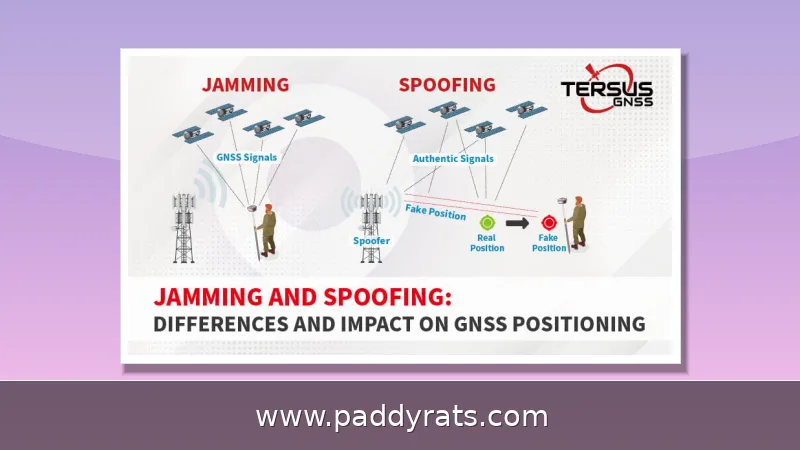
People tend to use "jamming" and "spoofing" interchangeably, but they're actually two distinct attacks, and each one requires a different response. Jamming is about brute force: the device floods the GPS frequency with noise, overpowering the satellite signal until the receiver can't get a fix at all. Spoofing, on the other hand, is deception. It mimics real satellite transmissions and feeds the receiver fake location and time data, so the device keeps reporting as if everything's fine — just with the wrong coordinates. That distinction really matters out in the field. A jammed tracker typically goes dark and stops sending data, which is fairly easy to catch once you know the warning signs. A spoofed tracker is sneakier — it keeps lying quietly, sending data that looks completely normal, which could have a fleet manager chasing a vehicle that was never actually there.
That difference matters if you're trying to build a defense. Advanced jammers don't just sit on one frequency — they hop around, or hit several GNSS constellations at once, like GPS, GLONASS, and Galileo. Some even jam cellular networks at the same time. Spoofers are trickier to catch, since their output looks completely normal on the receiving end. That's why anti-jamming and anti-spoofing systems exist: to tell real satellite signals apart from noise and fakes. On top of that, spectrum monitoring can pick up and locate jammers through mobile direction finding, and by analyzing frequency spectra, it can figure out how long the interference lasts and what kind of signal it is.
Who Uses GPS Jammers and Why?
GPS jamming wasn't originally a consumer problem—it started as government and military tech, and military-grade units are still in a league of their own: highly advanced, tightly controlled, and basically impossible for regular people to buy. But the civilian market that grew up underneath it tells a very different story. Once the components got cheap and easy to source, jammers became an off-the-shelf tool for anyone with something to hide. The most common users are drivers trying to dodge tracking: speeders avoiding police detection, criminals covering up vehicle thefts, trucking fleet drivers hiding their location from employers, and taxi and heavy goods vehicle drivers evading maximum driving hours rules. The motive is usually pretty simple—avoid a ticket, a disciplinary note, or a criminal charge—but the tool itself creates problems that go way beyond the person using it.
Portable jammers are the smallest and most casual option out there: little plug-in or battery-powered units that only knock out GPS in a tight, localized area. Vehicle jammers step up from there. They're hard-wired or dash-mounted and can take down GPS, cellular, and Wi-Fi all at once, which explains why they turn up so often in cargo theft cases. Stationary jammers run at much higher power from a fixed location, blanketing a wider area, and they tend to be more common outside the United States, where enforcement and hardware controls differ. GPS spoofers round out the list, though they work on a different principle: instead of drowning out the signal, they imitate legitimate satellite transmissions to feed a receiver false location data. The financial motive behind all of this is very real. According to COTS Journal, 85% of cargo thefts in Mexico involve a GPS jammer, and in the U.S., the average loss per cargo theft incident hit $587K in 2023 — enough to make a cheap jammer look like a worthwhile investment to a determined thief.
Are GPS Jammers Legal? Fines and Penalties
Nope — GPS jamming is illegal in the United States, Canada, the United Kingdom, and most other countries. In the U.S., the Communications Act of 1934 bans marketing, selling, or operating jammers, and that law gets enforced. Back in 2013, the FCC hit one driver with a $32,000 fine for using a jammer at Newark Airport, which made it pretty clear that regulators will go after individuals, not just manufacturers. Penalties can reach $100,000 or more, and they can also include prison time and confiscation of your equipment. Canada takes a similar position under its Radiocommunication Act, which comes with its own restrictions. The logic behind these strict rules is easy to follow: jamming doesn't just hide where a vehicle is, it can also take out 9-1-1 calls and disrupt police, fire, and emergency medical services. So if you're thinking about blocking GPS signals, go in knowing the legal risk is real and the consequences are serious.
| Country / Law | Key Restriction | Example Penalty |
|---|---|---|
| United States – Communications Act of 1934 | Bans marketing, selling, or operating jammers | $32K FCC fine (Newark Airport, 2013); up to $100,000+ and imprisonment |
| Canada – Radiocommunication Act | Own restrictions on jamming devices | Enforcement action and equipment seizure |
| United Kingdom | Jamming is illegal | Fines and potential prosecution |
The compliance risk here goes both ways, and that's the part that catches a lot of employers off guard. If a fleet manager looks the other way when drivers start using jammers, or just doesn't bother documenting a jamming event when one happens, the liability that follows can be far bigger than the price of the device itself. In the U.S., jamming penalties can hit $100,000 or more, and they don't stop at fines—imprisonment and seizure of the equipment are on the table too. Then there's the paper trail issue. If a company can't prove it detected, reported, and responded to interference, regulators and insurers may read that silence as negligence. The table below breaks down the exposure at a glance.
| Exposure | What It Looks Like |
|---|---|
| Federal fines | Up to $100,000 or more under U.S. law; a $32K FCC fine was issued to one driver for using a jammer at Newark Airport in 2013 |
| Criminal penalties | Imprisonment and loss of equipment for illegal jamming |
| Employer liability | Tolerating jammers or failing to document a jamming event can shift responsibility onto the fleet manager |
| Operational losses | $587K average loss per cargo theft incident in the U.S. (2023); 85% of cargo thefts in Mexico involve a GPS jammer |
How Do You Detect a GPS Jammer in Your Fleet?
Detection starts with knowing what a jammed device looks like in your data. Signs include sudden signal loss, frozen location data, straight-line trip gaps, and tamper alerts. A jammed tracker often stays online over the cellular network but reports no valid GPS fix while the engine is running, which platforms flag as a jamming event. That combination, connectivity without position, is the signature to watch for.
A solid anti-jamming program doesn’t rely on any single gadget. It starts with clear written policies and consistent monitoring, then layers in proactive prevention. On the technology side, that means choosing advanced GPS tracking devices with built-in jamming detection, turning on alerts for GPS signal errors and for trips that go missing or get interrupted, and using fallbacks like cellular triangulation and last-known-location storage so you still have something to work with when the satellite fix drops out. Real-time tamper alerts matter too, because they tell you something is wrong while it’s happening, not days later. Just as important is how you read the data: track patterns over time rather than reacting to isolated incidents, and pair device-health reports with maintenance logs so a genuine hardware fault doesn’t get misread as an attack. Finally, internal backup batteries that send power-cut alerts close the most obvious gap, since pulling a fuse is one of the oldest tricks in the book.
When the stakes are high enough—think airports, power grids, financial trading floors, or any operation where a GPS outage translates into systemic cost—spectrum monitoring and dedicated counter-jamming systems become the serious option. These aren't consumer gadgets; they're investigative tools built to hunt down interference rather than simply watch it happen. The GP-Probe Nano, for instance, is a portable GNSS and GPS jammer detector that plugs into an Android device over USB-C, giving field technicians a fast way to sweep an area and flag suspicious signals. RFeye receivers from CRFS take things further, letting investigators locate the source of interference in real time instead of piecing together what went wrong after the fact. That distinction matters: knowing a jammer exists is useful, but finding it is what actually stops the disruption.
How to Protect GPS Trackers from Jamming
Physical hardening still works, and it is cheap. Hide the tracker in a secure, non-obvious location, and for recurring problems use hardwired units with covert installation. Materials matter as much as placement: aluminum foil, copper, silver, metal boxes, concrete, wet trees, and thick materials can block or scramble GPS reception, while plastics and fiberglass let signals pass straight through. Wrapping a GPS device in aluminum foil creates a Faraday cage, which is exactly why it shows up in theft cases.
The trick is that the same physics that protects a tracker can be used against it. Drivers defeat trackers with plug-in GPS jammers, foil wrapping, pulling the fuse or cutting power, unplugging OBD trackers, breaking the antenna, and hiding in dead zones. A hardwired install with a hidden backup battery, combined with tamper alerts and cellular fallback, removes most of those options. For personal vehicle use, privacy mode authorization gives employees a legitimate off-switch instead of pushing them toward a jammer.
What Materials Block GPS Signals?
If you need to understand attenuation, think in terms of conductivity and density. Any sufficiently solid or conductive material will weaken GPS reception, and the effect stacks with thickness. The table below is a practical reference for what blocks, what passes, and how each material is typically used.
What Are the Real-World Risks of GPS Jamming?
The safety case against jamming is stronger than the legal one. Jammers can prevent 9-1-1 and emergency calls and interfere with police, fire, and emergency medical services. Air traffic control, search and rescue, the electric grid, and mobile phone services are all vulnerable to interference that a driver never intended to cause. A jammer does not discriminate between the signal you want to block and the signals everyone around you depends on.
History offers hard lessons. In 2007, a navy exercise in San Diego harbor caused ATM and pager failures, and it took three days to identify the ships as the cause. South Korea was subject to a major campaign of GPS jamming from North Korea in 2016, affecting ship and aircraft navigation. The London Stock Exchange has been subject to repeated GPS outages affecting the timestamping of financial transactions. As 5G systems move into frequencies adjacent to GPS, interference risk is likely to grow rather than shrink.
For fleet operators, the practical takeaway is that jamming is a business continuity problem, not just a tracking problem. The table below maps the main threat types to their typical range and who uses them.
Frequently Asked Questions About GPS Jammers
These are the questions readers ask most often about blocking, detecting, and legally handling GPS interference.
How Do GPS Jammers Work?
A GPS jammer is a small RF transmitter that floods the GPS frequency band with radio noise, overpowering weak satellite signals. Civilian GPS uses the L1 frequency at 1575.42 MHz, and a 1-watt jammer can drown it out within a short radius, so the receiver cannot compute a position. Because satellite signals arrive at roughly -125 dBm, even modest noise output is enough to win the fight at close range.
Is It Legal to Block GPS Signals?
No. GPS jamming is illegal in the United States, Canada, the United Kingdom, and most other countries. In the U.S., the Communications Act of 1934 bans marketing, selling, or using jammers, with fines up to $100,000 or more, imprisonment, and equipment loss. Enforcement happens: the FCC issued a $32K fine to a driver who used a jammer at Newark Airport in 2013.
How Can I Tell If My GPS Tracker Is Being Jammed?
Signs include sudden signal loss, frozen location data, straight-line trip gaps, and tamper alerts. A jammed tracker often stays online over the cellular network but reports no valid GPS fix while the engine is running, which platforms flag as a jamming event. If you see connectivity without position, treat it as interference until a hardware fault is ruled out.
What Materials Can Block GPS Signals?
Any sufficiently solid or conductive material can attenuate GPS signals. Aluminum foil, copper, silver, metal boxes, concrete, wet trees, and thick materials can block or scramble reception, while plastics and fiberglass let signals pass through. Wrapping a GPS device in aluminum foil creates a Faraday cage, which is why foil is such a common tool in vehicle theft and tracker-evasion cases.
Frequently Asked Questions
How do GPS jammers work?
A GPS jammer is a small RF transmitter that floods the GPS frequency band with radio noise, overpowering weak satellite signals. Civilian GPS uses the L1 frequency at 1575.42 MHz, and a 1-watt jammer can drown it out within a short radius, so the receiver cannot compute a position.
Is it legal to block GPS signals?
No. GPS jamming is illegal in the United States, Canada, the United Kingdom, and most other countries. In the U.S., the Communications Act of 1934 bans marketing, selling, or using jammers, with fines up to $100,000 or more, imprisonment, and equipment loss.
How can I tell if my GPS tracker is being jammed?
Signs include sudden signal loss, frozen location data, straight-line trip gaps, and tamper alerts. A jammed tracker often stays online over the cellular network but reports no valid GPS fix while the engine is running, which platforms flag as a jamming event.
What materials can block GPS signals?
Any sufficiently solid or conductive material can attenuate GPS signals. Aluminum foil, copper, silver, metal boxes, concrete, wet trees, and thick materials can block or scramble reception, while plastics and fiberglass let signals pass through.