A GPS jammer is a small radio transmitter that drowns out satellite signals on the L1 band at 1575.42 MHz, and because GPS arrives incredibly weak, even one watt on the ground can wipe out a position fix. Here is how jamming differs from spoofing, who uses these devices, what the law says, and how fleets detect and defend against it.
What Is a GPS Jammer and What Does It Do?
A GPS jammer is basically a small, high-power radio transmitter that blasts noise on the same frequencies GPS satellites rely on — usually the civilian L1 band at 1575.42 MHz. It doesn't crack encryption or hack into a receiver. It just drowns out the satellite signal, so the receiver picks up static instead of timing data and either loses its position fix completely or spits out a degraded, unreliable one.
What makes this so easy comes down to signal strength. GPS satellites sit at roughly 12,550 miles (about 20,000 km) up and put out only about 20 to 50 watts each. By the time that signal travels all the way down to the ground, it's actually fainter than the background radio noise around you — which is exactly why a one-watt transmitter sitting a few feet away can drown it out. There's a bit of math behind it too: thanks to GPS spread-spectrum process gain, a jammer generally needs to be at least +50 dBm above the GPS signal to reliably knock a receiver offline, and since GPS typically arrives at around -125 dBm, that threshold isn't hard to hit.
How GPS Jamming Works: Weak Satellite Signals and RF Noise
The reason jamming works comes down to a lopsided matchup of power and distance. GPS satellites sit thousands of miles away and broadcast at fairly modest wattage, so by the time their signals reach you, they're incredibly faint. A jammer, on the other hand, is sitting just inches or a few feet from the antenna, which means it can push way more energy into that same narrow slice of spectrum. The receiver has no way to tell the real satellite data apart from the interference, so it simply loses its lock.
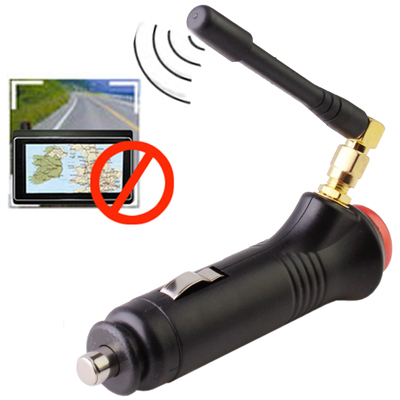
Portable jammers are basically plug-and-play gadgets, just a bit bigger than a USB flash drive, and they usually draw power from a 12V cigarette lighter port. Once they're running, they create an interference bubble of about 5 to 30 feet—other sources put it at 16 to 33 feet, or a radius of 5 to 10 meters. If you step up to a more powerful stationary unit, it can blanket an entire parking lot, a warehouse, or a stretch of road, and it can keep jamming for minutes or even hours. And a chirp jammer running off a 12V car socket? That can take out GNSS signals across a radius of several hundred meters.
In practice, the process is pretty straightforward. You plug the jammer into the car's auxiliary power outlet, set it down near the GPS tracker that's already installed, and turn it on. From there, the device throws out an interference signal across its rated radius, which blocks the tracker from picking up the GPS satellite signal—so it has no way to report a location.
GPS Jamming vs GPS Spoofing: Blocking Versus Faking
People tend to talk about these two like they're the same thing, but they actually do very different damage. A jammer just blasts RF noise on the GPS frequency, which stops the device from picking up satellite data at all—so it has no way to figure out where it is. Spoofing is sneakier: it imitates real satellite signals and convinces the device to calculate a false position. That's why a spoofed tracker might show a route that never happened, or a location that seems totally believable but is completely made up.
For investigators, that distinction is what really matters. Jamming cuts the signal off entirely, so what you tend to see is a dead feed or a position that just freezes in place. Spoofing is sneakier: it feeds the device fake data, so it keeps reporting positions that might drift, jump around, or trace a route that simply isn't possible. There's also a hybrid worth knowing about, denial-of-service spoofing, which broadcasts location data that's obviously wrong. In effect, it works like a targeted form of jamming.
There are also a few specific jamming techniques that come up in the sources, and they're worth knowing about. Continuous wave jamming is the simplest: it just blasts a constant signal on GPS frequencies. Sweep or barrage jamming is more aggressive, shifting frequency rapidly to cover a wider spectrum, going after L1, L2 and L5 all at once. Directional jamming takes a different approach, aiming RF energy at one specific platform or area instead of broadcasting everywhere. And then there's reactive jamming, which stays quiet until it detects GNSS activity, making it much harder to spot.
Types of GPS Jammers: Portable, Vehicle, Stationary and Spoofers
Jammers come in all shapes and sizes, and which one you're dealing with changes the kind of threat it poses. The table below breaks down the main categories, along with their typical power and range and how they tend to be deployed.
| Type | Typical form | Range | Common use |
|---|---|---|---|
| Portable jammer | Plug-in or battery-powered, slightly larger than a USB drive | About 5 to 30 feet (5 to 10 meters) | Localized outages, hiding one tracker |
| Vehicle jammer | Hard-wired or dash-mounted | Vehicle-scale bubble | Often blocks GPS, cellular and Wi-Fi at once |
| Stationary jammer | Higher power, fixed location | Parking lots, warehouses, road sections | Blanket coverage across multiple GNSS constellations |
| Chirp jammer | Powered from a 12V car socket | Several hundred meters | Wide-area GNSS denial |
| GPS spoofer | Imitation transmitter | Depends on power | Feeding false location data instead of blocking |
The pattern holds up pretty much every time: put the jammer closer to the antenna it's targeting, crank up the power, and the denial zone gets bigger. That's the same reason stationary setups cause the most trouble for the infrastructure around them—they're throwing out the most power from a fixed spot—while the little portable ones are the easiest to hide, whether that's tucked somewhere in a cab or buried in a cargo container.
Who Uses GPS Jammers and Why
GPS jammers were originally created by governments for military use, to conceal vehicle location and gain an advantage in high-risk situations. Protecting a convoy from precision-guided threats is one scenario where militaries may treat jamming as a legitimate, authorized tool.
Reported civilian uses are far less noble. Speeding drivers use jammers to avoid police detection, criminals use them to cover vehicle thefts and cargo crime, trucking fleet drivers use them to hide their location from employers, and taxi or heavy goods vehicle drivers use them to evade maximum driving hours rules. Because the hardware is cheap and sold openly online, often falsely marketed as a privacy device, the barrier to misuse is low.
That combination of low cost and high impact explains why the problem keeps growing. A single driver with a $30 device can erase hours of fleet visibility, and a coordinated theft crew can make a loaded trailer disappear from a tracking map at exactly the moment it matters most.
Are GPS Jammers Illegal and What Are the Penalties?
GPS jamming is illegal in many countries, including the United States, Canada and the United Kingdom. In the U.S., the Communications Act of 1934 outlawed the marketing, sale or use of GPS jammers. In Canada, the Radiocommunication Act prohibits importing, manufacturing, distributing, selling, possessing and using them.
Penalties cited in enforcement cases include fines of up to $100,000 or more in the U.S., imprisonment, and loss of equipment. One driver received a $32,000 FCC fine for using a jammer at Newark Airport in 2013. Despite that, jammers are still sold online, frequently advertised with misleading privacy claims that do not change their legal status.
For fleet operators, the legal angle cuts both ways. A driver caught jamming may face personal penalties, but the carrier can still face regulatory scrutiny, insurance disputes and customer claims if tracking data was deliberately disabled. Written policy, driver training and tamper alerts are the practical defenses.
Fleet and Business Impact: What Jamming Costs Operators
Jamming interrupts routing, safety monitoring, compliance and maintenance. The immediate effects include loss of location visibility, navigation and routing problems, and compromised safety features such as automatic collision notifications and emergency response. From there the damage compounds into delays, financial losses and reputational damage.
The financial stakes are well documented. According to COTS Journal, 85% of cargo thefts in Mexico involve a GPS jammer. In the United States, the average loss per cargo theft incident was $587,000 in 2023. Those numbers explain why insurers and shippers increasingly ask carriers to prove that tracking was active and tamper-resistant for the entire trip.
Compliance exposure is just as real. Hours-of-service rules, temperature-controlled cargo logs and proof-of-delivery records all depend on reliable position and time data. When that data vanishes, operators can be left reconstructing trips manually, disputing penalties and explaining gaps to customers who have contractual visibility requirements.
Collateral Damage: Why Jammers Hit More Than One Target
Jammers do not discriminate. The same RF noise that hides a truck also threatens air traffic control, search and rescue operations, the electric grid and mobile phone services, all of which rely on precise timing or positioning. The London Stock Exchange has been subject to repeated GPS outages affecting the timestamping of financial transactions.
History offers blunt examples. In 2007, a navy exercise that caused loss of GPS communications in San Diego harbor left residents unable to withdraw cash from ATMs and stopped doctors' emergency pagers; it took three days to identify the ships as the cause. In 2016, South Korea was subject to a major campaign of GPS jamming from North Korea that affected ship and aircraft navigation.
Jamming activity has also been reported in Syria, Ukraine and along the U.S.-Mexico border. For fleet managers, the lesson is that a localized jammer is rarely truly localized. If a route passes near a port, a border corridor or a conflict zone, the operational risk extends well beyond the vehicle carrying the device.
How to Detect GPS Jamming and Protect a Fleet
Signs of jamming include sudden signal loss, frozen location data, straight-line trip gaps and tamper alerts. Spectrum monitoring with mobile direction finding detects and locates jammers, while analysis of frequency spectra for duration and signal type indicates whether interference is accidental or deliberate. A London L1 and L2 monitoring campaign over a few weeks detected significant jamming activity, ranging from crude unmodulated sources poorly centered on L1 or L2 to synthesized sources suggesting deliberate targeting.
Fleet tools can set alerts for GPS signal errors and flag missing or interrupted trips. Modern trackers counter jamming with cellular triangulation fallback, last-known-location storage and real-time alerts to fleet managers. Layering those features with driver reporting, route risk scoring and physical cargo controls gives operators a defensible response when a signal disappears.
The most effective posture combines technology and process. Treat any unexplained gap as a security event, cross-check it against cellular and driver data, and document the response. That habit turns a jammed tracker from an invisible loss into a detected incident that can be investigated, reported and, ideally, prevented next time.
Frequently Asked Questions
How does a GPS jammer actually block a signal?
A GPS jammer is a small radio transmitter that broadcasts noise on the same frequency as GPS satellites, mainly the L1 band at 1575.42 MHz. Because satellite signals arrive extremely weak, a low-power ground transmitter can overpower them, so the receiver cannot lock onto satellites and loses position data.
What is the difference between GPS jamming and GPS spoofing?
Jamming floods the GPS frequency with radio noise so the receiver gets no usable satellite data at all. Spoofing instead mimics real satellite signals and feeds the receiver false location information, so the device reports a wrong position or an impossible route rather than simply losing its fix.
Are GPS jammers legal?
GPS jamming is illegal in many countries, including the United States, Canada and the United Kingdom. In the U.S., the Communications Act of 1934 outlawed marketing, selling or using them, and penalties can include fines of up to $100,000 or more, imprisonment and loss of equipment.
How can a fleet tell if a GPS tracker is being jammed?
Common signs include sudden loss of GPS signal, frozen or stale location data, straight-line gaps in a trip, and tamper alerts. Modern trackers counter this with cellular triangulation fallback, last-known-location storage and real-time alerts to fleet managers.