GPS jammers overpower the faint satellite signals your tracker depends on, and they show up in cargo theft, vehicle heists, and airport interference cases. Here is how jamming works, the signs to watch for, and the detectors and fleet tactics that catch it.
What Is a GPS Signal Jammer and How Does It Work?
A GPS signal jammer is really just a radio transmitter that drowns out satellite navigation signals by blasting noise on the same frequencies GPS receivers listen to. GPS satellites sit about 12,550 miles (roughly 20,200 km) above us, and each one broadcasts at only about 20 to 50 watts — so by the time those signals reach the ground, they're down to around -130 dBm. That's an incredibly faint whisper. A ground-based transmitter running just 1 watt can easily overpower it within its immediate range, and a cheap 10 dBm jammer can cut through signals across 100 meters or more.
The physics explains why these tiny devices work so well. GPS uses spread-spectrum modulation, which gives the system something called process gain — meaning a jammer usually has to sit at least +50 dBm above the GPS signal to be fully effective. Even then, a low-power jammer putting out just 10 to 20 milliwatts can overpower signals across 250 to 300 meters. As for the practical interference radius, most numbers fall somewhere around 16 to 33 feet (5 to 10 meters) for pocket-sized devices, though a few sources stretch that to 5 to 30 feet. The hardware itself is almost shockingly simple. When Hackaday tore down a mini GPS jammer, they found a 78M05 regulator, an NE555 timer, and a microwave voltage-controlled oscillator marked 13BA A041 — with the 555 generating a 133 KHz sawtooth that modulates the VCO centered on 1,575 MHz.
The commercial side of this is just as troubling. You can buy a basic car GPS signal blocker for as little as $3, while multi-band models run anywhere from $300 to $1,700 — and they're sold openly on more than 100 websites. It's also worth getting the terminology straight, since you'll come across all sorts of names for the same hardware: GPS jammers, GPS blockers, GPS signal jammers, telematics jammers, or the broader catch-all term GNSS interference. Now here's the key legal point: the GPS L1 frequency at 1575.42 MHz is protected by international regulation, and no ground-based transmitter is allowed to operate there. So any signal you pick up in that band at ground level is, by definition, illegal interference.
GPS Jamming vs. Spoofing: What Is the Difference?
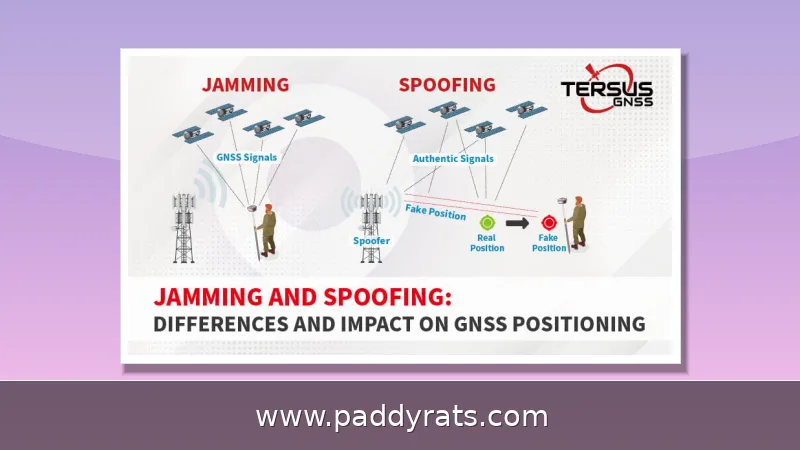
People tend to use "jamming" and "spoofing" as if they mean the same thing, but these two attacks come at a receiver from opposite directions. Jamming is the brute-force approach: the device floods the GNSS band with RF noise, the receiver loses its lock, and your tracker goes dark — no position, no updates, nothing at all. Spoofing is the quiet one. Instead of drowning out the real signal, the attacker broadcasts fake signals built to look like legitimate satellite transmissions, so the receiver keeps reporting positions as if nothing were wrong. The positions are just wrong. That's why the giveaway is behavioral rather than hardware-based: a jammed unit drops offline, while a spoofed unit looks perfectly fine on your dashboard even as it feeds you a location that doesn't exist. In practice, this difference tells you where to look — a dead tracker suggests interference, but a tracker that's cheerfully reporting bad coordinates should make you wonder if someone is feeding it false data.
That distinction should shape the way you investigate. If a tracker goes completely dark and then comes back online the moment it leaves a certain area, jamming is probably the explanation. But if the positions it reports look reasonable on their own yet don't match what the driver was actually doing — or what shows up in fuel records or door sensor data — then spoofing deserves a closer look. These days, fleet platforms tend to pull from both kinds of signals: they watch non-reporting unit trends that suggest blocking, and they flag movement patterns that couldn't physically happen, which points to fabricated data. The bottom line? Detection isn't about any single reading — it's about reading patterns across GPS status, cellular behavior, and what the driver says actually happened.
What Are the Signs Your GPS Tracker Is Being Jammed?
The earliest signs of GPS jamming usually show up in how a tracker behaves, not in any diagnostic readout. The telltale pattern is a device that abruptly loses its GPS lock at one specific location, then recovers the moment the vehicle pulls away. You may also notice location data that freezes in place or starts drifting, trip logs with straight-line gaps where the route should be curving, a growing number of non-reporting units (NRUs) across the fleet, or tamper alerts that trigger when someone physically interferes with the device. And when the data just doesn't match what the driver was actually doing, that's one more red flag worth escalating.
Those numbers get a lot more unsettling once you see the context behind them. In Mexico, GPS jammers show up in 85% of cargo truck hijackings, and in the UK, 80 to 85% of organized vehicle thefts involve them — figures GPSPATRON pulled from government and industry reports. The recovery rates tell the whole story: with a working tracker, you get your vehicle back 90 to 95% of the time. Without one, that drops to roughly 23 to 25%. So a jammer doesn't just interrupt a signal — it flips the odds against you. The money on the line is just as grim. According to Trak-4, the average loss per cargo theft in the U.S. hit $587,000 in 2023, and KwaZulu-Natal province alone recorded 10 cash-in-transit heists in the last quarter of 2024.
A smart way to handle these alerts is to separate what the device is telling you from what the operation actually expects to see. Losing signal on a truck that should be barreling down the interstate is one thing. The same dropout on a vehicle that's been sitting for twenty minutes in a lot it has no business being in, with a driver who won't answer the phone, is a whole different situation. That distinction matters, because jammers don't announce themselves. They just make your tracker go quiet, and if dispatch writes off every Non-Reporting Unit as routine background noise, your window to react closes before you even realize it's open. So work the triage logic right into your process: check the alert against the vehicle's expected status, the time of day, the route history, and whether the driver picks up. A single dropped ping on the highway is usually nothing more than a dead zone. But signal loss plus a stationary vehicle plus radio silence from the cab is a signal in itself, and that's the point where raw telematics data stops being just a log file and starts functioning as a real countermeasure.
How Do You Detect GPS Jamming with Dedicated Detectors?
Dedicated detectors operate on a pretty straightforward idea: they monitor the GNSS band — GPS L1 at 1575.42 MHz, for instance — where no ground-based transmitter is legally permitted to operate. Since that band is reserved for satellite signals, any transmission picked up at ground level counts as illegal interference. No guesswork involved. That same clarity is what gives detectors their reach, too. Because the GPS band is so unambiguous, a detector can spot interference from surprisingly far away — often well past the jammer's actual working radius. The GP-Probe Nano L1 is a solid example: it can pick up standard cigarette-lighter jammers from up to about 500 meters away in open environments. So even if a jammer is only disrupting devices within a few dozen feet, a dedicated detector can flag its presence long before you ever get that close.
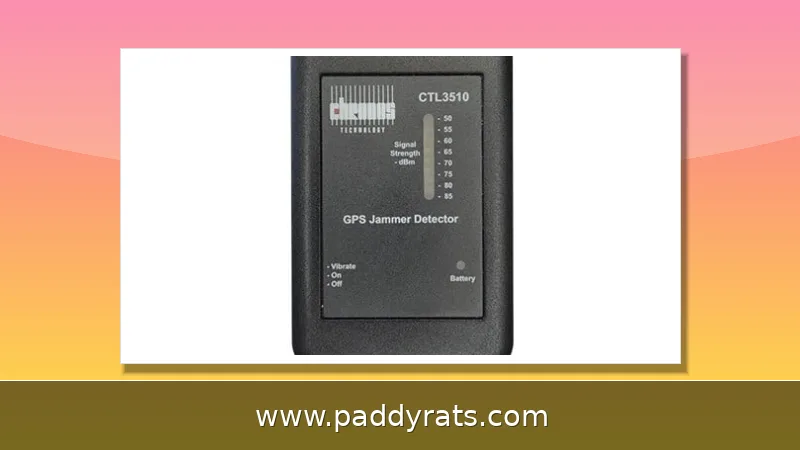
These are tools you carry with you and use on the road, not something you study on a workbench. Take the GP-Probe Nano L1: it's roughly the size of a USB flash drive, and it gets your attention in three ways—a vibration motor, a speaker, and a 36-LED power scale. Battery life is solid, too. You get up to 30 days in Detector Mode, or as long as three months in Logger Mode if you're just recording events for later review. It connects to an Android phone through USB Type-C and pairs with the GPSPATRON Connect app. The Chronos CTL3520 from NavtechGPS takes a different approach. It's designed to be compact and easy to operate, with enough sensitivity to pick up low-power GPS jammers.
Spectrum monitoring platforms take that same idea and scale it up for professional use. Take CRFS RFeye receivers: they offer excellent noise performance, come with automation features, send an alert the moment interference shows up, and include a GPS holdover module that keeps timing synchronized. Safran's IDM suite pushes things further still, bundling monitoring, detection, suppression, and countermeasure tools into one package that covers both GPS and GNSS spoofing and jamming. Out in the field, teams usually pair a portable detector for patrols and site inspections with fixed or vehicle-mounted monitoring to keep an eye on high-risk corridors.
How Does Fleet Telematics Detection Work?
Fleet telematics platforms detect jamming indirectly. Rather than scanning the radio-frequency environment themselves, they watch the health of the data stream coming off each tracker and look for patterns that don't add up. Geotab, for instance, flags jamming activity and pushes alerts to fleet managers; Verizon Connect monitors trends in its Non-Reporting Units; Azuga builds jamming detection directly into its fleet tracking software; Trak-4 pairs GPS tracking with cellular fallback so a unit keeps reporting when satellite lock is lost; and LandAirSea covers both consumer and commercial tracking use cases. The common thread is simple: a jammed tracker doesn't go silent. It keeps transmitting over cellular, but its position fixes become erratic, its timestamps drift, or it suddenly reports a stale location. The platform scores those anomalies and raises a flag.
| Telematics Platform | Detection Approach |
|---|---|
| Geotab | Detects jamming and alerts fleet managers |
| Verizon Connect | Tracks Non-Reporting Unit (NRU) trends |
| Azuga | Jamming detection built into fleet tracking software |
| Trak-4 | GPS tracking paired with cellular fallback |
| LandAirSea | GPS tracking solutions for consumer and commercial use |
Modern trackers push back against jamming with three practical defenses: cellular triangulation fallback, last-known-location storage, and real-time tamper alerts. The logic here is simple. A GPS jammer floods the L1 band with noise, but it does nothing to the cellular network the tracker also relies on. So when the satellite lock drops, the device can switch to estimating its position from nearby cell towers, even if that fix is coarser than a true GPS reading. At the same time, it holds onto the last confirmed location before the signal vanished, giving investigators a clean starting point instead of a blank map. And rather than sitting silent until the next scheduled ping, it fires off a tamper alert to the fleet right away. Put those three together and a jamming blackout stops looking like a dead zone. It becomes a usable incident report, complete with a time, a place, and a reason to call someone.
The table below breaks down the main categories of jamming and spoofing devices, along with what each one is actually good at, based on the source material. It's worth keeping in mind that these tools differ widely in range, power, and purpose: portable jammers tend to be low-power units with limited range that cause localized outages, while vehicle-mounted jammers are hard-wired and capable of blocking multiple signals at once. Stationary jammers run at higher power and cover a larger area, and they're more common outside the U.S. GPS spoofers work differently altogether—instead of blocking signals, they imitate legitimate transmissions. That distinction matters when you're trying to figure out what kind of interference you're dealing with.
| Device Category | How It Works | What It's Actually Good At |
|---|---|---|
| Portable jammers | Low-power, battery-operated units | Limited range; localized outages |
| Vehicle jammers | Hard-wired into the vehicle | Blocking multiple signals at once |
| Stationary jammers | Higher power output | Larger coverage area; more common outside the U.S. |
| GPS spoofers | Imitate legitimate transmissions | Deceiving receivers with fake data rather than blocking |
| Device type | Typical range | Behavior | Where it is common |
|---|---|---|---|
| Portable jammer | Localized, tens of meters | Blocks GPS in a small area | Vehicle theft, cargo hijacking |
| Vehicle-mounted jammer | Vehicle-sized footprint | Hard-wired, blocks multiple signals | Organized theft rings |
| Stationary jammer | Large area | Higher power, wider disruption | More common outside the U.S. |
| GPS spoofer | Receiver-dependent | Imitates legitimate transmissions | Targeted deception attacks |
Put that table to work in the real world, and the picture gets clearer fast. Portable and vehicle-mounted jammers are the threats most fleets will actually run into, since they're cheap, easy to hide, and they hit hardest at the exact moment a truck is most exposed — stopped, idling, or parked overnight. Stationary jammers, which run at higher power and cover a wider area, tend to show up more often outside the U.S., while spoofers represent a more sophisticated adversary altogether. The hardware itself keeps advancing: the UK Government Office for Science has documented multi-band briefcase jammers with eight channels, a sign of how far these devices have come from the simple cigarette-lighter units. The practical takeaway is that matching your detection investment to the threat profile you actually face beats buying the most powerful tool on the market.
| Jammer Type | Typical Threat Level for Fleets | Key Characteristics |
|---|---|---|
| Portable | High — most commonly encountered | Cheap, concealable, effective at close range |
| Vehicle-mounted | High — most commonly encountered | Hard-wired, blocks multiple signals |
| Stationary | Lower in the U.S., more common abroad | Higher power, larger coverage area |
| Spoofer | Sophisticated adversary | Imitates legitimate GPS transmissions |
| Multi-band briefcase (8-channel) | Advanced, documented by UK Government Office for Science | Shows how far jammer hardware has evolved |
Spectrum Monitoring and Direction Finding for Jammers
Spectrum monitoring turns detection into location. By analyzing frequency spectra, investigators can determine the duration of interference and the signal type, which helps distinguish accidental interference from deliberate jamming. Mobile direction-finding systems then locate the source. This matters because monitoring cellular or radio bands is far more complex — those bands carry legitimate traffic and generate false alarms — whereas the GPS band is unambiguous and supports long-range detection.
History shows why this capability is not academic. In 2007, a navy exercise in San Diego harbor caused ATMs to fail and doctors' pagers to stop working, and it took three days to identify the ships as the cause. South Korea was subject to a major campaign of GPS jamming from North Korea in 2016. The London Stock Exchange has experienced repeated GPS outages affecting the timestamping of financial transactions, which CRFS has documented through its spectrum monitoring work. Each case illustrates the same lesson: interference in the GNSS band propagates far beyond the intended target.
For fleets and security teams, the practical implication is that detection and legal escalation are linked. Because GPS jamming is illegal in many countries including the U.S., Canada, and the U.K., documented interference evidence supports enforcement. In the U.S., the Communications Act of 1934 outlawed marketing, sale, or use of jammers, with penalties including fines up to $100,000 or more, imprisonment, and loss of equipment. A 2013 case saw a $32,000 FCC fine issued to one driver for using a jammer at Newark Airport.
One technical caveat is worth internalizing. Because GPS is spread spectrum, a simple continuous-wave jammer gets spread into noise, so you need to separately measure carrier or noise density — the C/N0 and jam-to-noise (J/N) ratio — to know whether you are looking at a jammer or ordinary signal degradation. That is why professional monitoring tools measure more than raw signal strength.
Are GPS Jammers Illegal, and What Happens If You Use One?
Yes. GPS jamming is illegal in many countries, including the U.S., Canada, and the U.K. In the U.S., the Communications Act of 1934 outlawed the marketing, sale, or use of jammers, and enforcement has real teeth: penalties include fines up to $100,000 or more, imprisonment, and loss of equipment. The Federal Communications Commission has pursued individual cases, including a $32,000 fine issued in 2013 to a driver who used a jammer at Newark Airport.
The legal exposure is not limited to the person holding the device. Interference that disrupts aviation, financial timestamping, or emergency services can escalate quickly, as the 2007 San Diego harbor incident demonstrated when ATMs failed and doctors' pagers stopped working. For fleet operators, the compliance takeaway is straightforward: jamming detection is both a security control and a documentation practice. Preserving detector logs, telematics alerts, and incident reports gives investigators and regulators the evidence they need to act.
Fleet Tactics for Detecting and Responding to GPS Jamming
Effective anti-jamming programs combine technology, process, and people. Start with layered detection: dedicated GNSS-band detectors for high-risk routes, telematics NRU and tamper alerts for every vehicle, and spectrum monitoring for depots or corridors where incidents recur. Then define a response playbook so that a signal loss triggers a known sequence — attempt contact, check cellular fallback position, review the last known location, and escalate to security or law enforcement within a defined window.
Driver training closes the loop. Drivers should know the signs of jamming, understand that a device failing in a specific spot is a red flag rather than a routine glitch, and have a simple way to report it. Professor David Last of the University of Bangor, quoted by NBC News, has long warned that GPS crime is underappreciated precisely because the symptoms look like ordinary equipment failure. Tracker UK's documented Mercedes-Benz G63 AMG theft case shows how quickly a vehicle can disappear when jamming goes unrecognized.
Finally, measure your program. Track how many NRU events turn out to be jamming, how fast you escalate, and whether recovery outcomes improve. With recovery rates falling from 90 to 95% with a working tracker to roughly 23 to 25% without one, the difference between a detected incident and an undetected one is not incremental — it is the difference between recovering a vehicle and losing it entirely.
Frequently Asked Questions
What are the signs that a GPS tracker is being jammed?
Common indicators include sudden loss of GPS signal, frozen or inaccurate location data, straight-line trip gaps, non-reporting unit trends, and tamper alerts. Data that does not match driver activity is another clue. Jamming differs from spoofing, which feeds false positions instead of blocking the signal.
How do GPS jammer detectors work?
Detectors monitor the GNSS band, such as GPS L1 at 1575.42 MHz, where no ground transmitter is legally allowed, so any ground-level signal there is illegal interference. Devices like the GP-Probe Nano L1 alert via vibration, speaker, and LED scale, and can log events for later analysis.
Are GPS jammers illegal?
Yes. GPS jamming is illegal in many countries including the U.S., Canada, and the U.K. In the U.S., the Communications Act of 1934 outlawed marketing, sale, or use. Penalties include fines up to $100,000 or more, imprisonment, and loss of equipment.
Can GPS jamming be detected from far away?
Yes. A detector in the GPS band can identify interference from a very long distance, often much further than the jammer's effective operational radius. The GP-Probe Nano L1 detects standard cigarette-lighter jammers at ranges up to approximately 500 meters in open environments.