A UAV signal jammer floods the radio link between a drone and its pilot, forcing fail-safe behavior like return-to-home, hover, or a hard landing. Here is how the hardware works, which bands it hits, what it costs, and who is actually allowed to switch it on.
What Is a UAV Signal Jammer and How Does It Work?
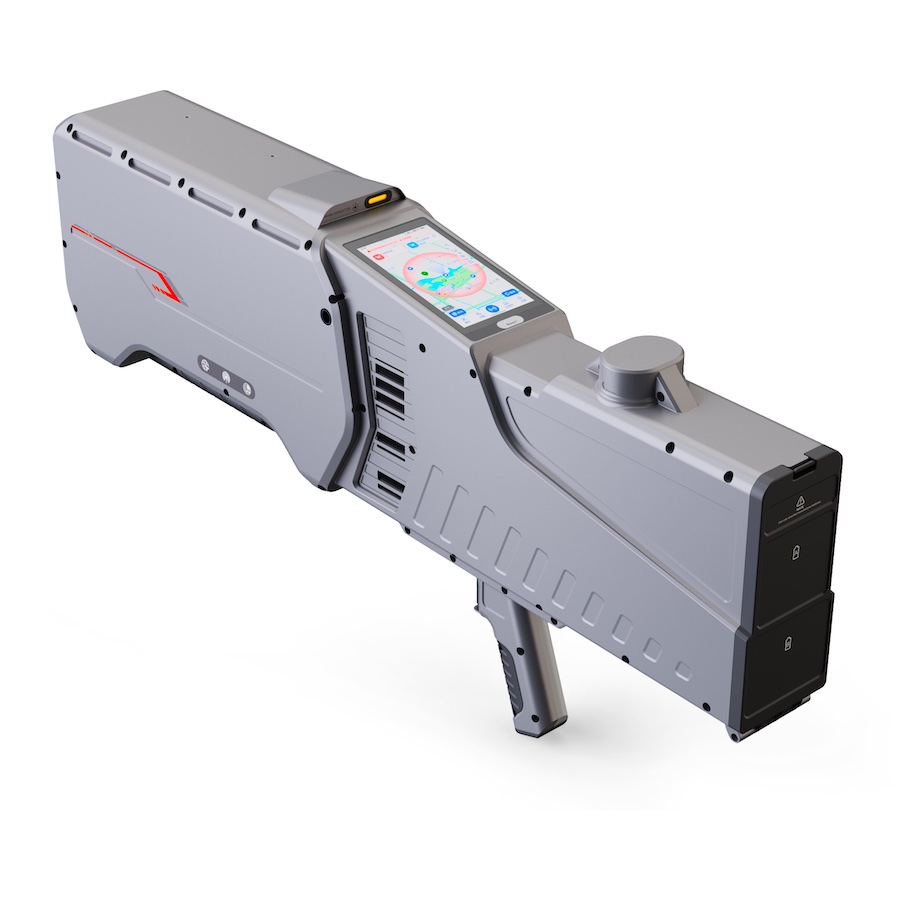
A UAV signal jammer—often sold as a drone jammer, anti-drone gun, or counter-UAS RF jammer—is basically a radio transmitter that drowns out the link between a drone and whoever's flying it. It doesn't hack the aircraft, and it doesn't shoot it down. What it does is broadcast noise, or protocol-aware interference, on the exact frequencies the drone is listening to, so the command, video, and telemetry packets never make it through intact.
Once that link is severed, most flight controllers trigger their fail-safe routine. Depending on how the operator set up the aircraft beforehand, it might fly back to its home point, hold its position in the air, come down in a controlled landing, or just fall out of the sky. That unpredictability is really the biggest flaw of RF jamming: you can ground the drone, but you almost never get to decide how it goes down.
I've seen this play out with everything from consumer quadcopters to purpose-built FPV airframes, and honestly, the behavior is never exactly the same twice. A DJI-class drone with a solid GPS lock will usually just turn around and fly home. A cheap racing drone with no GPS hold? That thing often just drifts or drops out of the sky. That gap matters a lot when the drone is carrying something dangerous, or when it's hovering over a crowd of people.
There are three main types of jamming. Broadband jamming floods a wide range of frequencies with high-power noise. Spot jamming focuses all that power on a single narrow band. Barrage jamming goes after several spot targets at the same time. Then there's the more sophisticated stuff: protocol-aware jamming, which mimics and layers itself over the original signal. That makes it much harder for the drone to tell the fake signal apart from its actual controller.
Which Frequencies Do Drone Jammers Target?
Most modern jammers don't bother with just one band. They're designed to hit everything a commercial or DIY drone depends on at once, since leaving even a single link intact might let the thing keep flying. The table below breaks down the usual bands and what each one actually carries.
| Frequency band | Typical use | Notes |
|---|---|---|
| 433 MHz / 900 MHz | Control links, commercial and DIY | Common on long-range and homemade builds |
| 1.2 GHz / 1.5 GHz | Video and telemetry | Older analog and some long-range video |
| 2.4 GHz / 5.8 GHz | Primary command-and-control | DJI and most commercial drones |
| GNSS (GPS, GLONASS, Galileo, BeiDou) | Navigation and positioning | Triggers position-loss fail-safes |
| 4G / 5G | Cellular-linked drones | Covered by some high-end systems |
GNSS bands are worth calling out on their own, since they're shared with pretty much everything else. A jammer blasting L1 and L2 doesn't just mess with the target drone — it can also degrade GPS reception for phones, cars, and emergency services in the same area. That collateral footprint is a big part of why regulators come down so hard on these devices.
For typical off-the-shelf units, the jamming radius usually lands somewhere between 200 and 1,000 meters. Purpose-built anti-drone jammers do better, reaching 200 to 3,000 meters, though that depends on output power and how closely the jammer's bands line up with what the target drone is actually using. Real-world range is another story — it drops off quickly in urban canyons, behind buildings, or against a drone running a frequency-hopping link that switches channels the second it senses interference.
Portable vs Stationary vs Reactive Jammers: Key Specs Compared
There are basically three physical form factors on the market, and their specs are all over the place. Portable units come as handheld or ManPack devices, use omni and directional antennas, cover up to nine bands, run about an hour on battery, and reach roughly 3 km. Stationary units rely on sector or omni-directional antennas and also cover up to nine bands, but their range stretches to 12 km, with selective jamming that can run automatically or manually. Reactive jammers take a different approach: they mount a directional antenna on a pan-and-tilt unit, hit beyond 8 km, and pair nine fixed bands with four programmable ones spanning 400 MHz to 6000 MHz.
| Product | Type | Key specs |
|---|---|---|
| ElevonX Skyner Raptor SJ | Portable | Jamming to 2 km, detection to 3 km, <=5.5 kg with battery, 900 MHz to 5.8 GHz |
| ElevonX Skyner Base SDJ | Stationary | Jamming to 4 km, detection height 0-1200 m, 25 MHz to 6000 MHz |
| ElevonX Skyner Base J | Stationary | Covers 95% of drone signals, jams up to 30 drones, IP66, -40C to +55C |
| MADDOS portable | Handheld / ManPack | Up to 9 bands, 1 hour battery, up to 3 km, RADHAZ certified |
| MADDOS stationary | Fixed | Up to 9 bands, up to 12 km, selective jamming |
| MADDOS reactive | Pan-and-tilt | Over 8 km, 9 fixed plus 4 programmable bands |
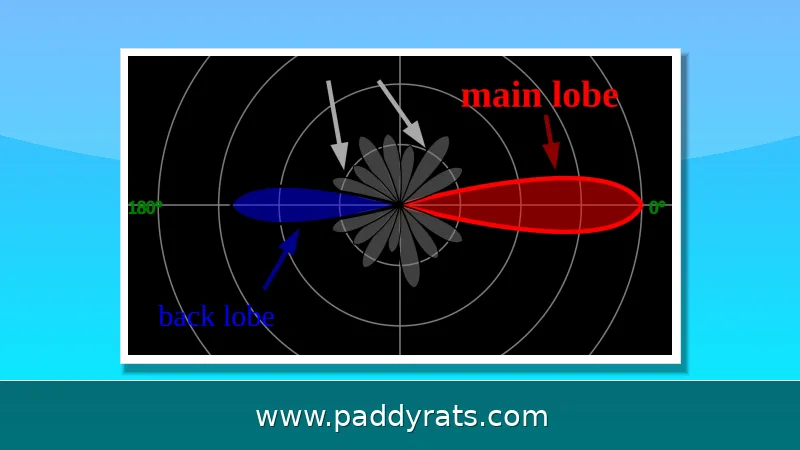
| DedroneDefender 2 | AI smart jammer | Targets beyond 300 m out of sight, 20-degree cone, GNSS plus broad spectrum |
| Jammermaster JM004 | Portable | Built-in directional antennas, $2,399.99 |
Some manufacturers push the power and range even farther. Shenzhen Ruicen Technology, for instance, offers a 400W high-power anti-drone unit built into a portable suitcase. It covers 100–6000 MHz, detects 5.8G drone alarms at 1–3 km, and can detect and locate targets out to 10 km while automatically jamming at 3 km. Then there's Greetwin's 4-channel FPV drone jammer, which disrupts the 700, 800, 1100, and 1300 MHz bands. It's designed for vehicle mounting and uses active cooling to keep things from overheating.
The market numbers show just how quickly this space is growing. MarketsandMarkets expects the global UAV jammer market to climb from USD 1.77 billion in 2026 to USD 5.90 billion by 2031, which works out to a 27.2% compound annual growth rate, with AI-powered systems doing most of the heavy lifting. Business Research Insights paints an even bolder picture: USD 2.86 billion in 2026, then USD 52.25 billion by 2035, a 38.1% CAGR. That said, take both forecasts as rough direction rather than hard truth. Research firms don't always agree on what actually counts as a jammer, so their numbers can diverge quite a bit.
Jammers vs Spoofers: What Is the Difference?
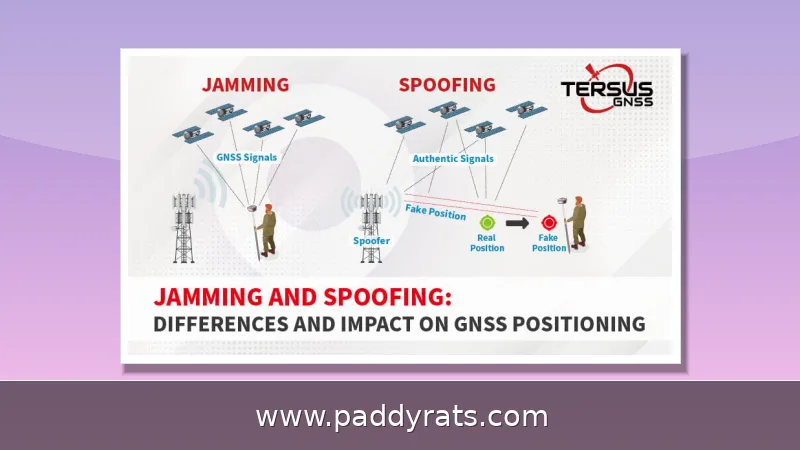
A jammer overwhelms radio signals with noise, while a spoofer overrides them by transmitting counterfeit signals strong enough to replace the source. That single distinction changes everything about the outcome. Jamming breaks the link and pushes the drone into fail-safe behavior. Spoofing feeds the drone false GPS or control data, which means an attacker can potentially steer it somewhere specific rather than just knocking it offline.
Spoofing is technically harder because the fake signal has to be compatible with the receiver and stronger than the genuine satellite or controller transmission at the antenna. When it works, though, it is far more dangerous, because the operator may not even realize the aircraft has been taken over. This is why military and critical-infrastructure buyers increasingly ask for spoof detection alongside jamming capability.
Anti-jamming countermeasures are evolving to match. Controlled Reception Pattern Antennas, or CRPA, shape their reception pattern to reject interference coming from a specific direction. Multi-frequency GNSS receivers, Inertial Navigation Systems, and sensor fusion let a drone keep flying when satellite lock is lost. Frequency-hopping systems such as Doodle Labs Sense automatically switch channels the moment they detect interference, which is exactly the behavior that shortens a jammer's effective range.
Who Can Legally Operate a Drone Jammer?
In the United States, operating, marketing, or selling RF jamming equipment is a federal crime unless you are specifically authorized. The Communications Act of 1934, at 47 U.S.C. 301, 302a, and 333, gives the FCC authority to prohibit these devices outright, and violations carry fines up to $112,500 per incident plus possible criminal prosecution. There is no consumer exemption, no hobbyist carve-out, and no "I was only protecting my own property" defense.
Authorized users under existing federal law include the Department of Defense and military installations under Title 10, expanded by JIATF-401 guidance in January 2026; the Department of Homeland Security, including CBP and the Secret Service; the Department of Justice, including the FBI; the Department of Energy for nuclear facility protection; and the Coast Guard for maritime security.
The SAFER SKIES Act, folded into the FY2026 NDAA, added new categories. State and local law enforcement can now operate jammers after training at the FBI National Counter-UAS Training Center in Huntsville, Alabama. Correctional facility security agencies that meet federal certification qualify, as do agencies protecting National Special Security Events and SEAR-rated events such as the FIFA World Cup 2026.
Private companies, individual property owners, and private security firms remain unauthorized unless they are contracted by an authorized agency. Most countries outside the US prohibit RF jammers as well, with narrow military or law enforcement exceptions. If you are evaluating a jammer for a private site, the realistic path is contracting with a licensed counter-UAS provider, not buying hardware yourself.
How to Protect Drones from Jamming
Defending a drone against jamming starts with assuming the link will be contested. The most effective single step is a multi-frequency GNSS receiver paired with an Inertial Navigation System, so the aircraft can dead-reckon its position when satellite signals disappear. Add sensor fusion that cross-checks barometer, compass, and optical flow data, and the drone can keep a stable attitude even under heavy interference.
Frequency-hopping and spread-spectrum links raise the bar further. Systems like Doodle Labs Sense monitor the spectrum and switch channels automatically when they detect jamming, which forces the attacker to either widen the noise floor or lose the target. On the operator side, directional antennas and reduced transmit power lower your own signature and make it harder for an adversary to find and jam your control link in the first place.
It also helps to plan missions around the failure mode. If a drone is programmed to return to home on link loss, a jammer near the launch point can turn that behavior into a trap. Setting a safe hover altitude, defining a lost-link landing zone away from people, and testing fail-safe behavior before every operation are cheap habits that pay off when the RF environment turns hostile.
Real-world conflict data shows how brutal this contest has become. RUSI estimated in May 2023 that Ukrainian forces were losing as many as 10,000 drones per month, mainly to Russian jamming. Russian forces fielded RP-377 jammers originally designed for radio communications as vehicle-mounted units, Volnorez portable backpack jammers, and static CUAV systems such as Argus-5000 and SkyHunter-4M/P. That scale of losses is why anti-jam design is now a procurement requirement, not a nice-to-have.
What Are the Pros and Cons of RF Jammers?
RF jamming has real advantages. It is a medium-cost, non-kinetic option that comes in sizes from handheld to vehicle-mounted. It neutralizes a drone quickly and, in many cases, with minimal damage to the airframe, which matters when the drone itself is valuable evidence. For fixed sites with a defined perimeter, a stationary jammer can cover a lot of airspace for far less money than a kinetic interceptor.
The drawbacks are equally real. Range is limited, effects are imprecise and unpredictable, and the drone may fall uncontrolled or veer off in a random direction. Jammers are illegal in most countries, they are less effective against pre-programmed autonomous drones that never need a live link, and they do not locate the pilot. They also disrupt nearby communications, including 9-1-1 calls, which is a serious liability in populated areas.
| Pros | Cons |
|---|---|
| Medium cost, non-kinetic | Limited range, imprecise |
| Available in many form factors | Unpredictable drone behavior |
| Quick neutralization, minimal damage | Illegal in most countries |
| Drone can be recovered as evidence | Weak against pre-programmed drones |
| Broad area coverage when stationary | Does not locate the pilot, disrupts nearby comms |
The vendor landscape mirrors that trade-off. Dedrone, now part of Drone Violations, sells DedroneDefender 2, an AI-powered smart jammer integrated with DedroneTracker.AI that targets drones beyond 300 meters even when they are out of sight, using a 20-degree targeting cone and broad-spectrum plus GNSS jamming. ElevonX fields the Skyner family across portable, mobile, and base configurations. MADDOS covers portable, stationary, and reactive units, while Rohde & Schwarz offers R&S ARDRONIS and the GUARDION Drone Defence System developed with ESG and Diehl Defence.
My takeaway after comparing these systems is that no single jammer solves the problem. The strongest counter-UAS setups layer detection, identification, and jamming, and they accept that RF interference is a blunt instrument with legal and safety consequences. Buyers who treat jamming as one tool in a stack, rather than a magic switch, end up with far more reliable protection.
Frequently Asked Questions
How does a UAV signal jammer work?
A drone jammer is an RF transmitter that broadcasts powerful noise on the same frequencies a drone uses for command, control, video, and navigation. This overwhelms the link and forces the drone into fail-safe mode: return to home, hover, controlled landing, or an uncontrolled fall. The outcome depends on how the aircraft was configured before takeoff.
Are drone jammers legal in the United States?
No. Under the Communications Act of 1934, at 47 U.S.C. 301, 302a, and 333, the FCC prohibits operating, marketing, or selling jamming devices. Violations carry fines up to $112,500 per incident plus possible criminal prosecution. Only authorized government entities, such as the Defense Department, DHS, DOJ, and certain trained local agencies, may legally operate them.
What frequencies do drone jammers target?
Common bands include 433 MHz and 900 MHz for control links, 1.2 GHz and 1.5 GHz for video and telemetry, and 2.4 GHz and 5.8 GHz for primary command-and-control on DJI and most commercial drones. Jammers also hit GNSS bands such as GPS, GLONASS, Galileo, and BeiDou, and some high-end systems cover 4G and 5G.
What is the difference between a jammer and a spoofer?
A jammer overwhelms radio signals with noise, while a spoofer overrides them by transmitting counterfeit signals strong enough to replace the source. Spoofers can hijack a drone's GPS and take control of it, whereas jammers simply disrupt the link and force fail-safe behavior. Spoofing is harder to execute but potentially far more dangerous.