Signal jammers are widely listed by specialist shops and even mainstream marketplaces, with prices from about $25 to more than $5,000. Here is who sells them, what they cost, and why buying one in the United States is against the law.
Who Sells Signal Jammers: Retailers and Suppliers
If you're in the market for a signal jammer, you won't have to look far—plenty of storefronts are eager to take your order. Specialty retailers such as Jammer Store, Jammer Master, JammerX, JammerMFG, Telejammer, Security Pro USA, and Endoacustica all carry cell phone, GPS, WiFi, Bluetooth, and drone jamming devices in their catalogs. Jammer Master says it's been supplying customers since 2010, offers free worldwide shipping and a one-year warranty, and lists [email protected] as its contact. JammerX takes a different approach, organizing its lineup by use case—everything from portable and desktop units to high-power models aimed at personal, commercial, and government buyers.
Mainstream marketplaces only add to the confusion. Search Amazon and you'll mostly find signal blocking bags, Faraday pouches, bug detectors, and RF scanners instead of actual jammers — products that sit at the softer edge of the category, since they either shield a device or sniff out interference rather than transmit anything themselves. Walmart's Auto & Tires section and eBay go a step further, with listings for red and blue cell phone signal jammers turning up alongside the usual accessories. That distinction matters: the dedicated jammer suppliers are the ones selling real transmitters, and several of them admit outright that whether a purchase is legal depends entirely on where the buyer intends to use it.
Figuring out where these devices actually come from can get confusing fast, since the sellers operate on wildly different levels. Some are factories that build the hardware themselves, some are wholesalers serving licensed buyers only, and others are just general marketplaces where a jammer listing might pop up right next to a phone case or a pair of earbuds. The vendors above tend to fall into a few fairly distinct groups, and each one markets itself in its own way. Manufacturer-direct sellers like Jammer Store and Telejammer lead with specs and band counts, while suppliers such as Jammer Master, JammerX, and JammerMFG lean harder on shipping terms, warranties, and wholesale or OEM options. Then there's a separate tier that caters to law enforcement, military, and security buyers, and mainstream platforms like Amazon, Walmart, and eBay mostly carry accessories or the occasional scattered listing. The table below breaks down what each one claims to offer, based on the copy from their own catalogs.
| Vendor | Type | What They Claim to Offer |
|---|---|---|
| Jammer Store (jammer-store.com) | Manufacturer | Cell phone jammers, blockers, GPS and WiFi jamming equipment |
| Jammer Master (jammermaster.com) | Supplier since 2010 | Free worldwide shipping, 1-year warranty; [email protected] |
| JammerX (jammerx.com) | Supplier | Portable, desktop, high-power, GPS and WiFi jammers for personal, commercial and government use |
| JammerMFG (jammermfg.com) | U.S. wholesale supplier | GPS, RF and cell blockers; OEM and white-label options; +1 (315)313-4081 |
| Telejammer (telejammer.com) | Factory | Cellphone, GSM, GPS and WiFi jammers; 12-band 44W and 18-antenna 158W briefcase models |
| Security Pro USA (securityprousa.com) | Supplier | Signal and drone jammers for law enforcement and military |
| Endoacustica (endoacustica.com) | Supplier | Professional signal, RF and microphone jammers, anti-drone systems |
| Amazon | Marketplace | Signal blocking bags, Faraday pouches, bug detectors, RF scanners |
| Walmart | Marketplace | Auto & Tires signal jammer products |
| eBay | Marketplace | Red and blue cell phone signal jammer listing |
What Signal Jammers Cost: Price Tiers and Examples
If you start shopping around for a signal jammer, the prices can swing pretty wildly in both directions. A buyer's guide cited in the sources lays out the full range: about $25 at the low end for cheap Amazon gadgets, up to roughly $2,250 for wideband units, with hobbyist eBay listings going for under $70 and professional multi-band gear pushing past $2,000. That spread isn't arbitrary—it comes down to antenna count, band coverage, and overall build quality. Jammer Master's catalog shows the progression clearly: a mini cell phone jammer starts at $420, while a drone jammer gun goes all the way up to $5,200. Somewhere in the middle are the workhorse models most commercial buyers end up considering, and what you pay generally depends on how many frequencies the unit can take down at once.
| Tier | Typical Price | Example |
|---|---|---|
| Budget / hobbyist | Under $70 | Hobbyist eBay listings |
| Entry-level | Around $25 | Cheap Amazon gadgets |
| Mid-range | $420 | Mini cell phone jammer (Jammer Master) |
| Professional multi-band | Above $2,000 | Wideband units |
| Top-end | $5,200 | Drone jammer gun (Jammer Master) |
If you want a sense of what jammers actually go for, the prices basically speak for themselves. Below, I've pulled representative listings from three suppliers mentioned in the source material — Jammer Master, JammerX, and JammerMFG — and put them side by side so the tier structure becomes obvious. A few patterns jump out fast: pocket-sized GPS and WiFi blockers sit at the bottom, frequently under $100, while multi-band portable units run into the high hundreds, and anything designed for wideband coverage or drone defense shoots past the $1,000 line. One caveat — JammerX prices are listed in euros, so read those as a rough currency comparison, not an exact match. And keep in mind that antenna count, band coverage, and power output all move the price, which means two units sitting at similar price points may not really be comparable at all.
| Supplier | Example Product | Price |
|---|---|---|
| Jammer Master | Mini Cell Phone JM025 | $420.00 |
| Jammer Master | 4G Phone JM021 | $520.00 |
| Jammer Master | 8 Antennas WiFi & Bluetooth JM003 | $635.99 |
| Jammer Master | Handheld Mobile Phone 16 Antennas 25 Meters JM018 | $699.00 |
| Jammer Master | 12 Antennas Desktop JM001 | $749.99 |
| Jammer Master | 5G Mobile JM023 | $980.00 |
| Jammer Master | All-in-One Directional JM030 | $1,220.00 |
| Jammer Master | Drone Jammer Gun JM029 | $5,200.00 |
| JammerX | Car Mini GPS jammer RunnerX | €79 |
| JammerX | Armor 8 and 8F | €399.99 |
| JammerX | Alpha 6 | €499.99 |
| JammerX | Armor 24 | €999.99 |
| JammerX | Armor 27 | €1,099.99 |
| JammerMFG | Mini Pocket WiFi Jammer | $98.86 |
| JammerMFG | 8 Band Portable Cell Phone Jammer | $336.98 |
| JammerMFG | PJ-12S 12-band WiFi GPS 5G Jammer | $435.36 |
| JammerMFG | CT-12H Military-Grade Portable 12 Bands | $1,075.12 |
| JammerMFG | P-32Ultra 32 Bands | $1,278.15 |
| Supplier | Example product | Listed price |
|---|---|---|
| Jammer Master | Mini Cell Phone JM025 | $420.00 |
| Jammer Master | 12 Antennas Desktop JM001 | $749.99 |
| Jammer Master | 24 Antennas Portable 5G JM019 | $1,150.00 |
| Jammer Master | Drone Jammer Gun JM029 | $5,200.00 |
| JammerX | Armor 8 / 8F | 399,99 euros |
| JammerX | Armor 27 | 1.099,99 euros |
| Telejammer | G9 PRO USB Car GPS Jammer | $36 |
| JammerMFG | PJ-31 31 Bands 5G, WiFi 6E/7E & FM | $1,050.29 |
A few patterns stand out pretty fast. Single-purpose gadgets—think a USB car GPS blocker or a pocket WiFi unit—usually land in the double digits or low triple digits. Move up to multi-band portable units with eight to twelve antennas, and prices tend to cluster between roughly $400 and $900. Once you're dealing with 24 bands or more, briefcase-style builds, or anything made specifically for drones, you're past the $1,000 mark, and the drone jammer gun at $5,200 is the obvious outlier. JammerMFG's own lineup follows that same spread, from $98.86 for a mini pocket WiFi jammer up to $1,278.15 for a 32-band portable unit.
How a Signal Jammer Works
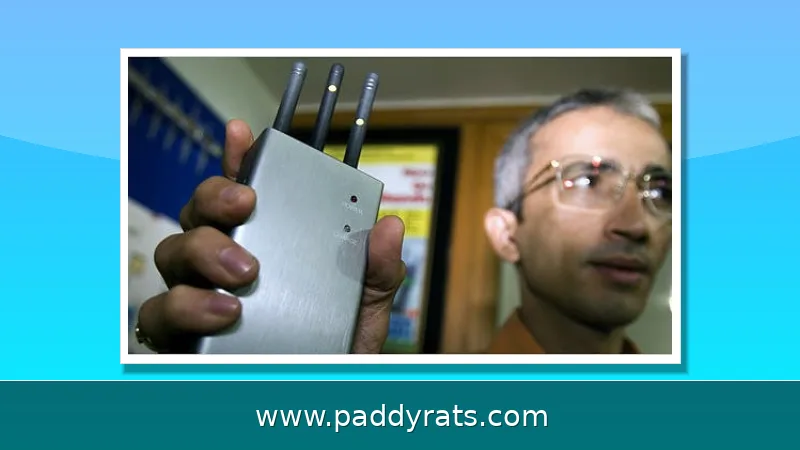
A signal jammer is basically a denial-of-service attack, except it's carried over radio waves rather than a network connection. It broadcasts on the same frequencies the target system is already using. Picture two people trying to talk at once on the same channel—a phone can't separate two signals sharing one frequency, so it just locks onto whichever is stronger. That's almost always the jammer's noise, which drowns out the original transmission from the cell tower and cancels it out. The phone ends up showing zero bars and looking completely idle, even though there's nothing actually wrong with it. One thing people tend to miss: the interference happens on the downlink, the tower-to-phone path, which is exactly why the device seems dormant instead of broken. It isn't damaged—it just can't hear anything over the noise. The same principle holds across the whole category. Early jammers were military and law enforcement tools, built to stop cell-triggered explosives and cut off communications during hostage situations, and the simpler models sold today still block only a single frequency. Range is pretty limited in practice—Wilson Amplifiers puts typical coverage at no more than about 30 square feet—so this is a localized tool, not some wide-area weapon. You'll also see the same device sold under a long list of names: signal blocker, cell phone blocker, mobile phone silencer, text stopper, RF jammer, GPS jammer, WiFi jammer, Bluetooth jammer, drone jammer, or UAV jammer. It also helps to keep a few related-but-different products straight. A Faraday cage physically blocks signals instead of transmitting over them, a spectrum analyzer detects interference rather than causing it, and a signal booster or amplifier does the opposite of jamming—it strengthens coverage instead of suppressing it.
Signal jamming didn't start out as a consumer product — it grew out of military and law enforcement work, where it was used to stop cell-triggered explosives and to cut off communications during hostage situations. That background explains why the hardware out there today varies so wildly in what it can actually do. Cheap, entry-level jammers knock out just one frequency, so a budget device might kill a GPS signal but leave a phone call completely untouched. Multi-band units are a different story: they can cover several cellular, WiFi, GPS, or Bluetooth bands at once, which is what makes them useful when you're dealing with more than one target. Range is where the marketing tends to get ahead of reality, though. According to Wilson Amplifiers, jamming usually covers no more than 30 square feet, so the real-world effect stays local — one room, or maybe part of one — rather than blanketing a whole neighborhood like some product listings would have you believe.
The terminology in this category is loose, and that looseness matters when you're shopping or comparing specs. The exact same piece of hardware might be listed as a signal blocker, a cell phone blocker, a mobile phone silencer, a text stopper, an RF jammer, a GPS jammer, a WiFi jammer, a Bluetooth jammer, a drone jammer, or a UAV jammer — the label often reflects the marketing angle or the frequency band being targeted rather than any real technical difference. So if you're searching for one term and coming up empty, try the others before assuming a product doesn't exist. It also helps to separate jammers from three products people constantly mix up with them, even though they do something completely different: a Faraday cage physically blocks signals by enclosing a device in conductive material, a spectrum analyzer detects interference rather than causing it, and a signal booster or amplifier strengthens coverage instead of suppressing it. Knowing which category you actually need saves both money and confusion.
| Term | What it actually does |
|---|---|
| Signal blocker / cell phone blocker / mobile phone silencer / text stopper / RF jammer / GPS jammer / WiFi jammer / Bluetooth jammer / drone jammer / UAV jammer | Transmits on the same frequencies as the target system to disrupt it — the same hardware under different marketing labels |
| Faraday cage | Physically blocks signals by enclosing a device in conductive material |
| Spectrum analyzer | Detects interference; it does not cause it |
| Signal booster / amplifier | Strengthens coverage rather than suppressing it |
Is Buying a Signal Jammer Legal in the US?
If you're a buyer in the United States, the answer is pretty simple: no. According to the FCC's Jammer Enforcement page, it's against the law to advertise, sell, distribute, import, or otherwise market RF jamming devices to non-federal entities here in the US. That wording matters more than it might seem at first glance. The prohibition doesn't stop at flipping a switch on a jammer — it reaches all the way back to the storefront. Anyone who markets these devices to ordinary buyers, whether through a flashy website or a marketplace listing, is already on the wrong side of the rules. So even though the retailers and suppliers above may happily ship to other countries, a US buyer gets no real cover from the fact that a product page exists. The seller's willingness to list a jammer doesn't make your purchase lawful, and it won't shield you if the FCC comes knocking. In short, the legal risk starts before the device ever reaches your door.
Wilson Amplifiers adds that it is illegal to sell, advertise, distribute or operate cell signal jammers in the United States and much of the world. The reasoning is public safety, not paperwork: jammers interfere with authorized radio communications, can prevent 9-1-1 and emergency calls, and disrupt law enforcement channels. The Communications Act of 1934 outlaws interference with authorized radio broadcasts, and penalties can reach six figures.
Some suppliers try to manage the risk contractually. JammerMFG says it works with licensed operators only and asks buyers to verify regional compliance before purchase, which is a signal that the company knows who its lawful customers are. If you suspect jamming in your area, the recommended path is to contact law enforcement or file a complaint with the FCC rather than shopping for countermeasures.
Wholesale, OEM and White-Label Jammer Supply
Beyond retail listings, there is a business-to-business layer that most casual searches miss. JammerMFG describes itself as a US wholesale supplier of GPS, RF and cell blockers, offering OEM and white-label options to dealers, security firms and government contractors. Its published contact details include phone +1 (315)313-4081 and an email address for inquiries. Telejammer positions itself as a signal jammer factory, which implies manufacturing capacity rather than resale.
That wholesale framing matters because it changes who the customer is. A dealer buying white-label units is not the end user, and a government contractor working with licensed operators is operating in a different legal category than an individual. The compliance burden shifts to verifying that the end deployment is authorized, which is exactly what JammerMFG's licensed-operators-only language is designed to do.
For anyone evaluating a supplier, the practical questions are the same ones you would ask of any hardware vendor: does the company publish real specifications, does it name its manufacturing role, and does it state plainly who may legally buy? A supplier that answers all three is at least being transparent about the constraints. A supplier that promises worldwide shipping with no mention of licensing is not.
Signal Jammer Market Size and Forecasts
Market research on jamming equipment is unusually fragmented, and the source material shows why: estimates disagree because analysts are not counting the same thing. The table below collects the published figures, with the caveat that some reports appear to include military and drone-defense contracts while others cover only commercial signal jammers.
| Source | Base value | Forecast value | CAGR |
|---|---|---|---|
| Strategic Market Research | $2.85B (2025) | $4.64B by 2032 | 7.2% |
| Fortune Business Insights | $4.61B (2025) | $9.27B long term | Not stated |
| Coherent Market Insights | $1.8B (2026) | $3.6B by 2033 | Not stated |
| Research and Markets | $2.37B (2026) | $3.36B by 2030 | 9.1% |
| Future Market Report | $10.95B (2025) | $21.1B by 2033 | 8.54% |
| market.us | $4.04B (2025) | $8.70B by 2035 | 8.70% |
The base values alone range from $913.05 million to $10.95 billion, which is a definitional gap rather than a forecasting dispute. A LinkedIn analysis of the small signal jammer segment projected a 4% CAGR through 2033, well below the broader figures, which supports the idea that the headline numbers are being driven by defense and drone-security spending. Companies named across these reports include L3Harris Technologies, Raytheon Technologies, Northrop Grumman, Lockheed Martin, Thales Group, BAE Systems, Israel Aerospace Industries, SecureWave Communications, Jammer Solutions Inc. and Blackout Signal Systems.
The takeaway for a US reader is that a large and growing global market does not change the domestic rule. The demand reflected in these forecasts is concentrated in government, military and licensed-operator channels, not in consumer purchases. That is the same distinction the FCC enforcement language draws, and it is the reason a retail listing can exist online while remaining unlawful to buy, import or operate in the United States.
Frequently Asked Questions
Who sells signal jammers?
Online retailers include Jammer Store, Jammer Master, JammerX, JammerMFG, Telejammer, Security Pro USA and Endoacustica. Amazon, Walmart and eBay also list blockers, pouches and detectors. JammerMFG offers wholesale, OEM and white-label supply to dealers, security firms and government contractors in the US.
How much does a signal jammer cost?
Listings run from about $25 for cheap gadgets to $2,250 for wideband units. Jammer Master prices range from $420 for a mini cell phone jammer to $5,200 for a drone jammer gun. JammerX portable models sit near 399,99 to 1.099,99 euros.
Is it legal to buy a signal jammer in the United States?
No. The FCC states it is unlawful to advertise, sell, distribute, import or operate RF jamming devices to non-federal entities in the United States. Jamming interferes with authorized radio communications, including 9-1-1 and law enforcement channels, and can bring six-figure fines.
How does a signal jammer work?
A jammer transmits radio signals on the same frequencies used by wireless systems, creating a denial-of-service attack. The handset receives the stronger jamming noise instead of the base station signal, so a jammed phone shows no signal bars. Jamming happens on the downlink.