Software defined radio replaces mixers, filters, and demodulators with software running on DSPs, FPGAs, or general purpose processors. Here is how SDR works, what hardware and software to start with, and what you can actually receive and transmit.
What Is Software Defined Radio and How Does It Work?
Software defined radio, or SDR, is a radio communication system where some or all of the physical layer functions are handled in software instead of being hardwired into analog circuitry. That means things like filters, error correction, synchronizers, modulators, demodulators, and frequency tuners can all be written as code and swapped out whenever you need. At its most basic, an SDR setup is just a computer paired with a sound card or another type of analog-to-digital converter, sitting behind an RF front end that pulls in energy from the antenna.
The signal path is actually pretty easy to follow once you trace it from start to finish. First, the RF front end picks up that weak signal from the antenna. Then the tuner downconverts the band you care about to an intermediate frequency that falls within the ADC's range, and the ADC samples it into digital data. After that, high-speed reprogrammable devices like DSPs, FPGAs, or general purpose processors handle the real work — filtering, demodulating, decoding, storing, and even retransmitting. On my own bench setup, switching modes is just a software change, not a reason to pick up a soldering iron.
That reconfigurability is really the whole point. With a traditional radio, most of the signal processing happens in hardware, so you're pretty limited in how much you can reconfigure or reprogram it. If a hardware error shows up, there's no way to fix it in the field, and you can't just redeploy the same unit for a different job. SDRs flip that logic: they behave more like a desktop computer, where a single hardware platform runs all sorts of functions depending on which software applications you load onto it.
The terminology can get dense fast, so it helps to keep a short map in mind. Across vendor docs and forums, you'll run into SDR, software-defined radio, hybrid SDR, direct sample SDR, RF front end (RFE), digital backend, DSP, FPGA, SoC, ADC, GNU Radio, SDR++, SDR#, RTL-SDR, HackRF One, SCA (Software Communications Architecture), and JTRS. They all describe the same basic idea from different angles: where the analog world ends and the digital world begins.
Hybrid vs Direct Sampling SDR Architectures
SDR designs basically fall into two families, and the tradeoff between them explains most of the spec sheets you'll come across. Hybrid SDRs rely on classic analog heterodyning to tune and capture spectrum, so they aren't constrained by the ADC sample rate — they can reach very high frequencies and hold up well against overload from strong out-of-band signals. The downside? Limited sample bandwidth, and analog mixing can introduce noise along the way.
Direct sampling SDRs flip that approach on its head. Instead of mixing signals down through analog stages, they use ultra high speed ADCs and FPGAs to grab big chunks of spectrum all at once, which also means the hardware ends up being more compact. There's a catch, though. Without bandpass filtering, strong out-of-band signals can degrade performance, and the whole architecture is capped by the A/D sample rate to VHF and lower bands. That trade-off is exactly why direct sampling designs have become popular as digital skimmers, the kind that keep an eye on wide swaths of spectrum simultaneously.
When you get down to it, picking between these comes down to just a few specs that actually matter. If you're in the market for a receiver, think about what frequencies and bandwidths you'll genuinely use, and pick the architecture that fits — don't just grab whatever has the flashiest numbers on the box.
| Architecture | How it tunes | Key advantage | Key limitation |
|---|---|---|---|
| Hybrid SDR | Analog heterodyning plus digital backend | Not limited by sample rate; handles very high frequencies; resists strong out-of-band signals | Limited sample bandwidth; analog mixing may add noise |
| Direct sampling SDR | Ultra high speed ADC plus FPGA | Samples large spectrum at once; more compact | Needs bandpass filtering; limited to VHF and lower bands by A/D sample rate |
What really gives both architectures their flexibility is the filtering—and these days, that filtering happens in software. Those algorithms handle everything from operating modes to frequency and modulation, which means you can toss out the dedicated mixers, filters, amplifiers, modulators, and demodulators that used to be mandatory. In practice, that translates to fewer parts that can fail and fewer parts sitting on a shelf somewhere. Better yet, when you want to add a new mode, you just download software instead of going out and buying a whole new radio.
Key Hardware and Software for Getting Started
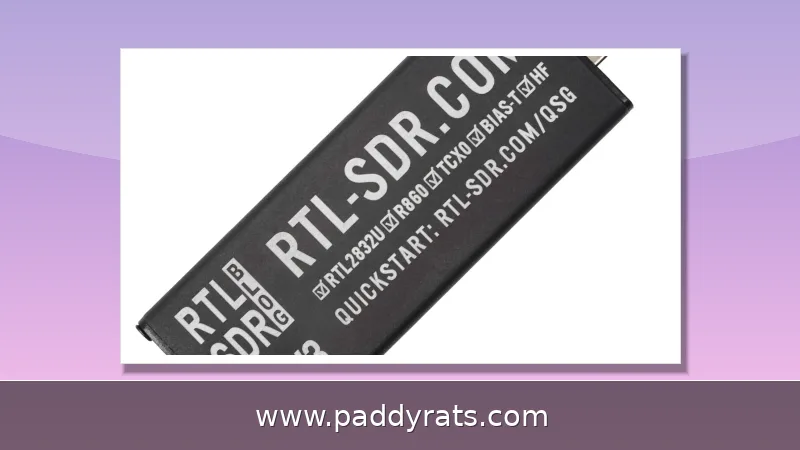
Most people get into SDR through a cheap USB dongle, and honestly, the prices are pretty hard to beat. The RTL-SDR Blog V4 runs about $30, or $50 if you want the kit with telescopic antennas, and it tunes from roughly 500 kHz all the way past 1.7 GHz. If you go with the NooElec NESDR Smart v5 bundle instead, you get antennas for 433 MHz, 1090 MHz, and adjustable use, which covers plenty of beginner listening right out of the box.
Once you get into professional-grade gear, the range opens up a lot. Depending on the model, NI's SDRs can cover anywhere from 1 MHz to 20 GHz, with up to 1.6 GHz of instantaneous bandwidth and your choice of USB, Ethernet, or PCI Express connectivity. XetaWave frontends, meanwhile, tune signals between 150 MHz and 2.4 GHz. And if you're looking for popular options that can transmit as well as receive, Great Scott Gadgets' HackRF One and HackRF Pro, along with HydraSDR, are worth a look.
On the software side, the free tools do most of the heavy lifting. SDR++ and SDR# both run on Windows, Linux, and Chromebook, while GNU Radio lets you build your own custom SDR applications from scratch. Then there's rtl_433, dump1090, Linrad, and SDR-Radio.com — the last of which supports 24 receivers at once — covering everything from sensor decoding to aircraft tracking to advanced listening. You'll also run into Analog Devices' RadioVerse family, VIAVI Solutions, MathWorks MATLAB, and Digilent all over lab and teaching setups.
| Device | Typical price | Frequency coverage | Notes |
|---|---|---|---|
| RTL-SDR Blog V4 | About $30; $50 with antenna kit | 500 kHz to over 1.7 GHz | Most popular low-cost receive-only starting point |
| NooElec NESDR Smart v5 | Bundle pricing varies | Includes 433 MHz and 1090 MHz antennas | Ready-to-use kit for sensors and ADS-B |
| NI SDR (model dependent) | Professional pricing | 1 MHz to 20 GHz; up to 1.6 GHz instantaneous bandwidth | USB, Ethernet, or PCI Express connectivity |
| XetaWave frontend | Industrial pricing | 150 MHz to 2.4 GHz | Tunable frontend for industrial links |
A useful antenna rule of thumb before you buy anything: divide 72 by the frequency in MHz to get each dipole side length in meters. For the FM broadcast band at 87.5-108 MHz, that puts a simple dipole in the roughly 0.7 to 0.8 meter range per side, which is easy to build from speaker wire and a balun.
Practical SDR Applications and Use Cases
What you can do with an SDR depends mostly on the software you load and the antenna you connect. Common starting projects include listening to FM radio, receiving airport weather broadcasts and aircraft ADS-B signals, monitoring wireless sensors, receiving satellite navigation, setting up a DRM transmitter, building a GSM network, detecting interference, and testing repeater systems. None of those require changing the hardware.
Frequency planning is where beginners usually get stuck, so a few landmarks help. The FM radio band runs 87.5-108 MHz, ADS-B aircraft tracking sits at 1090 MHz, and Freenet in Germany occupies 149.01-149.11 MHz across 6 channels. Once you know the band, you know the antenna and the sample rate you need.
A concrete first session looks like this. Buy a suitable SDR such as the NooElec NESDR Smart v5, install the drivers, install SDR# or SDR++, set RF gain around 40 dB, select WFM for FM radio, and set the step to 100 kHz. On Linux or a Chromebook, enable the USB settings, manually install drivers if the dongle is not recognized, start SDR++ first and then plug in the receiver, and check RTL AGC or Tuner AGC if you see no signal.
If you want to go deeper, a GNU Radio with HackRF course covers DSP fundamentals, decibels, sample rates, complex numbers, filters, aliasing, and replaying captured signals. That foundation is what separates someone who can only tune presets from someone who can build a decoder for a protocol nobody has published yet.
Benefits and Limitations of SDR Technology
The benefits list is long and mostly about flexibility and cost. One common hardware platform can receive and transmit a wide range of modulation methods, functionality changes by downloading new software, operating frequency and mode can be chosen adaptively, development cost and time to market drop, hardware obsolescence is less of a threat, in-field updates become routine, and a single platform can support multiple protocols.
The limitations are real too, and they show up in specific scenarios. Direct sampling SDRs without bandpass filtering can be overloaded by strong out-of-band signals, and the same architecture is limited by the A/D sample rate to VHF and lower frequency bands. Hybrid designs trade bandwidth for that robustness. Anyone transmitting also has a responsibility to be a good neighbor on the spectrum.
| Factor | SDR | Traditional radio |
|---|---|---|
| Signal processing | Mostly software on DSPs, FPGAs, or GPPs | Mostly analog and fixed hardware |
| Reconfiguration | Download new software or firmware | Limited; often requires new hardware |
| Error correction | Can be corrected or improved in software | Hardware errors generally cannot be fixed |
| Redeployment | Same unit supports multiple protocols and bands | Typically single-purpose |
Cost efficiency and universal wireless access are the reasons SDRs spread from hobby benches into commercial and government programs. The same argument that made software eat the desktop applies here: once the general-purpose platform exists, most of the innovation moves into code that can be shipped and updated far faster than new silicon.
SDR in Military, Civil, and Industrial Communications
Military SDRs are where the architecture gets its most demanding requirements. They are typically architected with red-black separation, where the red side handles sensitive information and cryptography while the black side handles communication stacks and drivers on separate hardware. That separation is a security control, not a marketing term, and it shapes how these radios are built and certified.
Rohde & Schwarz illustrates how long this market has existed: the company offers SOVERON for military use and CERTIUM for civilian use, and its CERTIUM ATC radios have more than 35 years in the ATC market with more than 60,000 sold globally. DARPA's SDR 4.0 program and the Software Communications Architecture (SCA) developed by the US military as part of JTRS pushed standardization further; SCA is now widely described as a quasi-standard for best SDR software practice.
Civil and industrial users benefit from the same reconfigurability. Air traffic control, public safety, utility telemetry, and industrial links all need radios that can be updated without replacing fleets of hardware. The American Radio Relay League (ARRL) maintains SDR resources for amateurs, and its SDR article was updated on 10/30/2025 by W1DRF, which is a good sign that the hobby documentation is being actively maintained.
The through-line across all three sectors is the same: reduce cost, provide universal wireless communications access, and gain flexibility and cost efficiency. Whether the buyer is a defense ministry, an airport operator, or a hobbyist with a $30 dongle, the value proposition is identical in structure even when the budgets are not.
How Does a Software Defined Radio Work in Practice?
In practice, an SDR uses an RF front end to capture signals, then an analog-to-digital converter samples them into digital data. Software running on DSPs, FPGAs, or general purpose processors then performs filtering, modulation, demodulation, and tuning, replacing analog hardware components like mixers and filters. That description covers everything from a $30 dongle to a rack-mounted military radio.
The difference between hybrid and direct sampling matters most when signals are crowded. Hybrid SDRs use analog heterodyning to tune and capture spectrum, resisting strong out-of-band signals but with limited sample bandwidth. Direct sampling SDRs use high-speed ADCs and FPGAs to capture large spectrum portions at once, though they are limited to VHF and lower bands without bandpass filtering.
For beginners, the hardware and software question has a simple answer. A popular low-cost option is the RTL-SDR Blog V4 USB dongle, around $30, or $50 with an antenna kit. Free software like SDR++ and SDR# works across Windows, Linux, and Chromebook, and GNU Radio supports building custom SDR applications. Start there, then upgrade only when a specific project demands it.
Risks, Compliance, and Spectrum Etiquette
Every SDR owner eventually runs into the same technical limits. Direct sampling SDRs without bandpass filtering can be overloaded by strong out-of-band signals, which is why a cheap FM broadcast filter is often the single best upgrade for an ADS-B setup. The same architecture is limited by the A/D sample rate to VHF and lower frequency bands, so higher bands require a different front end or an upconverter.
Transmitting raises a separate set of obligations. Being a good neighbor on the spectrum means respecting power limits, avoiding interference with licensed users, and knowing which bands you are legally allowed to transmit on in your country. Receive-only dongles like the RTL-SDR are the safest way to learn before you buy transmit-capable hardware such as a HackRF.
Security is the other constraint, and it is why military SDRs processing classified information use red-black separation. Sensitive data and cryptography stay on the red side, while communication stacks and drivers run on separate black-side hardware. For civilian users the equivalent discipline is simply keeping your setup updated and understanding what your software is doing with the data it decodes.
Where to Start in 2026
The on-ramp has never been cheaper or better documented. Pick up an RTL-SDR Blog V4 or a NooElec NESDR Smart v5, install SDR++ or SDR#, and spend an evening tuning the FM band and 1090 MHz. Once those work, add rtl_433 for sensors and dump1090 for aircraft, then move to GNU Radio when you want to build rather than just listen.
For structured learning, Software-Defined Radio for Engineers was published in 2018 and remains a solid reference for the DSP side, while Fifty Things with SDR was published on 2024-03-16 and Getting Started With SDR was published on Sep 11, 2021, both offering project-driven paths. The ARRL's SDR resources, updated 10/30/2025, are worth bookmarking for amateur-specific guidance.
The pattern across every sector, from hobby benches to air traffic control, is the same: buy a general-purpose platform, then let software define what it becomes. That is why SDRs keep absorbing functions that used to require dedicated hardware, and why the skill of writing and configuring radio software keeps paying off long after any single piece of hardware goes obsolete.
Frequently Asked Questions
How does a software defined radio work?
An SDR uses an RF front end to capture signals, then an analog-to-digital converter samples them into digital data. Software such as DSPs, FPGAs, or general purpose processors then performs filtering, modulation, demodulation, and tuning, replacing analog hardware components like mixers and filters.
What can you do with a software defined radio?
You can listen to FM radio, receive airport weather and aircraft ADS-B signals, monitor wireless sensors, receive satellite navigation, set up a DRM transmitter, build a GSM network, detect interference, and test repeater systems, all by changing software rather than hardware.
What is the difference between hybrid and direct sampling SDRs?
Hybrid SDRs use analog heterodyning to tune and capture spectrum, resisting strong out-of-band signals but with limited sample bandwidth. Direct sampling SDRs use high-speed ADCs and FPGAs to capture large spectrum portions at once, though they are limited to VHF and lower bands without bandpass filtering.
What hardware and software do I need to get started with SDR?
A popular low-cost option is the RTL-SDR Blog V4 USB dongle, around $30, or $50 with an antenna kit. Free software like SDR++ and SDR# works across Windows, Linux, and Chromebook, and GNU Radio supports building custom SDR applications.
What is software defined radio and how does it work?
Software defined radio (SDR) is a radio system where physical layer functions like filtering, modulation, and demodulation are handled in software rather than fixed analog circuits. An RF front end captures the signal, an analog-to-digital converter samples it, and DSPs, FPGAs, or general purpose processors then process the digital data, allowing modes and frequencies to change without new hardware.
What is the difference between hybrid and direct sampling SDR?
Hybrid SDRs use analog heterodyning to tune signals, so they are not limited by ADC sample rate and can reach very high frequencies while resisting strong out-of-band signals, but they have limited sample bandwidth. Direct sampling SDRs use ultra high speed ADCs and FPGAs to capture large spectrum chunks at once, are more compact, but need bandpass filtering and are limited to VHF and lower bands.